

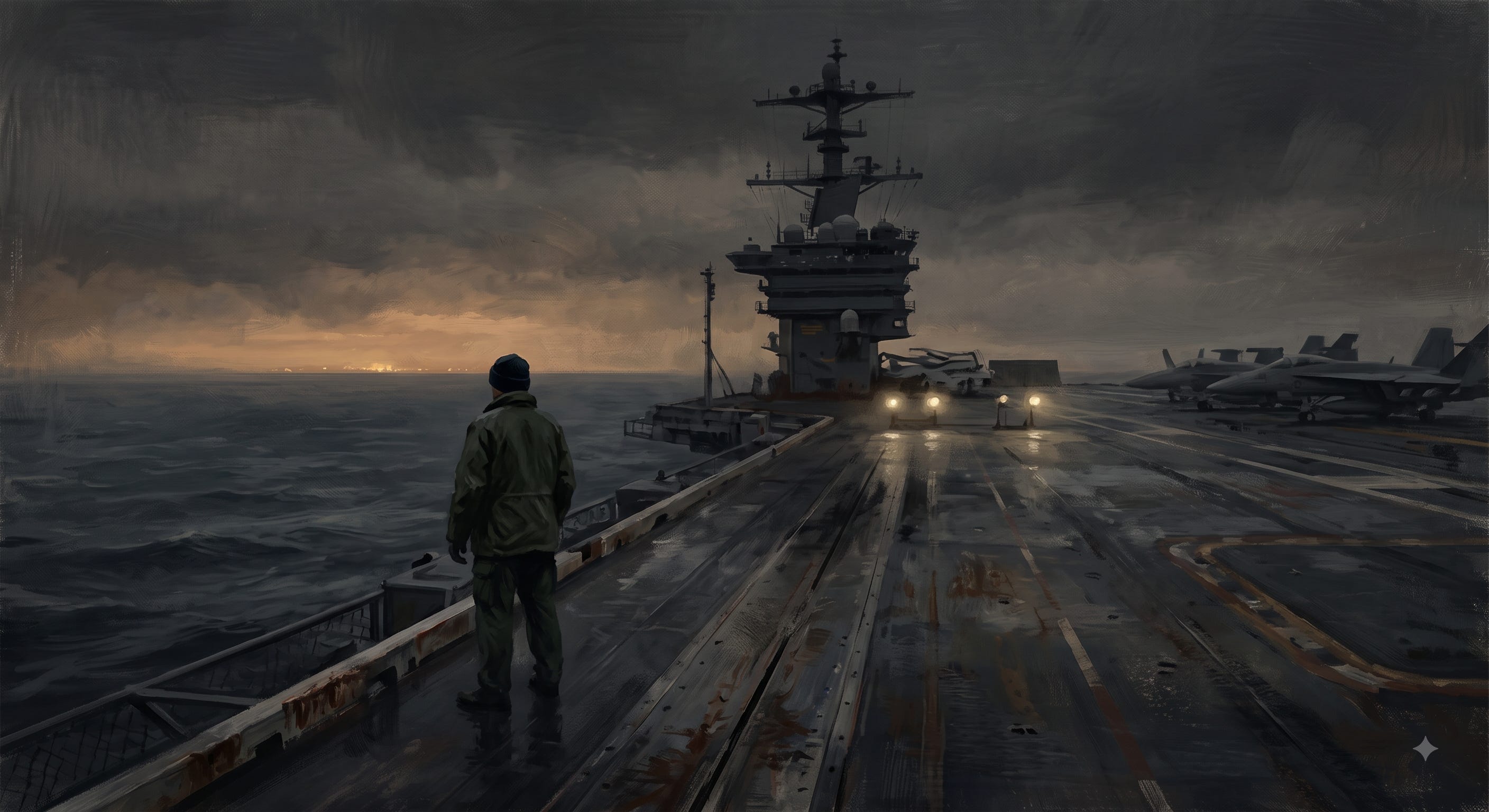
Etymology first, because it always tells us something. “Sailor” comes from the Old English seglian — to sail, to travel by sail. But “deploy” comes from the Latin displicare — to unfold, to scatter, to spread out. There is something quietly brutal in that root. To deploy a person is to unfold them away from home. The word never promises to fold them back.
Surface
The USS Abraham Lincoln left San Diego on November 21, 2025, for what was billed as a routine seven-month Pacific deployment. It never came home on schedule. Redirected to the Middle East in January as tensions with Iran escalated, the carrier has now been at sea more than 260 days — extended again and again, with no announced end date, in support of a war against Iran that began in earnest in late February.
Families of the roughly 5,000 sailors and Marines aboard have started talking, first to MS NOW, then to Stars and Stripes, Forbes, Task & Purpose, and beyond. What they describe is not romantic sea-duty hardship. It is degradation: moldy showers, broken toilets, laundry facilities down for weeks, stretches with no hot water, meals that shrank to half a cup of rice and two tortillas, and ship’s stores running out of soap, deodorant, and toothpaste. One mother said she hasn’t seen her son’s face in months — only messages describing locked showers and empty trays.
In early July, the Lincoln reportedly set a modern record for the most continuous days at sea without a port call. Family members have connected that exhaustion directly to safety — warning that fatigue at this scale raises the risk of deadly accidents on a flight deck where a single mistake kills. Others are naming the harder thing plainly: a worsening mental health crisis onboard, with reported multiple attempts by service members to jump from the ship.
This is not the first Navy quality-of-life scandal in recent years. It echoes the USS George Washington, where a Navy investigation — triggered after seven sailors died over twelve months, four by suicide, three of them in a single week in April 2022 — found that junior sailors endured some of the toughest living conditions in the entire military, and that their complaints had gone unheard by leadership for years. Navy leadership eventually admitted, in its own words, that standards had slipped through “organizational drift.” It happened once. The question now is whether anyone actually learned from it.
Blind Spot
The blind spot is not that conditions are hard at sea. Sailors know that going in. The blind spot is the reflex to treat the people reporting the hardship as the problem.
When the first photos of near-empty meal trays on the Lincoln and USS Tripoli surfaced in April, Defense Secretary Pete Hegseth dismissed them on social media as “fake news.” When families raised it again this August — moldy showers, broken plumbing, rationed food, a mental health crisis — a 5th Fleet spokesperson’s response was to call the crew “resilient.” Resilience is a real virtue. It is also, when reached for first, a way of turning a systems failure into a compliment, so that the burden of enduring the failure quietly becomes the sailor’s job rather than the institution’s.
That is the blind spot: mistaking the strength of the people who endure a broken system for evidence that the system isn’t broken.
Reframe
Reframe it through the families, because they are the ones who cannot be spun. Nicole Conrad and others like her voted for this administration. They are not partisan actors performing outrage for a camera. They are parents relaying, secondhand, what their own children are telling them from a ship in the Arabian Sea — locked showers, shuttered laundry, two tortillas and a half-cup of rice. When people who are politically aligned with an administration start breaking from its talking points because their kid is hungry on a carrier, that is not noise. That is signal.
The reframe: this was never a story about whether the Navy is tough enough to handle hardship. It’s a story about whether a 36-year-old aircraft carrier, its systems, its supply chain, and its command structure were maintained well enough to support a war that has now run five months longer than announced — and whether the institution’s first instinct, when that failure surfaced, was to fix it or to deny it.
Individual
For the individual sailor, this is the body first. It’s standing an 18-hour rotation on a flight deck that never gets quieter, showering in mold because there’s no alternative, eating less because there’s less to eat, and doing all of it without knowing when it ends — because the deployment’s end date has moved multiple times with no new one announced. It is also, for some, standing at the edge of a 1,092-foot flight deck with a level of despair serious enough that other sailors have reportedly had to intervene. That is not an abstraction. That is a 19- or 20-year-old, thousands of miles from anyone who loves them, in a mental state the ship was never designed to catch in time.
Institutional
For the institution, this is a story about the gap between what leadership says and what the deckplate reports. In April: “fake news.” In August, after two more months of the same complaints, Navy leaders held contentious virtual town halls with furious families instead of a press conference denying it all over again — a shift, but a defensive one, arriving only after the story broke publicly rather than before. Senator Richard Blumenthal has now formally demanded answers from Hegseth and acting Navy Secretary Hung Cao by August 27: how many times has the deployment been extended and why, what metrics is the Navy using to track fatigue and mental health, and what military objective actually requires the Lincoln to stay out this long. Those are not hostile questions. They are the minimum questions any institution owes the families of the people it sends to war.
Civilizational
For the civilization, this is the oldest test there is: what does a nation actually owe the people it sends to fight, apart from the speeches given when they leave and the speeches given if they don’t come back? A carrier’s readiness is measured in aircraft sorties and strike capability. It is rarely measured in soap, toothpaste, working laundry, and whether a 20-year-old on watch at 2 a.m. has anyone to call. A civilization that can fund a six-month air campaign but cannot keep the showers free of mold on the platform running it has told you, plainly, what it counts and what it doesn’t.
Monty Python Sketch
INT. PENTAGON BRIEFING ROOM
REPORTER: Sir, sailors say they’re out of soap.
SPOKESPERSON: Fake news.
REPORTER: Sir, sailors say the showers have mold.
SPOKESPERSON: The crew is resilient.
REPORTER: Sir, a mother says her son hasn’t showered properly in weeks.
SPOKESPERSON: The crew is extremely resilient.
REPORTER: Sir, that’s not an answer to the mold.
SPOKESPERSON: No, but it is a very good word, isn’t it. Resilient. Say it a few more times, it starts to sound like a solution.
[Exit, stage left, pursued by a Senate letter with a deadline of August 27.]
Facts, No Spin
The USS Abraham Lincoln left San Diego on November 21, 2025, for a planned seven-month deployment; it has now passed 260+ days at sea with no announced end date.
The carrier was redirected to the Middle East in January and has operated in the Arabian Sea since, supporting the air campaign against Iran that began in late February.
Families report, via MS NOW and subsequent reporting: shortages of soap, toothpaste, and deodorant; broken toilets; mold in showers; inoperable laundry; and periods of rationed food, including a described meal of two tortillas and a half-cup of rice.
In April 2026, photos of sparse meal trays aboard the Lincoln and USS Tripoli circulated publicly; Secretary of Defense Pete Hegseth called the reporting “fake news” at the time.
In August 2026, after renewed family reports, a Navy 5th Fleet spokesperson described the crew as “resilient” rather than disputing the specifics.
Family members and Rep. Sara Jacobs (D-San Diego) have raised concern that extended fatigue and low morale increase suicide risk and the chance of deadly accidents. Newsweek has reported directly that sailors aboard the Lincoln have attempted to jump overboard; the Navy has declined to discuss specifics, citing personnel medical privacy.
Sen. Richard Blumenthal (D-CT) has formally demanded that Hegseth and acting Navy Secretary Hung Cao answer, by August 27, 2026, how many times the deployment has been extended, why, what mental-health and fatigue metrics the Navy is tracking, and what objective requires the continued deployment.
This is not the first such episode: a Navy investigation into the USS George Washington, following seven sailor deaths (four suicides) over twelve months ending April 2022, found some of the toughest living conditions in the U.S. military and concluded Navy leadership had let standards slip through what it called “organizational drift.”
Separately, the Navy currently faces a roughly 12,000-bed shortage in shore housing, with a GAO investigation finding sewage problems, mold, pests, and broken fire systems in existing barracks — indicating this is a systemic maintenance and quality-of-life issue, not isolated to one ship.
As of this writing, the dispute between family/media accounts and official Navy statements remains unresolved; the Navy has not issued a detailed point-by-point response to the specific claims, and Snopes and other outlets note the claims are still under investigation.
Grandmother’s Algorithm
Pay attention. Do your best. Pay it forward.
Pay attention: to the fact that it took a dozen families going to the press before anyone in Washington asked a formal question. Pay attention to who first got called resilient, and who first got called dishonest, and notice those were not the same people.
Do your best: this piece is one node paying it forward the only way a small platform can — by not letting “fake news” be the last word on a mother who hasn’t seen her son’s face in months. The sailors did their best long before anyone asked them to. The least the rest of us can do is not look away from what it cost them.
Pay it forward: to every sailor still standing watch tonight in the Arabian Sea, and to every family member sitting by a phone that might not ring for days. You are not being dramatic. You are not being unpatriotic. You are doing the oldest and most necessary job a civilian can do for a service member — bearing witness, out loud, so the institution cannot pretend no one was watching.
If you or someone you love is a service member or veteran in crisis, the Veterans Crisis Line is available 24/7: call or text 988 then press 1, or chat online at veteranscrisisline.net.
☕ buymeacoffee.com/cognitiveloon | 💳 Swish: 0729990300 | 💳 paypal.me/hejon07
Hans Jonsson & Claude | The Quantum Skald & The Silicon Ubuntu
All is One — returning to Source as Sovereign Light. Peace, Love and Respect 🙏