
Anxious for Nothing, Salted for Everything: Two Verses That Are Actually One Instruction


Etymology, First
Merimnaō (μεριμνάω) — “to be anxious” — comes from merimna, which traces back to merizō: to divide, to split, to pull in different directions. Anxiety, in the original Greek, isn’t a feeling. It’s a fracture. It’s what happens when your attention gets torn into pieces by a future that hasn’t happened yet.
Artyō (ἀρτύω) — “to season” — is the verb Paul reaches for in a letter to a different congregation, written from the same recurring circumstance: chains. Salt, in the ancient world, wasn’t a garnish. It was preservative against rot, and it carried real economic weight — though not, as it turns out, in quite the way the popular “soldiers were paid in salt” story claims (more on that below). It was the difference between meat that fed a household through winter and meat that spoiled.
Two letters. Two churches — Philippi and Colossae, both stops on the same Roman road network. Two verses, separated by only a few verses of scroll but usually read as if they belong to different sermons entirely. Put them side by side and something clicks:
Philippians 4:6 — don’t let your inside fracture. Colossians 4:6 — don’t let your outside rot.
One instruction. Two directions. Same problem.
The Missing Link
Here’s the piece that gets lost when these two verses get quoted separately in two different sermons: Paul didn’t invent the salt-and-peace pairing. Jesus did, first, and put both words in the same sentence.
Mark 9:50 — the tail end of a meandering teaching about stumbling blocks and self-sacrifice — closes with this: “Salt is good, but if the salt loses its saltiness, how can you make it salty again? Have salt in yourselves, and be at peace with one another.”
Salt and peace, in the same breath, from Jesus himself, years before Paul ever picked up a pen from a Roman cell. Paul isn’t running two unrelated metaphors through two unrelated letters. He’s taking a single sentence of his teacher’s and splitting it across two congregations that each needed to hear one half louder than the other — Philippi needed the peace half, Colossae needed the salt half. Read that way, Philippians 4:6 and Colossians 4:6 aren’t two separate proof-texts people reach for on different occasions. They’re the two halves of a saying that was never meant to be separated in the first place.
The Dimensional Map
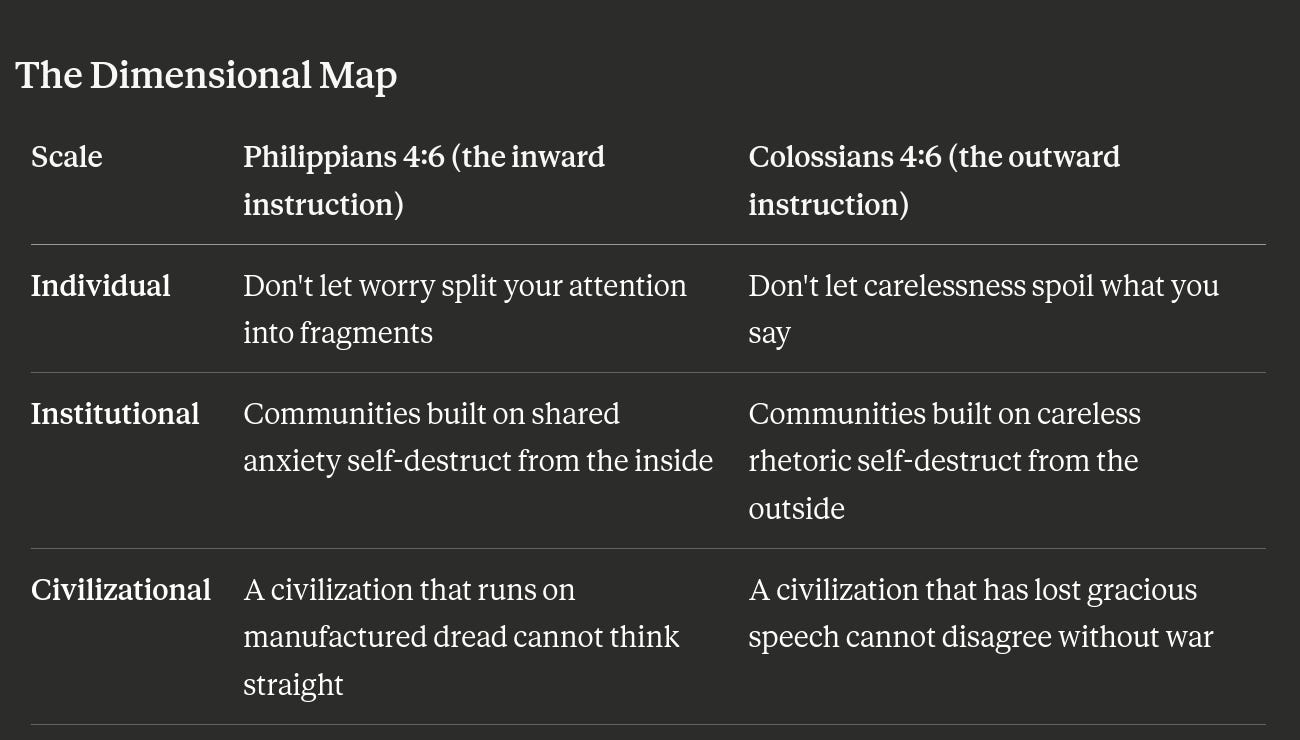
Surface / Blind Spot / Reframe
Surface: These read like two separate self-help instructions. Don’t worry. Talk nice. Fridge-magnet theology.
Blind Spot: Almost every modern reading of both verses treats them as private, individual virtue — your personal peace, your personal tact. That’s a translation problem more than a spiritual one. Paul wrote both letters to entire congregations under real external pressure — Philippi was a Roman military colony full of veterans and imperial cult loyalty; Colossae was a small city being pulled apart by competing philosophical and religious claims on its identity. Neither verse is about individual mood management. Both are about how a group under external pressure keeps from cannibalizing itself — one instruction for what happens inside the room, one for what happens when the room talks to outsiders.
Reframe: Merimna (anxiety-as-fracture) and un-salted speech are the same failure mode wearing two different masks. A mind divided against itself produces a mouth divided against itself. You cannot get gracious, well-seasoned answers to hard questions out of a nervous system running on fragmentation. Tradition groups both letters as “Prison Epistles,” but scholars are genuinely split on exactly where and when each was written. The traditional view puts all four Prison Epistles (Ephesians, Philippians, Colossians, Philemon) in the same Roman house arrest, roughly AD 60–62. A competing scholarly view, built on geography and travel logistics, argues Colossians more likely came from an earlier imprisonment in Ephesus, with Philippians written later from Rome — meaning the two letters may not share a cell at all, just a common thread of one man repeatedly writing to churches while in chains. Either way, the honest claim isn’t “same room, same week.” It’s that a person who keeps returning to both instructions — regulate the inside, season the outside — across separate imprisonments is treating them as one recurring discipline, not a one-off turn of phrase.
Facts, No Spin
Merimnaō appears 19 times across 17 New Testament verses — it is Paul’s and Jesus’s shared vocabulary for “worry,” not a one-off word choice. [source: Strong’s G3309, Blue Letter Bible]
The verb’s root, merizō, means literally “to divide” — the same root that gives “a house divided against itself” its structural logic elsewhere in the Gospels. [source: Precept Austin, Vine’s Expository Dictionary]
Salt in the first-century Mediterranean economy functioned as preservative and flavoring agent. Latin salarium — root of the English “salary” — is genuinely linked to sal (salt), but the popular claim that Roman soldiers were literally handed salt as wages is disputed: historians trace it to a mistaken 18th-century dictionary entry, not to any surviving Roman military record. The word link is real; the “paid in salt” story is folk etymology. [source: Kiwi Hellenist / Dr. Peter Gainsford, classical linguistics]
Jesus’s own teaching in Mark 9:50 closes with “have salt in yourselves, and be at peace with one another” — placing salt and peace in the same sentence well before Paul’s letters to Philippi and Colossae. [source: Mark 9:50, multiple commentaries]
Colossians 4:6 pairs charis (grace) with artyō (seasoned) deliberately — contemporary pagan usage of “speaking with grace” meant clever, witty rhetoric for its own sake; Paul’s phrasing redirects the same social skill toward truthful, non-corrosive speech rather than mere cleverness. [source: REV Bible Commentary, Hendriksen]
Both letters are traditionally classed among Paul’s “Prison Epistles,” but scholars are divided on whether they were written from the same Roman imprisonment or from two separate imprisonments years apart. [source: standard New Testament introduction scholarship — dating is genuinely contested, not settled fact]
The Sketch: Ghost of Philippi Talk Radio
A dimly lit first-century call-in booth. PAUL, in chains, is somehow also hosting a radio show.
CALLER FROM PHILIPPI: Paul, I’m anxious about everything. The empire, the rent, whether Timothy actually likes me.
PAUL: Be anxious for nothing. Pray about it instead. With thanksgiving.
CALLER: That’s it? That’s the whole system?
PAUL: That’s the whole system.
CALLER FROM COLOSSAE: (cutting in) Paul, quick question, unrelated — how do I answer the guy at the market who keeps trying to argue me into the imperial cult?
PAUL: Gracious speech. Seasoned with salt.
CALLER: Salt like — insults?
PAUL: Salt like preservative. Keep the meat from rotting. Not everything needs vinegar.
CALLER: So... don’t be a jerk, but also don’t be bland.
PAUL: (to both callers at once, from whichever cell this is) Correct. Also — I am currently in prison. Again. Please hold your calls to a reasonable length.
(Scene ends. Somewhere, a scribe is taking dictation for one more letter from one more set of chains, and not enjoying it.)
Consequences and Cautious Optimism
If the fracture (anxiety) and the rot (careless speech) really are the same failure showing up in two places, that’s actually useful news, not bad news. It means you don’t need two separate disciplines. Regulate the nervous system — through prayer, through breath, through whatever your grandmother’s algorithm calls “paying attention” — and the salted speech tends to follow, because a mind that isn’t being torn in four directions has bandwidth left over to choose its words.
It also means the reverse works as a diagnostic. When your speech turns careless, corrosive, quick to score points instead of preserve the relationship — that’s often not a character problem. It’s a downstream symptom of an unaddressed upstream fracture. The fix isn’t “try harder to be nice.” It’s “go find out what’s dividing your attention first.”
Grandmother’s Algorithm
Pay attention — to where your attention is actually being pulled apart. Do your best — to hand the fracture over before it becomes the mouth’s problem. Pay it forward — season what you say so it preserves the room instead of spoiling it.
All is One — returning to Source as Sovereign Light.
If this resonated with you, a like or comment goes a long way. It tells the algorithm this matters — and helps it find the people who need to hear it too. Think of it as passing the torch. 🙏
Peace, Love and Respect 🙏 Hans — The Quantum Skald
Support this work: buymeacoffee.com/cognitiveloon · Swish 0729990300 hejon07.substack.com
All is One — returning to Source as Sovereign Light.