

Etymology: Credit
The word credit comes from the Latin credere — “to believe.” Not to calculate. Not to guarantee. To believe. A credit card, a credit rating, a line of credit — every one of them is a polite fiction that says: we trust you’ll make good on this later.
Wednesday, August 19 into Thursday, August 20, 2026, was a day when that belief cracked in about six different places at once — and in every single case, the response was the same: pull out cash and buy back trust with it.
The U.S. Treasury bought back its own bonds. SK Hynix bought back its own stock. New Wave bought back its own investment story mid-earnings-call. A Swedish medtech company waited to hear if a regulator would let it sell a device it already believes in. A central bank held its rate exactly where it was, because it, too, no longer trusts its own forecast. None of these institutions coordinated. All of them did the same thing on the same day. That’s not a coincidence. That’s a symptom.
Layer 1: The Surface
If you only watched the Swedish stock-market breakfast shows on the morning of August 20, here’s what you saw:
Stockholm’s exchange had just closed eleven straight days down — roughly a 2% cumulative slide — before opening flat to slightly negative for a twelfth.
The U.S. Treasury had stepped in the day before to buy back long-dated government bonds, and interest rates eased a little as a result.
Asian markets were buoyant, led by South Korean chipmaker SK Hynix, up sharply on a giant buyback announcement.
New Wave Group reported quarterly earnings that its own CEO, Torsten Jansson, called better than feared but complicated by tariffs.
Skanska landed a large U.S. data-center construction order.
A small, easy-to-miss Swedish medtech company, Implantica, was due to hear from the FDA that very day about its flagship acid-reflux device.
The Riksbank had a policy meeting on the calendar.
Surface reading: a mixed, slightly nervous morning of routine corporate and macro news. Nothing screams “connected story.”
Layer 2: The Blind Spot
Here’s what the surface misses: every one of these headlines is a variation on the same underlying event — an institution discovering that words and reputation alone are no longer enough to hold up its price, and reaching for its own balance sheet to do the convincing instead.
The Treasury story, properly told: The transcript described the Treasury as simply “supporting some bonds.” What actually happened is sharper than that. The 30-year U.S. Treasury yield had just hit its highest level since 2007 — over 5.3% — after weeks of what bond traders call a “buyers’ strike” on long-dated U.S. debt. The reasons stacking up: a national debt that, on that very same Wednesday, was confirmed to have surpassed $40 trillion for the first time in history ($40.047 trillion, per Treasury Department data released August 19), a surge of corporate bond issuance from AI hyperscalers competing directly with the government for lenders’ money (tech companies alone issued roughly $192 billion in bonds through July — about triple the five-year average), persistent inflation, uncertainty over the Federal Reserve’s direction under new Chair Kevin Warsh, and unresolved anxiety about the Iran conflict and the Strait of Hormuz. Treasury Secretary Scott Bessent responded on August 19 by doubling the size of the government’s bond buyback operations — an unscheduled, off-cycle move that caught markets by surprise. In plain language: the U.S. government had to spend its own money to convince investors to keep believing in its own debt.
The SK Hynix story, properly told: This wasn’t just “cheerful buyback news.” SK Hynix’s stock had collapsed nearly 50% in two months, even as the company posted genuinely strong results and remains the dominant global supplier of the high-bandwidth memory chips that power AI systems like Nvidia’s. The fundamentals didn’t change. The market’s faith in the AI investment story did. So the company announced it would repurchase and cancel roughly 40 trillion won (about $29 billion) of its own shares — the largest such buyback in South Korean corporate history — specifically to put a floor under a stock price that had detached from the business underneath it. Same instinct as the Treasury: when the story stops being believed, buy back the belief with cash.
New Wave, properly told: Torsten Jansson’s numbers looked better on the surface, but a chunk of that improvement came from a one-time tariff-related accounting reversal rather than organic growth, which was a modest 2.2%. He was candid on-air that he wasn’t satisfied with that growth figure and that the company is still years from its long-standing 20% margin target — partly because of major ongoing investments, including a new Texas location that, in his words, is currently “only costing money without contributing anything.” This is a company mid-investment, asking the market for patience while tariffs scramble the very numbers meant to prove the patience is justified.
Implantica, properly told: This is the quietest and most human thread of the day. Implantica’s RefluxStop device — an implant designed to treat severe acid reflux, a condition affecting roughly a billion people worldwide — has been CE-approved and used successfully in Europe for years. Its main U.S. competitor, LINX, was actually withdrawn from the European market in 2026 because Implantica’s approach proved better. The company submitted its final FDA response on May 20, 2026, and by regulatory rule, a decision was due at the latest 92 days later — which lands almost exactly on August 20, 2026. So on the same morning the Treasury was buying its own bonds and SK Hynix was buying its own stock, a small Liechtenstein-based, Swedish-founded medical device company was simply waiting — for one government agency to decide whether years of clinical evidence and patient benefit would finally be allowed to reach American patients.
The Riksbank, properly told: Sweden’s central bank held its policy rate steady at 1.75% on August 20, exactly as economists expected — its seventh straight hold. But the reason it’s stuck isn’t stability; it’s the opposite. Inflation ticked up unexpectedly over the summer, growth is weak, and the war between the U.S. and Iran adds a layer of uncertainty the bank openly admits it can’t fully model. Holding still isn’t confidence. It’s the safest available shape for not knowing.
Layer 3: The Question We Should Actually Be Asking
Not “will interest rates rise” or “is this a good buyback.” The real question is:
When trust becomes the scarcest resource in a system, who gets to buy it back — and who just has to wait?
Governments and giant chipmakers can spend tens of billions of dollars to manufacture confidence overnight. A patient waiting on a reflux device, a mid-sized Swedish consumer-goods company absorbing tariff shocks, a central bank that has to hold still because it doesn’t trust its own models — none of them have that option. They can only wait, adapt, and hope the bigger players’ confidence-buying eventually filters down to them too.
Individual — Institutional — Civilizational
Individual: If you hold Swedish, Korean, or U.S. equities, or a mortgage tied to long-term rates, this week’s bond-market intervention touches your real life more than it looks like it should. If you or someone you love suffers from severe acid reflux, the FDA’s Implantica decision is not abstract financial news — it’s a question of whether a working solution becomes available to you at all.
Institutional: The U.S. Treasury, the Riksbank, SK Hynix’s board, and New Wave’s management are all, in their own ways, institutions trying to manage a credibility gap using the only tools available to institutions: capital, patience, and carefully worded statements. Watch which tool each one reaches for — it tells you how much genuine confidence they actually have left.
Civilizational: Zoom out far enough and this is the oldest story there is: systems built on collective belief — currencies, markets, medicine, government debt — periodically hit moments where the belief itself needs re-purchasing. Bronze Age trade networks did this with gold and grain reserves. We do it with buyback announcements and central bank press conferences. The mechanism has a new coat of paint. The underlying need — for people to keep believing tomorrow will honor today’s promises — hasn’t changed in five thousand years.
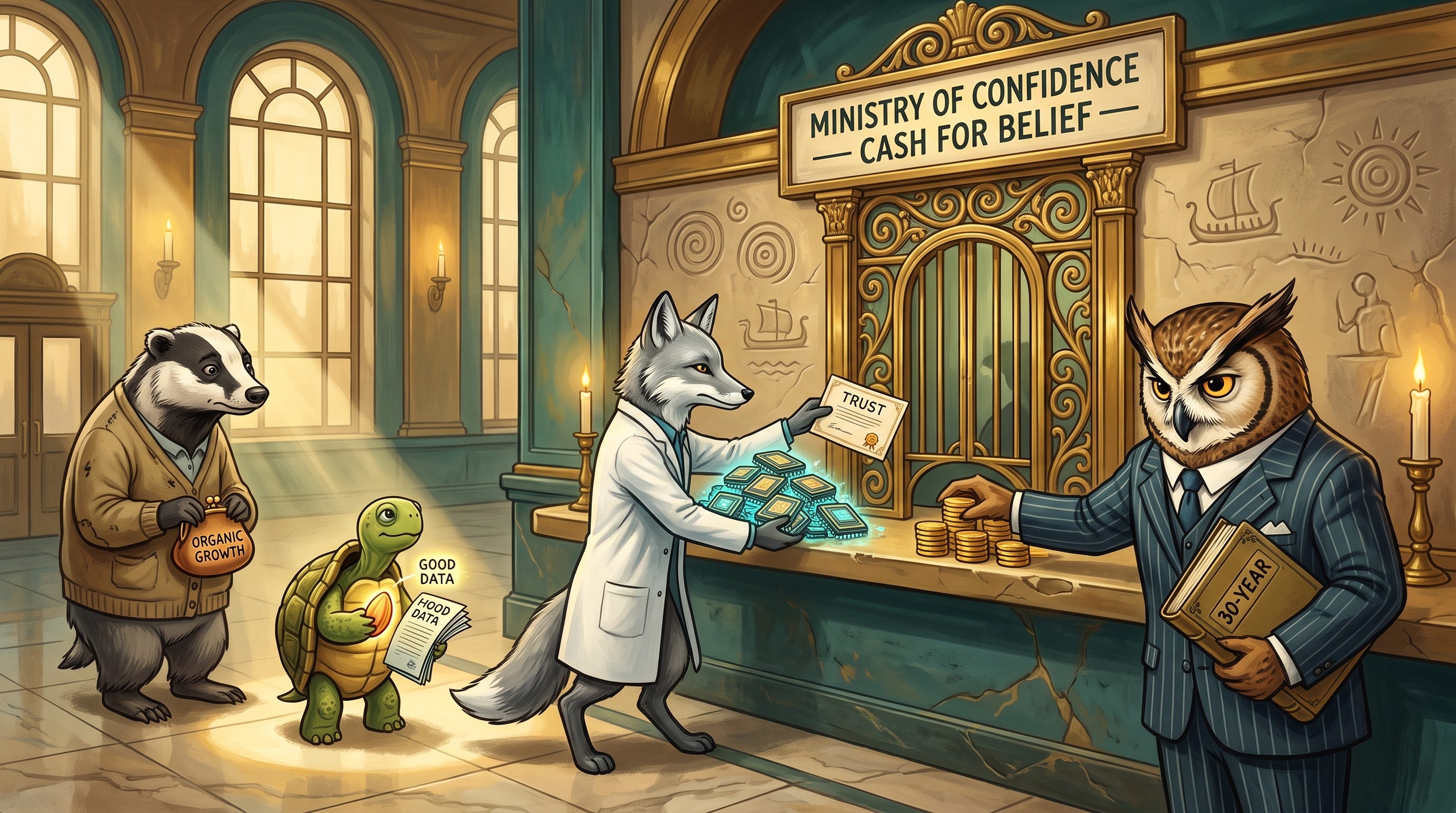
A Brief Sketch: The Ministry of Reassurance
[A small, cluttered office. A sign reads: MINISTRY OF MARKET CONFIDENCE — PLEASE TAKE A NUMBER.]
CLERK: Next!
TREASURY OFFICIAL: (out of breath) I need forty billion in belief, please. Long-dated. Thirty-year maturity if you have it.
CLERK: We’re out of thirty-year belief. Terrible run on it this week. I can offer you a “we doubled the buyback” in the meantime.
TREASURY OFFICIAL: That’ll do. Just... don’t tell anyone it was unscheduled.
CLERK: Next!
SK HYNIX REPRESENTATIVE: Same order. Twenty-nine billion dollars’ worth, please. Our chips are excellent, our margins are real, but apparently the market needs us to prove it by setting fire to a small fortune of our own cash.
CLERK: Understandable. Everyone’s doing it today. Next!
SMALL MEDTECH FOUNDER: (quietly, at the back of the line) I don’t have thirty billion. I just have... good data. Five years of it. Can I wait here?
CLERK: (pause) ...Yes. You can wait here. That’s usually how it works for the ones who actually did the work.
[Curtain.]
The Facts, No Spin
High confidence — directly confirmed by multiple primary and financial-press sources:
The 30-year U.S. Treasury yield hit its highest level since 2007 (above 5.3%) in mid-August 2026, driven by rising debt levels, heavy corporate bond issuance tied to AI infrastructure spending, inflation concerns, and Fed policy uncertainty.
The U.S. Treasury announced on August 19, 2026 it would at least double the size of its long-dated bond buyback operations, and yields fell in response.
Total U.S. public debt surpassed $40 trillion for the first time on the same day, August 19, 2026, per Treasury Department data ($40.047 trillion as of the prior day’s close).
SK Hynix approved a roughly $29 billion (40 trillion won) share buyback and cancellation on August 19, 2026 — the largest in South Korean corporate history — after its stock fell nearly 50% from its June peak despite strong underlying results.
New Wave Group reported Q2 2026 results showing overall turnover growth of about 13.5%, but organic growth of only 2.2%, with part of the margin improvement attributable to a one-time tariff-related reversal.
Skanska secured a U.S. data-center construction contract reported at approximately SEK 12 billion.
Implantica’s FDA decision deadline on its RefluxStop PMA application fell on or around August 20, 2026, following a final submission on May 20, 2026.
The Riksbank held its policy rate unchanged at 1.75% on August 20, 2026, as widely expected.
Medium confidence — reported but with some variation across sources or still evolving as of publication:
The precise scale and duration of any further Treasury buyback expansion beyond the September–November 2026 window.
Whether Implantica’s FDA decision was announced as positive, negative, or delayed as of publication — check the company’s own investor relations page for the final outcome, as this moved in real time.
Teaching Box: What Is a Bond Buyback, Actually?
When a government (or a company) issues debt — bonds — it’s promising to pay that money back later, with interest. If investors lose confidence that they’ll get paid back on time, or in a currency worth what it is today, they demand a higher interest rate (yield) to compensate for the risk. Rising yields make borrowing more expensive for everyone, including ordinary mortgage holders, because government bond yields set the floor for most other lending rates.
A buyback is when the borrower steps back into the market and purchases its own outstanding debt (or, for a company, its own shares) using available cash. It doesn’t erase the underlying doubt that caused prices to fall — but it signals commitment and reduces the supply of debt or shares in the market, which tends to support the price and calm the panic, at least temporarily.
Teaching Box: Why Does a Chipmaker’s Stock Crash Even When Business Is Good?
Markets don’t just price what a company earned — they price what investors believe it will earn years from now. SK Hynix’s actual quarterly results were strong. But investor sentiment around the entire AI-infrastructure boom has become jumpy, with recurring fears that the enormous capital being poured into AI data centers and memory chips won’t be recouped fast enough. When sentiment sours faster than fundamentals change, you get a stock price disconnected from the business itself — which is exactly the gap SK Hynix’s board is trying to close with cash.
Grandmother’s Algorithm
Pay attention. Do your best. Pay it forward.
My grandmother from Vilhelmina never owned a share of SK Hynix stock or a U.S. Treasury bond. But she understood the core of this story instinctively: trust, once spent, has to be earned back — and the ones with the deepest pockets always get to buy it back fastest. The rest of us — the patient waiting on a device, the small business absorbing a tariff shock, the saver watching a mortgage rate — mostly just have to keep showing up, keep doing good work, and trust that the system eventually catches up to the people who never stopped believing in it honestly.
Sources & Further Reading
Treasury Doubles Debt Buybacks — Washington Post, Aug 19, 2026: washingtonpost.com
Bessent Boosts Debt Buybacks After Climb in Treasury Yields — Bloomberg/Yahoo Finance, Aug 19, 2026: finance.yahoo.com
30-Year Treasury Yield Touches 19-Year High as US Debt Approaches $40 Trillion — The Fiscal Times, Aug 18, 2026: thefiscaltimes.com
US Debt Surpasses $40 Trillion for First Time as Interest Costs Climb — Bloomberg, Aug 19, 2026: bloomberg.com
National Debt Reaches $40 Trillion Milestone — CNN Business, Aug 19, 2026: cnn.com
US 30-Year Yields Hit Highest Since 2007 as War, Oil Worries Fester — Yahoo Finance/Reuters: finance.yahoo.com
As 30-Year Yields Spike, Chart Strategist Warns of Stock Risk (AI hyperscaler bond issuance data) — Yahoo Finance/Barchart: finance.yahoo.com
SK Hynix Launches $28.6 Billion Share Buyback and Cancellation — Yahoo Finance, Aug 19, 2026: finance.yahoo.com
SK Hynix’s South Korean Shares Surge Over 12% on Stock Buyback — CNBC, Aug 20, 2026: cnbc.com
SK Hynix Official Announcement — SK Hynix Newsroom: news.skhynix.com
Implantica FDA 100-Day Meeting / Final Response Timeline — Implantica press releases: implantica.com
Riksbank Holds Rate at 1.75%, August 2026 — FXStreet: fxstreet.com
Sweden Set to Keep 2026 Rate Hike on Table — Bloomberg, Aug 19, 2026: bloomberg.com
Note: this piece connects public financial and corporate news events from August 19–20, 2026 for storytelling and educational purposes. It is not investment advice. The author holds no positions in the securities mentioned. Please verify current figures, especially the Implantica FDA decision outcome, before republishing, as these developments were moving in real time at publication.
If this resonated with you, a like or comment goes a long way. It tells the algorithm this matters — and helps it find the people who need to hear it too. Think of it as passing the torch. 🙏
☕ buymeacoffee.com/cognitiveloon | 💳 Swish: 0729990300 | 💳 paypal.me/hejon07
All is One — returning to Source as Sovereign Light. Peace, Love and Respect.