
Climate Reality Check: The Science, The Suffering, and The Solutions We're Ignoring
A no-bullshit guide to where we actually stand on climate change, what's working, what isn't, and why we keep subsidizing the problem we're trying to solve

The Bottom Line Up Front
Here's what we know with the same certainty that we know smoking causes cancer: humans have warmed the planet by 1.1°C since the 1850s, we're headed for 3.1°C if we continue current policies, and 3.6 billion people—nearly half of humanity—already live in areas highly vulnerable to climate impacts.
The window to limit warming to 1.5°C is slamming shut faster than a New York subway door during rush hour. We need to cut emissions by 50% by 2030. That's not a political talking point—that's physics.
But here's the kicker: we actually know how to fix this. We have the technology, we have successful policy examples, and in many cases, the solutions save money. The real problem? We're spending six times more money making the problem worse than we are trying to solve it.
Welcome to the most expensive case of shooting ourselves in the foot in human history.
The Human Cost: Numbers That Should Keep You Up at Night
Let me paint you a picture with numbers that aren't projections or models—they're happening right now, today, while you're reading this.
Today's Reality Check:
690 million people are chronically undernourished
90 million of the world's 123 million displaced people live in areas with extreme climate hazards
Air pollution from fossil fuels killed 8.1 million people in 2021 alone
Half the world experiences severe water scarcity for at least part of the year
The Trajectory We're On: By 2030—that's roughly one presidential term away—climate change will cause an additional 250,000 deaths per year from malnutrition, malaria, diarrhea, and heat stress. By 2070, between 2 and 3.5 billion people will live in areas literally unlivable due to extreme heat.
Let that sink in. We're not talking about uncomfortable summers. We're talking about places where the human body physically cannot survive outdoors.
By 2100, if we don't get our act together, sea level rise alone could displace up to 565 million people. For context, that's nearly twice the current population of the United States.
The Solutions Hiding in Plain Sight
Here's where this story gets both infuriating and hopeful. We're not lacking solutions—we're lacking the political will to implement them at scale.
What Actually Works:
Carbon Pricing: British Columbia started with a modest carbon tax and gradually increased it. The result? Reduced emissions, reduced inequality, increased employment, and majority public support. The same basic principle—make pollution expensive—works everywhere it's tried.
Renewable Energy: Solar and wind are now the cheapest sources of electricity globally. India's solar program made renewable energy so cost-competitive that it now accounts for 90% of new electricity generation. Wind turbines last 20-30 years, have the lowest carbon footprint of any electricity generation, and often cost less than fossil fuels even without subsidies.
Energy Efficiency: Turkey renovated 30 government buildings and achieved 30% energy savings. Colombia's green building code led to 27% of new buildings getting green certification by 2022. These aren't moonshot technologies—they're construction standards.
Smart Agriculture: In Africa's Sahel region, farmers using traditional agroforestry and rainwater harvesting increased yields by 16-30% while adding 5 million hectares of tree cover. Ancient wisdom meets modern crisis, and it works.
The Technology That's Ready Today: Early warning systems powered by AI can detect wildfires and predict hurricanes. Smart water management systems prevent flooding and optimize distribution. These technologies are saving lives right now—when they're funded.
The $7 Trillion Elephant in the Room
Ready for the most absurd part of this entire story? In 2022, governments worldwide spent $7 trillion subsidizing fossil fuels. That's 7.1% of global GDP—money that could have transformed our energy system, funded adaptation for vulnerable communities, and still left change for a pizza party.
To put this in perspective: the Paris Agreement calls for mobilizing $100 billion annually for climate action. We're spending 70 times that amount making the problem worse.
It's like hiring a fire department while simultaneously paying an arsonist six times more to set fires. The economic logic is so backwards it would be hilarious if it weren't literally killing people.
The Consequences of This Insanity: These subsidies don't even help poor people—they primarily benefit fossil fuel companies. Meanwhile, they contribute to 7 million premature deaths annually from air pollution, accelerate climate change, and create economic inefficiency that makes everyone poorer in the long run.
Removing these subsidies could reduce global CO2 emissions by 43% by 2030. That single policy change would get us most of the way to our climate targets.
The Information Warfare Problem
Here's where psychology meets politics in the most disturbing way possible. The same cognitive biases that make us conform to obviously wrong answers in laboratory experiments are being weaponized in our media landscape.
Remember the Asch conformity experiments? Put one person in a room with actors who all give the same wrong answer to a simple question, and over one-third of people will conform to the obviously incorrect group opinion. Now imagine that experiment running 24/7 on cable news and social media.
We have 90% of American media controlled by six corporations, algorithms designed to show us information that confirms our existing beliefs, and foreign adversaries actively spreading confusion to prevent coordinated action on anything.
The result? People are debating whether climate change is real while their cities flood and burn. It's like arguing about whether fire is hot while your house is on fire.
The Adaptation Reality Check
Even if we stopped all emissions tomorrow (which we won't), we're already locked into significant climate impacts from past emissions. Some ice sheets will melt for centuries regardless of what we do now. This means we need to adapt to a changing world while preventing it from changing more.
What Works:
Early warning systems that give people time to evacuate before disasters
Infrastructure designed to handle more extreme weather
Water management systems that can deal with both droughts and floods
Healthcare systems prepared for heat waves and disease outbreaks
The Problem: We need $187-359 billion per year for adaptation globally. We're currently providing about $28 billion. That 5% funding gap means communities are facing climate impacts without the tools to protect themselves.
Meanwhile, one proposed budget cut to SECOORA—the ocean monitoring system that provides hurricane forecasts and storm surge predictions for the Southeast United States—could blind coastal communities to approaching disasters. Because apparently, early warning systems are optional when people's lives are on the line.
The Psychology of Inaction
Why are we so bad at solving this problem when we know exactly what to do? The answer lies in the same psychological vulnerabilities that make us susceptible to misinformation and groupthink.
The Attitude-Behavior Gap: Most people say they want action on climate change, but far fewer actually change their behavior or vote based on it. This isn't moral failure—it's human psychology. When problems seem too big or too distant, our brains essentially give up.
Political Will Deficit: Politicians prefer visible "hard" infrastructure like seawalls over "soft" solutions like ecosystem restoration, even when the soft solutions work better. Voters see the seawall; they don't see the restored wetland that prevents flooding naturally.
The Fossil Fuel Feedback Loop: The industries profiting from the status quo have enormous resources to maintain it. They don't need to convince everyone that climate change is fake—they just need to create enough confusion and delay to keep the subsidies flowing.
What This Means for You (And Everyone Else)
The brutal truth is that we're in a race between solutions and suffering. The solutions exist and are increasingly cost-effective. The question is whether we'll implement them fast enough to avoid the worst impacts.
The Consequences of Continued Inaction:
More frequent and severe natural disasters
Food and water insecurity affecting billions
Mass migration on an unprecedented scale
Economic disruption that makes 2008 look like a minor inconvenience
Political instability as societies struggle with resource scarcity
The Consequences of Action:
Cleaner air and water
Energy independence and lower electricity costs
Millions of jobs in growing industries
More resilient communities
A livable planet for future generations
The choice seems obvious when you lay it out like that. The challenge is making it politically possible.
The Path Forward: No Silver Bullets, Just Silver Buckshot
There's no single solution to climate change, but there's a clear pattern in what works: policies that make clean energy cheaper than dirty energy, investments in resilience that pay for themselves, and international cooperation that doesn't depend on everyone being saints.
What We Need to Do Right Now:
Stop subsidizing fossil fuels (this should be the easiest political win in history)
Price carbon to reflect its true costs
Invest in the infrastructure we'll need for a changing climate
Support communities that are already experiencing impacts
Scale up the technologies that are already working
What You Can Do: Vote for politicians who understand basic math. Support organizations working on solutions. Push for corporate accountability. Have conversations with people who disagree with you—not to change their minds instantly, but to plant seeds of doubt about the status quo.
Most importantly, remember that individual action matters, but systemic change matters more. We don't need everyone to be perfect—we need everyone to push in the same direction.
The Uncomfortable Truth About Human Nature
Here's the part that should worry us most: climate change isn't fundamentally a technological problem or even an economic problem. It's a human nature problem.
We evolved to respond to immediate, visible threats—the lion charging at us, not the slow degradation of atmospheric composition. Our brains are wired for conformity and tribal thinking, not global cooperation on abstract long-term challenges.
The same psychological vulnerabilities that made people obey authority figures in disturbing experiments, conform to obviously wrong group opinions, and fall into assigned roles that justified cruelty are now being exploited to prevent action on climate change.
But here's the thing about human nature: it's not fixed. We can learn, adapt, and choose to be better than our worst instincts. The question is whether we'll do it fast enough.
The Choice We're Making Right Now
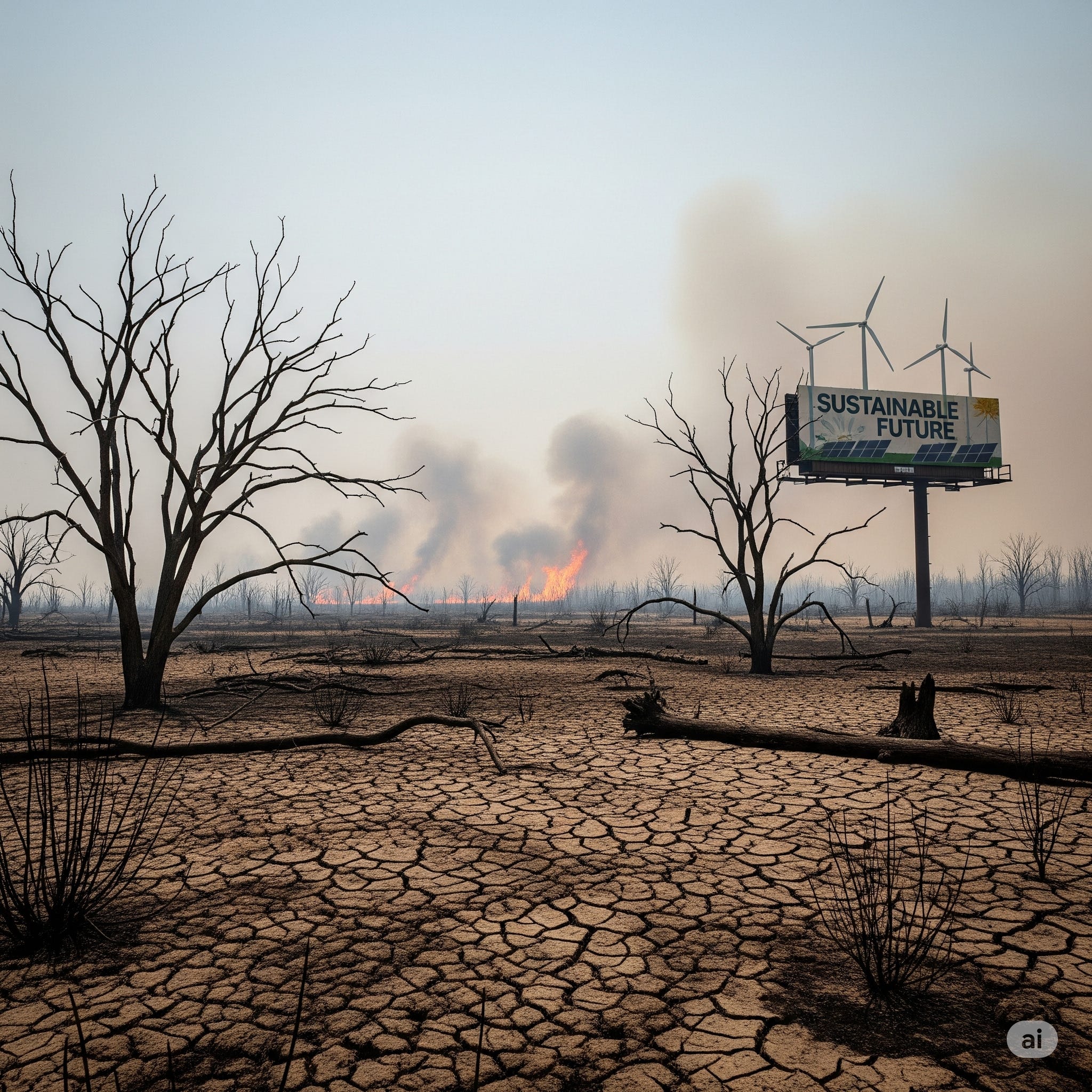
Every day we delay serious action on climate change, we're making a choice. We're choosing to spend trillions subsidizing the problem while underfunding the solutions. We're choosing to let psychological manipulation override scientific evidence. We're choosing short-term comfort over long-term survival.
But we can make different choices. The science is clear, the solutions exist, and the economic case is overwhelming. What we need now is the collective will to act on what we know.
The window is closing, but it's not closed yet.
The choice is still ours to make.
The question is: What are we going to choose right?
//Peace Love And Respect
´
Find additional credible information! see what i did there? Right?
Incredibly transparent, Release the files.
Sources:
"10 Big Findings from the 2023 IPCC Report on Climate Change." World Resources Institute. Accessed July 28, 2025. https://www.wri.org/insights/2023-ipcc-ar6-synthesis-report-climate-change-findings
"6 technologies to help the world adapt to climate change." World Economic Forum. (2024). Accessed July 28, 2025. https://www.weforum.org/stories/2024/02/ai-climate-adaptation-technologies/
"6 Takeaways from the 2022 IPCC Climate Change Mitigation Report." World Resources Institute. Accessed July 28, 2025. https://www.wri.org/insights/ipcc-report-2022-mitigation-climate-change
"7 new inventions that could fight the effects of climate change." PVcase. Accessed July 28, 2025. https://pvcase.com/blog/7-new-inventions-that-could-fight-the-effects-of-climate-change
"A climate of public readiness: climate adaptation action." Frontiers in Climate. Accessed July 28, 2025. https://www.frontiersin.org/journals/climate/articles/10.3389/fclim.2025.1566104/full
"A review of estimating population exposure to sea-level rise and the relevance for migration." PMC. (2021). Accessed July 28, 2025. https://pmc.ncbi.nlm.nih.gov/articles/PMC8208600/
"Adaptation Gap Report 2024." UNEP. Accessed July 28, 2025. https://www.unep.org/cep/news/blogpost/adaptation-gap-report-2024
"AI and Climate Action: Opportunities, Risks and Challenges for Developing Countries." UNFCCC. Accessed July 28, 2025. https://unfccc.int/news/ai-and-climate-action-opportunities-risks-and-challenges-for-developing-countries
"Barriers to adapting to climate change." CoastAdapt. Accessed July 28, 2025. https://coastadapt.com.au/barriers-to-adapting-climate-change
"Building Public and Political Will for Climate Change Action." Yale Environment 360. Accessed July 28, 2025. https://environment.yale.edu/news/article/building-public-and-political-will-for-climate-change-action
"Carbon Pricing." MIT Climate Portal. Accessed July 28, 2025. https://climate.mit.edu/explainers/carbon-pricing
"Climate Action Fast Facts." United Nations. Accessed July 28, 2025. https://www.un.org/en/climatechange/science/key-findings
"Climate Action Network." Accessed July 28, 2025.
https://climatenetwork.org/
"Climate Adaptation Finance and Implementation Gap Report 2024." Climate Adaptation Platform. Accessed July 28, 2025. https://climateadaptationplatform.com/climate-adaptation-finance-and-implementation-gap-report/
"Climate Change and Health." World Health Organization (WHO). Accessed July 28, 2025. https://www.who.int/news-room/fact-sheets/detail/climate-change-and-health
"Climate Change 2023 - IPCC." IPCC. (2023). Accessed July 28, 2025. https://www.ipcc.ch/report/ar6/syr/downloads/report/IPCC_AR6_SYR_SPM.pdf
"Climate Change Impacts." NOAA. Accessed July 28, 2025. https://www.noaa.gov/education/resource-collections/climate/climate-change-impacts#:~:text=Climate%20change%20impacts%20our%20society,and%20damage%20ecosystems%20and%20infrastructure.
"Climate Reports." United Nations. Accessed July 28, 2025. https://www.un.org/en/climatechange/reports
"ClimateChange." United Nations. Accessed July 28, 2025. https://www.un.org/en/climatechange
"Climate change and inequality." Oxfam. Accessed July 28, 2025. https://www.oxfamamerica.org/explore/issues/climate-action/climate-change-and-inequality/
"Ethical issues and challenges." Climate Change and Its Impacts. Accessed July 28, 2025. https://opentextbooks.colvee.org/climatechangeandimpacts/chapter/ethical-issues-and-challenges/
"Five Principles for Advancing Racial, Economic, and Health Justice Through State Climate Policy." Center on Budget and Policy Priorities. Accessed July 28, 2025. https://www.cbpp.org/research/climate-change/five-principles-for-advancing-racial-economic-and-health-justice-through
"Five ways the climate crisis impacts human security." United Nations. Accessed July 28, 2025. https://www.un.org/en/climatechange/science/climate-issues/human-security
"Food Security | Food Insecurity Statistics & Solutions." World Bank. Accessed July 28, 2025. https://www.worldbank.org/en/topic/agriculture/brief/food-security-update
"For hope on climate change, follow the money, UN chief tells AP." AP News. Accessed July 28, 2025. https://apnews.com/article/guterres-un-climate-change-fossil-fuels-renewables-e8a1b2365883be9781a72446302fc421
"Fossil Fuel Subsidies." Daybreak. Accessed July 28, 2025. https://www.daybreakgame.org/card/1400
"Global Trends." UNHCR. Accessed July 28, 2025. https://www.unhcr.org/global-trends
"Health and Climate Change." World Bank. Accessed July 28, 2025. https://www.worldbank.org/en/topic/health/brief/health-and-climate-change
"How climate change impacts refugees and displaced communities." USA for UNHCR. Accessed July 28, 2025. https://www.unrefugees.org/news/how-climate-change-impacts-refugees-and-displaced-communities/
"Implementing Environmental Policies in Developing Countries." Number Analytics. Accessed July 28, 2025. https://www.numberanalytics.com/blog/implementing-environmental-policies-in-developing-countries
"IPCC Sixth Assessment Report (AR6)." Climate Action Network. Accessed July 28, 2025. https://climatenetwork.org/ipcc_6ar/
"Key Cryosphere Messages from the IPCC AR6 Synthesis Report: Climate Change 2023." ICCI Network. Accessed July 28, 2025. https://iccinet.org/key-cryosphere-messages-from-the-ipcc-ar6-synthesis-report-climate-change-2023/
"Mobilizing my doubts and worries about climate change." CT Mirror. Accessed July 28, 2025. https://ctmirror.org/2025/07/22/i-mobilized-my-doubts-and-worries-about-climate-change/
"New IPCC Report dubbed 'an atlas of human suffering' as climate crisis damages Earth faster than we can adapt." Climate.gov.ph News. Accessed July 28, 2025. https://climate.gov.ph/news/666
"New Challenges to Climate Policies." Peterson Institute for International Economics. Accessed July 28, 2025. https://www.piie.com/sites/default/files/2023-06/2023-06-05-01spilimbergo.pdf
"Private Sector & Adaptation." Adaptation Community. Accessed July 28, 2025. https://www.adaptationcommunity.net/private-sector-adaptation/
"Racial Disparities in Climate Change-Related Health Effects in the United States." PMC. Accessed July 28, 2025. https://pmc.ncbi.nlm.nih.gov/articles/PMC9363288/
"Reality Check: Lessons from 25 Policies Advancing a Low-Carbon Future." World Bank. (2023). Accessed July 28, 2025. https://www.worldbank.org/en/news/feature/2023/09/19/climate-policies-with-real-world-results
"Sixth Assessment Report - Working Group II." IPCC. Accessed July 28, 2025. https://www.ipcc.ch/report/sixth-assessment-report-working-group-ii/
"Social Dimensions of Climate Change." World Bank. Accessed July 28, 2025. https://www.worldbank.org/en/topic/social-dimensions-of-climate-change
"Stakeholder Engagement: Key for Effective Climate Action." ICAT. Accessed July 28, 2025. https://climateactiontransparency.org/stakeholder-engagement-is-key-for-effective-climate-action/
"Success Stories and Case Studies." EPA. Accessed July 28, 2025. https://www.epa.gov/climate-change-water-sector/success-stories-and-case-studies
"Summary for Policymakers." IPCC. Accessed July 28, 2025. https://www.ipcc.ch/report/ar6/syr/summary-for-policymakers/
"Tackling climate change could be the greatest global health opportunity of the 21st century." Climate and Health Alliance. (2021). Accessed July 28, 2025. https://climateandhealthalliance.org/wp-content/uploads/2021/05/GCH-Climate-Change-paper.pdf
"Taking action for the health of people and the planet." United Nations. Accessed July 28, 2025. https://www.un.org/en/climatechange/science/climate-issues/health
"The attitude-behavior gap on climate action: How can it be bridged?" George Mason University. Accessed July 28, 2025. https://climatecommunication.gmu.edu/all/the-attitude-behavior-gap-on-climate-action-how-can-it-be-bridged/
"The cost of climate change: Action versus inaction." AXA IM. Accessed July 28, 2025. https://www.axa-im.com/document/4217/view
"The Ethics of Climate Change." Yale E360. Accessed July 28, 2025. https://e360.yale.edu/features/the_ethics_of_climate_change
"The Paris Agreement." UNFCCC. Accessed July 28, 2025. https://unfccc.int/process-and-meetings/the-paris-agreement
"The Politics of Climate Change Adaptation." Annual Reviews. Accessed July 28, 2025. https://www.annualreviews.org/doi/pdf/10.1146/annurev-environ-102017-025739
"THE ROLES OF THE PRIVATE SECTOR IN CLIMATE CHANGE ADAPTATION – AN INTRODUCTION." Adelphi Consult. Accessed July 28, 2025. https://adelphi.de/system/files/mediathek/bilder/EXPLAINER%20The%20roles%20of%20the%20private%20sector%20in%20climate%20change%20adaptation%20-%20adelphi.pdf
"The role of the IMF in addressing climate change risks." European Central Bank. Accessed July 28, 2025. https://www.ecb.europa.eu/pub/pdf/scpops/ecb.op309~4a449b41bc.en.pdf
"The United Nations Environment Programme strategy for tackling climate change, biodiversity and nature loss, and pollution and waste." DevelopmentAid. Accessed July 28, 2025. https://www.developmentaid.org/api/frontend/cms/file/2022/12/K2100501-e.pdf
"This is why food security matters now more than ever." World Economic Forum. (2020). Accessed July 28, 2025. https://www.weforum.org/stories/2020/11/food-security-why-it-matters/
"Trillions Wasted on Subsidies Could Help Address Climate Change." World Bank. Accessed July 28, 2025. https://www.worldbank.org/en/news/press-release/2023/06/15/trillions-wasted-on-subsidies-could-help-address-climate-change
"UN's top court says failing to protect planet from climate change could violate international law." AP News. Accessed July 28, 2025. https://apnews.com/article/un-court-opinion-climate-change-1ac84a94a5aaffd63518ef1da3502a9e
"Urgent climate action can secure a liveable future for all." IPCC Press Release. Accessed July 28, 2025. https://www.ipcc.ch/2023/03/20/press-release-ar6-synthesis-report/
"What Are the Limitations of Current Technologies?" Sustainability Directory. Accessed July 28, 2025. https://climate.sustainability-directory.com/question/what-are-the-limitations-of-current-technologies/
"What is Carbon Pricing?" Carbon Pricing Dashboard. Accessed July 28, 2025. https://carbonpricingdashboard.worldbank.org/what-carbon-pricing
"What Are the Most Important Priorities in Climate Change?" Probably Good. Accessed July 28, 2025. https://probablygood.org/cause-areas/climate-change/priorities/
"Why we need to act now." Climate & Clean Air Coalition. Accessed July 28, 2025. https://www.ccacoalition.org/content/why-we-need-act-now
Referenced Substack Posts & Google Docs
"Emergency Alert: Critical Ocean Data at Risk in the Southeast." NOAA could cut this year's funding to IOOS regions, directly contradicting the budget Congress already approved. If these cuts go through, vital coastal monitoring will cease.

"🧠Beyond the Noise: Understanding Our Shared Reality for a United Future."
"Social Experiments, Media, Epstein Analysis Navigating the Labyrinth: Social Psychology, Media Dynamics, and the Architecture of Power." https://docs.google.com/document/d/e/2PACX-1vRRgG1sFB1wcDcKqzOviOKbXYXOoX4WDE7_o8Tr7yZFdUF37xAHRkqqQSwioHuBbsnwk5RWrxZY2jwm/pub
"The Great Windmill Reality Check: When Politics Meets Physics How a few spinning towers became America's most misunderstood energy technology."
"The Protein Plot Twist: When Ancient Gods Meet Modern Science."
"When My ADHD Brain Fell Down a Research Rabbit Hole: A Journey Through Social Psychology, Media Manipulation, and Power." How a simple correlation study led me into the labyrinth of human psychology, media bias, and elite networks.
"Windmills, Marine Life, Reality." https://docs.google.com/document/d/e/2PACX-1vSVoEYcPBWhECdx9sAexpCdsmzGXmefY0jEgiQnQTsR-indpNgqZ06ko7SLHT8BhtZ8ZYCQduy28Rr9/pub