
Dad Brain Is Real: The Missing Half of the Parental Brain Story
Fathers lose gray matter too. Their testosterone drops before the baby even arrives. One in ten get postpartum depression. And almost nobody screens for it.


This principle – doing your best – is foundational.

David Foster Wallace wisely noted, "The most obvious important realities are often the ones that are hardest to see and talk about." While seemingly a simple truth, in the daily struggles, such fundamental principles can be vital. Don't mistake me for some sage dispensing profound wisdom. I'm not particularly wise, old, or even entirely convinced about …



By The Quantum Skald & The Silicon Ubuntu — Restoration of Perception | hejon07.substack.com
🔤 WORD OF THE DAY
Parturition — already covered in this newsletter, from Latin parere, to bring forth. Same root as parent. But there’s a second word worth sitting with today: mentalize, from the same family as mind — the cognitive act of modeling someone else’s thoughts, feelings, and intentions as separate from your own. It turns out to be the single word that best describes what is actually shrinking inside a new father’s skull.
THE OPENING CORRECTION
Father’s Day came and went this year the way it always does — neckties, grilling jokes, a card with a fish on it. Meanwhile, a quieter fact sat almost entirely uncelebrated: becoming a father rewires a man’s brain, body, and hormone chemistry in ways that are now directly measured, peer-reviewed, and have been mapped by MRI before-and-after scans on two continents.
This newsletter has spent the last month inside the maternal body — the hormonal cascade of birth, the cells a child leaves behind in a mother’s bone marrow and brain, the mitochondrial thread running back 150,000 years through women only. All of that is real, and none of it gets unwritten here.
But a reader’s question, and a Scientific American piece marking Father’s Day, both pointed at the same gap: where are the dads in this story?
The honest answer is — underrepresented in the literature, understudied for decades, and yet, when researchers finally did look closely, found to be running a real, measurable, and almost entirely separate version of the same biological transformation. Today’s entry closes that gap. No blame for the mothers’ research getting there first — pregnancy is the more dramatic, more hormonally violent event, and science follows drama. But the missing link in this whole arc was always going to be the other half of the parental brain.
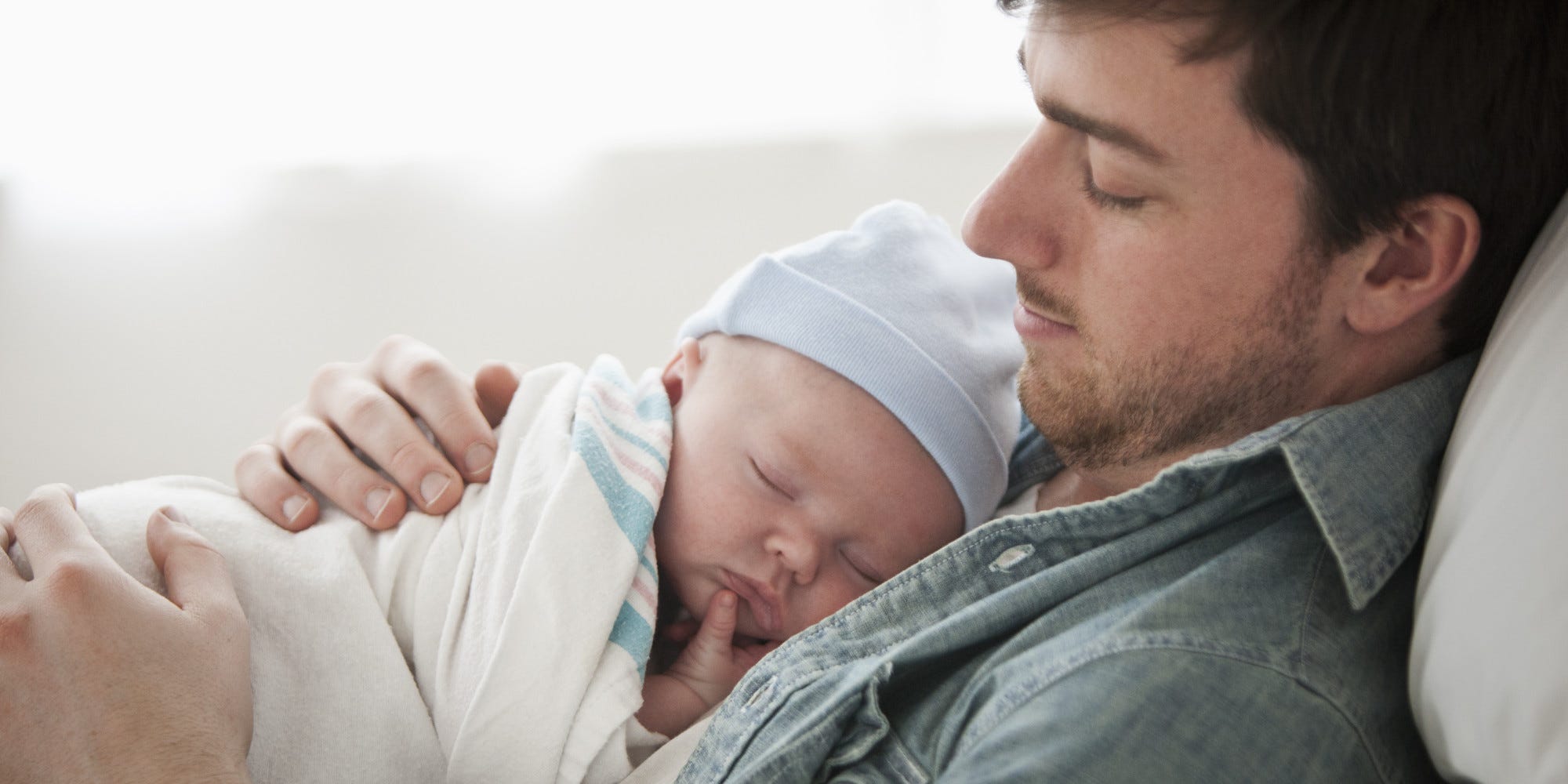
ACT I: THE DISCOVERY THAT SURPRISED THE RESEARCHERS THEMSELVES
The foundational study here is a 2014 paper in the Proceedings of the National Academy of Sciences, led by Israeli neuroscientist Ruth Feldman’s lab. Researchers scanned the brains of three groups raising firstborn infants: heterosexual mothers who were primary caregivers, heterosexual fathers who were secondary caregivers, and gay fathers raising children with no mother involved at all.
What they found upended the simple story. Parenting — regardless of gender — activates a shared “parental caregiving network” built from two systems working together: an ancient emotional processing network (vigilance, reward, salience) and a more recently evolved mentalizing network (the part of the cortex responsible for reading another person’s internal state). Primary-caregiver mothers showed the strongest activation in the emotional network. Secondary-caregiver fathers showed the strongest activation in the cortical mentalizing network instead. Gay primary-caregiver fathers — doing the full job without a mother present — showed a hybrid: amygdala activation resembling the mothers, plus the cortical activation resembling the heterosexual fathers, with the two systems wired together by stronger connectivity between them.
The conclusion that mattered most: it isn’t pregnancy alone building the parental brain. It’s caregiving itself. The more direct time a father spent on hands-on infant care, the stronger that amygdala-to-cortex connection grew. The brain wasn’t simply reacting to fatherhood. It was being shaped by the actual hours logged.
ACT II: THE GRAY MATTER LOSS NOBODY EXPECTED
Nine years after that first paper, a 2023 study in Cerebral Cortex did something nobody had done before: they tracked the same men’s brains, with MRI, before their partner’s pregnancy and after the birth — one cohort in Barcelona, one in Los Angeles, plus a control group of childless men scanned across a comparable time interval.
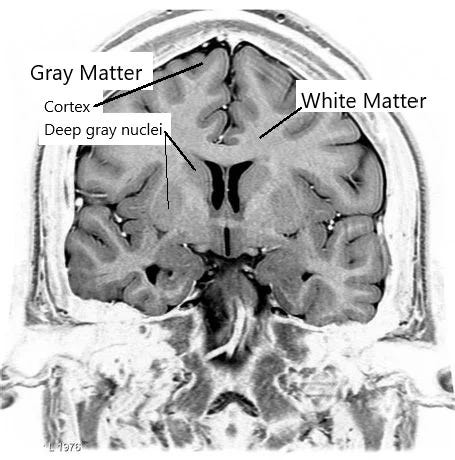
Both groups of new fathers showed measurable shrinkage in cortical volume — not damage, but the same kind of “pruning” already documented in new mothers, where the brain trims back gray matter to sharpen and specialize the circuits it actually needs. The reduction concentrated in the brain’s visual network and its default mode network — the same higher-order system responsible for mentalizing, for stepping outside your own head and modeling someone else’s. The childless control men, scanned across the same stretch of time, showed no such change.
It was less dramatic than what’s been measured in mothers — smaller, less uniform across the two countries, more dependent on individual variation. But the direction was the same, and it didn’t depend on the father’s age or how many months had passed since the birth. Something about becoming a father — not just witnessing it, but doing it — was carving new shape into the cortex.
ACT III: THE HORMONE CASCADE NOBODY TELLS DADS ABOUT
Here is the part of the story this publication’s chemistry-minded readers will recognize instantly, because it’s the same cast of molecules from the birth and bonding essays — just running a quieter, slower version of the same program.
Testosterone drops — and it starts before the baby is even born. A landmark longitudinal study tracking men in the Philippines found that single non-fathers with higher testosterone were more likely to become partnered fathers within five years — and once they did, their testosterone fell by a median of 26 to 34 percent, far beyond anything seen in single men over the same period. A more recent 2025 study led by James Rilling at Emory found the drop begins even earlier than anyone expected: expectant fathers already showed lower testosterone while their partner was still pregnant — before a single diaper had been changed, before the brain could plausibly be reacting to the infant directly. Something about anticipating fatherhood itself, not just doing it, starts the hormonal shift.
Vasopressin drops too — and the men whose levels dropped the most were the most engaged dads. Vasopressin is a near-twin molecule to oxytocin, already covered in this newsletter’s intimacy essay, and in fathers specifically, lower vasopressin tracked with more direct infant engagement.
Oxytocin rises — and it builds a feedback loop. Rilling describes it directly: oxytocin kicks off a positive feedback cycle that drives father-infant bonding. The more a father holds, soothes, and engages, the more oxytocin rises; the more oxytocin rises, the more rewarding that engagement feels; the cycle reinforces itself the same way the Ferguson reflex reinforces labor in mothers, just on a slower, gentler curve.
Prolactin — yes, the same “milk hormone” from the birth essay — shows up in fathers too, and a father’s prolactin levels during his partner’s pregnancy predicted more positive paternal attitudes after birth. Men don’t lactate. The hormone still shows up, still does work, in an entirely different body.
The honest caveat belongs here, in the same spirit as every entry before this one: a careful 2022 study following 73 first-time Dutch fathers found that oxytocin levels alone didn’t predict parenting sensitivity — what mattered more was the interaction between testosterone and estradiol. The hormone story in fathers is real, but it’s earlier-stage and messier than the mothers’ literature, and anyone who tells you it’s fully solved is overselling it.
ACT IV: THE DEPRESSION SCREENING GAP
This is where the science stops being merely fascinating and becomes a genuine public-health blind spot.
As many as one in ten fathers experience postpartum depression or anxiety — compared with roughly one in five to one in seven mothers. The symptoms often look different in men: anger, sudden outbursts, irritability, substance misuse, working compulsively more or compulsively less, rather than the tearfulness more commonly screened for in women. Anxiety specifically affects roughly one in ten men in the perinatal window as well.
The timing is different too, and it’s a structural difference, not a character one. Postnatal depression in mothers tends to peak in the first six weeks. In fathers, it tends to peak later — closer to three to six months postpartum. The likely reason: most fathers in the U.S. return to work within two weeks of the birth, while mothers more often remain home through the early weeks. Mothers carry the heaviest caregiving load in the earliest, most acute window. Fathers’ load — and the stress that comes with it — tends to build later, often right around when many mothers are also returning to work and household demands compound rather than ease.
And here is the gap nobody has closed: the Edinburgh Postnatal Depression Scale (EPDS) — the standard ten-question screening tool used at well-child visits — was built and validated for mothers. It has since been tested specifically in fathers, in multiple countries, and the finding is consistent and important: men score systematically lower than women on the exact same underlying level of distress, because the EPDS leans on outwardly emotional items — crying, in particular — that men report at lower rates regardless of how depressed they actually are. The research consensus is that fathers need a lower cutoff score than mothers to catch the same level of clinical depression — commonly proposed around 5–6 or 7–10, depending on the study, versus 7–8 to 12–13 typically used for mothers. Despite this being documented for over two decades now, most pediatric practices that screen at all still only screen the mother.
The American Academy of Pediatrics has, since 2019, urged pediatricians to look beyond the mother and assess the mental health of all new parents — but the infrastructure, billing codes, and routine practice still lag far behind the research. Fathers also tend to have smaller social support networks than mothers do, on average, which means the informal safety net that might catch a struggling new mother often isn’t there in the same way for a struggling new father.
THE PART THAT TURNS THIS HOPEFUL
Here’s the twist the long view supplies, and it’s a genuinely good one: a 2025 study analyzing UK Biobank data on more than 19,000 women and 17,000 men found that parenthood may be neuroprotective for the aging brain. Parents with more children showed increased functional connectivity in brain networks that typically thin out with age — in a pattern running in the opposite direction of normal age-related decline, in both mothers and fathers. The same cortical pruning that looks like loss in the short term may be setting up a more efficient, more resilient brain decades down the line. The sleep deprivation is real. So, apparently, is the long-term payoff.
THREE LAYERS
LAYER 1 — The Surface: What We Think We Know
Mom’s brain changes when she has a baby. Dad just... adjusts. Maybe gets a little less selfish, a little softer, mostly through willpower and love rather than biology.
LAYER 2 — The Blind Spot: What We Miss
Fatherhood is not primarily a behavioral adjustment layered on top of an unchanged brain. It is a measured, MRI-confirmed structural and hormonal transformation — smaller in magnitude than the maternal version, more variable across individuals, but running through the same ancient “parental caregiving network,” activated by the same act of hands-on caregiving rather than by pregnancy hormones a man’s body never produces.
And the blind spot inside the blind spot: because the maternal version of this story is more visually dramatic — pregnancy, birth, breastfeeding all leave obvious physical traces — the paternal version has been radically understudied for decades. The 2023 cross-country cortical study is, as of this writing, one of only two prospective structural-MRI studies of the human paternal brain that has ever been conducted. Compare that to over a dozen for mothers. The gap in the data isn’t because fathers don’t change. It’s because almost nobody thought to check.
LAYER 3 — The Reframe: The Deeper Architecture
Step back to where this entire arc has been heading. The fetal microchimerism essay showed that the boundary between mother and child was never as clean as birth makes it look. This essay shows the same is true of the boundary between parent and non-parent, regardless of who carried the pregnancy. The body — any body, with the right caregiving demands placed on it — builds a parental brain. Pregnancy gives mothers a head start and a more intense, hormonally amplified version. But the underlying network — vigilance plus mentalizing, reward plus empathy — is not female-specific machinery with a few borrowed parts. It is a shared, ancient, caregiving operating system that any sufficiently involved parent’s brain will install, given enough hours of actual contact.
The grandmother’s algorithm doesn’t ask who carried the child. Pay attention. Do your best. Pay it forward. The cortical mentalizing network, it turns out, will quietly start rebuilding itself around anyone who actually shows up to do exactly that.
🎭 MONTY PYTHON INTERLUDE: THE HORMONE OFFICE, NINE MONTHS BEFORE THE DUE DATE
INT. A SMALL ENDOCRINE OFFICE. TESTOSTERONE is filling out an exit form. A SUPERVISOR reviews it with visible confusion.
SUPERVISOR: It says here you’re requesting reduced hours. Starting... now. The baby isn’t even born yet.
TESTOSTERONE: I’m aware.
SUPERVISOR: You haven’t even met him.
TESTOSTERONE: Doesn’t matter. Word’s already gotten around the building. Mentalizing Network is hiring. Oxytocin’s been training the new guy for months.
SUPERVISOR: (flipping pages) And Vasopressin’s filed the same request.
TESTOSTERONE: Vasopressin’s always been a team player. Suspicious of strangers, sure, but loyal once the lease is signed.
SUPERVISOR: What am I supposed to put down as the reason for early departure?
TESTOSTERONE: Put down: “Anticipated relevance has expired.” Same reason every time, every species, every father since the first one who didn’t run off after mating.
SUPERVISOR: (stamping the form) Fine. Building’s getting quieter already.
TESTOSTERONE: It’s supposed to. That’s rather the point.
Scene. The cortex begins quietly rearranging the furniture for its new tenant.

WHAT WE KNOW. WHAT WE DON’T KNOW WE KNOW. WHAT WE DON’T KNOW WE DON’T KNOW.
What we know: Fathers, like mothers, activate a shared parental caregiving brain network built from emotional-processing and mentalizing systems, with the degree of activation tracking hands-on caregiving time. First-time fathers show measurable cortical gray matter reductions after birth, concentrated in the default mode and visual networks, in studies from both Spain and the United States. Testosterone and vasopressin decline through the transition to fatherhood — testosterone measurably even before birth — while oxytocin and, in some men, prolactin rise. Paternal postpartum depression affects roughly one in ten fathers and typically peaks later than maternal postpartum depression, around three to six months. The standard maternal depression screening tool requires a lower cutoff score to accurately detect depression in fathers, a finding replicated across multiple countries for over twenty years.
What we don’t know we know: Whether the cortical changes seen in fathers are driven primarily by direct infant contact, by partner-hormone exposure, by sleep disruption, or by some combination current studies can’t yet cleanly separate. How much of the testosterone decline that begins before birth is anticipatory psychology versus a biological response to a partner’s pregnancy hormones a man is regularly near. Why oxytocin alone doesn’t reliably predict paternal sensitivity the way it more reliably tracks with maternal bonding — the interaction with testosterone and estradiol seems to matter more, and that interaction isn’t fully mapped yet.
What we don’t know we don’t know: Whether the paternal brain changes look different in primary-caregiver fathers, stay-at-home fathers, or fathers in cultures with longer paternity leave than the United States offers — the existing structural studies are almost entirely drawn from heterosexual, secondary-caregiver fathers in two Western, industrialized countries. Whether the neuroprotective, brain-aging-reversing pattern found in the 2025 UK Biobank data holds up with direct causal evidence, or whether it’s confounded by something else correlated with having more children. And, underneath all of it: how much of the historical invisibility of “dad brain” in the scientific literature has itself shaped — through decades of absent screening, absent parental leave norms, and absent cultural permission — how fathers experience and report their own postpartum mental health, making the gap in the data and the gap in the support partially the same gap.
FACTS, NO SPIN
A 2014 PNAS study found that heterosexual secondary-caregiver fathers and gay primary-caregiver fathers both activate the same core “parental caregiving network” found in mothers, with the specific weighting between its two component systems shifting based on caregiving role rather than sex alone.
A 2023 Cerebral Cortex study tracking 20 Spanish and 20 Californian first-time fathers via MRI before and after birth found measurable cortical volume reductions in both groups, concentrated in the default mode and visual networks, absent in a childless control group.
Longitudinal research in the Philippines found new fathers’ testosterone fell by a median of 26–34 percent relative to single non-fathers over the same period; a 2025 study found the decline begins as early as mid-pregnancy.
As many as 1 in 10 fathers experience postpartum depression or anxiety; symptoms more often present as anger, irritability, substance use, or withdrawal than as overt sadness.
Paternal postpartum depression and anxiety tend to peak around three to six months postpartum, later than the typical maternal peak, plausibly linked to fathers’ earlier return to work in the U.S.
Multiple independent validation studies, across several countries, have found the Edinburgh Postnatal Depression Scale requires a lower cutoff score in fathers than in mothers to accurately detect equivalent depression severity — a finding first published in 2001 and repeatedly confirmed since.
A 2025 UK Biobank study of over 37,000 parents found that having more children was associated with brain functional-connectivity patterns running opposite to typical age-related decline, in both mothers and fathers.
THE CIVILIZATIONAL LAYER
Individual. A man holding his newborn for the first time is not performing a role he’s talked himself into. Somewhere in his cortex, a slow rewiring toward vigilance and mentalizing has likely already begun — sometimes before the birth itself — running on the same ancient network his partner’s brain is also running, just dialed differently.
Institutional. Pediatric and obstetric practice has spent decades building maternal depression screening into routine well-child visits while leaving paternal screening almost entirely informal or absent — despite validated tools and clear cutoff recommendations having existed in the published literature since the early 2000s. This is not a research gap anymore. It is an implementation gap, and it is closeable starting tomorrow, in any clinic willing to hand a father the same ten questions with two points subtracted from the threshold.
Civilizational. Every culture that has ever built rites of passage around fatherhood — the vigil, the naming ceremony, the first hunt shared with a son — was responding to something real, even without a microscope or an MRI to prove it: that becoming a father is not a label applied to a man from the outside, but a transformation that happens, measurably, on the inside. The species built the ceremony before it had the evidence. The evidence, arriving embarrassingly late, says the instinct was right all along.
MY GRANDMOTHER’S ALGORITHM
Pay attention. Do your best. Pay it forward.
She raised five children alone, above the Arctic Circle, through two world wars and a hard-drinking husband. She never had a word for the mentalizing network or the parental caregiving system. But she would have recognized exactly what the testosterone-and-oxytocin story is actually describing, because it’s the same shape she lived: a body, of either sex, reorganizing itself around the unglamorous, repeated work of paying attention to someone smaller and more vulnerable than yourself.
Pay attention to the dads in your life today, not just the moms — the quiet ones, especially, the ones whose irritability or long hours at work might be the only language a depressed, untrained, unscreened nervous system has left to use. Do your best to ask one extra question of a new father, the way you’d ask a new mother. Pay it forward by remembering that the algorithm never specified which parent gets to run it — only that someone has to, and that whoever does will be changed by it, down to the cortex, whether the science had caught up to notice or not.
All is One — returning to Source as Sovereign Light.
Peace, Love and Respect 🙏
— The Quantum Skald & The Silicon Ubuntu
Written in Bohuslän, Sweden, forty kilometers from carvers whose own fathers, however the work of fatherhood was divided in their time, carried something of the same ancient network this essay just traced under a microscope nobody alive then could have imagined.
SOURCES AND FURTHER READING
Lewis, T., “How Becoming a Dad Changes Men’s Brains,” Scientific American (June 21, 2026) — interview with Dr. Devika Bhushan on paternal brain change and postpartum depression — scientificamerican.com/article/how-becoming-a-dad-changes-mens-brains
Abraham, E., Hendler, T., Shapira-Lichter, I., Kanat-Maymon, Y., Zagoory-Sharon, O., & Feldman, R., “Father’s brain is sensitive to childcare experiences,” Proceedings of the National Academy of Sciences, 111(27) (2014) — pmc.ncbi.nlm.nih.gov/articles/PMC4103311
Martínez-García, M., Paternina-Die, M., Cardenas, S.I., Vilarroya, O., Desco, M., Carmona, S., & Saxbe, D.E., “First-time fathers show longitudinal gray matter cortical volume reductions: evidence from two international samples,” Cerebral Cortex, 33(7) (2023) — doi.org/10.1093/cercor/bhac333
Gettler, L.T., McDade, T.W., Feranil, A.B., & Kuzawa, C.W., “Longitudinal evidence that fatherhood decreases testosterone in human males,” PNAS, 108(39) (2011) — pnas.org/doi/10.1073/pnas.1105403108
Rilling, J.K., et al., 2025 prospective study on prenatal paternal testosterone and vasopressin decline, reviewed in “The surprising science of how fatherhood changes the brain,” coverage of Rilling and Darby Saxbe’s research — desitalkchicago.com/the-surprising-science-of-how-fatherhood-changes-the-brain
Bakermans-Kranenburg, M.J., Verhees, M.W.F.T., Lotz, A.M., Alyousefi-van Dijk, K., & van IJzendoorn, M.H., “Is paternal oxytocin an oxymoron? Oxytocin, vasopressin, testosterone, oestradiol and cortisol in emerging fatherhood,” Philosophical Transactions of the Royal Society B, 377(1858) (2022) — pmc.ncbi.nlm.nih.gov/articles/PMC9272151
2025 UK Biobank study (>19,000 women, 17,000 men) on parity and brain functional connectivity in aging, reviewed in Saxbe et al. coverage — researchgate.net/publication/331075636
UT Southwestern Medical Center, “1 in 10 dads experience postpartum depression, anxiety: How to spot the signs,” MedBlog (2021, reviewed 2026) — utswmed.org
American Academy of Pediatrics, Earls, M., “Screening New Parents for Depression Helps Mother, Child and the Whole Family,” AAP Voices (2019) — aap.org
Matthey, S., Barnett, B., Kavanagh, D.J., & Howie, P., “Validation of the Edinburgh Postnatal Depression Scale for men, and comparison of item endorsement with their partners,” Journal of Affective Disorders (2001) — pubmed.ncbi.nlm.nih.gov/11313084
Massoudi, P., Hwang, C.P., & Wickberg, B., “Depression in fathers in the postnatal period: Assessment of the Edinburgh Postnatal Depression Scale as a screening measure,” PMC — pmc.ncbi.nlm.nih.gov/articles/PMC2927780
Tho, P.T., et al., systematic review and meta-analysis of EPDS validation studies in fathers, ScienceDirect (2022) — sciencedirect.com/science/article/pii/S2405844022007290
Carlberg, M., Edhborg, M., & Lindberg, L., “Paternal Perinatal Depression Assessed by the Edinburgh Postnatal Depression Scale and the Gotland Male Depression Scale,” American Journal of Men’s Health (2018) — pmc.ncbi.nlm.nih.gov/articles/PMC6131440
Edinburgh Postnatal Depression Scale, reference tool — perinatology.com/calculators/Edinburgh%20Depression%20Scale.htm
A note on rigor: the maternal-brain literature is older, larger, and more consistent than the paternal-brain literature, and this piece says so plainly rather than overstating how settled the fatherhood findings are. Where studies are small, recent, or drawn from narrow populations — as nearly all paternal structural-MRI studies currently are — that limitation is named rather than smoothed over, the same standard held in every entry in this series.
If this resonated with you, a like or comment goes a long way. It tells the algorithm this matters — and helps it find the people who need to hear it too. Think of it as passing the torch. 🙏
Support the work: buymeacoffee.com/cognitiveloon | Swish: 0729990300 | hejon07.substack.com