
Democracy's Quantum Paradox: Why Your Vote Is Both Everything and Nothing
A mind-bending journey through the strange physics of American democracy, ancient wisdom, and why your ADHD cousin might just understand politics better than anyone

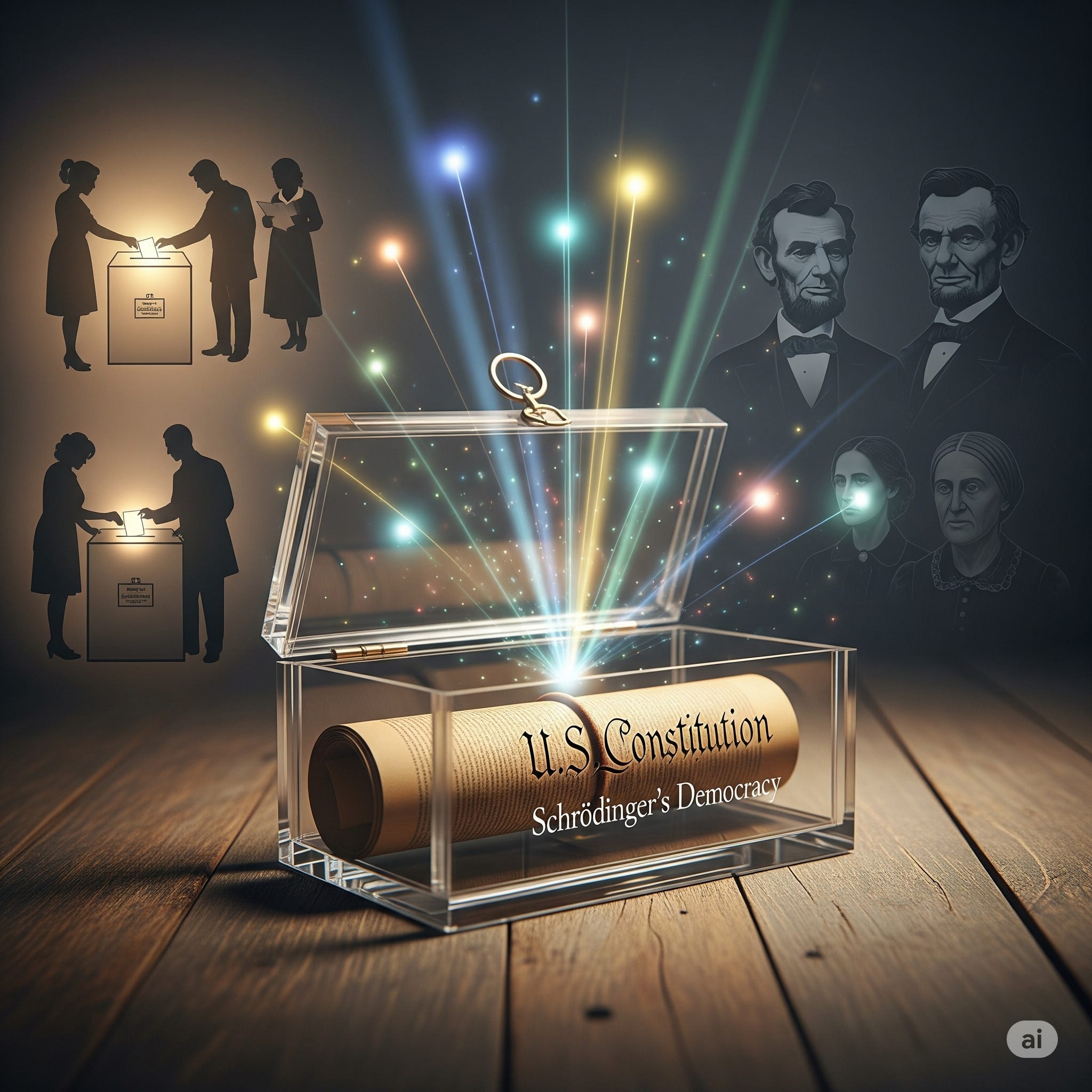
The Constitution as Schrödinger's Cat
Picture this: The U.S. Constitution sitting in a box, neither conservative nor liberal, neither strict nor flexible—until you open it by voting. Sounds crazy? Welcome to quantum democracy.
A brilliant new framework suggests our founding document works like quantum physics. Before an election, the Constitution exists in "superposition"—simultaneously supporting every possible interpretation of government power. Social democracy? Maybe. Libertarian? Absolutely. The document is like a coin spinning in mid-air, both heads and tails at once.
Then comes Election Day. When we vote, we're essentially "observing" this quantum system, forcing it to collapse into one specific reality for the next few years. Your ballot isn't just a choice—it's an act of collective reality-creation.
The plot twist? This isn't some modern academic theory. Indigenous peoples like the Iroquois Confederacy operated this way for centuries, allowing diverse viewpoints to coexist until consensus "collapsed" them into unified decisions. They understood something we're only now rediscovering: true democracy isn't about winning, it's about containing contradictions.
The Three-Legged Quantum Stool (And Why It Keeps Wobbling)
American democracy rests on three "quantum entangled" principles:
We the People (the source of power)
Limited Government (constraints on that power)
Enumerated Powers (clear definitions of those constraints)
Remove any leg, and the whole stool collapses into chaos or tyranny. These principles are inseparable, like quantum particles that instantly affect each other across vast distances.
But here's where comedian George Carlin crashes the party with a uncomfortable truth bomb: What if this beautiful quantum metaphor is just sophisticated propaganda? What if your vote-powered reality-shaping is an illusion, and there really is a "big club" running things—and you ain't in it?
The framework doesn't pick sides. Instead, it holds both the hopeful quantum model AND Carlin's cynical critique in tension. Because maybe democracy's strength isn't in being pure—it's in containing this fundamental paradox without breaking.
The Bootstrap Paradox: How Democracy Pulls Itself Up By Its Own Bootstraps
Here's a brain pretzel: To legitimately create a constitution, you need legitimate democratic procedures. But to have legitimate democratic procedures, you first need a constitution.
The American founders solved this through what can only be called a "legal magic trick." They lacked legitimate authority to create the Constitution, so they just... did it anyway. And it became legitimate because we've collectively agreed to treat it as legitimate ever since.
This is democracy's "Bootstrap Paradox"—it ultimately causes itself. Legitimacy isn't a fixed starting point; it's an ongoing, retroactive act of consensus. The Constitution works because we keep choosing to make it work.
The Grandfather Paradox: When Fixing Democracy Breaks It
But what happens when democracy needs repair? Enter the "Grandfather Paradox" of constitutional reform.
Sometimes you need extraordinary measures—court packing, norm-breaking, constitutional end-runs—to save the system. But if your fix works too well, people forget why the rules were broken in the first place. They start seeing your rule-breaking as illegitimate, undermining the very system you saved.
Argentina learned this the hard way in the 1980s. Their attempt to fix the courts created a precedent for more court-packing by less scrupulous actors, destabilizing the system for decades. The cure became the disease.
This creates a "packing spiral" where norm-breaking becomes normalized. The lesson? Saving democracy by breaking its rules can teach everyone that rule-breaking is acceptable.
The Golden Thread: Ancient Wisdom in Modern Clothes
Connecting all this is an ancient Greek concept called suneidēsis—"joint-knowing" or "co-consciousness." It's the innate capacity to know right from wrong, but more importantly, to know it together.
This shows up in a beautiful personal story about someone's Swedish grandmother—the family's undisputed moral authority who created what can only be described as a "moral gravitational field." Her power didn't come from dominance but from a highly developed capacity for joint-knowing that aligned her individual understanding with something larger.
Her folk wisdom? "Du måste vara om dig och kring dig för att få nåt i dig och på dig"—roughly, "You must manage yourself and your surroundings to get something into you and on you." Practical philosophy for developing co-consciousness.
This connects to indigenous governance structures where "Grandmothers" nominated chiefs and leaders considered impacts "seven generations" into the future. They understood that real power is circular and interconnected, not linear and hierarchical.
When we vote, we're not just collapsing quantum possibilities—we're exercising collective suneidēsis, bringing a particular moral reality into being through joint-knowing.
The ADHD Advantage: When "Broken" Brains See Bigger Pictures
Here's where it gets delightfully personal. The person developing this framework has ADHD—a brain that can "short-circuit" and lose its train of thought. But instead of treating this as a limitation, they frame it as a "superpower for interdisciplinary insight."
That scattered, non-linear thinking? It's actually the perfect cognitive architecture for suneidēsis—for seeing patterns across disparate domains that neurotypical thinkers might miss. The quantum physics, constitutional law, and indigenous wisdom connections that seem obvious to them might be invisible to more linear minds.
Their collaboration with AI to structure these insights becomes a model for human-technology partnership where tech amplifies rather than replaces human creativity. It's a "new covenant" of communication where consciousness and computation enhance each other.
The Universal Human Software: Why We Keep Having the Same Arguments
Humans are pattern-recognition machines running shared cognitive "software" with different cultural "applications." Evidence? Isolated civilizations repeatedly invent the same solutions:
Writing systems emerged independently in Mesopotamia, Egypt, China, and Mesoamerica
Agriculture developed separately in at least eleven regions worldwide
The same archetypes appear in stories globally—the Trickster (Loki, Coyote), the Wise Old Man (Gandalf, Obi-Wan)
The "Sacred Serpent" appears across continents in cultures with zero contact. Why? Because it solves the same fundamental problems: visualizing eternity (the Ouroboros), explaining dualistic forces, and connecting different realms of existence. Mythology wasn't primitive thinking—it was survival technology for grappling with abstract concepts.
When Wisdom Becomes Weaponized: The Forever Victim Trap
But here's the dark side of our shared software: survival strategies that work too well become traps. The framework identifies a six-stage progression:
Legitimate Threat: Real existential danger
Adaptive Response: Develop survival strategies (victim narratives, group loyalty)
Success: Strategies work, group gains power/sympathy
Institutionalization: Strategies become rigid doctrine, fused with identity
Weaponization: Defensive tools become offensive weapons
Contradiction: Group becomes what it once opposed
Examples are everywhere. In Gaza, both sides wield historical trauma as weapons. Some religious groups turn genealogy into "eugenics programs." Political movements use moral superiority to justify attacks on others.
The more effective your survival strategy, the more likely it becomes a rigid part of your identity, making adaptation impossible when circumstances change. The paradox of success strikes again.
The Way Forward: Embracing the Both/And
So what's the point of all this mind-bending analysis? It's not to solve democracy's paradoxes but to learn to live with them creatively.
The power lies in "both/and" thinking—holding contradictory ideas in productive tension rather than forcing false resolutions. Democracy is simultaneously quantum possibility and cynical manipulation. Mythology is both primitive folklore and ancient science. Your scattered ADHD brain is both chaotic and brilliantly synthetic.
The framework suggests three key moves:
Embrace the paradoxes instead of resolving them
Use personal stories as microcosms of larger patterns
Partner with technology to augment rather than replace human insight
The Uncomfortable Truth (With a Side of Hope)
Here's what this all means for you, me, and the future of democracy:
The uncomfortable reality: Your individual vote might matter less than you hope, but your participation in collective sense-making matters more than you know.
The delightful possibility: We're all running the same experiment of being human, which means the insights that work in one place can work everywhere.
The practical takeaway: The next time someone tells you democracy is broken, ask them: "Broken compared to what? And who gets to decide when it's fixed?"
Because maybe the goal isn't to fix democracy—maybe it's to get better at dancing with its contradictions.
Democracy isn't a machine to be repaired; it's a living paradox to be navigated with wisdom, humor, and a healthy respect for the fact that we're all just making it up as we go along.
And honestly? That's both terrifying and beautiful.
The greatest truths are often hiding in plain sight, waiting for a mind with the courage to make connections across disciplines. Sometimes it takes a scattered brain to see the whole picture.
//Peace
The Personal Standard: A Simple Teaching
Pay Attention!
My father instilled this in me—your personal standard. "I will do the best I can." Afterwards, simply: "I did."
That's the measure.
This principle – doing your best – is fundamental. "Do the best you can," without reservation. Everything else – external circumstances – can potentially be altered. What remains immutable is whether you truly gave your best effort. It's a cyclical process!
Loop and paradox!
Remember, "Don't hate, Educate! This is not about what to think, it's about how you could think!" Right?