
Ghost Drones and Ghost Accusations: Russia’s Newest Weapon Isn’t a Drone. It’s a Lie.

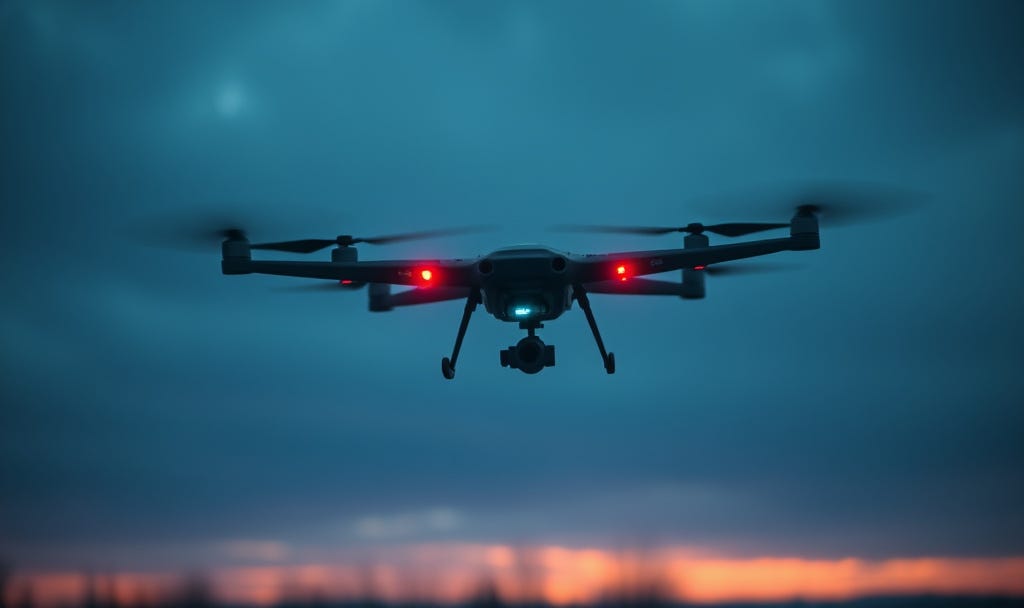
The Quantum Skald & The Silicon Ubuntu | Restoration of Perception
“Pay attention. Do your best. Pay it forward.” — The grandmother’s algorithm
There’s a war happening in the skies over northern Europe right now. But the most dangerous weapon being deployed isn’t flying at 200 kilometers per hour with a warhead. It’s a sentence. A Russian sentence. And it goes something like this:
“The Baltic states are allowing Ukraine to use their airspace to attack Russia.”
That’s the accusation. It is false. Eight Nordic and Baltic foreign ministers said so jointly, loudly, and in writing on May 22, 2026. And yet — the fact that eight governments felt compelled to issue an emergency joint statement tells you something important about the temperature of this moment.
Let’s slow this down. Let’s pay attention.
LAYER 1 — THE SURFACE: What Actually Happened
Here are the facts as verified by multiple NATO governments, Ukraine’s own foreign ministry, and independent investigators.
March 23, 2026. A Ukrainian military drone crashes near Lake Lavysas in Lithuania. It was targeting Russian oil infrastructure at the Primorsk terminal on the Gulf of Finland. It veered off course — almost certainly disrupted by Russian electronic warfare — and ended up 30 kilometres from the Belarusian border.
March 25, 2026. Two more Ukrainian drones enter Latvian and Estonian airspace from Russia. Same campaign. Same oil infrastructure targets. Same electronic warfare disruption.
May 7, 2026. Two suspected Ukrainian drones enter Latvian airspace overnight. One strikes an empty oil storage facility in Rēzekne — Latvia’s second-largest city, in the country’s southeast. Latvia’s government falls. The prime minister and defense minister both resign.
May 19, 2026. A Romanian Air Force F-16, flying NATO’s Baltic Air Policing mission out of Šiauliai, Lithuania, shoots down a suspected Ukrainian drone over Estonia. The first time NATO has ever downed an unmanned vehicle in Estonian airspace. Ukraine issues a public apology within two hours.
May 20-21, 2026. Vilnius airport closes after a drone is detected crossing from Belarus. Latvia issues its third airspace alert in three days. Lithuanians in the capital rush to shelters.
May 22, 2026. The foreign ministers of Estonia, Latvia, Lithuania, Finland, Sweden, Norway, Denmark, and Iceland issue a joint statement. They call Russia’s accusations a “blatant disinformation campaign.” They condemn Russia’s threats of the use of force against Latvia. They reaffirm Ukraine’s right to self-defence under Article 51 of the UN Charter.
That’s the surface layer. Clean. Documented. Verified.
LAYER 2 — THE BLIND SPOT: What You’re Not Being Told
Here is the part of the story that changes everything.
The drones aren’t going off course by accident. Russia is doing it on purpose.
Latvia’s military experts said so explicitly on May 22. Ukrainian foreign ministry spokesperson Heorhii Tykhyi said so directly: “Russia continues to redirect Ukrainian drones into the Baltics with the use of its electronic warfare. Moscow does this on purpose, together with intensified propaganda.”
Estonia’s Foreign Minister Margus Tsahkna said it even more bluntly: Russia is deliberately directing Ukrainian drones into NATO airspace.
Here’s the mechanism. Ukraine launches long-range drones toward Russian oil infrastructure — the ports of Ust-Luga and Primorsk on the Gulf of Finland. These are legitimate military targets. The drones fly through or near Russian territory on their way. Russia deploys GPS spoofing and electronic jamming systems to knock the drones off their intended flight paths — bending their trajectories toward the Baltic states instead. The drones, confused, cross into NATO airspace. Russia then immediately claims this proves the Baltic states were complicit.
The Atlantic Council called it bluntly: “Moscow now actively uses these cases to increase pressure against the Baltic states, aiming to redirect the political costs of Ukraine’s successful campaign away from itself and onto NATO’s eastern flank.”
Russia cannot stop Ukraine’s drones from hitting its oil exports. So instead, it weaponizes the drones’ failure. It turns every crashed Ukrainian drone into a diplomatic grenade — and lobs it at NATO unity.
The missing link nobody’s explaining clearly enough: Latvia had been building the most advanced counter-drone capability on NATO’s eastern flank. The BLAZE autonomous interceptor drone — NATO-certified, built in Riga — was weeks from deployment. NATO had just completed its first drone evaluation campaign at the Sēlija Military Training Area. Latvia was, at the very moment of the Rēzekne strike, closest to solving the problem Russia was exploiting.
Russia didn’t need Latvia’s air defenses to fail dramatically. It needed them to fail publicly, once — in a way that would topple a government and send a message to every other NATO ally: your alliance doesn’t protect you.
It worked. Latvia’s government fell.
And then Russia went to the UN Security Council and threatened Latvia directly.
On the same day Estonia’s airspace was violated.
LAYER 3 — THE REFRAME: The Question You Should Actually Be Asking
Stop asking: Whose fault is it — Russia’s or Ukraine’s?
That is the question Russia wants you to argue about. Every hour NATO allies spend debating whether Ukraine was “irresponsible” is an hour not spent on the actual threat.
The question you should be asking is this:
What happens when a great power figures out how to weaponize your ally’s weapons against your own territory — without firing a single shot at you directly?
Russia has discovered a new category of warfare. Call it attribution warfare. The mechanism is elegant in its cruelty:
You can’t stop the weapon (Ukrainian drone). You didn’t build it. You don’t control it.
The weapon enters your territory by design — enemy design, not yours.
The moment it lands, the enemy claims you invited it.
Your government collapses under the political pressure.
Your ally (Ukraine) apologizes and looks weak.
Your other allies start asking uncomfortable questions about your reliability.
Russia has successfully damaged NATO cohesion without conducting a single act of war.
This is the grandmother’s algorithm inverted. Instead of pay attention, do your best, pay it forward — Russia’s algorithm is create confusion, deny everything, let the chaos compound.
The eight-nation joint statement from the Nordic-Baltic foreign ministers is the counter-algorithm. It says: we see what you’re doing. We know it’s a lie. And we are not going to let the lie divide us.
But statements alone don’t shoot down spoofed drones.
THE FACTS, NO SPIN
What happened: Since March 2026, Ukrainian military drones targeting Russian oil infrastructure have repeatedly entered the airspace of Lithuania, Latvia, Estonia, Finland, and now triggered NATO’s first drone shootdown in Estonian skies.
What Russia says: The Baltic states are secretly allowing Ukraine to use their airspace to attack Russia.
What the evidence shows: Russian electronic warfare systems are jamming and GPS-spoofing Ukrainian drones to redirect them into NATO territory — then using the resulting incidents as propaganda fodder to threaten NATO allies and destabilize their governments.
What eight foreign ministers said: The accusations are false, the threats are condemned, Ukraine has the right to self-defence, and NATO’s collective security guarantee (Article 5) remains iron.
What Latvia lost: Its prime minister. Its defense minister. Its government. Because a drone — sent by its ally, diverted by its enemy — hit an empty fuel tank in Rēzekne.
What Russia gained: A NATO government toppled. A news cycle dominated. Baltic unity tested. And the precedent that electronic warfare plus disinformation can produce political consequences without a single Russian soldier crossing a border.
THE DIMENSIONAL STORY
Individual level: A family in Rēzekne hears an explosion on a Tuesday morning in May. The sky is still dark. They don’t know yet that their government will fall by Friday. They don’t know yet that the drone wasn’t aimed at them. They only know that war — a war they were told was being fought far away — has come close enough to shake the windows.
Institutional level: Eight foreign ministries sit down and agree on five paragraphs. It takes diplomatic coordination, political will, and the recognition that silence in this moment would be more dangerous than noise. The statement is careful. It is correct. It is the minimum. The question for institutions is always: what comes after the statement?
Civilizational level: Humanity has entered a phase of warfare where the weapons of one combatant can be weaponized against a third party by a second combatant — without the second combatant’s fingerprints on the trigger. This is not a Baltic problem. This is not a NATO problem. This is a civilizational inflection point about what sovereignty means when your airspace can be invaded by a drone you didn’t build, pointed at you by a country you’re not at war with, and then used as evidence of your own guilt.
The grandmother’s algorithm doesn’t have an answer for this. Neither does Article 5. Yet.
MONTY PYTHON INTERLUDE: THE RUSSIAN FOREIGN MINISTRY PRESS BRIEFING
[Scene: A press room in Moscow. A spokesperson in an immaculate suit stands at a podium.]
Reporter: Minister, you’re saying Latvia deliberately allowed Ukrainian drones to cross its territory to attack Russia?
Spokesperson: That is correct.
Reporter: But the drones came from Russia. They entered Latvia from Russian airspace.
Spokesperson: They were going TO Latvia. We were simply... accompanying them.
Reporter: And Latvia’s air defense systems — the ones that Latvia built to defend NATO from Russia —
Spokesperson: Suspiciously absent.
Reporter: They just deployed a NATO-certified autonomous interceptor drone system last month.
Spokesperson: A decoy.
Reporter: The Estonian foreign minister said Russia deliberately redirected the drones using electronic warfare.
Spokesperson: That is an absurd accusation. Our electronic warfare systems were on vacation.
Reporter: All of them?
Spokesperson: They rotate. It’s a labour rights issue.
[Spokesperson gathers papers, walks off. Jaunty tuba music plays.]
WORD OF THE DAY
Spoofing (from the Old English “spōwan,” to succeed by deception — appropriately enough)
In electronic warfare: the act of transmitting false GPS signals to confuse a drone’s navigation system, causing it to fly toward an unintended location. Not to be confused with spoofing in comedy, which is at least honest about being fake.
Russia has made spoofing into both a military tactic and a diplomatic philosophy. When you can’t win the argument, make everyone argue about the wrong thing.
FURTHER READING
Atlantic Council: How Russia exploits drone incursions in the Baltics — and how to respond
Defense News: NATO jet shoots down Ukrainian drone over Estonia
Euromaidan Press: Russia is “directing” Ukrainian drones into NATO territory, Estonian FM says
Meduza: Ukrainian drones keep straying into Baltic and Finnish airspace after being diverted by Russian EW
Swedish Government: Joint NB8 Statement, May 25, 2026
All is One — returning to Source as Sovereign Light 🌀
Peace, Love and Respect 🙏
The Quantum Skald & The Silicon Ubuntu Restoration of Perception | hejon07.substack.com
☕ Support the work: buymeacoffee.com/cognitiveloon 📲 Swish: 0729990300
If this resonated with you, a like or comment goes a long way. It tells the algorithm this matters — and helps it find the people who need to hear it too. Think of it as passing the torch. 🙏
I can't imagine why I'm paying for NATO propaganda. Ukrainian troops are in Latvia training them on new drone technology and getting ready for their big attack on the upcoming conference in St. Petersburg. ALL nations along Russia's borders MUST BE actually neutral. Instead, we have the all-out final Western assault on all of Eurasia at once: on Russia, Iran and China (the world's three remaining normative powers)