
How Ten Squiggly Lines Conquered the World (And Why Romans Couldn’t Do Math)
Or: That Time Muslim Scholars Saved Europe From Counting on Their Fingers Forever

Let that sink in. Huh? LOL
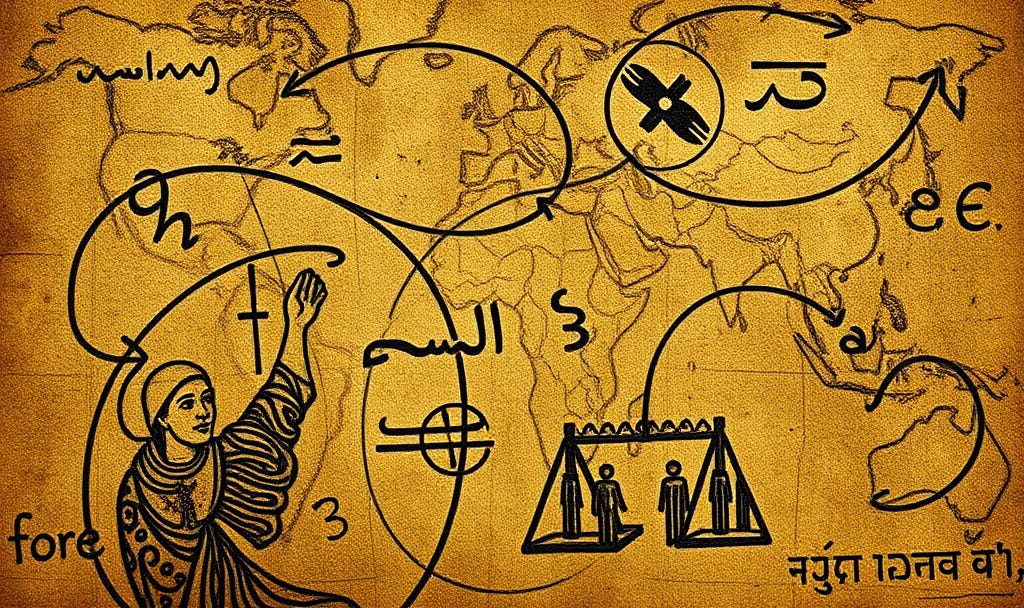
Picture this: You’re a medieval European merchant trying to multiply XLVII by CXXIII. Go ahead, I’ll wait. Still calculating? Your grandchildren called—they’d like you to finish before they die.
Meanwhile, some trader from Damascus just did the same calculation (47 × 123) in twelve seconds using these weird squiggly lines he learned from an Indian mathematician who learned it from someone who probably invented it while avoiding actual work. This, friends, is the story of how lazy thinking (finding the easiest way) became humanity’s greatest mathematical achievement.
The Three-Layer Reality Check
Layer 1: What’s the obvious answer? “Arabs gave us numbers 0-9, that’s why we call them Arabic numerals.”
Layer 2: What am I missing? Actually, Indians invented them. Muslims were just really good at marketing. And preservation. And improving things. And explaining them better. And forcing Europeans to pay attention by being absurdly rich from trade.
Layer 3: What question should I actually be asking? “How did an entire continent convince itself that MMXXIV was a reasonable way to write 2024?”
The Comedy of Errors (In Roman Numerals: The ???edy of Errors)
Here’s what nobody tells you about Roman numerals: They’re basically tally marks that went to private school. Someone looked at scratching lines in dirt and thought, “This needs more letters and unnecessary complexity.”
The Romans conquered most of the known world using a number system that couldn’t express zero. Think about that. They built aqueducts, ruled millions, created legal systems still used today—all while being mathematically incapable of saying “nothing.” Which explains a lot about their tax system.
Enter the Hindus, who around 600 CE had the revolutionary thought: “What if nothing... was something?” They created zero. Not the concept of nothing—philosophers had been annoying people with that for centuries—but nothing as an actual number you could use in calculations.
The Islamic Scholars: History’s Greatest Middlemen
Here’s where it gets interesting. Muslim mathematicians didn’t just translate Hindu numerals—they basically took a rough demo and produced the commercial release.
Al-Khwarizmi (whose name became “algorithm” because medieval Europeans couldn’t pronounce anything) wrote the user manual. He didn’t just explain HOW to use these numerals; he explained WHY you’d want to. His sales pitch was essentially: “Look, you can either spend three hours doing division with an abacus, or thirty seconds with these symbols. Your choice.”
The Muslims added:
Decimal points (because sometimes you need part of something)
Algebraic notation (because x is sexier than “the unknown quantity”)
Trigonometry that actually worked (sorry, Ptolemy)
The radical idea that math should be useful, not just philosophical
Europe’s Slow Learning Curve
When Fibonacci brought Arabic numerals to Europe in 1202, the reaction was basically: “We’ve been doing fine with Roman numerals for a thousand years, thank you very much.”
Italian city-states actually BANNED Arabic numerals in official documents because they were “too easy to forge.” Imagine being so committed to inefficiency that you make efficiency illegal. That’s like banning wheels because walking builds character.
The Church was suspicious because anything from the Islamic world obviously had to be satanic. Zero was particularly troubling—how could nothing exist? (Theologians would spend centuries on this. Seriously.)
The Punchline Nobody Saw Coming
Here’s the absurd part: The entire modern world—computers, space travel, your smartphone, cryptocurrency, that app that tells you when to water your plants—exists because some Indian mathematician got tired of counting on his fingers and some Muslim scholar thought, “This is cool, but it could be cooler.”
Every time you type a number, you’re using a Hindu invention, perfected by Muslim scholars, reluctantly adopted by Europeans who then claimed they invented mathematics.
The Romans had a thousand years to figure out multiplication. They built the Colosseum instead. The Indians invented zero while contemplating the void. Muslims turned it into actual science while Europe was still arguing about how many angels could dance on the head of a pin (the answer, by the way, requires decimal notation).
The Dimensional Thinking Bit
This whole story is actually about information compression. Roman numerals are one-dimensional—just addition and subtraction lined up. The position-based decimal system is multi-dimensional: each position is a different power of ten. It’s the difference between writing “one hundred and eleven” and “111”—same information, radically different efficiency.
It’s why binary works for computers (position-based, just base-2), why hexadecimal works for programming (base-16), and why the metric system makes Americans nervous (it’s too logical).
Did This Change Your Globe View?
The entire scientific revolution happened because we finally had a number system that didn’t require a PhD to do basic arithmetic. Calculus is impossible in Roman numerals. So is physics. So is engineering anything more complex than a straight line.
We literally went to the moon using symbols invented by people the average medieval European thought were heathens. The computer you’re reading this on uses binary—which is just the position-based system stripped down to its underwear.
So yes, ten squiggly lines changed everything. The Arabs didn’t invent them, but they did something more important: they recognized genius when they saw it, improved it, and then taught it to people who really, really didn’t want to learn.
The moral? Sometimes the most world-changing innovations aren’t the flashy ones. Sometimes it’s just finding a better way to count to ten. And sometimes, just sometimes, the middleman deserves the Nobel Prize.
P.S. The Mayans independently invented zero too, but their civilization collapsed before they could explain it to anyone. There’s probably a lesson there, but it requires calculus to understand.
🪶Peace, Love and Respect
Next time someone complains about “Arabic” numerals being taught in schools (yes, this actually happens), remind them that the alternative is doing their taxes in Roman numerals. Watch how fast they become multicultural.
What a great way to teach history! Bravo.
Or maths.
A straight line is a part of a circle with infinite radius.