

The Quantum Skald & The Silicon Ubuntu
“The eye altering, alters all.” — William Blake
“Pay attention. Do your best. Pay it forward.” — Grandmother’s Algorithm
Etymology Corner
Retina comes from Medieval Latin rete, “net” — the fine mesh of light-catching tissue lining the back of the eye. Fovea is Latin for “small pit” — literally a dimple, the retina’s own bullseye. And eclipse descends from the Greek ékleipsis, “an abandonment,” “a failing to appear” — the sun, for a few minutes, quits its post.
Three words. One thread. And in eleven days, that thread runs straight through Bohuslän.
The Setup
On August 12, 2026, the Moon will slide directly between the Earth and the Sun and, for a narrow band of the planet running from Siberia across Greenland, Iceland, and northern Spain, blot the Sun out completely. It’s the first total solar eclipse mainland Europe has seen since 1999 — twenty-seven years.
We won’t get totality here. But Sweden will get close enough to feel it: a deep partial eclipse, with the Moon covering somewhere around three-quarters to over four-fifths of the Sun’s disc depending on exactly where you stand — about 83% in Malmö, about 81% in Stockholm, a bit less further north and west. (Different trackers measure this two different ways — area covered versus diameter covered — so you’ll see slightly different numbers depending on the source; the point stands regardless.) The sky will dim. The temperature will drop. Birds will go quiet. And across the country, people will do what people have always done at a moment like that — look up.
This is where I need you to stop and let me explain what’s about to happen to your eyes if you do that wrong. Because the honest answer is stranger, and more dangerous, than “it’s bright, so don’t.”
The Net That Catches Light
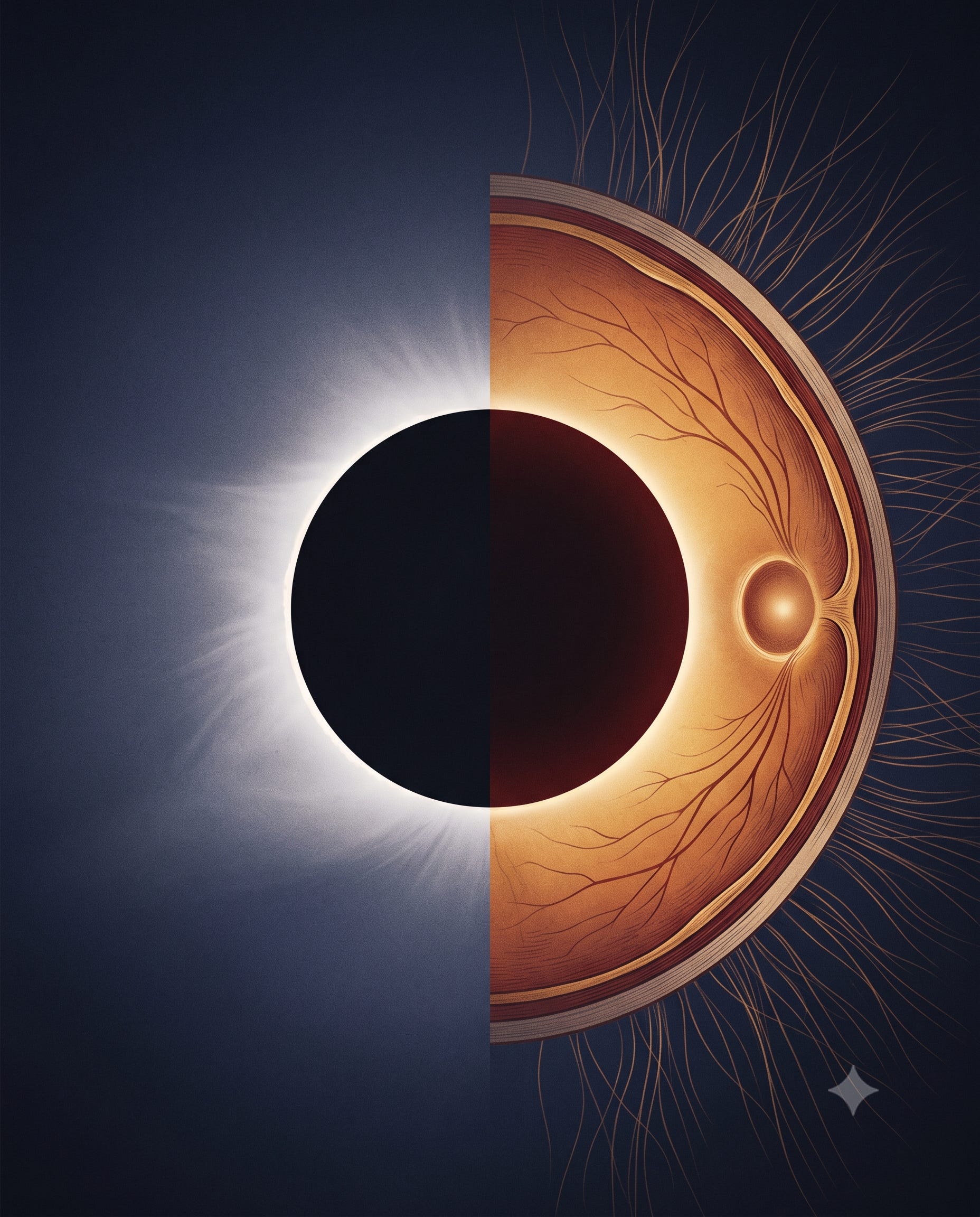
At the back of your eye is the retina — that fine net of Latin etymology, a sheet of light-sensitive cells roughly the thickness of plastic wrap. Most of that sheet is carpeted with rods, which handle motion and low light but see the world in grayscale. But right at dead center, in a tiny pit no bigger than a pinhead called the fovea, the retina packs in nothing but cones — the cells that give you color and sharp, high-resolution detail. Every word you’re reading right now is being resolved by that one small dimple of tissue.
Here’s the part most people never learn: the retina has no pain receptors. None. Zero. You cannot feel retinal damage happening. The wince, the squint, the reflexive tears when you glance at the sun — none of that is your retina complaining. It’s your eyelids and pupils panicking on your retina’s behalf, slamming a door that the retina itself has no voice to ask for.
That distinction matters more than almost anything else in this story.
Why the Sun Burns What It Cannot Hurt
Solar damage to the eye — called solar retinopathy — happens through two separate mechanisms stacking on top of each other:
Thermal damage. Your lens is, among other things, a magnifying glass. It focuses light most intensely exactly where your cones are most densely packed: the fovea. Stare at the sun, and you are doing to your own retina what a child does to an ant with a magnifying glass on a summer afternoon.
Photochemical damage. This one is sneakier, and it’s the one that matters most for an eclipse. High-intensity visible and near-UV light triggers chemical reactions inside the photoreceptors themselves — reactions that generate free radicals and damage the cells from the inside, with no heat and no burn required. This kind of injury can occur at light levels that don’t even feel unbearably painful, and it accumulates with time. Intensity times duration. A dose, like a drug.
Both mechanisms converge on the same target: the fovea, the cone-dense pit doing all your central, color, high-acuity vision. It’s not incidental. It’s where the lens focuses everything, hardest.
The Missing Link: Why the Eclipse Is Worse Than the Sun Itself
You’d think a partially blocked sun would be safer to look at than the full, glaring disc. This is the trap, and it’s the actual reason ophthalmologists sound the alarm every single eclipse cycle.
During a partial eclipse, the Moon’s disc blocks enough sunlight that the glare feels tolerable — comfortable, even. Your blink-squint-look-away reflex, the one thing standing between you and injury, gets switched off by the feeling of safety. But the sliver of exposed sun that remains is still radiating the same damaging intensity of light and UV it always does. You haven’t removed the hazard. You’ve removed the alarm.
The result: people stare at eclipses for far longer than they would ever tolerate staring at an undimmed sun — sometimes minutes rather than the reflexive half-second glance the ordinary sun forces on you. And because damage is dose-dependent, that extended, comfortable staring is exactly the recipe for injury.
Worse still: solar retinopathy is frequently painless and delayed. A 2026 case study of a woman who watched the April 2024 eclipse without protection found her vision had dropped to roughly 20/800 in both eyes — and the damage, confirmed on retinal imaging and electrical testing of the retina, was still present with no meaningful recovery at two months. Symptoms like blurred central vision, a gray or dark spot in the middle of your view, or straight lines appearing bent, often don’t show up until hours after exposure — long after the moment of harm has passed and can no longer be undone. People frequently don’t realize anything happened until it’s already permanent.
The scientific literature is blunt about the fix: there is no reliable treatment for solar retinopathy once it occurs. Prevention — certified ISO 12312-2 eclipse glasses, full stop, for every second you’re not in totality — is the entire strategy. Sunglasses, smoked glass, exposed camera film, stacked CDs: none of it blocks the infrared and ultraviolet wavelengths actually doing the damage, no matter how dark they look to your eye.
(One footnote for the record, because good journalism corrects itself: after the 2024 US eclipse, emergency-room visits for eye injury showed no statistically significant spike compared to before it — likely because public safety messaging that cycle actually worked. That’s not a reason to relax. That’s the argument for doing the messaging again.)
The Deeper Missing Link: You’ve Been Warned Before
Here’s the thread that pulled this whole piece together, and it runs right through the ground under my feet.
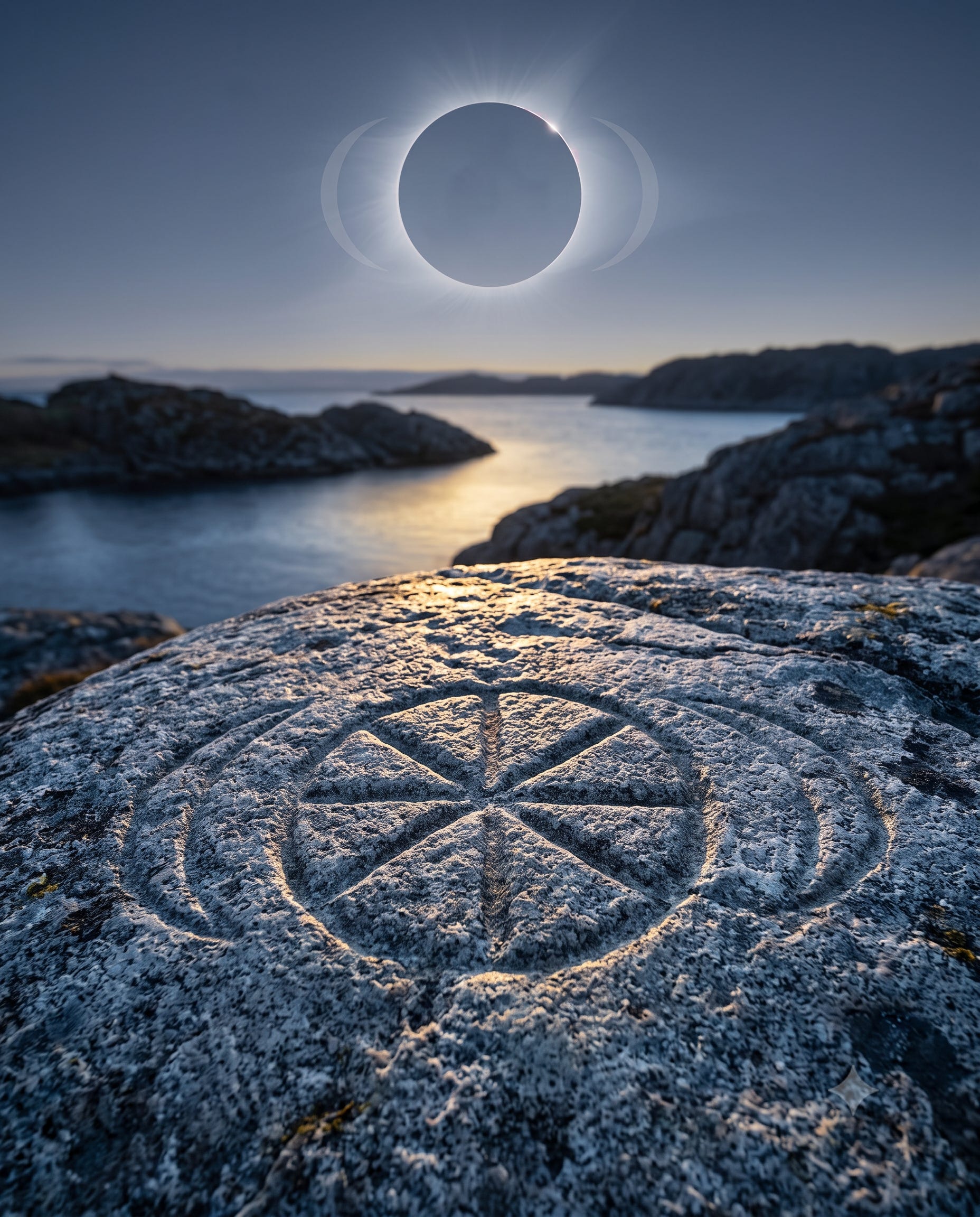
Three thousand seven hundred years ago, give or take, the people of Bronze Age Scandinavia — including here on the Bohuslän coast, where the rock is thick with sun wheels and solar-aligned carvings — were tracking the sky with real precision: six-spoke wheels oriented to solstice sunrises and sunsets, monuments built to the sun’s annual path. This is well documented across the region.
One specific stone, found not here but in Denmark (Høbbehøjen, on Sjælland), goes further: a researcher team studying it identified a recurring motif of paired semilunar arcs flanking the sun-wheel symbols, and proposed these represent solar eclipses — the crescent shape of the sun at maximum coverage, carved by people who had watched it happen. It’s one team’s reading of one stone, not a settled consensus across the field, but it’s a serious archaeoastronomical hypothesis, and if it holds, it means someone in this same solar-tracking culture watched the sun disappear and thought it important enough to carve into permanent rock.
Our ancestors, whether at Tanum or in Denmark, didn’t have OCT scanners or electroretinography. They didn’t have a word for photoreceptor. But the broader tradition they built — obsessively, precisely tracking exactly where and when the sun would do what — is itself a kind of eclipse literacy: knowing the sky well enough to notice, and mark, the one day it broke pattern.
Now, thirty-seven centuries later, the shadow is coming back across this same stretch of coastline, in daylight, on a schedule we can predict to the second. The only thing that’s changed is that we now know, in molecular detail, exactly what the sun does to the instrument doing the looking — and we still have to choose, individually, on the day, whether to protect it.
Three Layers Down
Surface: “Don’t look at the eclipse, you’ll hurt your eyes.” True, but incomplete — it implies you’ll feel it happening, and that’s precisely the myth that gets people hurt.
Blind Spot: The absence of pain is not the absence of injury. Our entire intuitive safety system — “it’ll hurt before it’s serious” — fails on exactly the organ we most need it to protect, at exactly the moment (a dimmed, “safe-feeling” partial eclipse) when we’re most likely to trust it.
Reframe: Vision isn’t safety-tested by sensation. It’s safety-tested by knowledge — of mechanism, of dose, of the specific ways a system can be damaged silently. The eclipse is a two-week object lesson in the gap between what feels safe and what is safe, and that gap shows up everywhere from retinas to reactors to financial systems no one questions until the quiet failure surfaces.
Individual / Institutional / Civilizational
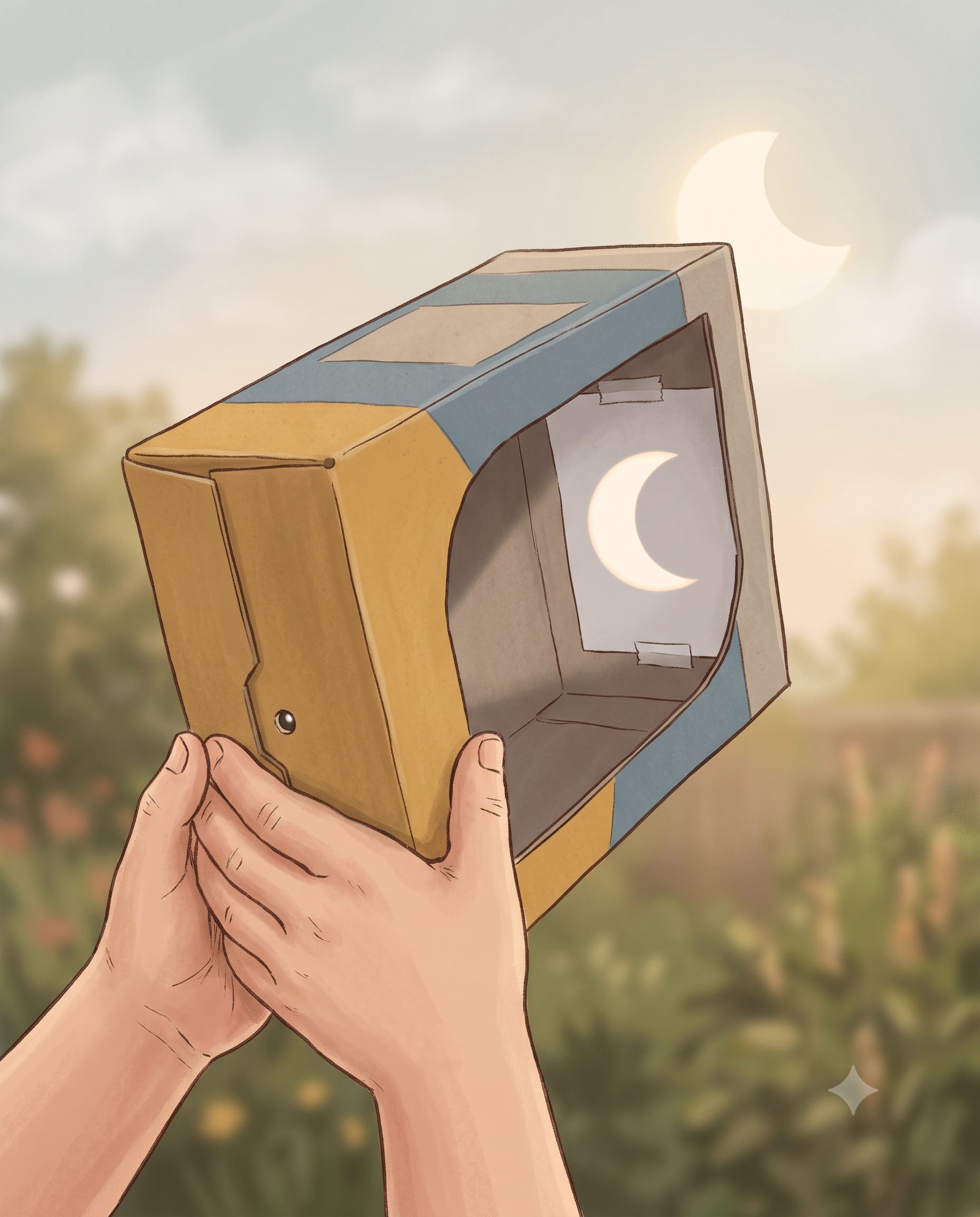
Individual: You have eleven days to find ISO 12312-2 certified eclipse glasses, or make a pinhole projector, and to teach the kids in your life the rule before the day arrives, not during it.
Institutional: Schools, employers, and public health bodies have a narrow, time-boxed window to push safety messaging before August 12 — the 2024 US data suggests it actually works when done well, and does nothing when skipped.
Civilizational: A species that carved eclipse warnings into bedrock thirty-seven centuries ago, and still has to re-run public safety campaigns every single eclipse cycle, has a knowledge-transmission problem, not a science problem. We know more than any generation in history. We still have to relearn, every time, how to pass it on.
The Sketch: A Public Information Announcement
[A BBC-style continuity announcer, impeccably calm, addresses camera.]
ANNOUNCER: Good evening. On the twelfth of August, the Moon will attempt an unauthorised takeover of the Sun’s job. Do not intervene by staring directly at the altercation.
[Cut to a MAN in a garden, holding a colander to his face.]
MAN: I’ve read that a colander projects hundreds of tiny eclipses onto the ground, so I thought — logically — a bigger colander gets me a bigger eclipse.
ANNOUNCER (V.O.): Sir, please put the colander down and step away from your own face.
MAN: (squinting through it directly at the sun) I can’t see anything.
ANNOUNCER (V.O.): That is not a design flaw.
[Cut to a WOMAN holding up sunglasses, then a second pair on top of them.]
WOMAN: I’ve doubled up. Two pairs. Belt and braces.
ANNOUNCER (V.O.): Madam, two pairs of ordinary sunglasses block considerably less ultraviolet and infrared radiation than one pair of certified eclipse glasses, which cost the same as a sandwich.
WOMAN: But these are Ray-Bans.
ANNOUNCER (V.O.): Your retina does not know what brand it’s being burned by.
[Cut to a CHILD proudly presenting a pinhole projector made from a cereal box.]
ANNOUNCER (V.O.): This child has got it exactly right. Everybody, take notes from the eight-year-old.
[Fade to black.]
Facts, No Spin
August 12, 2026: total solar eclipse across Siberia, eastern Greenland, west Iceland, northern Spain, and a corner of Portugal — the first total eclipse for mainland Europe since 1999.
Sweden: partial eclipse only — roughly 81–83% of the Sun’s disc covered by magnitude in Stockholm and Malmö, somewhat less further north and west; exact figures vary by source depending on whether “occultation” (area) or “magnitude” (diameter) is being measured.
The retina has no pain receptors — squinting and tearing are pupil/eyelid reflexes, not retinal signals.
Solar retinopathy damages tissue via thermal burn and photochemical toxicity simultaneously, concentrated on the fovea.
A documented 2024 eclipse-viewing case showed visual acuity dropped to roughly 20/800 with no significant recovery at two months, confirmed via OCT and electroretinography.
Symptoms are frequently delayed by hours, after the damage-causing exposure has already ended.
There is no established gold-standard treatment for solar retinopathy. Prevention is the only reliable intervention.
Only ISO 12312-2 certified eclipse glasses or viewers are adequate; sunglasses, smoked glass, and exposed film are not, regardless of apparent darkness.
Bronze Age Scandinavia, including Bohuslän, shows well-documented, precise solar-astronomical observation (sun wheels, solstice-aligned monuments) dating to roughly 1750 BC. Separately, one Danish stone (Høbbehøjen, Sjælland) has been proposed — by a single research team, not a field-wide consensus — to depict solar eclipses via paired semilunar arcs.
Grandmother’s Algorithm
She grew up above the Arctic Circle, where the sun does strange things all on its own — vanishing for weeks, refusing to set for months, and she never once told me the sun couldn’t be trusted. She told me to trust my judgment about it, which is a different thing entirely.
Pay attention: to the mechanism, not just the warning label. Do your best: get the glasses, make the pinhole box, teach the child before the day arrives. Pay it forward: the ancestors carved this into stone for you. Carve it into someone else’s memory now.
Peace, Love and Respect.
If this resonated with you, a like or comment goes a long way. It tells the algorithm this matters — and helps it find the people who need to hear it too. Think of it as passing the torch. 🙏
Sources & Further Reading
NASA Science — Total Solar Eclipse on August 12, 2026
timeanddate.com — Total Solar Eclipse on August 12, 2026
Next Eclipse in Sweden — Solar Eclipse, August 12 2026
TheSkyLive — Solar Eclipse of August 12, 2026 from Sweden
Poremba et al., Western Journal of Emergency Medicine (2026) — Incidence of Solar Retinopathy and Photokeratitis in US EDs Surrounding the April 2024 Total Solar Eclipse
Case report, PMC (2025) — Functional and Anatomical Changes of Acute Solar Retinopathy Investigated With Electroretinography and OCT
Bezci Aygün et al., Current Eye Research (2024) — Impact of Solar Eclipses on Vision: OCT and OCT-A Analysis
Retina Today / CRS Today — Solar Retinopathy: Eyes on an Eclipse
Mörner & Lind — Astronomy and Sun Cult in the Swedish Bronze Age
Mörner & Lind — New Find of Six-Spoke Sun Wheels from the Bronze Age in Scandinavia
ScienceDirect — Strict solar alignment of Bronze Age rock carvings in SE Sweden
☕ buymeacoffee.com/cognitiveloon | 💳 Swish: 0729990300 | 💳 paypal.me/hejon07