



Foreword: Reading the Unreachable
You are about to read words describing an experience that is, biomechanically, more impossible for you than the cockpit of a Gripen. At least the Gripen pilot is human. What you’re about to inhabit isn’t.
There are roughly 5,000 species of dragonfly on Earth, and not one of them has ever filed a flight report, because not one of them has a cortex capable of writing one. What they do have is a kill rate that would make an F-16 squadron weep into its debrief coffee: 95 to 97 percent. Compare that to a cheetah (roughly 50%), a lion (25-30%), a great white shark (50%), or — since we’re already in the neighborhood — an air-to-air missile in real combat conditions, which has historically been far messier than the brochures suggest. The dragonfly is, pound for pound, neuron for neuron, the most successful aerial predator that has ever existed. It has been running this exact hunting program, more or less unmodified, for 300 million years. It was doing this before the dinosaurs. It will probably still be doing this after us.
So let’s build the same kind of bridge we built into the Gripen’s cockpit. Except this time the “avionics” are a brain with roughly sixteen specific neurons doing a job that takes a Raven ES-05 radar plus a flight computer plus a trained human plus a $30,000 missile to replicate, badly, in our world.
Strap in. There is no strap. You don’t have hands.
0317 Hours. A Reed Stem, Six Centimeters Above a Pond Surface. Bohuslän, Summer.
The Sensor Suite: 30,000 Pixels and a 360° Dome
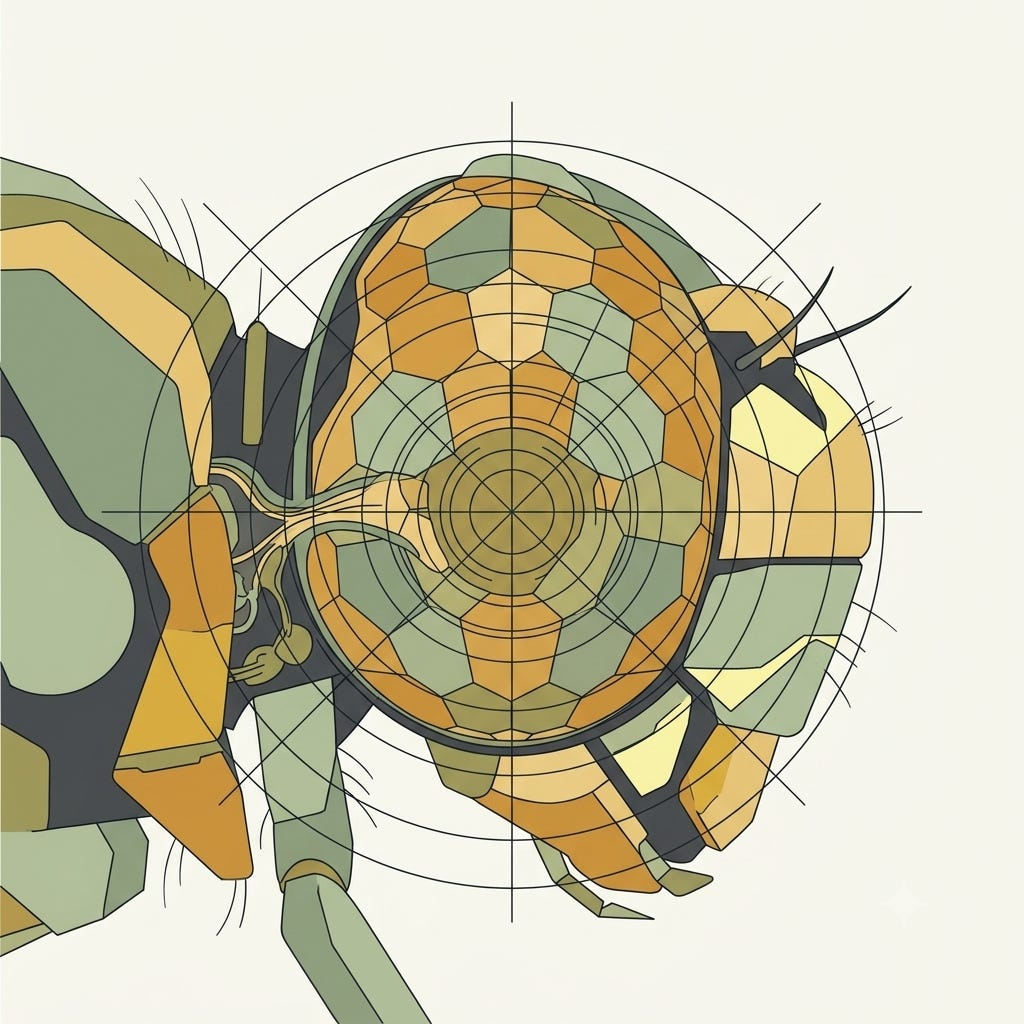
Forget the Gripen’s 48-centimeter Wide Area Display. Your “windscreen” is your head — two enormous compound eyes wrapping almost entirely around it, built from roughly 30,000 ommatidia each, tiny lens-tipped tubes pointed in slightly different directions, tiling together into something closer to a dome-mounted camera array than a pair of eyeballs. Dragonflies can see in all directions at once — one of the natural advantages of a compound eye that wraps around the head, giving a spherical field of vision so that prey is still being watched even after it has flown past.
Here’s the catch, and it’s a big one: resolution is terrible by human standards. Even with 30,000 ommatidia, you’re only getting about 30,000 bits of visual information to your brain — compared to the millions of photoreceptors feeding a single human eye. If the Gripen’s HUD was crisp green vector graphics, this is more like piloting through a coarse, low-resolution mosaic — except one specific patch of that mosaic, a foveal band near the top-front of the eye, is sharper than the rest, tuned specifically for sky-against-sky target detection.
And the system isn’t even uniform. The dorsal (upward-facing) ommatidia and the ventral (downward-facing) ones run on different hardware entirely. Day-flying dragonflies carry four or five different opsins, letting them see colors beyond human range, including ultraviolet — with the upward-facing eye carrying only blue and UV receptors, while the downward-facing eye carries receptors for longer wavelengths like green and orange. Translation: you’re not flying with one camera. You’re flying with two stacked sensor packages, optimized for two different jobs — sky-scanning above, terrain-and-foliage-reading below — fused into one feed your brain never has to consciously reconcile. The Gripen’s engineers would kill for that kind of seamless sensor fusion. Yours came standard, no contract required.
Target Acquisition: One Degree of Sky, Two or Three Pixels of Mosquito
A mosquito at hunting range typically occupies less than one degree of your visual field, stimulating only two or three ommatidia total. That’s the entire signature. Two or three pixels, against a sky-sized mosaic of thirty thousand. And yet you find it, every time, almost instantly, because you’re not running a general-purpose image classifier — you’re running dedicated, hard-wired “bug detector” circuitry. Neuroscientists call them small target motion detector neurons, and they’re tuned to ignore everything else: swarms of conspecifics, wind-shaken reeds, sun-glitter on water, none of it registers. The system filters for exactly one signature — small, dark, moving against sky — and gives a robust response even when the background is genuinely cluttered.
The moment that signature appears, your head — not your whole body, just your head, swiveling on a neck joint insects technically aren’t supposed to have much of — snaps onto it. A rapid 50-millisecond saccade fixes the target onto your fovea, the high-resolution patch of the eye, and smooth tracking holds it there for another 250 milliseconds while your “mission computer” runs the numbers.
You have, in total, well under a second to decide: pursue or ignore. Each interception only lasts 300 to 600 milliseconds, start to finish. The Gripen pilot had ten seconds to merge with an enemy fighter and called that “two seconds that feel like ten.” You have half a second, total, beginning to end. There is no time for doubt. There barely is time for a thought, and you don’t have the architecture for thoughts anyway.
Weapons-Grade Math, Running on Sixteen Neurons
This is the part that should make your skin crawl, if you had skin instead of chitin.
When the Gripen’s pilot fires a Meteor missile, an entire weapons system — active radar seeker, ramjet motor, proportional-navigation guidance software written by engineers with PhDs — takes over the intercept math. You don’t have a weapons system. You don’t have a missile. You are the missile, and the guidance computer is a cluster of roughly sixteen cells.
They’re called target-selective descending neurons, TSDNs, and here’s exactly what they do: this small population codes a population vector that reflects the direction of the target with high accuracy and reliability across the full 360 degrees, with their spatial receptive fields and response latency matching the patch of retina where prey gets focused and the actual reaction time observed during real hunting flights. Sixteen cells, full spherical coverage, real-time. The Gripen’s AESA radar array needs hundreds of transmit-receive modules and a cooling system to do something like this. You need sixteen neurons and zero cooling, because you’re cold-blooded and the question doesn’t apply.
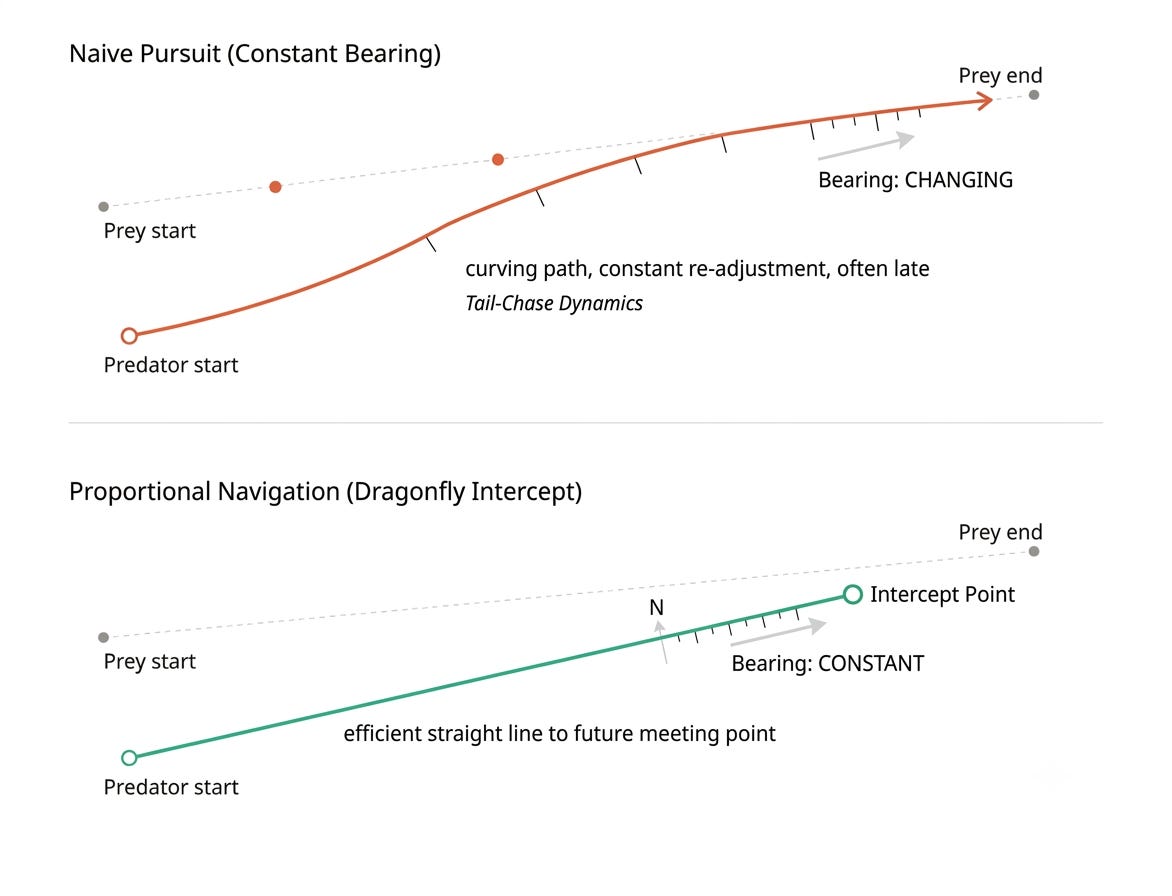
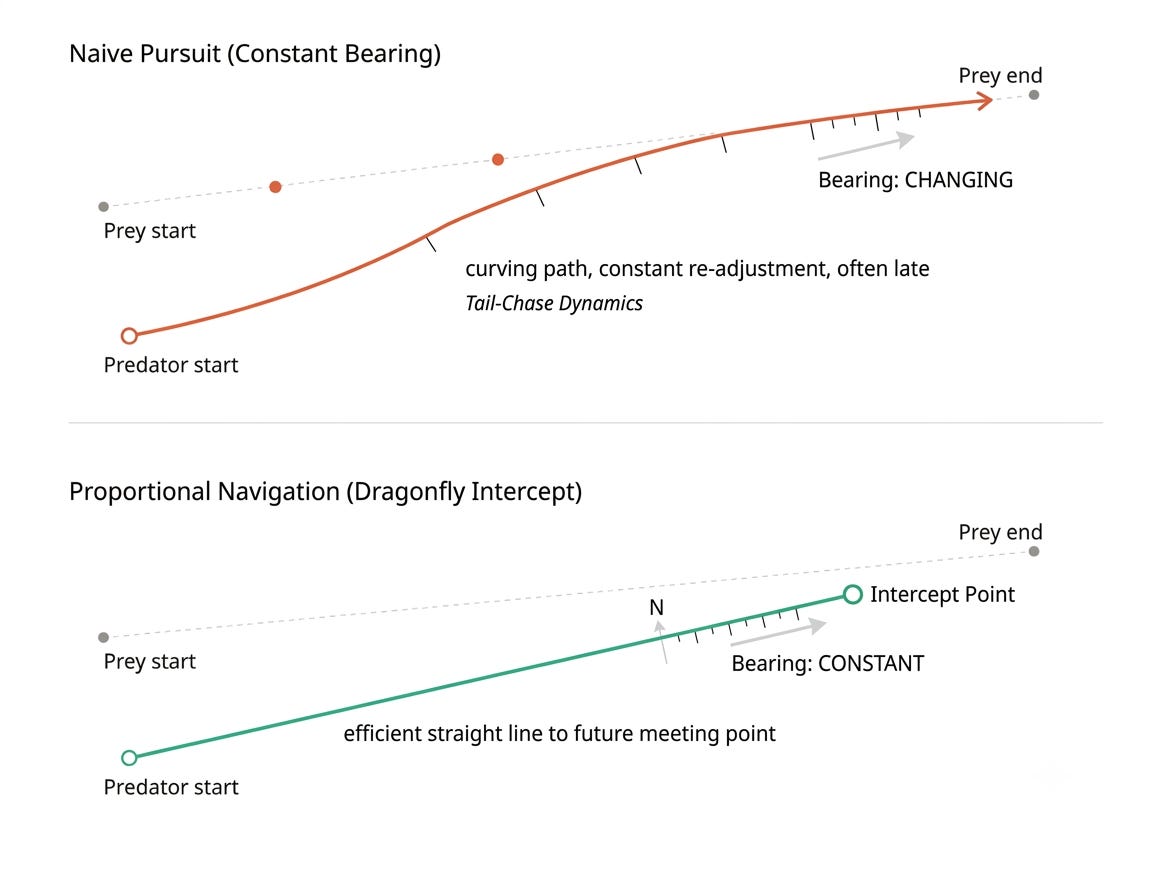
And the guidance law they’re running isn’t “point yourself at where the target is.” That’s amateur hour — a heat-seeking missile from the 1960s. You are running something closer to proportional navigation, the same guidance principle used in modern radar-guided missiles: calculating changes in pitch and yaw in real time to hold the prey’s image at a fixed location on the retina, using self-knowledge of your own maneuvers as a correction signal, so the resulting flight path is a genuine proportional-navigation interception trajectory rather than a simple chase.
In plain words: you don’t chase the mosquito. You chase the point in space where it’s about to be, continuously recalculated, dozens of times a second, correcting not just for the target’s motion but for your own motion too — because if you don’t subtract your own movement out of the equation, you can’t tell prey-motion from self-motion, and the whole intercept collapses into noise. You are solving a moving differential equation, live, mid-air, with a brain smaller than a grain of rice.
The Tell: You Are Not Reacting. You Are Predicting.
Here’s the detail that should genuinely unsettle anyone who assumes insects are simple reflex machines. Researchers tracked real hunts and compared your steering corrections against the prey’s actual evasive maneuvers, expecting a tight coupling — prey jukes, predator reacts. Instead: 75% of your steering events happen with no corresponding move by the prey at all, and 70% of the prey’s own maneuvers get no immediate corrective response from you whatsoever.
You are not reacting to the mosquito. You are flying to where your internal model says the mosquito is going to be, and mostly ignoring its actual panicked wobbling, because your model is already better than its evasion. That requires an internal model — a live representation of where the target is heading — plus a separate model of your own motion, so the two can be told apart. That’s not instinct in the cartoon sense. That’s a predictive simulation, running continuously, in real time, in an animal with on the order of a million neurons total (a human cortex runs on the order of 16 billion). The dragonfly is doing more computation per neuron than almost anything else alive.
The Approach: Banking Into the Kill Box
Final phase. Target locked, TSDNs running their population vector, proportional nav engaged. Now your body does something specific and deliberate: at takeoff you immediately align with the anticipated prey trajectory, position yourself just below the target, hold your body tilted at a fixed 30-degree angle, and keep the prey centered on the foveal band of your eye — which reduces the whole three-dimensional intercept problem down to a single variable: closing the vertical gap using raw speed.
Translate that into Gripen-speak and it’s eerily familiar: you’ve converted a 3D fire-control problem into a closure-rate problem by choosing your geometry before the merge, exactly the way a fighter pilot picks an intercept angle that turns “complicated 3D math” into “now I just need more knots than him.” You did this 300 million years before anyone built a flight computer to do it on purpose.
The diagram below shows why this matters. A naive predator that simply steers toward the prey’s current position every instant ends up flying a curved tail-chase — always a little behind, always correcting, bleeding time and energy on every correction. The dragonfly instead picks a fixed bearing toward the future meeting point and holds it, which collapses the same problem into a straight line. Same start, same finish, completely different flight path — and only one of them gets there reliably.
Final centimeters: legs swing forward into a basket — not a strike, a trap. No missile detonation, no gun pass. Just geometry, closed perfectly, nineteen times out of twenty.
The Number That Should Bother the Pentagon More Than the Gripen Does
The Gripen essay ended on the idea that “smart beats expensive.” The dragonfly is the same argument taken to its logical extreme, and it’s not subtle about it: Sandia National Laboratories has studied dragonfly interception specifically because of its potential for steering missiles to intercept incoming ballistic-missile threats — military engineers, reverse-engineering a bug’s targeting circuit because it might out-think their own guidance software.
Sixteen neurons. Thirty thousand low-resolution pixels. A brain you could lose in a teaspoon. A 95-97% kill rate sustained continuously for the length of geological epochs, no software updates required, no $44,000-per-flight-hour maintenance contract, no ground crew.
You climb down off the reed. There’s no ladder. There’s no “down off” — you just stop hovering, settle, fold your wings flat over your back like a closing canopy, and wait for the next one-degree flicker of wrongness against the sky.
You’ve done this before. Three hundred million years of “before.”
Based on published neuroscience research on dragonfly target-selective descending neurons (TSDNs), small target motion detector (STMD) neurons, and field-tracked predatory flight kinematics. Comparative kill-rate figures for other apex predators are drawn from published ecological literature.
If this resonated with you, a like or comment goes a long way. It tells the algorithm this matters — and helps it find the people who need to hear it too. Think of it as passing the torch. 🙏
Loved this. I love the dragon flies here. Didn’t realize they eat mosquitoes. Now I love them more! 🤣
Fascinating!