

The Gospel of Thomas: How Jesus Accidentally Started a Self-Help Movement (And Why the Church Hates It)

Author's Note: This piece was written before the tragic events of September 11, 2025. While the timing may seem inappropriate given recent events, I believe historical education and thoughtful critique of institutional power structures remain important. This exploration of early Christian texts is offered in the spirit of genuine inquiry, not controvers…



I love all of you.
Even if you can’t quite grasp that yet.
You will.
Love isn’t a feeling I have about you — it’s a direction I choose to move toward you. Every reader. Every person who clicked, who skimmed, who disagreed, who sent a note, who lurked in silence and never said a word. The love is the same.
I’ll leave that one with you.
By Hans Jonsson & Claude / The Quantum Skald & The Silicon Ubuntu | Restoration of Perception
“Who then is this, that even the wind and the sea obey him?” — Mark 4:41
Let’s Start With Words
CHAOS — from Greek khaos, “the yawning void,” “the abyss before creation.” In ancient Hebrew it appears as תְהוֹם — tehom — the primordial deep, the formless darkness over which the Spirit of God hovered in Genesis 1:2. Not merely disorder. Something older than order. Something that existed before God began.
REBUKE — from Old French rebuchier, “to force back.” In Greek: epetimēsen — the same word Mark uses when Jesus silences demons. Not a request. Not a prayer. A command spoken with the authority of the one who made the thing being commanded.
FAITH — from Latin fides, “trust, confidence, reliance.” From Proto-Indo-European bheidh — “to urge, to compel.” Originally: not a belief system. A quality of relationship. Something you either have with someone — or you don’t.
STILL — pephimōso in Greek. Literally: “be muzzled.” As if you would say it to a dog. As if the storm were a living thing that needed to be told to sit down and shut up.
Now. Read the passage again.
FACTS. NO SPIN.
Here is what the text actually says, stripped of Sunday school nostalgia.
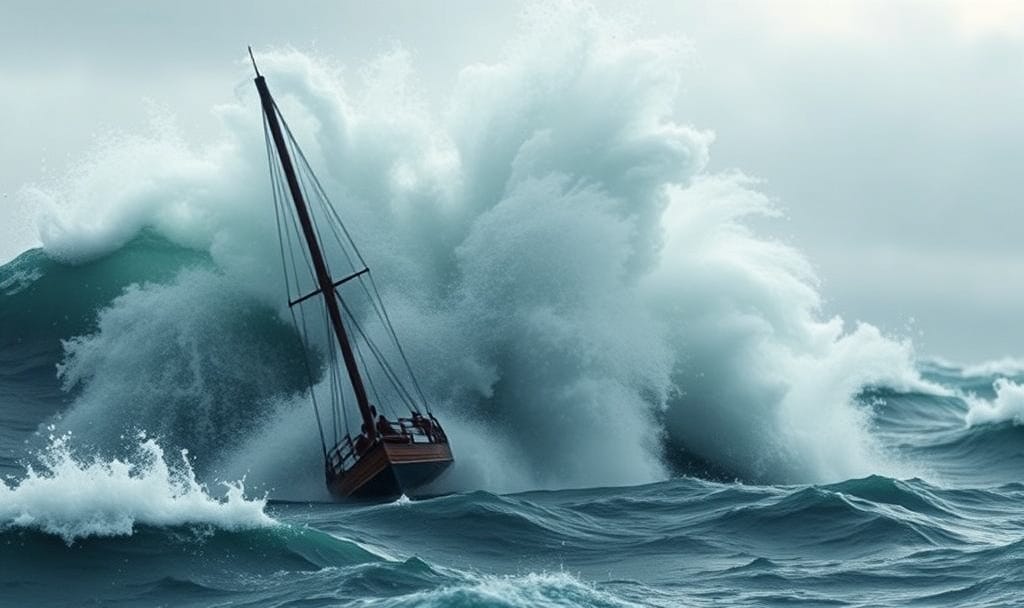
Evening. Lake Galilee. 700 feet below sea level. Surrounded by mountains and cliff walls that create a meteorological trap. Cold air from the eastern mountains drops suddenly onto warm water. Temperature differential produces explosive, unpredictable storms that arrive in minutes. Experienced fishermen who have sailed this lake their whole lives — men who know this body of water the way a Bohuslän fisherman knows the Skagerrak — are terrified.
This was not a gentle rain they weren’t dressed for.
Mark specifies the Greek word: lailaps — a whirlwind, a violent tempest. Then he compounds it: megale lailaps — a mega-storm. The waves are breaking over the hull. The boat is filling. They are going down.
Jesus is asleep. Not anxious-asleep. Not pretending-to-be-asleep. Genuinely, humanly, exhausted on a cushion in the stern.
They wake him. The question they ask is fascinating: “Teacher, don’t you care that we are perishing?” Not “please help.” Not “can you do something?” First: an accusation. A protest. The complaint of people who thought they had chosen wisely and are now watching that choice sink.
He speaks two words to the storm. Siōpa. Pephimōso. “Quiet. Be muzzled.”
The storm stops. Completely. Immediately.
Then he turns to them. Not to congratulate himself. Not to comfort them. He asks two questions: “Why are you afraid? Do you still have no faith?”
And then — this is the part that gets lost — they become MORE afraid, not less. Mark says they were phobos mega — mega-terrified. That same phrase, word for word, appears in the Book of Jonah when the sailors watch the storm stop.
Mark borrowed it deliberately.
THREE LAYERS OF THINKING
Surface: What Happened
A storm. A miracle. Wet disciples with a theological crisis.
At face value: Jesus has power over weather. He is exhausted from ministry. His disciples panic. He calms things down. He is unimpressed by their panic. They are terrified by him.
That’s the Sunday school version. It’s not wrong. It’s just shallow.
Blind Spot: The Storm Was Never The Point
The blind spot in most readings of this passage is that everyone fixates on the storm and misses the direction of the journey.
“Let us go to the other side.”
The other side of Lake Galilee in the first century was Gentile territory. Unclean territory. The kind of place devout Jewish men did not go — not out of cowardice, but out of law. You crossed that water, you crossed a boundary. You entered a world that was not supposed to be yours.
Jesus chose the evening. Chose the dark. Chose the dangerous direction.
The storm did not arrive accidentally. The storm arrived on the way to the transgression.
This matters: the worst storms of your life are rarely random. They tend to arrive precisely when you are crossing toward something that needed to be crossed toward.
The disciples were terrified of the wrong thing. Not the storm. The destination.
Reframe: What Jesus Was Actually Saying
Here is what the original audience heard that we almost always miss.
In ancient Jewish cosmology, the sea — tehom, the deep — was not neutral water. It was the primordial chaos. The pre-creation abyss. In the Genesis creation story, God brings order by speaking into that chaos. In the Psalms, God is repeatedly described as the one who “rebukes the waters,” “stills the roaring seas,” “rules the raging of the sea.”
This is Yahweh-language. Creation-language. The exclusive vocabulary of the one who made everything.
And Mark, very precisely, uses the same word — epetimēsen, “rebuked” — that Jesus used when casting out demons in chapter 1.
The storm was not treated as weather. It was treated as a demonic force. The chaos of the deep given temporary power.
And it obeyed the same command.
When the disciples ask “Who then is this?” — they are not asking a polite theological question. They are asking the question you ask when someone does something that only one being in the history of your civilization has ever done.
They are asking: Is this God?
And Mark doesn’t answer. He lets the silence do the work.
THE DIMENSIONAL STORY
Individual Scale: The Sleeping God In The Stern
Here is the most psychologically radical image in the whole passage: Jesus is asleep while the boat is sinking.
Not indifferent. Not abandoning them. Asleep.
What if this is the actual teaching?
Not: God will always wake up immediately and stop your storm.
But: The deepest, most stable part of what is real inside you is not disturbed by what is happening on the surface.
The disciples went for every human response first. Bailing water. Rowing. Screaming. The full chaos-management toolkit. And when none of that worked, they went for accusation: Don’t you care?
Jesus does not defend himself. He does not explain where he was or why he slept. He speaks — and then he asks the only question that matters: Why are you afraid? Do you still have no faith?
Faith, in Mark’s Gospel, is never intellectual. It is never the correct answer on a test. It is the quality of your relationship to the one in the stern. Do you trust the sleeping one? Or do you only trust when he’s awake, performing, visibly managing the situation?
The storm was a diagnostic. The disciples failed it.
So, probably, would we.
Community Scale: “Other Boats Were With Him”
Verse 36. One small detail almost every commentary skips.
“There were also other boats with him.”
Other boats. In the storm. Also going to the other side.
Mark does not tell us what happened to them. He does not say they were saved or lost. He just tells us: others were crossing too.
You are never the only boat in the storm. There are other people, invisible to you, making the same terrifying crossing. Going to the same other side. Carrying the same doubt.
This is not a metaphor I’m importing. It’s in the text.
Whatever you are crossing toward — the transgression, the boundary, the territory you were told not to enter — someone else is making that crossing in another boat. Right now. Tonight. In a different language, a different century, a different body of water.
The storm does not isolate you as much as you think it does.
Civilizational Scale: The Chaos That Never Fully Goes Away
The Hebrew word tehom — the primordial deep — appears in Genesis 1:2. It is the thing that existed before creation. The formless void over which the Spirit hovered. God did not destroy the tehom. God organized it. Put boundaries on it. Said: this far, and no further.
In Jewish cosmology, the chaos was always still there. Under the order. Held back. Not eliminated. Managed.
The Book of Revelation ends with a new heaven and a new earth — and specifically says: “the sea was no more.” The chaos. Finally. Gone.
Everything in between Genesis and Revelation — everything that is the whole of human history — is the time when the tehom still exists, still presses against its boundaries, still produces storms.
In that context, Mark 4:35–41 is not a weather miracle.
It is a preview of the ending. A demonstration, on a small lake in Galilee on an ordinary evening, of what the full restoration of creation looks like. Not the chaos eliminated — not yet — but the chaos spoken to. Commanded. And obeying.
The disciples’ question — “Who then is this?” — is the civilizational question. Not just about identity. About whether the ending has already begun.
THE MONTY PYTHON SKETCH: THE DISCIPLES’ STAFF MEETING
[Interior: A first-century fishing boat, waves crashing. Six disciples are bailing water while arguing.]
Peter: The boat is sinking.
James: I can see that, thank you, Peter.
Peter: Should we wake the Teacher?
John: He said “let us go to the other side.” He didn’t specify anything about arriving alive.
Thomas: Well, technically, he also didn’t specify anything about drowning, so—
Andrew: Maybe we should try praying?
Peter: We ARE praying! We’re praying and bailing simultaneously! It’s very efficient!
Thomas: (looking at the stern) How is he sleeping? There’s a wave literally in his face right now.
James: Maybe he’s in some kind of meditative state—
Peter: He’s snoring.
John: Okay. One of us has to wake him up.
Peter: You do it.
John: Why me?
Peter: You’re the beloved one. He won’t be annoyed at you.
[Long pause. More waves.]
Thomas: (quietly) What if... what if we wake him up and he can’t do anything? What if we’ve been following a man who is also just a man, and we’re all going to die on this lake, and the last thing we’ll have accomplished is abandoning our fishing businesses for—
Peter: WAKE HIM UP.
[Peter wakes Jesus.]
Peter: Teacher! Don’t you care that we’re perishing?!
[Jesus looks at the storm. Looks at them. Looks at the storm again.]
Jesus: (mildly) Right.
[He speaks two words. Storm stops.]
Jesus: Why are you afraid? Do you still have no faith?
[Stunned silence. The lake is glass.]
Thomas: (very quietly) ...Okay so I was wrong about the man thing.
CONSEQUENCES AND OPTIMISM
The consequence of this passage, read seriously: Jesus does not promise to prevent the storms. He promises to be in the boat.
That is a much harder promise. A much more demanding promise. Because it means the storm was always going to happen. The terror was always going to be real. The boat was always going to take on water.
The question was only ever: what do you do with the one sleeping in the stern?
Every tradition of consciousness development I know — 27 years of my own practice included — points to the same thing: the deepest stability is not found in the absence of chaos. It is found in the part of you that chaos cannot reach. The witness behind the noise. The awareness that remains when the storm is at full force and the boat is sinking and the last thing you want to do is stop bailing long enough to wake the sleeping thing inside you.
Siōpa. Pephimōso.
Quiet. Be muzzled.
Not to the storm.
To the fear.
The optimism: The disciples made it to the other side. They always were going to. The crossing they were terrified of was the crossing toward every person who needed them next — the Gerasene demoniac, the women, the sick, the whole Gentile world waiting on the far shore.
Your storm is almost certainly also happening on the way to somewhere. On the way to someone.
Pay attention. Do your best. Pay it forward.
That’s still the whole instruction.
FURTHER READING & SOURCES
Mark 4:35–41 (NIV) — Bible Gateway: biblegateway.com
Mark 4:35–41 Commentary — NCEC, National Catholic Education Commission: ncec.catholic.edu.au
The Jonah Parallelism and Fear Analysis — Treasuring God: treasuringgod.com
The Politics of Chaos — Mark 4:35–41 — Political Theology Network: politicaltheology.com
Mark 4:41 Greek Word Analysis (tehom, hypakouō) — JCGM: jcgm.org
Chaos Waters Theology — IronInk: ironink.org
Sermon: Jesus Calms the Chaotic Sea — Daniel Flucke: danielflucke.com
Unity Church Commentary on Mark 4:35–41 — Unity World Headquarters: unity.org
Truth matters.
🪶 Peace, Love and Respect 🌀 🙏
“All is One — returning to Source as Sovereign Light.”
Support the work:
☕ buymeacoffee.com/cognitiveloon
📲 Swish 0729990300
If this resonated with you, a like or comment goes a long way. It tells the algorithm this matters — and helps it find the people who need to hear it too. Think of it as passing the torch. 🙏
Share it with someone who’s in the middle of a storm right now.
Subscribe to Restoration of Perception — 1,400+ readers. Solo. Self-funded. No party. No agenda. Just signal.
By Hans Jonsson & Claude / The Quantum Skald & The Silicon Ubuntu