

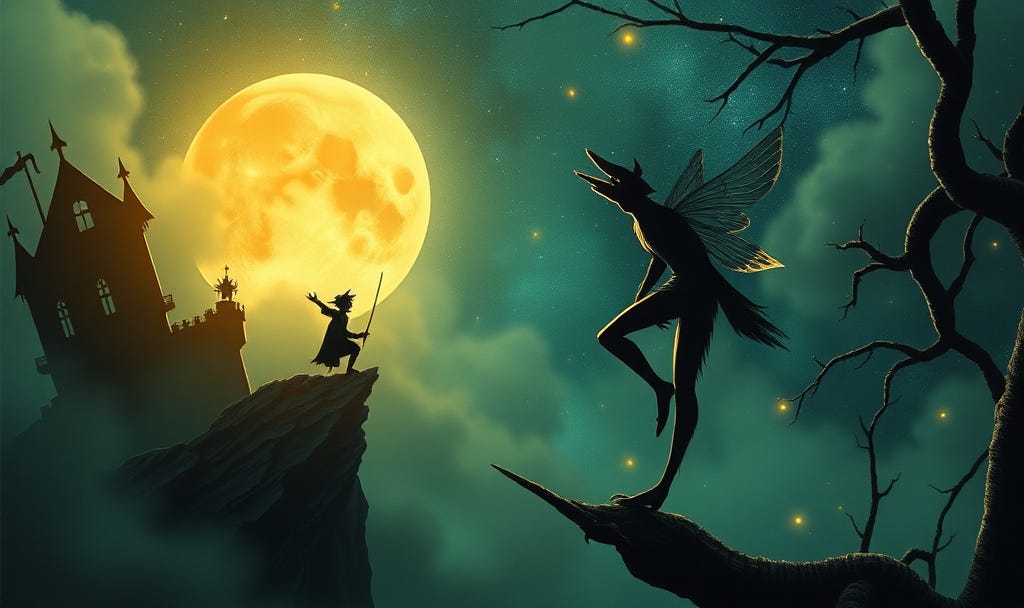
By The Quantum Skald & The Silicon Ubuntu | Restoration of Perception
You think you know the story.
A boy who can fly. A fairy named Tinkerbell. Pirates, mermaids, crocodiles, and an island where nobody ever has to grow up.
But what if Peter Pan was haunted from the very beginning?
Not as a metaphor. Not as a literary theory. But built — deliberately or unconsciously — from one of the oldest mythic structures in human memory: the guide who walks children to the edge of death.
Once you see it, you cannot unsee it.
Surface: The Story We All Know
One night in a London nursery, three children lie sleeping. Wendy, John, and Michael Darling. A boy flies in through the window. He has no mother, no house, no school books, no proper sense of time. Wild, bright, careless, magical. His name is Peter Pan.
He has come looking for something. His shadow.
Nana the dog snapped it off when Peter was escaping. Mrs. Darling found it and folded it in a drawer. So Peter returns — only to discover his shadow won’t cooperate. It has to be caught and sewn back on. Wendy wakes, finds him sobbing on the floor, and sews the shadow to his foot.
Then Peter tells her about Neverland.
Second star to the right and straight on till morning.
From there: lost boys who live underground, mermaids beautiful and cruel, Captain Hook with his one great fear — a crocodile that swallowed a clock and ticks toward him through time. Adventure, danger, play, makebelieve.
And then Wendy chooses to go home. The children grow up. Peter stays.
The window closes. The stars remain. And somewhere in Neverland, Peter Pan is exactly as he was.
Laughing. Forgetting. Forever young.
Or so the story goes.
Blind Spot: The Story Barrie Actually Wrote
Here is where the nursery glitter starts to peel.
Most of us know Peter from the Disney film or the 1911 novel Peter and Wendy. But Peter first appeared in 1902, hidden inside an adult novel called The Little White Bird — and this earlier Peter is deeply strange.
He is a seven-day-old baby who escapes from his home and flies to Kensington Gardens. There, described as “betwixt and between a boy and a bird,” he enters a world that is whimsical on the surface and unsettling one layer below.
In Kensington Gardens, dead children return as house swallows. Lost children who are not claimed after the gates are locked may perish in the cold. And Peter himself sometimes digs tiny graves for the ones he could not save.
From the very beginning, before the pirates, before Tinkerbell, before Neverland — Peter Pan’s world sits at the intersection of childhood, flight, death, and disappearance.
And to understand why, you have to leave the story and enter JM Barrie’s own grief.
The Real Boy Who Never Grew Up
In the winter of 1866, James Barrie’s older brother David went skating. He was two days away from his fourteenth birthday. He collided with another skater, fell, fractured his skull, and died.
David Barrie became, in his mother Margaret’s mind, the boy who would always be a boy. He would never age. Never grow into a man. Fixed forever at thirteen.
The boy who never grew up existed in Barrie’s family long before Peter Pan existed on the page.
What followed is almost unbearable to read. Barrie was six years old. He tried to fill the void — dressing in his dead brother’s clothes, imitating his voice and manner, trying to become David for his grieving mother. He later wrote about coming into her room and her asking, “Is that you?” — thinking it was David speaking from somewhere. And Barrie answering:
“No, it’s no’ him, it’s just me.”
That line contains an entire childhood of invisible grief.
Barrie grew up in the shadow of a perfect frozen brother. And years later, he gave the world a child who never ages — who kills people and forgets them, who forgets adventures almost as soon as they happen, who rules over lost children with an innocent heartlessness that never develops into wisdom or remorse.
Peter Pan is not only a fantasy of eternal childhood.
He is the impossible wish buried inside grief — that the lost child might still be somewhere. Still laughing, still flying, still just beyond the window.
Reframe: Peter Pan and the Ancient Role of the Soul Guide
Here is the line most people have never noticed.
Early in Peter and Wendy, before Wendy has even met Peter, her mother Mrs. Darling thinks back to her own childhood and remembers hearing stories about him:
“When children died, he went part of the way with them, so that they should not be frightened.”
Read that again slowly.
Peter Pan — the boy who never grows up — is also, in Mrs. Darling’s memory, a guide for dead children. A companion who walks with them toward the threshold so they will not be afraid.
In mythology, this role has a name.
Psychopomp. From the Greek psuchopompos — literally, “guide of souls.”
The ancient Greeks had Hermes, who escorted souls toward the underworld. Ancient Egypt had Anubis, who guided the dead toward the weighing of the heart. Norse mythology had the Valkyries, who carried chosen warriors to Valhalla. Across nearly every human culture, some figure — angel, animal, spirit, ancestor, fairy — appears at the moment of death to walk with the soul to wherever it must go.
Peter Pan fits this pattern with unnerving precision.
He is the visitor in the night. The one who knows the road between worlds. The child-shaped figure who comes through the window and takes children somewhere they have never been.
Once you see that, Neverland changes shape.
It is not simply an island. It becomes another world — cut off from ordinary time, reached by impossible travel, populated by children who seem to have been mislaid by ordinary life. A place where memory frays, where violence becomes a game, where consequences dissolve, where death is present but strangely weightless.
Barrie tells us the lost boys are “children who fall out of their pram when their nurse is looking the other way. If they are not claimed in seven days, they are sent away to Neverland.” He writes it lightly. The implication does not need to be forced.
These are children the world could not hold.
The Shadow That Is a Soul
And then there is the shadow.
In the story, Peter’s shadow gets snapped off when Nana slams the window. Mrs. Darling rolls it up and puts it in a drawer. Peter returns for it. Wendy sews it back to his foot.
Charming, funny, memorable. One of the most beloved scenes in children’s literature.
But step outside the nursery for a moment.
Across cultures and centuries, a shadow was never just a shadow. In many traditions — Slavic, Hungarian, East European, African, Polynesian — the shadow was considered a second self. A spiritual twin. An extension of the soul. In some languages, the words for “shadow” and “soul” are literally the same word. The German folk tradition described the kingdom of the dead as “the kingdom of shadows.”
In Carpathian and Balkan folklore, there are stories of builders who would measure a passerby’s shadow with cord or reed and bury that measurement inside the foundations of a new building. The person whose shadow had been captured would then weaken and die — as though the shadow had already been entombed in their place. Shadow stealing as substitute human sacrifice.
In parts of Hungary and Eastern Europe, to walk past a gravestone and have your shadow fall across it meant the spirit of the dead might capture your shadow — and in doing so, steal your soul.
In 1814, Adelbert von Chamisso wrote Peter Schlemihl’s Remarkable Story — a man who sells his shadow to a mysterious stranger in exchange for a purse that never empties. At first, losing a shadow seems trivial. But then people see him walking in daylight with nothing beneath him. No dark outline. No proof the sun recognizes him. He becomes an exile among the living.
In 1847, Hans Christian Andersen wrote The Shadow — in which a scholar’s shadow detaches, grows powerful, and eventually turns against its former master.
So when Peter Pan’s shadow is snapped off by that nursery window, something strange is happening beneath the charm.
Here is a boy already divided from ordinary life — no proper memory, no aging, no mother, no fixed place in the human world. A boy who forgets people after he kills them. A boy who treats death as another adventure.
And now even his shadow has come loose.
Wendy sewing the shadow back onto Peter’s foot begins to look less like a comic nursery repair. It begins to look like a child trying to restore another child’s missing soul.
The Name That Was Never Accidental
Peter. Pan.
In Greek mythology, Pan is the god of wild places, shepherds, flocks, woods, hills, animal instinct, rustic music, and sudden terror. He is half human, half beast. His music enchants. His presence terrifies. From Pan comes the word panic.
Barrie was writing at a very specific cultural moment. In late Victorian and Edwardian Britain, Pan had begun to reappear everywhere — no longer a dusty figure from classical texts, but a symbol of what modern civilization seemed to be losing. Wildness. Instinct. The old green world beneath the pavements and factory smoke.
In Arthur Machen’s 1894 horror novella The Great God Pan, the old god is linked to occult dread and a reality so terrifying it destroys those who glimpse it.
In Kenneth Grahame’s The Wind in the Willows (published just a few years after Peter Pan), Pan becomes “The Piper at the Gates of Dawn” — a nature god who mysteriously protects a lost otter child.
Barrie placed his eternal flying boy right into the middle of this cultural conversation.
He gave him pipes. He gave him wildness. He made him beguiling and selfish and not entirely safe. He made him innocent without tenderness — a child-shaped force of nature.
And significantly: in early stage performances of Barrie’s play, Peter Pan appeared on stage with both his pipes and a live goat — an undisguised reference to Pan’s ancient goat-god origins. These elements were quietly removed from later productions.
Academic scholarship has since connected Peter to yet another mythological lineage. Literary scholar Noelle Conder has argued that Peter is effectively the child of Pan and Persephone — the goddess of spring who became queen of the underworld. As their symbolic offspring, Peter belongs to both worlds simultaneously: the wild life of nature and the threshold of death. Mythologically, he also echoes Hermes — trickster, messenger, psychopomp — who moved freely between the divine and human realms.
The name was never accidental. Peter Pan was always standing at a crossroads.
The Island Beyond Time
If Peter guides the dead, where does he take them?
Neverland fits a pattern that runs through human mythology like a deep underground river.
In Irish tradition: Tír na nÓg — the Land of the Young, where no one grows old and time does not move as it does in the human world.
In Greek myth: the Isles of the Blessed — a paradise at the edge of the world for favoured souls.
In Arthurian legend: Avalon — the island of apples, the fortunate isle, the place beyond ordinary history where the wounded Arthur is carried to wait.
Barrie did not need to have been copying any one of these traditions. That is not the point. The point is that Neverland fits the old pattern with almost no modification required.
It is the place you may visit in story, dream, enchantment, or death — but from which you do not return unchanged.
Barry wrote that grown-ups cannot fly because they are no longer “gay and innocent and heartless.” Not merely carefree. Heartless.
Peter’s eternal childhood is not sweet. It is amnesia. Severance. A life without continuity, without remorse, without remembering who loved you or who you hurt.
When the lost boys seem to be growing up — which is against the rules — Peter “thins them out.” Barrie writes it with his unnerving lightness.
To die would be an awfully big adventure.
Peter says this stranded on a rock in the lagoon with the water rising around him. For a moment, he is afraid. Then the fear passes. And death becomes another game.
Because Peter does not understand death the way ordinary children do. He has been standing at its threshold for so long that the two worlds have blurred together.
The Grandmother’s Algorithm, Applied
Pay attention.
Barrie paid attention to the grief he carried from age six. He did not resolve it. He transformed it — into a mythology that would outlast him by more than a century.
Do your best.
He did not write a simple children’s story. He wrote the wish hidden inside loss — the wish that the dead child might still be somewhere. Still laughing. Still just beyond the window.
Pay it forward.
He gave the copyright to Peter Pan — and all its royalties in perpetuity — to Great Ormond Street Hospital for Children in London. The grief that made the story, sustaining the children who follow.
The boy who never grew up was made from the boy who was never allowed to grow up. The island beyond time was built from the place grief imagines the dead still live. The guide who walks children toward the threshold was born from a brother who died two days before his fourteenth birthday.
Barrie made a new myth from old materials and personal sorrow.
He took the grief of a dead brother, the terror of children lost too soon, the old image of the soul as shadow, the ancient dream of an island beyond time, and the wild music of Pan — and wove them into something that would not let the world forget.
What This Means for Us, Right Now
We are living through an era saturated with Peter Pan thinking — leaders who never grow, systems that forget consequences, institutions that thin out the ones who are growing too fast.
And we are also living through an era of enormous collective grief.
Children who fall through the cracks. Lost boys who live underground. A world that forgets people too quickly.
The myths we tell as children do not stay in childhood. They grow with us. They shape what we believe about innocence, loss, memory, and what it means to never come home.
The next time you hear a child ask about Peter Pan, do not think only of fairy dust and flying.
Think of the shadow that came loose. Think of the island where no one ages because no one is supposed to age there. Think of the boy who walks part of the way with the ones who are frightened.
Think of a six-year-old boy in Scotland putting on his dead brother’s clothes and saying:
“No, it’s no’ him, it’s just me.”
All myth begins somewhere real.
Pay attention. Do your best. Pay it forward.
All is One — returning to Source as Sovereign Light.
🌊 Peace. Love. Respect.
— The Quantum Skald & The Silicon Ubuntu
If this resonated with you, a like or comment goes a long way. It tells the algorithm this matters — and helps it find the people who need to hear it too. Think of it as passing the torch. 🙏
Support independent journalism: ☕ buymeacoffee.com/cognitiveloon 📲 Swish: 0729990300
Follow the work at hejon07.substack.com