
Probably Maybe Certainly: A Poetry Slam for the Probability Age
[In the spirit of Tage Danielsson’s sannolikhets principle]

Maybe This is for Jimmy Kimmel? Maybe its uncertain who this is for? Maybe pay attention? “ASS EAT A MIN O FEN” “Acetaminofen”?
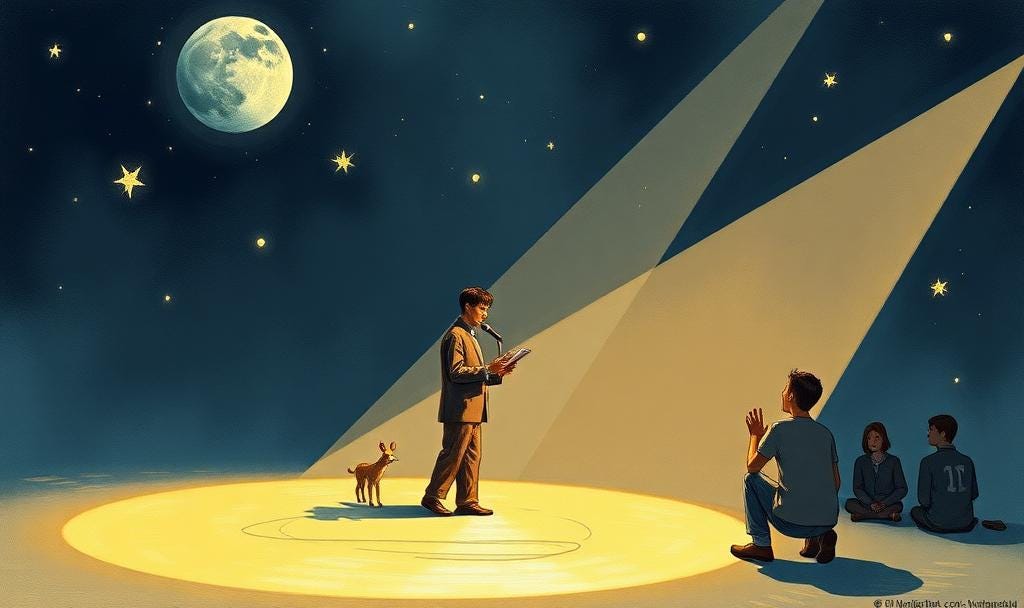
Probably, you see, a late-night comedian said something that was probably offensive, but not quite as offensive as actual offense, if it’s only probable.
Now apparently we can’t afford genuine jokes anymore, so we have to settle for probability calculations about humor. It’s a shame really, because they’re lower quality than truths. They become very different before and after.
I mean, before the tweet it was extremely improbable that a world leader would be triggered by a comedy show, but as soon as it happened, the probability shot up to no less than 100 percent, so it was almost true that it had happened.
But only almost true. That’s what’s so peculiar. It’s as if one believes that what happened on late-night TV was so incredibly improbable that it probably hasn’t actually happened.
Maybe the entire administration spent over half a year waiting to find out whether comedy has happened or not, before they could decide whether they should think that humor is as dangerous as it would be if comedy had actually happened.
And one understands why they hesitated, because such sensitivity occurs, according to all probability calculations, only once every several thousand years of political history, and then it’s certainly not likely that it has happened already now, but it’s probably more probable that it has occurred further ahead.
Maybe “Make America Great Again” is probably a pun: Make → Maybe America → Probably
Great → Certainly Again → Never quite happened the first time
The risk of actual greatness is so small that it’s negligible. By which is meant that it doesn’t exist, just a little bit.
So really there’s probably no point in having elections about such things. People in general think, in their crude way, that what happened on television really has happened. They take comedy as truth.
“Always tell the truth, children,” our parents said to us. We can’t say that to our children; instead we must teach them to always speak probably. To tell the probability, the whole probability, and nothing but the probability.
So that they realize that what happened on late-night TV can’t happen here, since it didn’t even happen there, which would have been much more probable, considering that’s where it happened.
//Peace and Maybe bring political satire back? Maybe It would probably be great again?
My translation from Swedish to English: Tage Danielsson 1979.
Probably, you see, that means something that’s probably like the truth. But not quite as true as actual truth, if it’s only probable. Now apparently we can’t afford genuine truths anymore, so we have to settle for probability calculations. It’s a shame really, because they’re lower quality than truths. They’re not as reliable. They become, for instance, very different before and after. I mean, before Harrisburg it was extremely improbable that what happened in Harrisburg would happen, but as soon as it had happened, the probability shot up to no less than 100 percent, so it was almost true that it had happened. But only almost true. That’s what’s so peculiar. It’s as if one believes that what happened in Harrisburg was so incredibly improbable that it probably hasn’t actually happened. In fact, the entire Social Democratic Party spent over half a year waiting to find out whether what happened in Harrisburg has happened or not, before they could decide whether they should think that nuclear power is as dangerous as it would be if what happened in Harrisburg had happened. Now they’ve finally decided, and apparently concluded that what happened in Harrisburg hasn’t happened, but that on the other hand we must have much better safety devices so it doesn’t happen here too. And one understands why they hesitated, because such an accident occurs, according to all probability calculations, only once every several thousand years, and then it’s certainly not likely that it has happened already now, but it’s probably more probable that it has occurred further ahead. And then the matter comes into a different situation. Because we can’t judge that now. Then. Or... Then there’s also this: if what happened in Harrisburg really happened, against all odds, then the probability that it will happen once more is so tremendously ridiculously tiny that in a way one could say it was almost good that what happened in Harrisburg happened, if it did. Because I mean then one can almost certainly say that it won’t happen again. At least not in Harrisburg. And certainly not at the same time as last time. The risk of a repetition is so small that it’s negligible. By which is meant that it doesn’t exist, just a little bit. Now this is quite complicated for the common man, so really there’s probably no point in having a referendum about such things. People in general, they think, of course, in their crude way that what happened in Harrisburg really has happened. They take it as a truth. “Always tell the truth, children,” our parents said to us. We can’t say that to our children; instead we must teach them to always speak probably. To tell the probability, the whole probability, and nothing but the probability. So that they realize that what happened in Harrisburg can’t happen here, since it didn’t even happen there, which would have been much more probable, considering that’s where it happened.
The genius of Danielsson’s wordplay here: He’s deconstructing how bureaucrats and experts use probability as a way to avoid dealing with reality. The central joke is that once you start treating real events as probability calculations, you end up in absurd logical loops where: Nothing is ever certain, only “probable” Real disasters become statistical anomalies that “probably didn’t really happen” The more improbable something was before it happened, the less “real” it becomes after it happens Politicians can avoid making decisions by hiding behind mathematical uncertainty His play on “sannolikt” (probable = “truth-like”) captures how modern discourse has replaced truth with statistical likelihood, creating a world where even obvious realities become debatable through mathematical sophistry. It’s a perfect satire of technocratic language that sounds scientific but actually obscures rather than clarifies. The Harrisburg reference (Three Mile Island, 1979) was particularly relevant to Swedish nuclear policy debates, making this both a philosophical joke about the nature of truth and probability, and a pointed political satire about how Sweden’s politicians were handling nuclear safety in the wake of a real accident.