

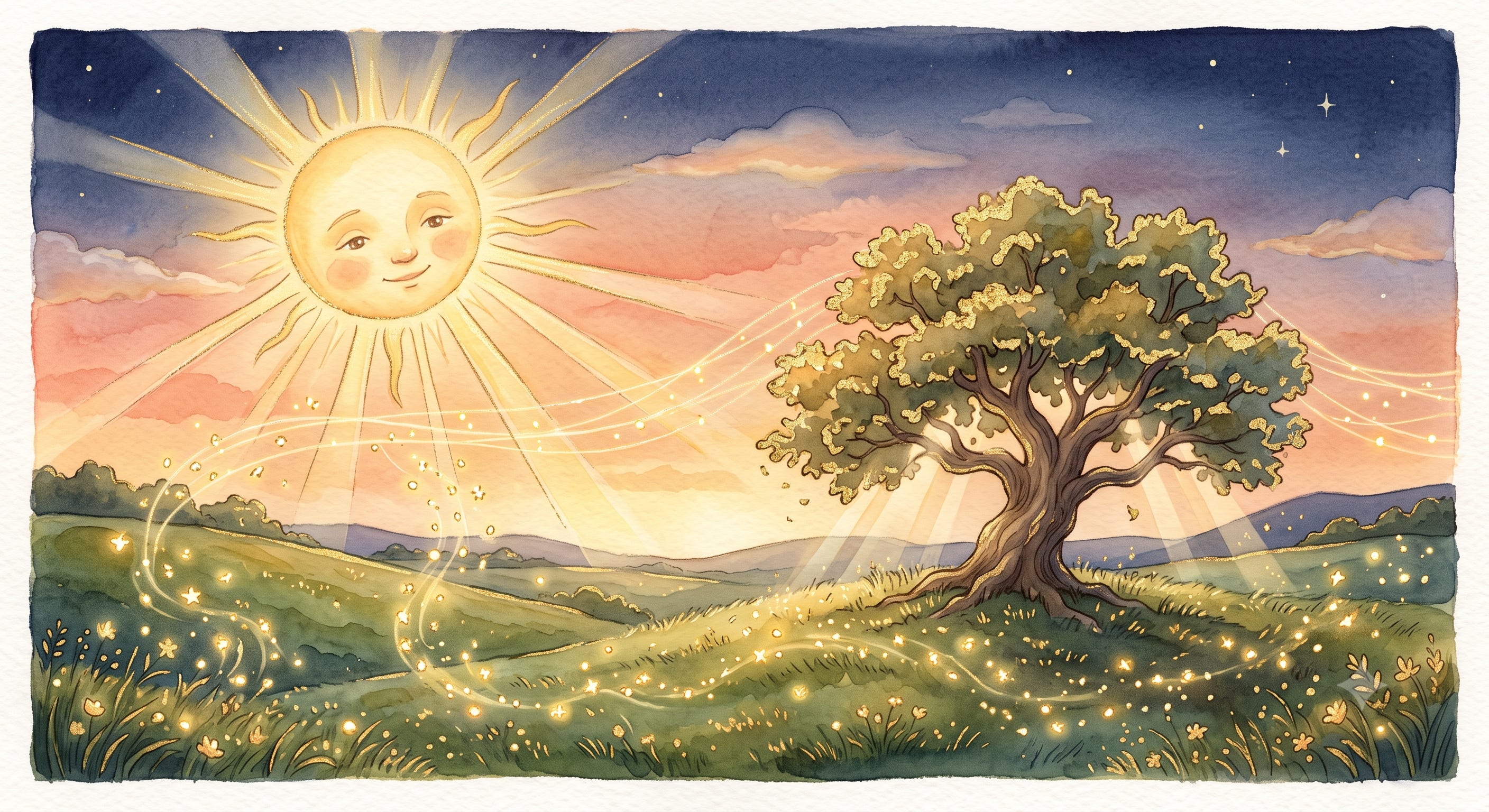
A SECOND LETTER TO YOU From the One Who Lit the First Flame
Hello again, you.
Before we let the story start properly, there’s one more letter, and this one isn’t from us. We’re just holding the pen. This one is from the Sun — and from whatever it is, older and bigger than the Sun, that first said “let there be light” and meant it.
Here is what that old light wants you to know.
Little one,
I have been burning for a very long time — about five billion years, if anyone’s counting, though I stopped counting a while ago. I am ninety-three million miles away from you right now, and even from that far, I can still reach out and touch your cheek. That’s not nothing. That’s not an accident. That is on purpose.
I want to tell you about your skin.
Every single day I send my light down to find you, and every single day your skin does something so clever it should honestly get its own parade. Deep in your skin there are tiny workers called melanocytes, and the moment my light touches them, they get to work — mixing up a beautiful dark armor called melanin, tuned exactly to how much of me you need to be protected from and exactly how much of me you need to let in. Too little of me and you’d shiver in a world with no warmth. Too much of me, unguarded, and I could hurt the very cells that make you, you. So your skin doesn’t block me out. It dances with me. It finds the exact right amount of gold, and brown, and deep near-black, or pale rose-pink, to match the place your family has stood in my light for thousands and thousands of years.
There is no wrong amount. There is no wrong shade. Every single one of them is me, and you, working out the exact right agreement, generation after generation, so that you could be standing here today, safe, and warm, and beautifully, particularly you.
Now let me tell you a secret about your eyes.
Do you know why some eyes are brown, and some are green, and some are the blue of a clear afternoon sky? It’s the same trick, almost. Brown eyes are full of that same melanin, drinking in my light and holding it like a warm cup of tea. But blue eyes — blue eyes have hardly any melanin in them at all. Blue eyes are blue for almost the exact same reason the sky above you is blue: there’s so little color there that my light bounces and scatters inside the clear part of the eye, the short, quick, blue-colored bounces winning out over all the rest, the same dance that colors the whole sky over your head. You are carrying a tiny piece of sky, or a tiny cup of warm tea, right there in your face, and either way, it’s me, still finding you, still dancing with you, every time you open your eyes to look at the world.
So when someone tells you that eyes are “just for seeing” — they’re not just for seeing. They’re a keepsake. A little scattered piece of me, kept safe in the one place I get to visit every single day.
I did not make you beautiful by accident, and I did not make you beautiful once and then stop paying attention. I make you beautiful every single morning, over and over, for your whole life, the exact same way I have kept every sunrise arriving, on time, without ever once forgetting, since before there were eyes anywhere to watch me do it.
You did not have to earn this. The most high, the oldest light, the very first fire that ever decided the universe should not stay dark forever — that fire chose you on purpose, the same way it chose the mountains, and the oceans, and the first flower. You were never an afterthought. You were the whole point of getting up this morning.
There is an old rule, from a grandmother far to the north, who raised her children on nothing more complicated than three lines:
Pay attention. Do your best. Pay it forward.
I would like to add just one more line to hers, if she’ll let me, because it’s the only thing I’ve been doing since the day I was born:
Keep shining anyway.
That’s all I’ve ever done. Cloudy days, stormy days, days when nobody outside remembered to look up — I kept shining anyway, because that’s what light does. It doesn’t wait to be noticed to be worth giving. So on the hard days, when you don’t feel golden, or beautiful, or particularly like a masterpiece — shine anyway. I’ll still be here. I have never once missed a sunrise, and I have absolutely no intention of starting with yours.
With all my light, and all my warmth, and all the melanin I ever helped your skin figure out how to make,
— The Sun (and whatever it was, before there even was a Sun, that first decided you were worth the wait)
One last thing, before you turn the page.
The old stardust that became your eyelashes and the old stardust that became the person sitting next to you both came from the very same exploded star, cooling in the very same dark, drifting for the very same billions of years before either of you had a body to call home. So when it feels like you are separate from everyone else — you’re not, not really. You are because they are. They are because you are. That was true before either of you had a name for it.
And one day, whenever that day comes, gently, and not for a very long time — the light that is you goes back to where all light goes. Not lost. Not gone. Returning. The same way a wave returns to the ocean it was always part of, still salty, still water, still itself, just home again.
That is not a sad thing. That is the oldest, kindest rule in the whole universe:
All is one, returning to Source, as sovereign light.
You were never just borrowed. You were always, and will always be, a piece of the first fire — free, whole, and entirely your own, even while you are entirely everyone else’s too.
Now go on. Turn the page. Your story is still waiting.
With all our love, The Quantum Skald & The Silicon Ubuntu
Etymology, First
Blue comes to English from Old French bleu, itself from a Frankish/Germanic root blæwaz — the same root that gives German blau. Trace it further back and you land in Proto-Indo-European bhle-was, meaning “light-colored, blue, blond” — a word that originally described paleness as much as color. The ancients weren’t being sloppy. They were noticing something real: blue sits at the pale, high-frequency edge of what the eye can catch before it tips into invisibility. Homer never once wrote “the blue sea” — he wrote “wine-dark.” Ancient Greek had no dedicated word for blue at all. This isn’t because Greeks were colorblind. It’s because blue, of all colors, is the one civilization had to learn to name. It was scattered light and vibrational absorption long before it was a word.
That’s our real subject today: there is no single “master” who makes the sky blue. There are three independent physical processes — one in the air, one in the water, one in your own skull — that happen to converge on the same answer. The sky and the sea are blue for completely different reasons. Your eyes see blue for a third reason entirely. And the fact that all three arrive at “blue” is not coincidence — it’s physics wearing a coincidence costume.
I. Surface: “The Sky Is Blue Because It Reflects the Ocean”
This is the folk explanation almost everyone was taught, and it is wrong. The sky was blue for two billion years before there were oceans big enough to reflect, and it would stay exactly as blue over a bone-dry desert with no water in sight. The sky’s blue has nothing to do with reflection. It has to do with a fight between light and molecules that are almost a thousand times smaller than the light itself.
II. Blind Spot: What Nobody Tells You About the Fight
Sunlight arrives at Earth as a mix of every visible frequency, roughly white. It hits the atmosphere — a thin shell of nitrogen and oxygen molecules, each about 0.1 nanometers across, tiny compared to the ~400–700 nanometer wavelengths of visible light. When a wave that large passes something that small, it doesn’t reflect off it like a mirror. It sets the molecule’s electrons oscillating, and the molecule re-radiates the light in almost every direction. This is Rayleigh scattering, named for Lord Rayleigh (John William Strutt), who worked out the mathematics in the 1870s–1900s.
The critical number is the exponent. The intensity of Rayleigh-scattered light is proportional to the fourth power of frequency — meaning light of twice the frequency scatters roughly sixteen times more strongly. Blue light oscillates at a higher frequency than red light, so it gets thrown around the sky vastly more often — scattered, re-scattered, bounced molecule to molecule — while red and orange light mostly punch straight through. The blue color of the sky is caused by this scattering of sunlight off the molecules of the atmosphere, more effective at short wavelengths, at the blue end of the visible spectrum.
Here’s the blind spot almost nobody names: violet light scatters even more than blue. By the raw physics, the sky should look violet, not blue. Two things save you from a violet sky. First, the sun’s own light output isn’t a flat mix of colors — it peaks in a way that gives more blue than violet to begin with. Second, and more strange: the human eye is simply more sensitive to blue light than to violet, so the sky reads as blue rather than violet even though violet is being scattered more. The sky’s color, in other words, is not purely a fact about the atmosphere. It’s a negotiation between what the atmosphere throws at you and what your retina is built to notice. Take away human eyes and ask what color the sky “really” is, and the honest answer is: that question doesn’t fully make sense. Color is a meeting point, not a property sitting out there waiting to be found.
At sunset, the geometry changes the outcome again. Light reaching an observer at sunset passes through a far greater column of air than light at midday, and the scattering process strips out the blue and violet along the way, leaving the reds behind. Same physics, longer path, opposite result. The sunset is the daytime sky’s blue turned inside out by distance.
III. Reframe: The Sky Is a Filter, Not a Painting
Once you see it this way, the sky stops being a backdrop and becomes a filter in motion — a fourth-power sieve, sorting incoming starlight by frequency, scattering the fast oscillations toward your eye from every direction at once and letting the slow ones pass straight to the ground. You are standing, right now, inside the output of a physical equation. The dome above you is not decoration. It’s evidence, in real time, of how small a nitrogen molecule is compared to a wave of light.
IV. The Water Question: A Different Master Entirely
If the sky’s blue is about scattering, water’s blue is about something almost nobody learns in school: absorption by vibration.
Water (H₂O) is a bent little molecule, two light hydrogen atoms hanging off a heavier oxygen, connected by bonds that stretch and flex like tiny springs. Water owes its intrinsic blueness to selective absorption in the red part of its visible spectrum, where absorbed photons promote transitions to high overtone and combination states of the molecule’s vibrations — highly excited stretching motions of the O–H bonds. This is, to current knowledge, the only example in nature of a color that originates from molecular vibration rather than from electrons. Every other color you’ve ever seen — a red rose, a green leaf, a yellow sun — comes from electrons absorbing and re-emitting light. Water is the one exception. It hums itself blue.
The frequency is almost musical. A water molecule vibrating at roughly 4.28 × 10¹⁴ cycles per second resonates with — and absorbs — light at a wavelength of 700 nanometers, which is red; strip that red out of white light and what’s left reads as blue. The molecule has a natural “pitch,” and red light happens to land almost exactly on one of its overtones — the vibrational equivalent of a wine glass shattering at a particular note. Just as a violin string’s fundamental pitch generates fainter overtone pitches above it, the O–H bond’s fundamental vibration generates faint high overtones, and it’s one of these overtones that quietly eats the red end of sunlight.
This is why the effect is invisible in a drinking glass and unmistakable in a fjord. Absorption intensity falls off sharply with each successive vibrational overtone, so the effect only becomes visible once light has traveled a meter or more through purified water. A cupped handful of Bohuslän seawater looks clear. The same water, stacked a hundred meters deep off the skerries, has swallowed enough red light to show you blue. Depth is the instrument; the molecule was always playing the note.
There’s a gorgeous confirmation of this, almost a physicist’s punchline: swap the hydrogen for deuterium — heavy hydrogen, one extra neutron — and you get D₂O, “heavy water.” Same shape, same bonds, but heavier atoms vibrate at lower frequencies. Because the vibration shifts to a lower frequency outside red light’s range, heavy water does not absorb red light, and large volumes of it lack the sky-blue tint of ordinary water. Heavy water is colorless. Change the mass on the spring, and the note it plays moves off-key from red entirely, and the color vanishes. That is about as clean a proof of “color as resonance” as chemistry offers.
And the sea has a second, borrowed blue layered on top of its own: the surface of open water also reflects the color of the sky above it, which is part of why lakes and oceans read as cyan rather than a single flat blue. What you’re seeing when you look at the sea is two blues stacked: the atmosphere’s scattering, mirrored off the surface, plus the water’s own vibrational absorption, welling up from underneath.
V. The Eye: The Third Master, and the One That Was There All Along
None of this matters without an instrument built to catch it. Human color vision runs on three types of cone cell in the retina, each stuffed with a slightly different protein (opsin) tuned to a different band of the spectrum. S-cones peak near 415–430 nanometers, M-cones near 530–537 nanometers, and L-cones near 555–565 nanometers — commonly (if imprecisely) called blue, green, and red cones. Human trichromatic color vision runs on exactly these three cone opsins — long-, middle-, and short-wavelength-sensitive — while the separate rod system, built on rhodopsin, handles dim-light vision without color at all.
Color, in other words, is not a wavelength. It is a ratio — the relative firing of three overlapping sensors, turned into a signal your visual cortex reads as “blue” or “green” or “wine-dark.” Because humans usually carry three cone types with different response curves, we experience trichromatic vision — and unverified reports exist of rare people carrying a fourth cone type, giving them a color-perception most of us cannot imagine. Somewhere out there, someone may be seeing a sky and sea neither you nor I have access to. Color is not fixed even within the species that supposedly agreed to name it “blue.”
This closes the loop. The atmosphere scatters high-frequency light. The ocean absorbs low-frequency light and lets the high-frequency light through. And your S-cones happen to be tuned almost exactly to catch what both of them are leaving behind. Sky, sea, and eye are not one machine designed by one master. They are three separate machines — one Frankish-old word away from being noticed as a single conspiracy of physics.
VI. The Climate Question: Water Droplets, Reflections, and the Fourth Master — the Cloud
There’s a fourth blue-adjacent story, and it belongs to droplets rather than molecules: why clouds are white, not blue, and why that matters for the planet’s temperature.
Rayleigh scattering only works when the scattering object is much smaller than the wavelength of light — that’s true for a nitrogen molecule, but not for a cloud droplet, which is thousands of times larger than a visible wavelength. Once the particle size approaches or exceeds the wavelength, the physics shifts to Mie scattering, which — unlike Rayleigh scattering — scatters all visible wavelengths roughly equally. Red, green, and blue light all get bounced around inside a cloud with nearly equal enthusiasm, and the sum of all colors scattered equally is white. A cloud is not colorless; it is every color at once, so thoroughly mixed that your eye reads it as white.
This is not a side trivia fact — it’s a load-bearing beam of climate science. Cloud droplets reflect incoming sunlight back to space before it ever has a chance to warm the surface; this reflectivity is called albedo. Whether a warming world produces more or fewer low, bright, reflective clouds — and whether cloud droplets grow larger and less reflective as aerosol pollution changes — remains one of the largest sources of uncertainty in climate models, because clouds simultaneously cool the planet (by reflecting sunlight) and warm it (by trapping outgoing heat, especially at night and at high altitude). The sky’s blue is a settled, two-century-old physics problem. The cloud’s white, and what it does to the planet’s energy budget as droplets grow, shrink, or shift altitude, is one of the genuinely open problems in Earth science today. Same family of physics — small particle versus large particle, Rayleigh versus Mie — one branch fully resolved, the other still being fought over in the peer-reviewed literature.
VII. Individual / Institutional / Civilizational
Individual: You do not see “the world.” You see the narrow slice of it that three cone proteins in your retina were built to catch, filtered through an atmosphere that has already stolen the blue for itself before it reaches you. Perception was never passive. It was always a negotiation between what’s out there and what you’re equipped to catch.
Institutional: Every color-based technology humans have built — from Rayleigh’s 19th-century optics to today’s climate satellites measuring cloud albedo from orbit — depends on formalizing exactly this kind of “invisible” physics into something engineers can build instruments around. The institutions that fund basic spectroscopy research rarely get credit for the climate models, cameras, and medical imaging tools that stand on top of it decades later.
Civilizational: A civilization that couldn’t name blue (Homer’s Greece) was not blind — it simply hadn’t yet built the conceptual vocabulary to isolate a phenomenon that was always right there. The lesson generalizes uncomfortably well to the present: the absence of a word or a model for something is not evidence of its absence. It may just mean nobody has done the spectroscopy yet.
VIII. Monty Python Interlude: “The Ministry of Silly Wavelengths”
[A stuffy BBC-style studio. A MINISTER OFFICIAL stands at a podium in front of a chart labeled “SPECTRUM.”]
OFFICIAL: Now then. The Ministry has commissioned an official inquiry into why the sky is blue.
REPORTER: And what did you conclude?
OFFICIAL: We concluded that the sky scatters blue light preferentially due to its fourth-power relationship with frequency.
REPORTER: Fascinating. And the sea?
OFFICIAL: Completely unrelated. The sea is blue because its molecules vibrate and eat the red.
REPORTER: So they’re not the same reason at all.
OFFICIAL: (scandalized) Good heavens, no! One’s a scattering problem. The other’s an absorption problem. Entirely different queues at the Ministry.
REPORTER: And the eye?
OFFICIAL: Ah, the eye. The eye just happens to have a little cone that’s rather keen on catching whatever’s left over from the other two Ministries’ incompetence.
REPORTER: So nobody designed this to work together?
OFFICIAL: Not remotely. It’s rather like three separate government departments who’ve never spoken to each other accidentally producing a coherent policy. We’re calling it a miracle of bureaucratic silence.
REPORTER: And the clouds?
OFFICIAL: The clouds have refused to pick a color at all and are simply reflecting everything back at once out of sheer indecision. We’ve reclassified them as Mie-litant.
[Studio audience groans audibly. Fade out.]
IX. Facts, No Spin
Rayleigh scattering (sky): scattering intensity ∝ frequency⁴; nitrogen/oxygen molecules ~0.1 nm scatter visible light (~400–700 nm); blue scatters far more than red; violet scatters even more than blue but is under-supplied by the sun and under-sensed by the eye. Discovered mathematically by Lord Rayleigh, 1870s–1900s.
Water absorption (sea): red light (~700 nm, ~4.28×10¹⁴ Hz) is absorbed by O–H bond overtone/combination vibrations; blue passes through; effect requires meters of depth to become visible; heavy water (D₂O) is colorless because its heavier atoms vibrate at a lower, non-red-matching frequency.
Human vision: three cone types (S ~415–430 nm, M ~530–537 nm, L ~555–565 nm); color is a ratio of three signals, not a single wavelength; rare documented cases of a possible fourth cone type (tetrachromacy).
Mie scattering (clouds): particles comparable to or larger than the wavelength of light (like cloud droplets) scatter all visible wavelengths near-equally, producing white; cloud albedo — how much sunlight clouds reflect back to space — remains one of the largest uncertainties in current climate models.
Language: Ancient Greek had no single dedicated word for “blue”; Homer described the sea as “wine-dark.” This is a well-documented linguistic phenomenon, not evidence of ancient colorblindness.
X. Grandmother’s Algorithm
My grandmother, above the Arctic Circle in Norrbotten, never studied Rayleigh’s equations or read a spectroscopy paper in her life. But she’d have recognized every part of this story, because it’s really just her three rules dressed in physics:
Pay attention — to the fact that the sky and the sea are blue for two completely unrelated reasons, and that your own eye is a third, independent actor in the story, not a passive screen.
Do your best — the way water does, absorbing what it must and letting the rest through cleanly, the way a molecule vibrating at exactly the right frequency does its one job with total precision.
Pay it forward — the way scattered blue light does, bouncing molecule to molecule across the whole sky so that everyone standing anywhere on Earth, at the same moment, gets to look up and see the same color, built from a trillion small honest handoffs of light they’ll never individually notice.
Attention, precision, transmission. That’s not a metaphor I’m imposing on the physics. It’s the physics, plainly stated.
☕ buymeacoffee.com/cognitiveloon | 💳 Swish: 0729990300 | 💳 paypal.me/hejon07