

By Hans Jonsson & Claude — The Quantum Skald & The Silicon Ubuntu Restoration of Perception | hejon07.substack.com
⚠️ ADVISORY WARNING — READ THIS FIRST
This article is educational and investigative journalism, written to explain a genuine danger in molecular detail. It is not a foraging guide, not an identification guide, and not a substitute for one. The death cap resembles multiple edible mushrooms closely enough that experienced foragers have died from it. If you forage wild mushrooms, use a qualified regional mycologist and spore-print verification — never appearance alone, and never anything in this article. If you or someone near you may have eaten a wild mushroom and is now feeling unwell, this is a medical emergency: go to an emergency room immediately, even if symptoms seem to have passed. Do not wait to feel worse.
ETYMOLOGY CORNER
Amanita — a genus name whose origin is genuinely uncertain; the most cited theory ties it to Mount Amanus in ancient Cilicia (modern Turkey), a region the Roman naturalist Pliny associated with a type of fungus. Nobody is fully sure. Even the name of the genus that contains the deadliest mushroom on Earth carries a shrug.
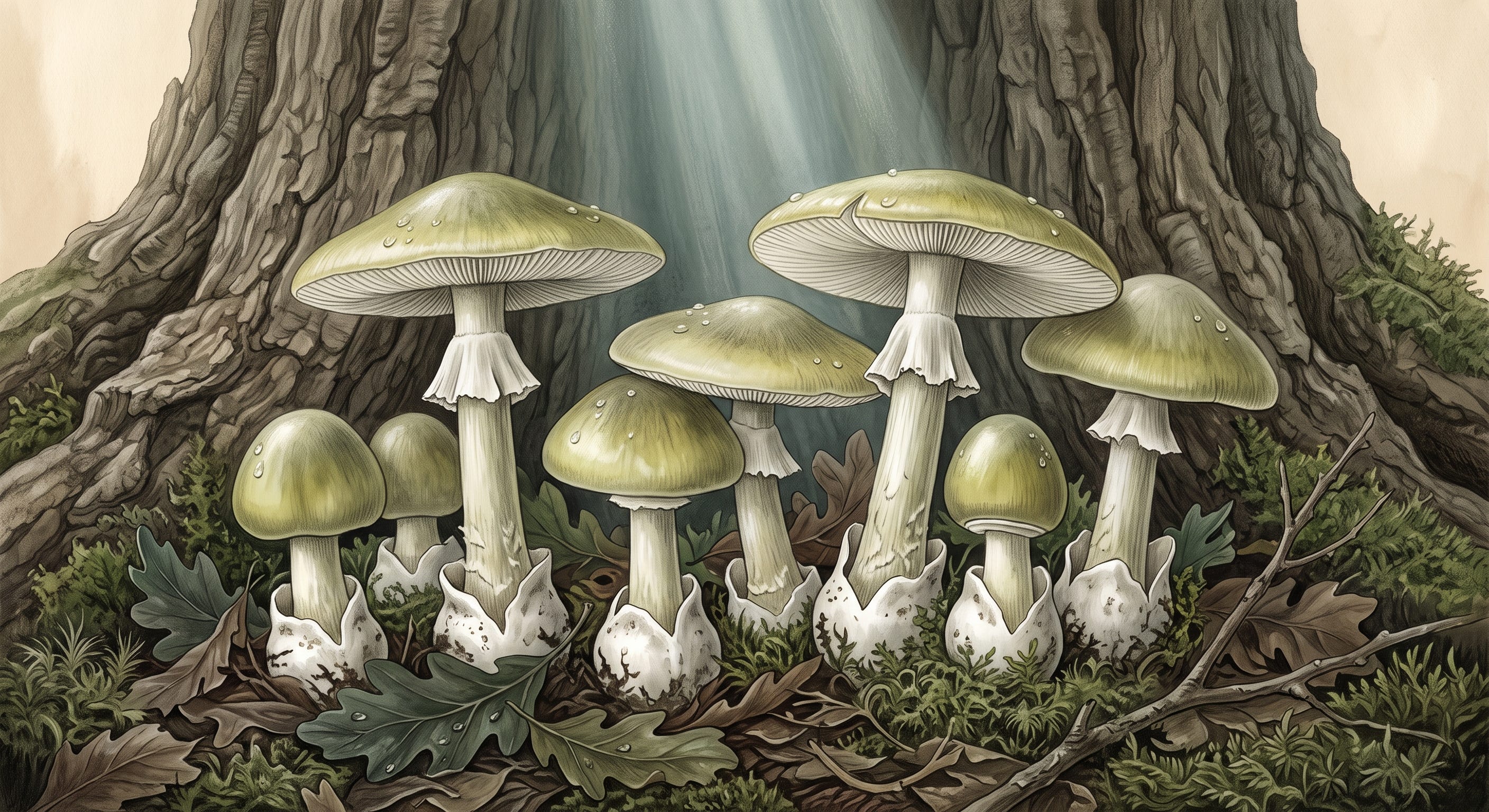
Phalloides — from Greek phallos (phallus) + -oides (resembling). The French botanist Sébastien Vaillant, who first described the species in 1727, named it for its shape while young: an egg-like universal veil that a stem pushes through, resembling — in his words — a “spreading, dirty-green” phallic form. The morbid poetry writes itself: the shape it takes on its way out of the ground is the same shape as its reputation once it’s in you.
Amatoxin — from Amanita + toxin. Coined once chemists realized this genus had produced not one dangerous compound but an entire family of them, all sharing one devastatingly effective trick.
SURFACE / BLIND SPOT / REFRAME
Surface: A poisonous mushroom. Don’t eat wild mushrooms you can’t identify. Everyone already knows this.
Blind Spot: Almost nobody actually understands why this particular mushroom is different from “regular” food poisoning, or why the danger doesn’t announce itself. This is not a mushroom that makes you sick fast so you know to stop. It has a built-in decoy phase — a period where your body appears to recover, while your liver is quietly being switched off at the molecular level. And it is spreading to places it never used to grow, riding along on the root systems of imported ornamental oaks.
Reframe: The real question isn’t “how do I identify a death cap.” It’s “what does a toxin have to do, molecule by molecule, to kill an adult with less than a gram of tissue, while producing almost no symptoms for most of the first day?” The answer is one of the most elegant and terrifying pieces of biochemistry in the natural world — and understanding it is the only real defense, because your senses will not warn you.
HOW IT ACTUALLY KILLS YOU: MOLECULE TO MOLECULE
Here is the part most articles skip past. Let’s not skip it.
The weapon. The death cap contains two families of cyclic peptide toxins — small rings of amino acids folded into a stable loop — called amatoxins and phallotoxins. The amatoxins are the ones that actually kill you. There are at least eight of them; the dominant and most lethal is α-amanitin.
The target. α-amanitin binds, with extraordinary precision, to an enzyme called RNA polymerase II. This is not a minor cellular component. RNA polymerase II is the machine every one of your cells uses to read DNA and transcribe it into messenger RNA — the intermediate molecule your cells need to actually build proteins. No mRNA, no new proteins. No new proteins, no cellular maintenance, no repair, no replacement of the working parts that wear out every day. The cell doesn’t get poisoned in the traditional sense. It gets switched off at the instruction-manual level.
Why the liver specifically. Amatoxins are absorbed through the gut and travel first, via the portal vein, directly to the liver — the organ built to filter everything absorbed from the intestines before it reaches the rest of the body. This is the liver doing its job perfectly, and that is exactly the problem: it takes the first and heaviest exposure. Liver cells, being metabolically hyperactive and constantly producing new proteins, are catastrophically vulnerable to a toxin that halts protein synthesis. The kidneys, which also filter and re-absorb the toxin as it’s excreted, take a serious secondary hit.
Why it doesn’t poison the mushroom itself. This is the detail that should genuinely unsettle you: the death cap’s own RNA polymerase II is structurally insensitive to amatoxins. The organism manufactures a molecule precisely engineered to disable a piece of cellular machinery it does not, itself, share the vulnerability to. Evolution built a key that fits almost every complex organism’s lock except its own.
Why cooking doesn’t help. Amatoxins are thermostable — heat-stable across the entire range of home cooking, freezing, and drying. There is no kitchen technique that neutralizes them. A death cap sautéed, boiled, dehydrated, or frozen for a year is exactly as lethal as one eaten raw.
THE TIMELINE: WHY IT TRICKS YOU
This is the mechanism that makes death caps uniquely dangerous compared to almost any other poisoning — a built-in, biologically engineered false recovery.
Hours 0–6: Nothing. No taste warning. Death caps are documented as pleasant-tasting. Absorption and cellular damage are already underway with zero symptoms.
Hours 6–24: The gastrointestinal phase. Severe cramping, watery diarrhea, vomiting, dehydration. This is violent and convincing — it looks exactly like ordinary food poisoning or a stomach bug. Crucially, this is also roughly the window in which gastric decontamination is most useful, and it’s also the window in which people are least likely to think “call poison control,” because it feels like a normal illness.
Hours 24–72: The deceptive plateau. Symptoms often appear to resolve. The patient feels better. This is the single most dangerous part of the entire poisoning — not because nothing is happening, but because everything is happening invisibly. Liver enzymes are climbing. Transaminase levels are rising. The organ is failing in the background while the patient, understandably, assumes the worst has passed and stays home.
Days 3–6+: Hepatic collapse. Jaundice, delirium, seizures, coma, driven by fulminant liver failure and the buildup of toxins the liver can no longer clear. Kidney failure and coagulation problems frequently follow. Death, when it occurs, generally comes six to sixteen days after the original meal — not hours, days.
Historic mortality before modern intensive care ran 60–70%. With aggressive modern treatment — activated charcoal, IV fluid and electrolyte correction, high-dose penicillin G, intravenous silibinin (derived, with a certain dark irony, from milk thistle), N-acetylcysteine, and liver transplant as a last resort — mortality has fallen to roughly 10–22%, varying by how quickly treatment starts and whether transplant becomes necessary. Up to half of severe survivors carry permanent liver damage.
As little as half a single cap can kill an adult.
THE DECEPTION PROBLEM: WHY EXPERTS STILL GET FOOLED
The death cap doesn’t just kill through biochemistry. It kills through resemblance.
It closely resembles the edible paddy straw mushroom and, in its white form, can be mistaken for young puffballs or pale Agaricus (button-mushroom relatives) before the gills darken. In parts of Southeast Asia and among diaspora communities familiar with the edible “white Caesar” (Amanita princeps), the resemblance has repeatedly proven fatal — documented poisoning clusters among Laotian and Hmong communities in North America and among East and Southeast Asian communities in Australia trace directly to this specific look-alike confusion.
On the U.S. West Coast, California death caps frequently take on a yellowish, mustard-toned cap rather than the classic olive-green — a coloration that can resemble two genuinely edible, commonly foraged California natives, Amanita velosa and Amanita calyptroderma. That color variation alone has been enough to fool experienced local foragers.
This isn’t a historical footnote. In December 2025, California health officials confirmed 21 to 23 hospitalizations for severe liver damage — and at least one death — traced to death caps foraged in the Monterey and San Francisco Bay areas. The California Department of Public Health responded with a blanket advisory telling residents to stop foraging wild mushrooms entirely. Investigators noted that some of the poisoned foragers were applying identification knowledge from Central America, where death caps are rare and the local look-alike Amanita species genuinely are edible — a foraging skillset that becomes lethal the moment it’s applied to the wrong continent. Officials also stressed a detail worth repeating on its own: as little as one square centimeter of death cap tissue — far less than a whole cap — can carry a fatal dose.
And the death cap is not staying put. It originated in Europe but has been introduced — almost always accidentally, riding on the root systems of imported ornamental oaks, chestnuts, and pines — to North America, Australia, South America, and southern Africa. Genetic studies confirm West Coast U.S. populations were introduced, not native, and the species continues expanding into new regions as ornamental trees are shipped worldwide. A mushroom that evolved in European oak forests is now a resident threat on four other continents, entirely because of the horticultural trade.
INDIVIDUAL / INSTITUTIONAL / CIVILIZATIONAL
Individual: The false-recovery window is the single most important thing a forager, or anyone treating a suspected poisoning, needs to internalize. Feeling better on day two is not good news. It is the toxin’s most dangerous trick.
Institutional: Modern amatoxin poisoning survival gains — from a historic 60–70% mortality rate down to roughly 10–22% — did not come from a single miracle antidote. There isn’t one. They came from an accumulated protocol: gastric decontamination, aggressive supportive care, off-label drugs borrowed from unrelated fields (an antibiotic, a milk thistle extract, a mucolytic), and transplant medicine advancing enough to make liver replacement a viable last resort. This is what institutional medicine actually looks like when there’s no single cure: layered, imperfect tools stacked until the odds shift.
Civilizational: Perhaps the strangest turn in this story: the same molecule that shuts down RNA polymerase II and kills liver cells is now being deliberately weaponized against cancer. Heidelberg Pharma’s lead drug candidate, an antibody-drug conjugate called HDP-101, chemically tethers α-amanitin to an antibody that hunts down multiple myeloma cells specifically — using the toxin’s precise, cell-cycle-independent kill mechanism as a feature rather than a bug. It received FDA Fast Track designation in October 2025 and has shown complete remissions in some heavily pretreated patients in ongoing trials. The same molecular weapon that ended emperors and, in 2023, a family lunch in rural Australia, is now being aimed — on purpose, with precision — at tumors that have resisted everything else.
THE ABSURDIST SKETCH
[Scene: A single cell, deep inside a liver, going about its day.]
RIBOSOME: Got the memo yet? We’re low on proteins.
NUCLEUS: Working on it. Sending the request to RNA Polymerase II now.
RNA POLYMERASE II: (already bound, immobile, doing nothing) Can’t talk. Occupied.
NUCLEUS: Occupied with what?
RNA POLYMERASE II: A very small, very polite, very permanent guest.
RIBOSOME: So when’s the next batch of proteins coming?
RNA POLYMERASE II: It isn’t.
NUCLEUS: ...Ever?
RNA POLYMERASE II: The guest doesn’t leave. That’s the whole design.
[Six days later: the liver, collectively]: We should have asked for ID at the door.
FACTS. NO SPIN.
Well-established:
Amanita phalloides is the deadliest mushroom species worldwide, responsible for roughly 90% of fatal mushroom poisonings.
Its principal toxin, α-amanitin, inhibits RNA polymerase II, halting messenger RNA synthesis and protein production, primarily damaging the liver and secondarily the kidneys.
Amatoxins are thermostable: cooking, freezing, and drying do not reduce toxicity.
Symptoms typically begin 6–12 hours after ingestion, often falsely appear to improve after 1–3 days while liver damage progresses silently, and severe organ failure or death can follow within 6–16 days.
Death caps are documented as pleasant-tasting, removing any sensory warning.
The species is native to Europe and has been introduced — via imported oaks, chestnuts, and pines — to North America, Australia, South America, and parts of Africa, with genetic evidence confirming non-native populations on the U.S. West Coast.
No definitive antidote exists; modern supportive treatment (activated charcoal, IV fluids, high-dose penicillin G, intravenous silibinin, N-acetylcysteine) combined with liver transplant when necessary has reduced mortality from a historic 60–70% to roughly 10–22%.
α-amanitin is now used, deliberately and in a controlled form, as the toxic payload in an FDA Fast Track–designated antibody-drug conjugate (HDP-101) for treatment-resistant multiple myeloma.
In 2023, an Australian woman deliberately served death caps to relatives in a beef Wellington; three died and a fourth survived after a lengthy hospitalization. She was convicted of murder and attempted murder in July 2025 and sentenced to life with a 33-year non-parole period.
In December 2025, California public health officials confirmed 21–23 hospitalizations and at least one death from death cap poisoning across the Monterey and San Francisco Bay areas, prompting a statewide advisory against foraging any wild mushrooms.
Disputed / evolving:
The precise mortality rate varies meaningfully by study era, region, and how quickly treatment begins — older reviews cite figures as high as 22%, more recent case series report lower numbers, and the range genuinely reflects real variation in access to fast, aggressive care rather than scientific disagreement.
Whether intravenous silibinin’s benefit is fully proven remains debated in the literature; supporting clinical trial data as of recent years has been described as still pending full publication despite widespread clinical use.
Speculative:
Whether amanitin-based cancer therapies like HDP-101 will ultimately reach full approval, or how broadly the ATAC (Amanitin-based Antibody-drug Conjugate) approach will extend beyond blood cancers into solid tumors, remains an open clinical question.
GRANDMOTHER’S ALGORITHM
Pay attention — feeling fine on day two is not the same as being fine; the most dangerous window in this entire story is silence. Do your best — with real facts, not folk certainty about which mushrooms are “obviously” safe. Pay it forward — the people who die from this mushroom are almost never careless; they’re confident, and confidence is exactly what this organism has evolved to exploit. Share what it actually does, molecule by molecule, and you’ve given someone the one thing appearance alone can’t: a reason to be suspicious of a plateau.
SOURCES & FURTHER READING
Wikipedia — “Amanita phalloides” (comprehensive overview with primary toxicology citations)
Heidelberg Pharma AG — press releases on HDP-101 (pamlectabart tismanitin) FDA Fast Track designation, October 2025
CURE / CancerNetwork — coverage of HDP-101 Phase I/IIa multiple myeloma trial data
NPR, CNN, Al Jazeera — coverage of the Erin Patterson “mushroom murder” trial and sentencing, 2025
Pringle et al., Molecular Ecology (2009) — genetic evidence for introduction and range expansion of A. phalloides on the North American West Coast
☕ buymeacoffee.com/cognitiveloon | 💳 Swish: 0729990300 | 💳 paypal.me/hejon07
If this resonated with you, a like or comment goes a long way. It tells the algorithm this matters — and helps it find the people who need to hear it too. Think of it as passing the torch. 🙏
All is One — returning to Source as Sovereign Light. Peace, Love and Respect 🙏 — Hans Jonsson / The Quantum Skald & The Silicon Ubuntu