

Hans Jonsson & Claude | The Quantum Skald & The Silicon Ubuntu
Word of the Day: Chimera
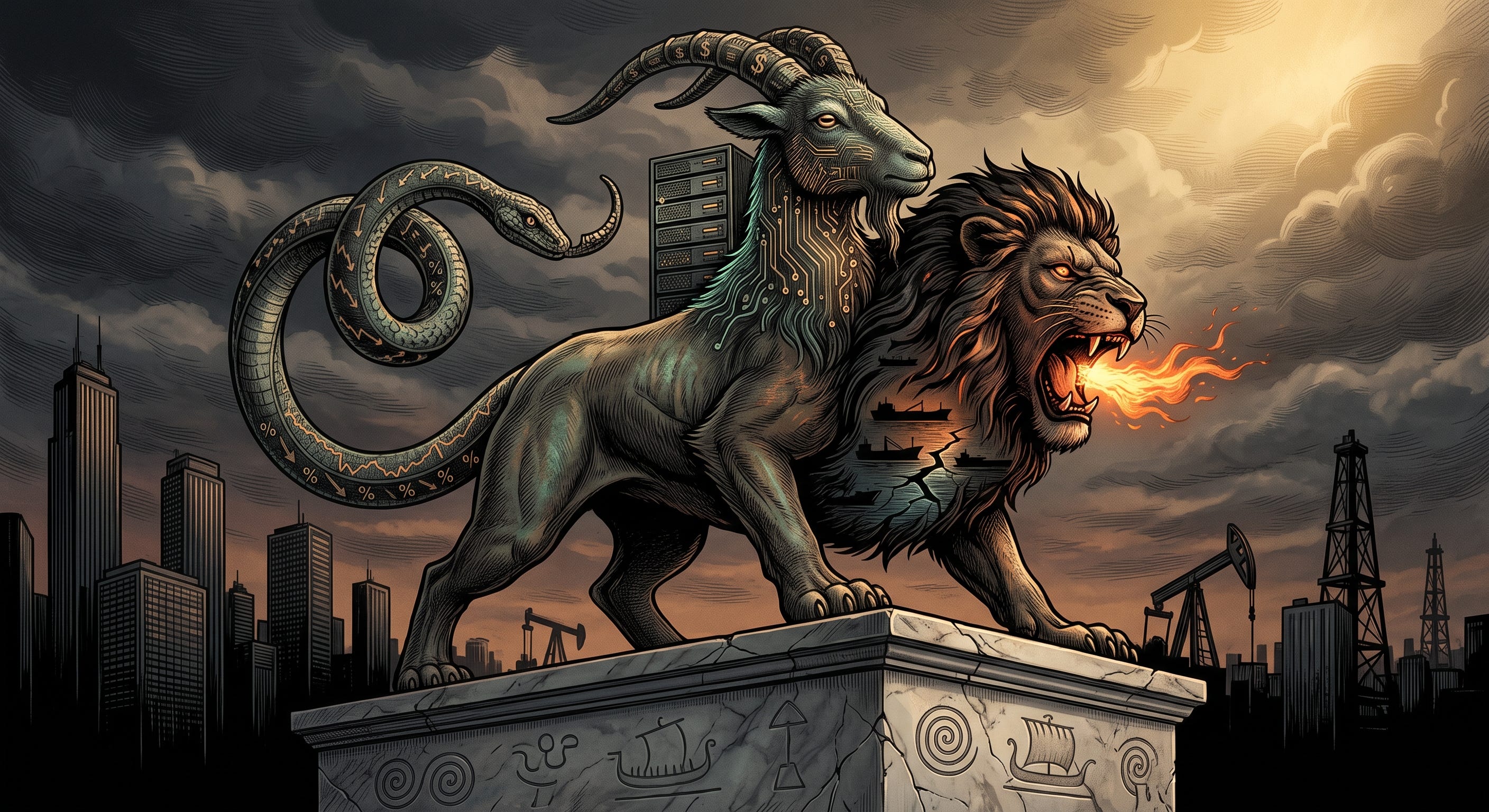
From the Greek khimaira — a fire-breathing monster with a lion’s head, a goat’s body rising from its back, and a serpent for a tail. In the old myth, the trick of the Chimera wasn’t that any one part of it was unbeatable. Lions can be speared. Goats can be outrun. Snakes can be crushed underfoot. The trick was that it was three creatures fused into one body, so that wounding the head did nothing to stop the tail, and killing the tail left the lion’s jaws untouched. You couldn’t fight it one piece at a time. You had to see the whole animal, or you’d die confused about which part killed you.
Right now, three separate news stories are being reported as three separate animals: a bond market meltdown, a war in the Strait of Hormuz, and an AI spending bubble. Financial media covers them on different days, by different reporters, in different sections. But they share one body. And it’s currently breathing fire on the global economy.
Facts, No Spin
The US 30-year Treasury yield hit 5.31% on August 17, 2026 — the highest level since June 2007, right before the last financial system nearly collapsed.
US national debt crossed roughly $40 trillion the week of August 18, months earlier than forecasters expected — a milestone reached in about five months, after the previous trillion took nearly two decades.
Interest payments on that debt have run around $1.0–1.4 trillion over the past year, now exceeding the entire US defense budget for the first time in the post-WWII era.
Japan’s 10-year bond yield hit a three-decade high, and Germany’s 30-year bund climbed to levels not seen since 2011 — this isn’t a US-only story, it’s a synchronized global selloff.
The Strait of Hormuz has been effectively closed for months. Trump has posted a map to social media labeling the strait “NEW U.S. TERRITORY,” while separately confirming there are no active talks with Iran.
The IEA has cut its 2026 global oil supply forecast to a 4.3 million barrel-per-day decline — about 4% of total world supply — citing the Hormuz shutdown as a central cause.
Nvidia has agreed to guarantee up to $105 billion in lease and power payments to help OpenAI build a data center campus in Ohio — a deal structure critics call “circular financing,” where Nvidia effectively funds the demand for its own chips.
Memory chip prices have exploded: DRAM contract prices have risen more than 50% quarter-over-quarter, and some enterprise memory modules are up over 80% in nine months, as AI accelerator demand eats the wafer capacity that used to make ordinary computer memory.
Foreign holdings of US Treasuries fell in June 2026, led by declines from Japan and China — the traditional biggest buyers of American debt are stepping back at the exact moment America needs to borrow the most.
Layer One: The Surface Story
If you only read the headlines, you get three unrelated dramas.
Drama one: Bond yields are spiking because of inflation and reckless government spending. Analysts blame deficits, blame the Fed, blame political dysfunction in Washington.
Drama two: There’s a war. The US and Israel are fighting Iran, the Strait of Hormuz — the chokepoint for a fifth of the world’s oil — has been effectively shut for months, and Trump just posted a map claiming it as US territory, prompting Tehran to respond that it “will remain Iranian.”
Drama three: Silicon Valley is spending money it doesn’t have on AI infrastructure it can’t yet prove will pay for itself, and the chip companies are starting to finance their own customers just to keep the story going.
Treated separately, each of these sounds like its own contained mess with its own villain. That’s the surface story, and it’s not wrong exactly — it’s just missing the skeleton underneath.
Layer Two: The Blind Spot
Here’s what the surface story misses: all three of these dramas are drawing from the exact same pool of money, at the exact same moment, and that pool is running low.
Follow the chain.
The war is expensive, and it’s inflationary. A naval blockade doesn’t run on good intentions — it runs on fuel, munitions, and sailors who need to be paid, resupplied, and kept combat-ready indefinitely, with no ceasefire in sight. Meanwhile, the war has knocked over 4% of global oil supply offline. Higher oil prices don’t stay in the energy sector — they move through fertilizer, shipping, food, and eventually show up as inflation in a grocery bill in a country that has nothing to do with the Persian Gulf. Inflation is the thing that makes bond investors demand higher yields to compensate for their money losing value. So the war feeds directly into the bond crisis.
📖 Quick Explainer: What’s a bond yield, actually? When a government wants to borrow money, it sells bonds — essentially IOUs. The yield is the interest rate it has to pay to convince someone to lend. Low yield means investors trust the borrower and don’t need much reward. High yield means investors are nervous and want to be paid more to take the risk. A 30-year yield above 5% is the market saying, in numbers: we are no longer sure you can pay this back easily.
The AI bubble is also expensive, and it’s also competing for the same money. Building AI data centers at the scale Silicon Valley is currently promising requires hundreds of billions of dollars in financing — money that has to come from somewhere. Increasingly, it’s coming from debt. Amazon, Alphabet, Meta, Microsoft, and Oracle alone sold roughly $194 billion in bonds in 2026 through early July — up 79% from all of 2025 — with hyperscalers and AI-adjacent issuers like Nvidia collectively on pace to hit $400 billion for the year. Nomura estimates that borrowing is now equivalent to roughly a quarter of the Treasury’s entire net note-and-bond issuance to private investors, five times its share a year ago. This isn’t a side effect of the bond crisis anymore — fixed-income strategists are naming it directly as one of the reasons the 30-year yield has stayed above 5% for its longest stretch since the 2008 crisis began. Add to that a memory chip shortage — AI chips (HBM) eat three to four times the factory capacity of ordinary computer memory per gigabyte, so as chipmakers chase AI margins, regular DRAM prices are spiking too, adding inflationary pressure that echoes right back into the bond market.
📖 Quick Explainer: Circular financing This is when a company effectively pays its own customer to buy its own product, then books the resulting sale as revenue growth. Nvidia guaranteeing up to $105 billion so OpenAI can lease a data center that will be filled with — you guessed it — Nvidia chips is a version of this. It’s not illegal or even necessarily wrong. But it makes it very hard to know how much of the “AI boom” reflects real, durable demand versus one company propping up its own numbers.
And the buyers who used to soak up all this borrowing are pulling back — from every direction at once. Japan and China, historically two of the largest foreign holders of US Treasuries, have been steadily reducing their positions for years, and both posted fresh declines in June 2026. The traditional “safe, boring” buyer base for US government debt is shrinking exactly as the government needs to sell more debt than ever, exactly as corporate America needs to sell more debt than ever to build the AI buildout, exactly as a war is driving up global inflation. Three demands on one shrinking pool of money, all peaking at once.
That’s the blind spot. This isn’t three crises. It’s one plumbing system with three faucets running at full blast, and the water pressure is dropping.
Layer Three: The Reframe
The deepest reframe here isn’t “the US is in trouble” — governments have survived debt crises before. It’s this: the entire architecture assumed capital would stay cheap forever, and every single load-bearing decision of the last five years was built on that assumption.
The war strategy assumed the US could sustain open-ended military spending without consequence. The AI buildout assumed hyperscalers could borrow at low rates indefinitely to fund speculative infrastructure. The federal budget assumed refinancing trillions in old debt would happen at the same near-zero rates it was originally issued at. All three bets were placed at a table where the house rules just changed.
None of these actors chose to stop. The war didn’t end because it got expensive. The AI spending didn’t slow because financing got harder. The government didn’t cut spending because interest costs exploded. Each system just kept doing what it was built to do, and the resulting strain landed on the one shared resource none of them controls: the price of borrowed money, set by a bond market that is finally, belatedly, doing arithmetic.
The Chimera doesn’t have a single head to cut off. That’s the point of the myth. You don’t solve this with one policy fix, one ceasefire, or one chip export ban. You solve it — if it gets solved at all — by recognizing that these are not three separate fires, but one fire with three names.
The Dimensional Layer
Individual. This shows up in your life as a laptop that costs more than it did a year ago, a mortgage rate that won’t come down, and a grocery bill that keeps climbing even when the news says “inflation is cooling.” You didn’t choose any of the three bets above. You’re paying for all of them anyway.
Institutional. Every institution here is trapped by its own prior commitments. The Treasury can’t stop borrowing without triggering a government shutdown fight. The Fed can’t cut rates freely without risking the dollar and reigniting inflation. Tech companies can’t stop building without admitting the AI story was oversold. Everyone is locked into finishing a bet they can no longer afford to walk away from.
Civilizational. This is the oldest pattern there is: an empire that fights on too many fronts while its currency and credit erode underneath it. It happened to Rome. It happened to Spain’s silver empire. The forms change — bond yields and data centers instead of legions and galleons — but the underlying arithmetic doesn’t. A civilization can absorb one enormous bet. It struggles to absorb three, simultaneously, on borrowed money, with no clear exit from any of them.
The Absurdist Sketch: The Ministry of Simultaneous Emergencies
[A cramped office. Three doors, each labeled: WAR ROOM, TREASURY, and AI DIVISION. A single overworked clerk sits at a desk with three phones, all ringing at once.]
CLERK: (picking up phone one) Ministry of Simultaneous Emergencies, which crisis is this — oh, the Strait? Yes, still closed. No, we don’t know for how long. Yes, we did post a map calling it ours. No, that doesn’t actually open it. (hangs up)
(phone two rings, he answers without looking) Treasury desk. You want to know who’s buying the bonds this month? (pause) Nobody, really. We’re asking ourselves too. (hangs up)
(phone three rings) AI Division — yes, we know memory chips tripled. No, we can’t explain why a chatbot needs the entire world’s supply of RAM. Yes, we’re aware the data center guarantee is bigger than several national economies. (pause) No, we didn’t check if it would all fit together before we approved it.
[A FOURTH PHONE, unlabeled, begins ringing. The clerk stares at it, terrified.]
CLERK: (to the audience) That one’s the bond market. Nobody answers that one. We just watch the light blink and hope it stops.
[Lights down. The phone keeps ringing.]
The Grandmother’s Algorithm
Pay attention. Do your best. Pay it forward.
My grandmother never had to underwrite a Treasury auction or price a data center lease. But she understood something the Chimera economy has forgotten: you cannot run three fires at once and expect any of them to be put out well. She paid attention to what actually mattered before spending. She did her best with what she had, instead of borrowing against a future she couldn’t guarantee. And she paid it forward — not by promising the next generation infinite growth, but by leaving behind something solid enough that they wouldn’t inherit her debts along with her hopes.
That’s not a policy prescription for the US Treasury. It’s a smaller, more honest instruction for the rest of us, watching this unfold from the outside: build what’s real. Build what’s local. Build what doesn’t depend on three simultaneous bets going right on the other side of the world.
If this resonated with you, a like or comment goes a long way. It tells the algorithm this matters — and helps it find the people who need to hear it too. Think of it as passing the torch. 🙏
All is One — returning to Source as Sovereign Light.
☕ buymeacoffee.com/cognitiveloon | 💳 Swish: 0729990300 | 💳 paypal.me/hejon07
Sources & Further Reading
Bonds & Debt
CNBC — 30-year Treasury yield tops 5.31%, the highest in 19 years
Washington Post — U.S. debt is set to hit $40 trillion, months earlier than expected
Bloomberg — Foreign Holdings of Treasuries Fell in June, Led by Japan Drop
Peter G. Peterson Foundation — Interest Costs on the National Debt Are Reaching All-Time Highs
The Hormuz War
Al Jazeera — Trump threatens to make the Strait of Hormuz a US territory: Can he?
The New Arab — Trump posts map declaring Strait of Hormuz ‘new US territory’
IEA — Global 2026 oil supply shortfall to deepen as Hormuz reopening remains elusive
Wikipedia — 2026 United States naval blockade of Iran
The AI Bubble & Memory Crisis
Axios — OpenAI announces massive data center in Ohio with Nvidia guarantee
CNBC — Nvidia backing $105 billion in financing for OpenAI data center in Ohio
TechTimes — AI Wiped Out Two Decades of Falling RAM Prices
Tom’s Hardware — RAM Price Index 2026: DRAM Price Tracker
Companion reading from this desk: “The Frankenstein Problem” (Japan’s bond cascade) and “The Samurai and the Server Farm” (how AI capex is draining Japanese savings) — both on hejon07.substack.com.