





By Hans Jonsson & Claude | The Quantum Skald & The Silicon Ubuntu
Etymology first, because it’s the whole story
Wine — English, from Old English wīn, borrowed from Latin vinum, from a root shared across the ancient Mediterranean (Greek oinos, Hebrew yayin). It has always meant one thing: fermented grape.
But the Bible doesn’t use one word for it. It uses at least three, and the differences matter:
Yayin (יַיִן) — fermented wine, an intoxicant, the word most often paired with warnings about drunkenness.
Tirosh (תִּירוֹשׁ) — freshly pressed grape juice, “new wine,” on its way to becoming yayin but not there yet.
Oinos (οἶνος) — the Greek word the Septuagint and New Testament use to translate both, the same root Jesus’s miracle at Cana runs on.
None of these three words means what a modern Kool-Aid-adjacent reader might hope. All three come from the same plant, the same vine, the same crushed fruit. The wine in the Bible was grape wine. That part isn’t in dispute — it’s confirmed by the text and, more convincingly, by the ground itself: residue analysis on Bronze Age through Second Temple-era jars across the Levant turns up tartaric acid and other wine-fermentation markers, sitting next to actual wine presses and storage installations dug out of Israelite sites. This isn’t folklore. It’s chemistry.
So if it was grape wine, and it was fermented, and it made people drunk enough that the Bible has to keep telling people to cut it out — where does the idea come from that ancient wine was “different,” softer, more like an herbal tonic than a modern glass of Cabernet?
That idea isn’t wrong. It’s just aimed at the wrong target.
Surface
Ask most people what wine was like in Bible times and you’ll get one of two confident, opposite answers:
“It was basically the same as today — grapes, fermented, alcohol, done.”
“Actually, it was mostly unfermented grape juice — ‘real’ wine came later, and the Bible’s ‘wine’ was non-alcoholic.”
Both answers get repeated with total certainty. Only one of them survives contact with archaeology.
Blind Spot
Here’s what neither answer accounts for: ancient wine was never drunk straight, and it was never left alone.
It was a base ingredient, not a finished product. What happened to it after fermentation is the actual story — and it happened for three completely different reasons, at three completely different points in the supply chain.
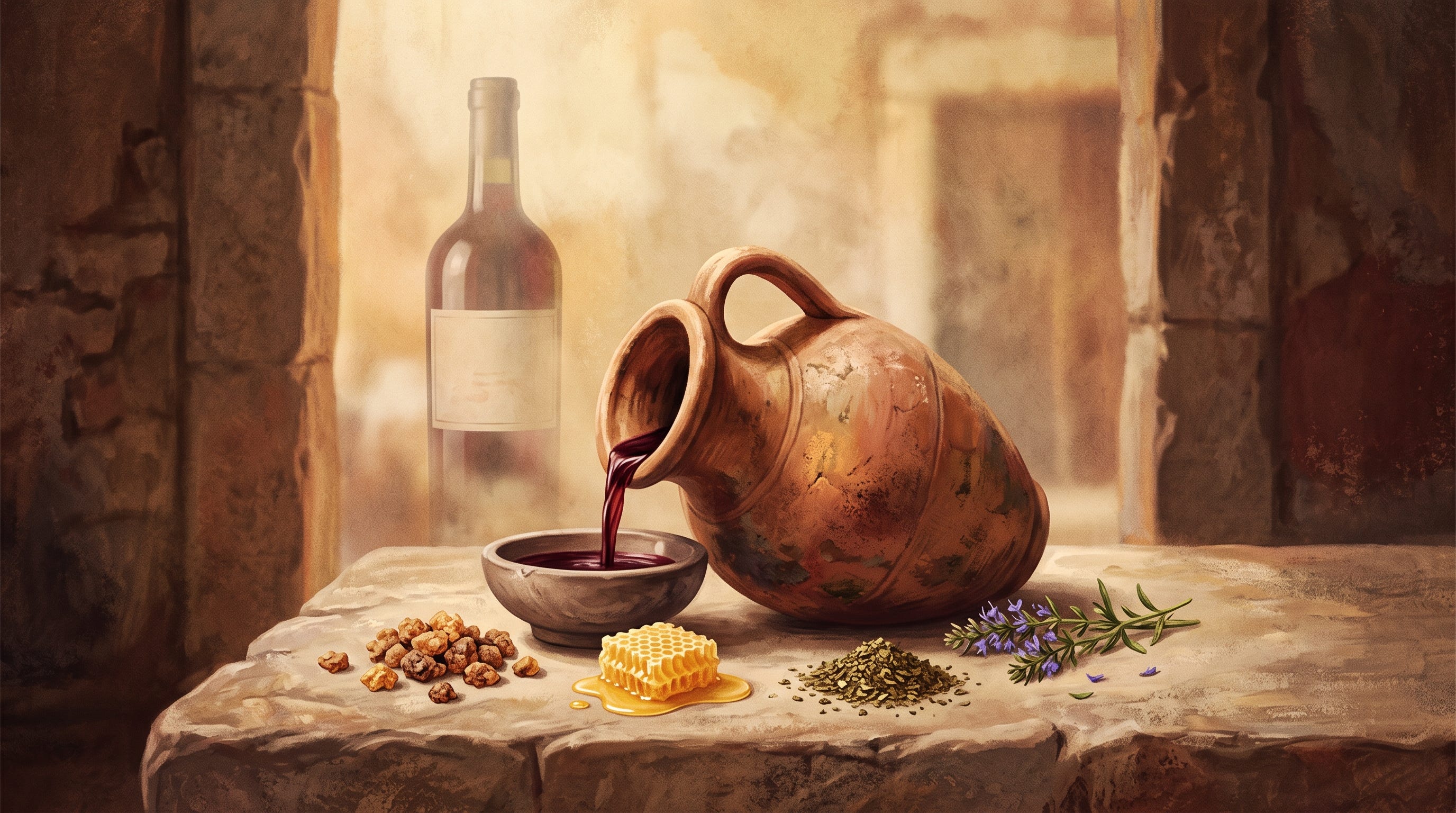
📖 The Kitchen Cabinet in a Cup The Talmud lists what went into doctored wine: balsam, honey, pepper, myrrh, capers, wormwood, and sapa — a thick, boiled-down Roman grape syrup. Song of Songs 8:2 names it directly: yayin ha-reqach, “spiced wine.” Song of Songs also names ashishah, a hardened grape syrup thick enough to eat with a spoon. This wasn’t a niche practice. It was the default.
Reason one: it tasted bad, and travel made it worse. Wine made in ancient Israel and Judea often didn’t hold up well over distance or storage. Jars shipped to Egypt got dosed with honey, berries, pepper, and salt just to be palatable on arrival. Bottles sent all the way to Rome came out so thick and sweetened they were closer to syrup than to a pourable drink.
Reason two: it was medicine as much as it was a beverage. The Good Samaritan pours wine into a wound as an antiseptic (Luke 10:34). Paul tells Timothy to take “a little wine” for his stomach (1 Timothy 5:23). The BYU Studies research on wine at Masada even documents wine being blended with herbs specifically to make eye salve. In a world without pharmacies, the wine jar doubled as the medicine cabinet.
📖 Why the Grape Was Already a Chemist There’s a reason wine had medicinal credibility beyond folk belief: the grape itself manufactures defensive chemistry. Tannins — concentrated in skins and seeds — are astringent polyphenols responsible for red wine’s dry, gripping structure. Resveratrol, the compound most associated with wine’s modern “health halo,” is a phytoalexin: a stress-response molecule the grape produces specifically when attacked by UV exposure or fungal pathogens, synthesized through the same plant pathway as its other defenses. It’s concentrated almost entirely in the skin, which is why red wine — fermented with skin contact — carries far more of it than white. Ancient physicians didn’t know the biochemistry. They didn’t need to. They just knew, correctly, that this particular plant fought back against things that threatened it, and reached for it accordingly.
Reason three — and this is the one nobody puts on a Sunday School flannel board — it was weaponized as an anesthetic at an execution.
At the cross, Mark 15:23 records that Jesus was offered wine mixed with myrrh — a resin known in the ancient world to produce a numbing, sedating effect when dissolved in wine. This wasn’t a random kindness. It was standard practice: Roman executioners doctored the wine given to condemned prisoners specifically to dull resistance and blunt the horror of what was coming, less out of mercy than convenience — a compliant, half-sedated body is easier to nail to a beam. Jesus, per the text, refused it. Later — a separate moment, a separate drink — he was offered wine vinegar on a sponge, and that one he accepted, fulfilling Psalm 69:21’s line about being given vinegar for thirst. Two different cups. Two different chemistries. Most retellings collapse them into one detail and miss that the first cup was a drug offer he turned down.
Water was also added on the regular — diluting wine with water was the wider Greco-Roman norm by the time of the New Testament, which is part of why the miracle at Cana (John 2) reads as such a shock in its original context: the steward isn’t just impressed by good wine, he’s stunned that the best wine showed up last, when custom said you serve your good stock first and let people’s palates dull before you cut corners.
So: grape, yes. Alcoholic, yes. But also routinely stretched with water, doctored with resin and honey and spice for taste, deployed as medicine, and — at least once, at the worst possible moment in the whole story — offered as a drug to numb a man being executed, who said no.
Reframe
The honest picture isn’t “wine” versus “grape juice.” It’s wine as a raw material that got customized for whoever was going to drink it — sweetened for export, spiced for the table, diluted for daily use, medicated for the sick, drugged for the condemned. The Bible doesn’t describe a single beverage. It describes an entire craft, region by region, occasion by occasion.
Which makes it worth asking: if the archaeology and the text both point this clearly toward “real, doctored, diluted wine” — why does the “it was basically grape juice” theory have such staying power in modern American Christianity?
That answer isn’t in the ancient world at all. It’s in 1869, in a dentist’s kitchen in Vineland, New Jersey.
Individual
Thomas Bramwell Welch was a Methodist minister-turned-dentist and a fervent temperance man — so fervent that when his own congregation elected him communion steward, he refused to even touch the fermented wine he was supposed to serve. He’d spent his younger years helping hide and move enslaved people on the Underground Railroad; alcohol was the other great moral crusade of his life, and he treated it with the same intensity.
Welch read up on Louis Pasteur’s new pasteurization process — designed for milk — and realized he could apply it to grape juice to kill the yeast before it could ferment. In his own kitchen, using grapes off a trellis outside his door, he pressed, filtered, and heat-treated a batch of juice that would never become wine. He called it “Dr. Welch’s Unfermented Wine.”
His church didn’t want it. Neither did most others, at first. Welch gave up on the business in 1873.
Institutional
His son Charles had the marketing instincts his father lacked. He rebranded the product as grape juice — a category that, as a distinct named product, essentially did not exist before this — and rode the swelling nineteenth-century temperance movement to a very different outcome. In 1893 he founded the Welch’s Grape Juice Company. In 1913, U.S. Secretary of State William Jennings Bryan served grape juice instead of wine at a formal diplomatic function. In 1916, the Methodist Episcopal Church made it official doctrine: “let none but the pure juice of the grape be used in administering the Lord’s Supper.” Other Protestant denominations followed.
And alongside the product launch came a theological campaign — the first serious popular argument that the wine of the New Testament wasn’t really fermented at all, that Jesus himself was functionally a teetotaler, and that “biblical wine” and “modern wine” were two unrelated things wearing the same name. That argument wasn’t drawn from new manuscript discoveries or fresh archaeology. It arrived on the exact same timeline as a grape-juice company that needed it to be true.
Civilizational
This is the pattern worth sitting with: a text doesn’t have to be rewritten to have its meaning quietly replaced. Nobody edited a single word of Mark or John. What changed was the cultural filter readers were handed to interpret those words through — a filter manufactured in a specific decade, for a specific commercial and moral campaign, that then got inherited by millions of people who never knew the filter had a founding date, a patent process, and a sales team.
It’s the same mechanism as translation disputes over contested words in any sacred text — not fabrication, but emphasis, quietly steering old words toward a modern argument, until the modern argument feels ancient. Watch for this pattern anywhere someone hands you a “the original meaning was actually X” claim: ask who benefits from X, and when X started being said out loud.
The Sketch
INT. THE MINISTRY OF SACRAMENTAL BEVERAGES — 1869. A small wooden desk. A sign reads “COMMUNION STEWARD — PLEASE DO NOT TOUCH THE WINE.”
WELCH: (recoiling from a chalice like it’s radioactive) I cannot serve this. I will not serve this. Fetch me... Pasteur.
DEACON: Pasteur is a milk man, Thomas.
WELCH: (already pressing grapes with his bare hands) Not. Anymore.
Forty years pass in a single scene transition. The chalice is now a Mason jar with a corporate logo.
CHARLES WELCH: (to a room of investors) Gentlemen, I give you: wine, but make it never wine.
INVESTOR: Will the churches take it?
CHARLES: (sliding a pamphlet across the table titled “It Was Never Fermented, Actually”) They will if we ask the theology department first.
THEOLOGIAN: (entering, adjusting glasses) I’ve reviewed two thousand years of continuous Christian sacramental practice and I have concluded, coincidentally, this week —
CHARLES: Yes?
THEOLOGIAN: — that it was grape juice the whole time.
DEACON: (quietly, to no one) Nobody asked the grapes.
Facts, No Spin
Well-established (archaeological + textual consensus):
Biblical “wine” was fermented grape wine; residue analysis on Levantine storage jars from the Bronze Age through the Second Temple period confirms wine-processing chemistry at Israelite sites.
Wine was routinely diluted with water and doctored with honey, resins, and spices — this is described in the Talmud and named directly in Song of Songs (”spiced wine,” *yayin ha-reqach”).
Mark 15:23 records Jesus being offered wine mixed with myrrh at the crucifixion, and that he refused it; a separate offer of wine vinegar later in the same accounts was accepted.
Thomas Bramwell Welch developed pasteurized, non-fermenting grape juice in 1869 specifically as a communion wine substitute, and the Methodist Episcopal Church mandated its use in 1916.
Resveratrol and tannins are grape-produced defensive compounds — resveratrol a phytoalexin induced by UV and fungal stress, tannins concentrated in skin and seed — both synthesized through the plant’s core stress-response chemistry, not folklore.
Reasonably well-supported, some scholarly variation:
The specific ratios of water-to-wine dilution in the Levant aren’t precisely fixed by a single source, though the wider Greco-Roman practice of diluting wine is well documented.
Whether wine-and-myrrh at crucifixions was standard Roman practice everywhere, or a regional/textual detail, is debated among historians — but it’s consistent with myrrh’s known analgesic use in wine across the ancient world.
Contested / worth flagging as ideology, not history:
The claim that biblical “wine” was essentially non-alcoholic grape juice is not supported by the archaeological or textual record. It emerged as a popular theological argument in the same era, and largely the same social movement, that produced Welch’s Grape Juice — not from new manuscript evidence.
Grandmother’s Algorithm
Pay attention. Notice when someone hands you a tidy answer about what an old text “really meant” — and notice what modern product, movement, or comfort that tidy answer happens to support.
Do your best. with the actual evidence in front of you — the jars, the residue, the words on the page — even when the plainer answer is messier than the one you were handed.
Pay it forward. The truth about the cup isn’t shocking or scandalous. It’s just human: people have always doctored what they drink to survive it, sweeten it, or endure it. Pass that honesty along instead of the marketing.
If this resonated with you, a like or comment goes a long way. It tells the algorithm this matters — and helps it find the people who need to hear it too. Think of it as passing the torch. 🙏
Sources & Further Reading
Bible Odyssey — Wine in Ancient Israel
Jewish Encyclopedia — Wine
Biblical Archaeology Society — A Biblical Spice Rack
BYU Studies — The Fruit of the Vine: Wine at Masada and in the New Testament
Katrina D. Hamel — Winemaking in First-Century Israel
Christian History Institute — Raise a Juice Box to the Temperance Movement
Christianity Today — Raise a Juice Box to the Temperance Movement
United Methodist Church — Communion and Welch’s Grape Juice
Wikipedia — Thomas Bramwell Welch
Lee Harmon — Mark 15:23, What was Jesus Offered to Drink?
Carey Ellen Walsh — The Fruit of the Vine: Viticulture in Ancient Israel (academic monograph)
All is One — returning to Source as Sovereign Light. Peace, Love and Respect.
☕ buymeacoffee.com/cognitiveloon · 💳 Swish: 0729990300 · 💳 paypal.me/hejon07
What of the oft-repeated claim that wine was so fundamental to these cultures because it substituted for water that many times was germ-laden, since "the alcohol served as an antiseptic "?
The same is claimed for the drinking habits prevalent in America's early years.
We can appreciate that actual lived experience informed societies long before germ theory was recognized. But I'm skeptical that spirits could've replaced water on a daily basis, which renders the claim at least suspect.