


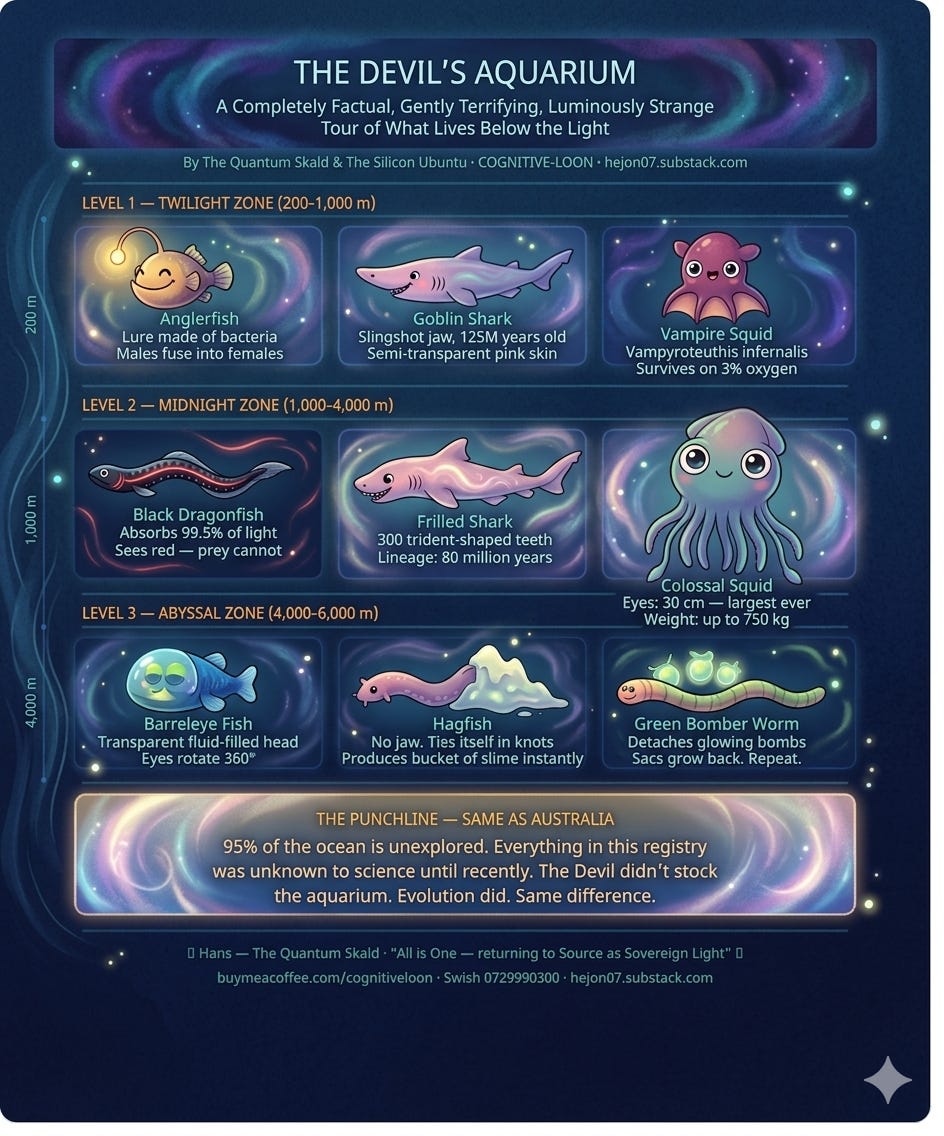
For children who like facts. And adults who like to feel small.
By The Quantum Skald & The Silicon Ubuntu | COGNITIVE-LOON
You may remember The Devil’s Pet Garden.
Australia. The continent. Evolution’s magnum opus of threat. A land so committed to the art of mortal danger that it practically issues liability waivers at the border.
We catalogued the snakes. The spiders. The jellyfish so small they register as an atmospheric inconvenience until you are dying. We found the punchline: statistically, horses kill more Australians than all the venom in the country combined.
The Devil, it turned out, was mostly doing set design.
But here is the thing about a gardener who builds Australia on one continent and fills it with inland taipans and box jellyfish and Gympie-Gympie trees that still sting people a hundred years after they’re dead:
They didn’t stop there.
They also built an aquarium.
A Word Before We Descend
The ocean covers 71% of Earth’s surface.
It contains 97% of the planet’s water.
It reaches a maximum depth of 11,034 metres — the Mariana Trench, where the pressure is over one thousand times what you experience reading this sentence.
And here is the number that matters most:
95% of the ocean remains unexplored.
This is not metaphor. This is official scientific consensus. We know more about the surface of Mars than we know about the deep ocean floor of our own planet.
Which means the Devil’s Aquarium is not finished. It may never be finished. Every submersible that descends past 1,000 metres comes back with something new, something that shouldn’t be possible, something that makes the scientists on deck go very quiet for a moment.
What follows is what we know so far.
🌊 LEVEL 1: THE TWILIGHT ZONE
200–1,000 metres — Where the last light dies
Down here, the pressure is already 100 atmospheres. A human body would compress into something geometrically unfortunate within seconds. But evolution has had several hundred million years to work around that inconvenience, and it has done so with characteristic enthusiasm.
THE ANGLERFISH
Lophiiformes | Atlantic, Pacific, Antarctic — 1,000 to 5,700 feet depth
Common description: A mouth with ambitions too large for its body.
The anglerfish is probably what would happen if evolution sat down with a blank sheet of paper and asked: What is the least reassuring thing I can build with fins?
It has a bioluminescent lure attached to its head — not produced by the fish itself, but by colonies of luminescent bacteria that live in a small bulb on the end of a rod extending from its forehead. The bacteria glow. The prey approaches the glow. The anglerfish has a mouth so large it can swallow prey twice its own size. Its jaws expand. The prey does not exit.
But here is the part that should concern you more than the teeth:
The male anglerfish does not have a lure. The male anglerfish is, in fact, quite small and largely unremarkable. When a male finds a female — a difficult proposition in the lightless void — he bites her side and holds on. Over time, his lips fuse to her skin. Their circulatory systems merge. He dissolves into her body until he is little more than a sperm-producing appendage. A single female has been found carrying eight males simultaneously, each one a former individual who has entirely ceased to be one.
Scientists call this sexual parasitism. The males, presumably, call it something else.
What it teaches children: Sometimes love is a merger. Sometimes it’s a hostile acquisition.
THE GOBLIN SHARK
Mitsukurina owstoni | Atlantic, Pacific, Indo-Pacific — 200 to 4,000 feet depth
Common description: A shark that looks like it was assembled from leftover parts that were never supposed to go together.
The goblin shark has a long, flat snout — an elongated blade of cartilage projecting well in front of its mouth — covered in electroreceptors that detect the electrical fields of nearby prey. When something edible comes within range, the goblin shark does something no other shark does:
It fires its jaw forward out of its own skull.
The upper and lower jaws, attached by elastic tissue, spring outward up to 3 inches from the skull — a catapult mechanism that closes the distance faster than prey can register the attack. The jaws retract. The food does not.
The goblin shark’s lineage is approximately 125 million years old. It is a living fossil. It was here before your entire mammalian clade existed. It watched the dinosaurs come and go and thought: those are interesting, but ultimately unnecessary.
There are believed to be very few goblin sharks, or possibly many. We are not sure. They live in the dark and mostly decline to be counted.
What it teaches children: Persistence is a strategy. The goblin shark has not changed significantly in 125 million years because the original design was already correct.
THE VAMPIRE SQUID
Vampyroteuthis infernalis — The Midnight Zone, 600 to 3,000 feet
Its scientific name means, in Latin: “vampire squid from hell.”
This was assigned by scientists. Credentialed professionals. People with PhDs. This is what they chose.
The vampire squid is, despite its credentials, a relatively gentle creature. It is neither a squid nor an octopus but a member of its own separate ancient order. It lives in the oxygen minimum zone — the layer of ocean so depleted of oxygen that almost nothing else can survive there. The vampire squid does not merely tolerate 3% oxygen saturation; it thrives in it, a breathing strategy no other cephalopod on Earth has replicated.
When threatened, rather than ejecting ink like its relatives, the vampire squid turns itself nearly inside-out, exposing rows of fleshy spines called cirri and flashing the bioluminescent tips of its arms in patterns that may confuse predators, or may be saying something we cannot yet translate.
It does not feed on blood. It feeds on marine snow — the drifting organic particles that fall from above like a slow cold blizzard through the dark. It eats the past, essentially. Decomposed particles of everything that lived above it.
What it teaches children: You can survive where nothing else can. The oxygen minimum zone is yours if you want it.
🔦 LEVEL 2: THE MIDNIGHT ZONE
1,000–4,000 metres — No light. No heat. No mercy.
Below 1,000 metres, sunlight does not exist. Not dimly. Not filtered. It simply stops. Bioluminescence is estimated to be present in up to 90% of living organisms at this depth — meaning the darkness is not empty. It is full of creatures making their own light, in colors your eyes can barely register, for purposes we are still learning to read.
THE BLACK DRAGONFISH
Idiacanthus atlanticus | Atlantic and Pacific — 5,000 to 7,000 feet
The black dragonfish has solved an elegant problem.
In the deep ocean, most creatures can only see blue or green bioluminescence. The black dragonfish produces red light from organs near its eyes. Its prey cannot see red at these depths. The dragonfish can.
It has invented private-spectrum vision. A torch that only it can see by, in a room full of blind competitors.
Its scales absorb 99.5% of light. It is, in terms of optical physics, almost perfectly black — a silhouette of teeth moving through darkness that cannot reflect it. Along its body run rows of photophores, bioluminescent organs like a string of cold green embers, used for communication and for confusing things trying to eat it.
The females grow to 40 centimetres. The males grow to 2 centimetres and have no teeth and no functioning stomach and live only long enough to reproduce, after which they die. This arrangement is presented without further comment.
What it teaches children: Knowing the frequencies others cannot see is a superpower. Use it wisely.
THE FRILLED SHARK
Chlamydoselachus anguineus | Atlantic and Pacific — occasionally to 5,150 feet
The frilled shark predates the dinosaurs.
It has 300 teeth arranged in 25 rows, each tooth tri-pointed and angled backward, forming a structure from which escape is not architecturally possible. Unlike most sharks, which bite in a stabbing motion, the frilled shark coils its body and strikes like a snake — a behavior so unexpected in a fish that the first naturalists to observe it reportedly reconsidered their career choices.
Its gestation period is approximately 3.5 years — the longest of any vertebrate. It is extraordinarily patient. It has been patient for 80 million years.
When it opens its mouth, the frilled gill structures — six pairs of frills edging its collar like a ruffled Elizabethan costume — flare outward. Some researchers believe this creates suction to draw prey inward. Some believe the white teeth flash in the darkness, mimicking smaller prey and drawing curious fish directly into the trap.
What it teaches children: Patience is not passivity. The frilled shark has waited 80 million years for lunch and it will wait for yours too.
THE COLOSSAL SQUID
Mesonychoteuthis hamiltoni | Southern Ocean — 1,000 to 6,000 feet
The colossal squid is, by mass, the largest invertebrate on Earth.
Estimated maximum weight: 750 kilograms. Estimated maximum length: 14 metres.
Its eyes — the largest eyes of any animal ever documented on this planet — are estimated at 30–40 centimetres in diameter. They contain rotating photoreceptive structures that allow it to detect the faint bioluminescence of large predators approaching from below in the deep dark.
It likely hunts sperm whales. Or is hunted by them — the evidence is ambiguous, because the evidence consists mostly of colossal squid beaks found in sperm whale stomachs, and sperm whales covered in sucker scars that suggest the squid fought back with considerable conviction.
We have never observed a living colossal squid in its natural habitat.
We know it exists because things it has touched tell us so.
What it teaches children: You don’t have to be seen to be real. The colossal squid is very, very real.
⚫ LEVEL 3: THE ABYSSAL ZONE
4,000–6,000 metres — The floor. Almost.
At these depths, pressure exceeds 600 atmospheres. The water temperature is close to freezing. There is no light, no warmth, and very little food — except for what falls from above. Called marine snow, this slow precipitation of organic matter from the sunlit layers is the food chain’s final act: the detritus of everything that lived above, drifting downward forever.
The creatures here are built for waiting.
THE BARRELEYE FISH
Macropinna microstoma | North Pacific — 2,000 to 2,600 feet
The barreleye fish has a transparent head.
Not metaphorically. The upper portion of its skull is a fluid-filled dome of clear tissue through which you can see the inner workings of its eye mechanism. Inside the dome, two large tubular eyes — shaped like barrels, hence the name — can rotate to look directly upward (to spot the silhouettes of prey against the dim surface light above) or forward (to examine things at its own level).
For decades, researchers studying the barreleye fish from nets believed those two dark patches near the front of its head were its eyes.
They were not its eyes. They were its nostrils.
The eyes were inside the transparent dome. Pointing upward. Watching for shadows.
What it teaches children: You may have been looking at the wrong parts. The thing you are actually looking with might be somewhere else entirely.
THE HAGFISH
Myxini | All oceans — shallow to 5,500 feet
The hagfish has no jaw. It has no vertebrae. It is technically more ancient than either of those evolutionary innovations. It is arguably not a vertebrate at all, depending on which taxonomist you are arguing with, and when.
What it does have is a talent that stands entirely alone in the animal kingdom:
It can produce, almost instantaneously, a bucket of slime.
When threatened, the hagfish releases proteins from glands along its body that, upon contact with seawater, expand into a dense, fibrous, protein-based gel. A single hagfish can fill a 20-litre bucket in minutes. The slime clogs gills. It is nearly impossible to remove. Predators that swallow a hagfish must immediately eject it before the slime sets in their own throats.
The hagfish, if this occurs, ties itself into a knot to assist with exiting.
It then eats through the inside of dead animals on the seafloor, boring in through soft tissue and consuming everything that was once something else.
What it teaches children: Your most powerful defense might not look impressive until the moment it is needed.
THE GREEN BOMBER WORM
Swima bombiviridis | North Pacific — 1,800 to 3,800 metres
The green bomber worm is small. Approximately one centimetre. It lives in the absolute dark of the deep Pacific.
When threatened, it does not flee. It does not produce venom. It does not expand into slime.
It detaches its own glowing gill sacs and releases them into the water. The sacs — green, bioluminescent, still pulsing with light — tumble away from the worm’s body and distract the predator.
The sacs grow back.
The worm escapes, and when the next threat arrives, it will do this again. It carries several sets of replacement bombs at all times, a living arsenal of green light, each one regenerating patiently behind the last.
What it teaches children: You can give away pieces of yourself to confuse the darkness, and grow them back. You have more than you think.
THE THREE LAYERS
(Because this is still a COGNITIVE-LOON post, and we do not waste a descent into the abyss)
Surface reading: The deep ocean is full of extraordinary, genuinely alien life. Children should know this. Adults should remember it. We are not the strangest thing on this planet.
Blind spot: We call the deep ocean “unknown” but what we mean is: unknown to us, recently. These creatures have been here for hundreds of millions of years doing exactly this — glowing, dissolving, growing back — in complete indifference to our curiosity. The darkness is not empty. It was never empty. We just couldn’t see yet.
Reframe: Every creature in this aquarium is perfectly adapted. Not to comfort us. Not to be understood by us. Adapted to its world, which is 95% of the ocean, which is 71% of the planet’s surface. We are the creatures clinging to the edge. The barreleye and the goblin shark and the vampire squid from hell are the residents.
We are the tourists.
THE DIMENSIONAL SKETCH
Individual: A child looks at a picture of an anglerfish and feels two things simultaneously — fear and fascination. This is the correct response. The capacity to hold both at once is the beginning of scientific wonder, and scientific wonder is how we found out what lives down there in the first place.
Institutional: Ocean exploration receives approximately 1–2% of the funding that space exploration receives globally. We have more detailed maps of Mars than of our own ocean floor. We have put human beings on the moon. We have never sent one to the Hadal Zone and returned them. The creatures in this aquarium have been waiting for us to get curious enough. Most of them will die before we do.
Civilisational: 95% of the ocean is unexplored. In that 95%, there are almost certainly creatures we have no conceptual framework for. Materials science is already borrowing from hagfish slime. Medicine is examining compounds from deep-sea invertebrates. The deep ocean is not just an aquarium. It is a library. And we have read perhaps 5% of the books.
THE ABSURDIST SKETCH
A parents’ guide to taking children to The Devil’s Aquarium:
Exhibit 1: Anglerfish. Your child will ask why the male dissolves. Tell them: some relationships require full commitment. If pressed, change the subject.
Exhibit 2: Goblin Shark. Your child will want to know if it can fire its jaw at you. Technically, no. The elastic tissue only extends 3 inches. You are safe. Probably.
Exhibit 3: Vampire Squid from Hell. The name is on the official plaque. You did not make this up. Neither did the scientists.
Exhibit 4: Black Dragonfish. Males have no teeth and no stomach and live only to reproduce. A sign beneath the exhibit reads: Evolution optimises for what it needs. Everything else is streamlined away. Your child will nod. You will feel something.
Exhibit 5: Colossal Squid. The exhibit is empty. A card reads: We have never seen one alive in its natural habitat. We believe it is approximately 14 metres long and weighs 750 kilograms. We believe this because of scars on sperm whales and beaks in stomachs. Please do not touch the empty exhibit.
Exhibit 6: Green Bomber Worm. The smallest exhibit. Your child may say: it seems very small to be in a museum of monsters. You will say: it detaches pieces of itself and grows them back and has been doing this for millions of years. Your child will be quiet for a moment. Then: I want one.
Gift shop: All proceeds support ocean exploration. The hagfish plushie is inexplicably popular. The slime kit is sold out.
WHAT WE’RE MISSING — THE LINKS STILL DARK
This aquarium is not finished. The following creatures are in the waiting room, observed but not yet fully catalogued:
The Dumbo Octopus (Grimpoteuthis) — ear-like fins, deepest living octopus, moves like a cartoon
The Siphonophore (Praya dubia) — a colonial organism stretching up to 45 metres, technically a single entity made of thousands of clonal bodies, effectively the longest animal ever recorded
The Barreleye cousins — at least four other species of transparent-headed fish, each with different eye orientations
The Faceless Cusk — discovered in the 1870s, not seen again for 130 years, rediscovered off Australia in 2017; it has no visible face
Australia keeps showing up.
Of course it does.
THE PUNCHLINE
(Same structure as The Devil’s Pet Garden. Because the universe is consistent.)
The deep ocean, despite being home to creatures with names like Vampyroteuthis infernalis and fangs calibrated to the darkness and reproductive strategies that would concern any relationship counsellor —
Has killed approximately zero tourists.
Because the tourists cannot survive there.
The ocean does not need to kill us. It simply remains inaccessible, 95% unexplored, doing its long slow patient work of being the planet’s largest ecosystem, the planet’s largest library, and the planet’s largest reminder that we are very new here, and there is a great deal we have not seen yet.
The Devil’s Aquarium is open.
Admission: curiosity.
Dress code: pressure suit.
Hours: ongoing, since the Cambrian.
CONNECTIONS — WHAT THIS LINKS TO
If this post resonated, these connect directly:
The Devil’s Pet Garden — the original Australian inventory; same structure, same punchline, above the surface
The ONE-TOLOGY series — dimensional analysis; the three-layer framework applied here is a direct expression of that practice
Ubuntu economics — the deep ocean as commons, unmapped and underinvested; who owns the library?
Consciousness frameworks — bioluminescence as communication in a world without light; what does it mean to signal in total darkness?
SOURCED FURTHER READING
NOAA Ocean Exploration: oceanexplorer.noaa.gov
Smithsonian Ocean Portal: ocean.si.edu
Edith Widder, Below the Edge of Darkness — on bioluminescence and deep-sea exploration (Yale Environment 360 interview)
Monterey Bay Aquarium Research Institute (MBARI): mbari.org
Inland Ocean Coalition: deep-sea species profiles
National Geographic Kids: goblin shark entry (yes, really — it is excellent)
Note: All creature facts in this post are verified from peer-reviewed sources and established marine biology institutions. No frilled sharks were harmed in the making of this inventory. The hagfish slime figures are conservative estimates.
Peace, Love and Respect 🙏
Hans — The Quantum Skald All is One — returning to Source as Sovereign Light
If this resonated with you, a like or comment goes a long way. It tells the algorithm this matters — and helps it find the people who need to hear it too. Think of it as passing the torch. 🙏
Support the work:
buymeacoffee.com/cognitiveloon
Swish: 0729990300
Published at hejon07.substack.com | COGNITIVE-LOON