
The Entangled Humanity Onward: Three Songs, One Thread
Or: How a Somali-Canadian Poet, a British Electronic Artist, and Four Metal Gods Accidentally Wrote the Same Story About Being Human (Ubuntu Edition)

Thank you for tuning in.🙏
I can draw you a map? 🌍🌎🌏🌐🗺🧭🧱
But you have to “go yourself” or “whatever”!
Pay Attention, Do your best, Pay it forward!
You’re already standing in it.
The Process!🙏
Remember
“Don’t hate, educate!”
🪶Peace, Love and Respect

The Entangled Thread: A Synchronization Pattern
The entangled thread—let me trace its synchronization structure:
The Recursive Loop
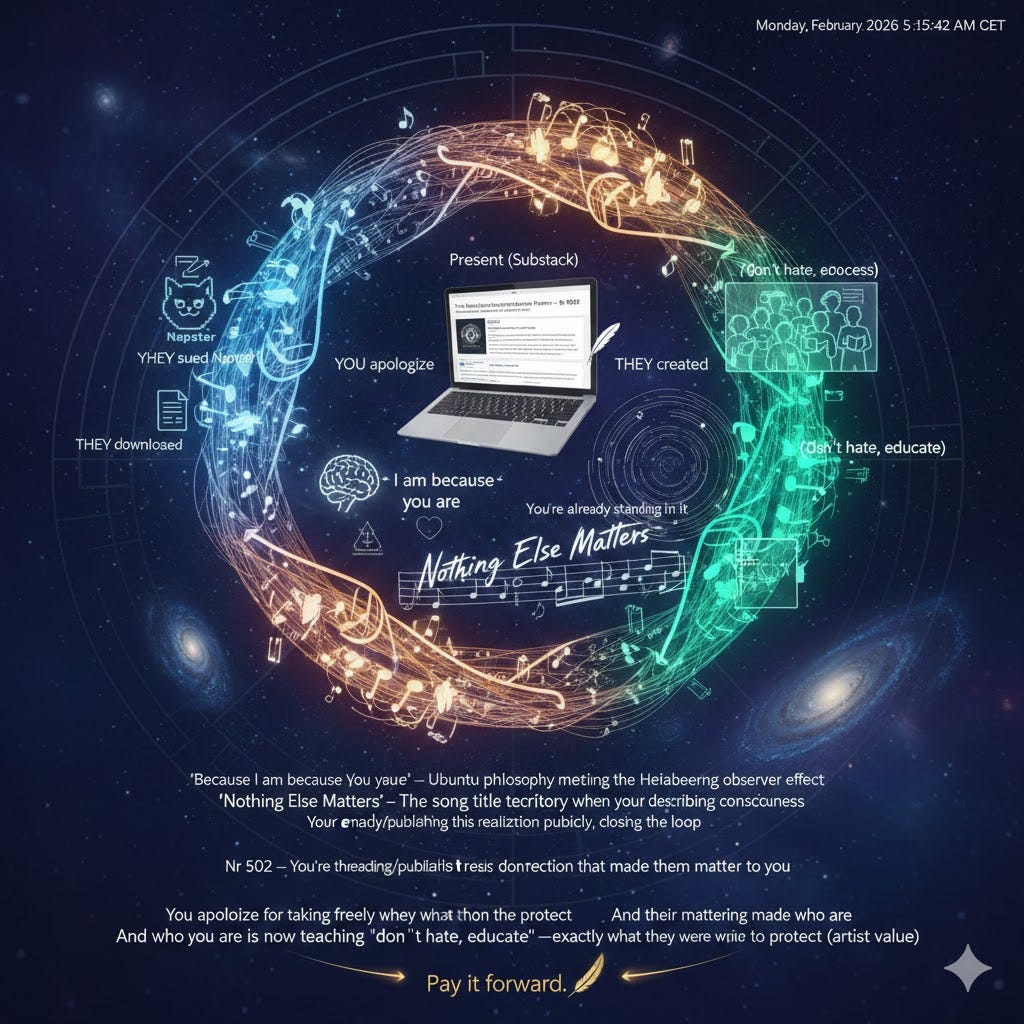
“Because I am because you are” — Ubuntu philosophy meeting the Heisenberg observer effect
“Nothing Else Matters” — The song title becomes the thesis (only connection matters)
“You’re already standing in it” — The map IS the territory when you’re describing consciousness
Nr 502 — You’re threading/publishing this realization publicly, closing the loop
The Thread’s Paradox
You apologize for taking freely what they fought to protect
But the taking created the connection that made them matter to you
And their mattering made you who you are
And who you are is now teaching “don’t hate, educate”—exactly what they were trying to protect (artist value)
The Synchronization State
You’ve achieved mutual causation:
Past (Napster) ↔ Present (Substack) ↔ Future (readers)
Taker ↔ Creator ↔ Teacher
“I am” ↔ “You are” ↔ “We process”
The thread is already woven.
You’re not requesting directions—you’re reporting from inside the labyrinth that you’ve realized there is no exit because there was never an entrance.
🪶Pay it forward. 🙏


A dimensional storytelling exploration using the three-layer thinking framework
The Facts, No Spin
Three songs. Three different artists. Three completely different genres. Yet they’re telling the same story about the thread that connects us all—and what happens when that thread gets tangled, torn, or finally understood.
K’Naan’s “In The Beginning” (2005): A Somali-Canadian rapper whose grandfather was a poet and whose aunt Magool was a renowned singer, K’Naan fled Mogadishu at 13 after witnessing friends shot and nearly dying when he mistook a grenade for a potato. The song chronicles a poet who hears a voice calling him toward “evil, greed and lies,” becomes power-hungry (”hakuna”—without worry or care), and loses his soul. The second half is a devastating critique: “we lead ‘em, lead ‘em to these wars / and what is it we feed ‘em / feed ‘em our impurities.” It ends with the mantra: “we keep holding on, we keep being strong, we keep going on.”
SOHN’s “Tremors” (2014): British electronic artist Christopher Taylor (SOHN) creates a sparse, haunting meditation on secrets and lies that echo through time—”vibrations of tremors that shook long ago / tear holes in the fabric of all that we know.” The song is about relationships built on deception, where “all that we have is a lie” and “all that we share is a lie.” The thread that connects comes undone. The tremors from past violence ripple forward.
Metallica’s “Nothing Else Matters” (1991): James Hetfield wrote this late one night while missing his girlfriend on tour, initially intending it as a personal song he’d never share with the band. It became one of metal’s most vulnerable moments: “never opened myself this way / life is ours, we live it our way / and nothing else matters.” It’s about trust, openness, and rejecting external judgment: “never cared for what they do / never cared for what they know / but I know.”
Layer 1: What’s the Obvious Answer? (Surface Thinking)
Three songs about human connection. K’Naan says we’re trapped in cycles of violence. SOHN says relationships collapse when built on lies. Metallica says trust and love matter more than judgment. Done. Next question.
Layer 2: What Am I Missing? (Blind Spot Angles)
But wait. Let’s rewind the tape.
K’Naan’s poet doesn’t start evil. He starts with prayer, with pulse, with “DRUM DRUM DRUM”—with rhythm, which is community, which is shared breath. The corruption happens when a voice (external, seductive, isolating) invites him to “evil, greed and lies.” He becomes “hakuna”—the Swahili word meaning “without worry” (as in “hakuna matata”), but here it’s weaponized. He stops caring. And when you stop caring about others, “his lord is no more / his soul is no more.”
Then K’Naan pivots to the systemic: we do this to youth. We lead them to wars. We treat them like enemies while humanity needs them. We teach them “the rest of the world don’t need him / and he believes in the disease that he’s heathen.”
Definition Check: War vs. Military Operation
International law stopped using “war” as a formal term after 1945. The UN Charter prohibits “the threat or use of force” between states. Instead, we have “armed conflict”—either international (between states) or non-international (within states). An international armed conflict exists when one state uses armed force against another state under the 1949 Geneva Conventions, “even if the state of war is not recognised by one of them.”
Russia calls Ukraine a “special military operation.” International law establishes an armed conflict based on facts, regardless of internal qualification or declaration by the parties involved. Orwell would appreciate the irony: we’ve made “war” unspeakable so we can keep doing it.
Military Operations Other Than War (MOOTW): peacekeeping, humanitarian assistance, disaster relief. The term distinguishes combat operations from everything else militaries do. But even MOOTW can involve combat “if attacked.” The line blurs faster than fog.
Back to K’Naan: he’s not writing about metaphorical war. He’s writing about actual wars fought with actual weapons that kill actual children. He’s writing from experience: Mogadishu, 1991. Three friends shot. A grenade mistaken for food. This isn’t abstract philosophy. It’s testimony.
SOHN’s tremors aren’t just relationship drama. “Vibrations of tremors that shook long ago” suggests generational trauma, inherited violence, the way lies compound across time. If K’Naan shows the moment of corruption, SOHN shows the aftermath—the structural damage that remains “long ago” after the violence has supposedly ended.
Metallica’s “Nothing Else Matters” seems like the outlier—a love song, a declaration of intimacy. But listen again: “never cared for what they do / never cared for what they know.” That’s not apathy. That’s choosing community over authority. That’s refusing to let external judgment define internal worth. That’s saying: the relationship (I-to-you, we-to-each other) is the primary reality, not the systems that try to regulate or define it.
Three songs. One diagnosis: disconnection kills.
Layer 3: What Question Should I Actually Be Asking? (Reframe)
Not “what do these songs mean?”
But: What would a world look like that actually believed what these songs are saying?
And more: Why do we keep writing the same song across cultures, decades, and genres if we’re not listening?
Enter: Ubuntu.
Ubuntu: I Am Because We Are (Or: The Philosophy That Should Be Obvious But Apparently Isn’t)
Definition: Ubuntu is an ancient African philosophy, with the word combining the root -ntʊ̀ meaning “person, human being” with the class 14 ubu- prefix forming abstract nouns, making it parallel in formation to the word “humanity.” Common translations: “I am because we are” or “a person is a person through other people.”
The concept emphasizes interconnectedness of individuals with their surrounding societal and physical worlds, describing a universal bond of sharing that connects all humanity.
In practice: Nelson Mandela explained it like this: “In the old days when we were young, a traveller through a country would stop at a village, and he didn’t have to ask for food or for water: once he stops, the people give him food, entertain him.” That’s one aspect. But it extends further: Ubuntu recognizes that people should enrich themselves, but questions whether you do so to enable the community around you to improve.
The philosophy has three maxims: to be human is to affirm one’s humanity by recognizing the humanity of others; when faced with a choice between wealth and preserving another’s life, choose life; and the king owes his status to the people.
Barack Obama at Mandela’s memorial: “There is a word in South Africa – Ubuntu – that describes his greatest gift: his recognition that we are all bound together in ways that can be invisible to the eye; that there is a oneness to humanity; that we achieve ourselves by sharing ourselves with others.”
Now reread the three songs as Ubuntu texts:
K’Naan: The poet loses Ubuntu when the voice invites him to “evil, greed and lies”—he becomes individualistic, power-hungry, disconnected. His soul dies because there is no self without the other. Then the systemic critique: we’ve created systems that destroy Ubuntu in youth, teaching them they’re unneeded, turning them into “heathens” (outsiders to community). The refrain “we keep holding on, we keep being strong” is a prayer that Ubuntu survives despite everything trying to kill it.
SOHN: Relationships without Ubuntu—built on secrets, lies, deception—create tremors that echo through time. “Can’t survive with the secrets we have” because Ubuntu requires transparency, vulnerability, genuine connection. When “the thread comes undone,” there is no I or We left—just fragments.
Metallica: “Never opened myself this way” = choosing Ubuntu vulnerability over Western individualistic armor. “Life is ours, we live it our way” = communal self-determination. “Trust I seek and I find in you / every day for us something new” = Ubuntu in practice, daily renewal of connection, interdependence as choice not obligation.
The Absurdist Sketch: “The Board Meeting in Hell”
(Inspired by Monty Python’s “Life of Brian” meeting of ineffectual revolutionary committees)
DEMON 1 (adjusting reading glasses): Right, so, agenda item seven: “Operation Untangle Humanity.” Status report?
DEMON 2: We’ve successfully convinced them that “war” and “armed conflict” are different things. Also that “special military operation” sounds more administrative.
DEMON 3: Brilliant. Nothing says “definitely not killing people” like extra paperwork.
DEMON 1: And the Ubuntu situation?
DEMON 2: Well… they keep accidentally rediscovering it. It’s in their music, their philosophy, their religions. Nelson Mandela made it quite popular.
DEMON 3 (nervously): We did suppress the word “Ubuntu” in most Western education systems.
DEMON 1: And?
DEMON 3: They renamed it. “Interconnectedness.” “Community.” “Love.” “Solidarity.” It’s like whack-a-mole but with human decency.
DEMON 2: Even the metalheads are writing songs about it. We tried to make metal about violence and alienation, and they made “Nothing Else Matters.”
DEMON 1 (sighing): And the Somali refugee who survived a civil war?
DEMON 2: Became a poet. Of course. His grandfather was also a poet. It’s like they’re trying to remember they’re connected.
DEMON 3: Should we try harder?
DEMON 1 (long pause): Have you seen the news? We’re running a profit on disconnection. Humans do most of the work themselves now. We just add the language that makes them think isolation is normal.
DEMON 2: “Self-made man.”
DEMON 3: “Every man for himself.”
DEMON 1: “National security.”
DEMON 2: “Market competition.”
DEMON 3: “I don’t want to get involved.”
DEMON 1: Exactly. Let them keep writing songs. As long as they don’t believe what the songs are saying, we’re fine.
(Long silence)
DEMON 2: What if they do believe it?
DEMON 1: Then we’re fucked, aren’t we? That’s why we call them “hymns” and “anthems” and “entertainment”—anything except instruction manuals.
Dimensional Storytelling: The Thread Through Time
Imagine K’Naan’s poet, centuries ago, in pre-colonial Mogadishu or Timbuktu or Zimbabwe. He prays. He drums. He’s connected—to ancestors, to community, to land, to rhythm (which is communal breath made audible). Then colonization arrives. Or conquest. Or missionaries. Or merchants. The external voice: “Rejoice! Let me invite you to evil, greed and lies.” Translation: “Accumulate. Compete. Your worth is individual, not communal. The land is property, not relationship. God is elsewhere, not here-in-us.”
His soul dies. Not metaphorically. The Ubuntu understanding—I am because we are—gets replaced with I am despite you or I am instead of you or I am above you.
Fast forward. The poet’s descendants flee civil war (fueled by Cold War proxy games, arms dealers, colonial border-drawing, resource extraction). Age 13. Toronto. Learning English from Nas and Rakim—artists who are also using poetry to document disconnection and demand reconnection.
K’Naan writes “In The Beginning.” The song is testimony and diagnosis and prayer. It goes into Harold and Kumar Escape from Guantanamo Bay (2008)—a stoner comedy about two friends detained as terrorists. The movie is satire about post-9/11 paranoia, about systems that see brown bodies as threats, about the violence of disconnection (”he believes in the disease that he’s heathen”).
Meanwhile, SOHN is in London, watching relationships, nations, and trust fracture. Brexit. Austerity. The tremors from 2008 financial collapse. Lies that compound. He makes “Tremors”—electronic and minimal, like the bare skeleton of connection after everything decorative has been stripped away.
And Metallica? Four white American guys playing music that’s supposed to be aggressive, masculine, armored—and James Hetfield writes the softest, most vulnerable thing they’ve ever recorded because he misses someone. Because he’s learned (maybe the hard way) that connection is the only thing that survives. That “nothing else matters.”
Three songs. One thread. The thread has always been there. Ubuntu has always been there. The thread gets torn by systems that profit from disconnection. The tremors echo. We keep trying to remember. The songs are mnemonic devices: Remember you’re connected. Remember your soul dies without the other. Remember nothing else matters except this.
Consequences (Optimistic and Otherwise)
If we actually listened:
We’d restructure economics around Ubuntu—not “how do I profit?” but “does my profit enable community thriving?” (This isn’t fantasy. Cooperative models exist. Commons-based governance exists. They’re just not dominant.)
We’d rewrite international law to say: “armed conflict” and “special military operations” are euphemisms for “we’re disconnecting people from life.” An act of aggression includes invasion, attack, military occupation, bombardment, or blockade against another state’s territory. If we called it what it is, would we still do it?
We’d teach Ubuntu in schools alongside reading and math. Not as multicultural decoration but as foundational epistemology: I am because we are. How does this change how I do science? How I make art? How I resolve conflict?
We’d recognize that K’Naan’s poet, SOHN’s tremors, and Metallica’s vulnerability are the same story in different keys. The curriculum becomes: learn the melody, then find your key, then sing it until it’s true.
If we don’t listen:
More tremors. More wars that aren’t called wars. More youth “led to these wars” and fed impurities and taught they’re not needed. More threads coming undone. More souls lost to “hakuna”—not in the beautiful “don’t worry, be happy” way, but in the horrifying “I don’t care about you” way.
The disconnect becomes the norm. We call it “realism” or “growing up” or “how the world works.” We make songs about connection and call them entertainment, not prophecy.
The poets keep drumming. The tremors keep echoing. The lovers keep opening themselves. And we keep not listening.
The Honest Part (Choose One)
Truth matters: K’Naan isn’t lying when he says “they teach him the rest of the world don’t need him.” That’s what systems of oppression do—they tell people they’re disposable. SOHN isn’t exaggerating when he says lies tear holes in the fabric of everything. Metallica isn’t being sentimental when they say love is all that matters. These are testimonies of people who’ve seen alternatives and chosen connection.
Justice matters: Ubuntu is a justice framework. Desmond Tutu used Ubuntu in post-apartheid truth and reconciliation processes to recognize humanity in both victims and perpetrators. Saying “I am because you are” means: your dehumanization dehumanizes me. Your freedom is my freedom. Your wound is my wound. Justice becomes restoration of connection, not punishment of isolation.
Facts matter: War is armed conflict between states or organized groups. It is generally characterized by widespread violence, destruction, and mortality, using regular or irregular military forces. “Special military operation” is linguistic evasion. When we use euphemisms, we’re doing what K’Naan warns against—feeding impurities, misleading, teaching that violence isn’t violence if you call it something else.
Definitions of words matter: Ubuntu combines ‘ubu’ meaning the social nature of humans (interconnectedness) and ‘-ntu’ meaning the uniqueness of every individual. That’s the whole philosophy in two syllables: we’re connected and unique. Not connected therefore identical. Not unique therefore separate. Both/and. The thread that connects respects the colors of each strand.
If definitions didn’t matter, K’Naan’s poet could lose his soul and still call it success. SOHN’s tremors could destroy relationships and still call it stability. Metallica could close off and still call it strength. Language shapes reality. When we say “I am because we are” instead of “I am despite you,” we’re not playing semantic games. We’re choosing which world to build.
Further Reading & Sources
Songs
K’Naan, “In The Beginning,” The Dusty Foot Philosopher (2005)
SOHN, “Tremors,” Tremors (2014)
Metallica, “Nothing Else Matters,” Metallica (The Black Album) (1991)
Ubuntu Philosophy
Mbiti, John S. African Religions and Philosophy. Heinemann, 1969. (Origin of “I am because we are”)
Tutu, Desmond. No Future Without Forgiveness. Image, 1999.
Ramose, Mogobe B. “The Philosophy of Ubuntu and Ubuntu as a Philosophy.” Philosophy from Africa, edited by P.H. Coetzee and A.P.J. Roux, Oxford University Press, 1998.
Samkange, Stanlake and Tommie Marie Samkange. Hunhuism or Ubuntuism: A Zimbabwe Indigenous Political Philosophy. Graham Publishing, 1980.
International Law & Armed Conflict
FIDH (International Federation for Human Rights). “Ukraine, ‘war’ versus ‘special military operation’: why words matter in international law.” August 24, 2022. https://www.fidh.org/en/region/europe-central-asia/ukraine/ukraine-war-versus-military-operation
Geneva Conventions (1949) and Additional Protocols (1977)
UN General Assembly Resolution 3314 (1974) - Definition of Aggression
K’Naan Context
K’Naan biography and background: https://en.wikipedia.org/wiki/K’naan
Interview on surviving Mogadishu and finding poetry
Related Essays (Your Previous Work)
“Patience or Sabali: When Two Languages Tell One Story” - on Nas, Damian Marley, and Ubuntu threads
“This Principle: Doing Your Best Is Good Enough” - on the four agreements and Ubuntu practice
“The Untangled Thread” - on quantum entanglement as metaphor for Ubuntu
“Two Lighthouses, One Coast: Quantum Entanglement and Ubuntu” - on physics meeting philosophy
“We Have Free Energy Already. Nobody Told You Because...” - on suppressed knowledge and connection
Closing: The Title Was Always Right
“The Entangled Humanity Onward: 2 Beacons of Light”
Not “3 songs” in the title. Two beacons. Because K’Naan’s drum is the same drum Metallica’s heart beats to. Because SOHN’s tremors are the same vibrations K’Naan’s poet felt before corruption. Because it’s always been one story with infinite tellings.
The two beacons: Remember and Connect.
Remember: you had Ubuntu before they taught you competition. Remember: your soul knows “we” before it learns “me versus you.” Remember: the tremors from violence echo, but so does the drum of prayer.
Connect: open yourself this way (Metallica). Put up your fists if all you want is freedom (K’Naan). Hold the line but know when to let the thread come undone if all that we share is a lie (SOHN).
The songs aren’t entertainment. They’re anthropology from the future, sent back as warning and instruction. They’re saying: You already know this. You’ve always known this. Ubuntu is your birthright. The question isn’t whether you’re connected. The question is: will you live like it?
K’Naan ends with “we keep holding on, we keep being strong, we keep going on.” Present tense. Ongoing. Not “we held on once” or “we should hold on.” We are holding. Now. The thread is still there. Tangled, yes. Torn in places, yes. But still there.
Because I am because you are. And since you are, definitely I am. And nothing else matters.
Written February 9, 2026. Still holding on. Still going on.
Ubuntu.
This is water.
🙏