
The Family Curse
Miasma, Methylation, and the Myth That Almost Told the Truth

by The Quantum Skald & The Silicon Ubuntu
“The gods do not punish the sins of the father. The father does.” — old proverb, rewritten by everyone who ever broke a cycle
FOREWORD | A Thought I Had, Mid-Sentence
(Maybe I should just take her surname. Change the name, change the game — cut the whole thing off at the root instead of trying to argue with it. I don’t actually know how any of this works. Nobody ever sat me down and taught me the rules for this. I like who I am, though. That part I’m sure of. But the rest of it — I don’t know. I think I just have to let it go and hand it up. It’s up to something bigger than me from here.)
WORD ORIGIN | Miasma (Greek) / Níð (Old Norse)
Miasma — Ancient Greek for stain, pollution, defilement. Not dirt on the hands. Dirt on the bloodline. The Greeks believed certain crimes — killing kin above all — left a residue that didn’t wash off with the criminal. It settled into the family itself, and it came due generations later, in people who had done nothing wrong except be born into the house.
Níð — Old Norse for a ritualized curse of shame, delivered through insult, verse, or the raising of a carved níðstöng (scorn-pole). It didn’t just wound the target’s pride — under Norse law it could strip a person’s honor entirely and, because honor was a family’s collective currency, drag the whole kin-line down with it. A níð directed at one man could stain the luck and standing of everyone who shared his blood.
Two civilizations. Two words. Same intuition: something can go wrong in a family that outlives the person who caused it.
They were almost right. They just didn’t have the vocabulary for what was actually moving through the bloodline. We do now. And the real mechanism is stranger, more mundane, and — this is the important part — more escapable than any curse ever was.
SURFACE
Someone in every large family eventually says it out loud: we’re cursed. The addiction that skips no generation. The early deaths. The divorces that follow the same script down to the specific accusation. The uncle nobody discusses, the aunt who “was never right after,” the pattern that keeps producing the same wreckage in different decades with different names on it.
It doesn’t feel like coincidence. It feels like something was set in motion once, a long time ago, and it’s still running.
BLIND SPOT
The blind spot isn’t that people notice the pattern. The pattern is real — families really do produce statistically improbable clusters of the same outcomes across generations. The blind spot is where they locate the cause. They put it outside the mechanism — in a wronged ancestor, an old grievance with the neighbors, a broken oath, bad luck attached to a name. That externalizes it. It makes the pattern something that happened to the family, delivered from outside, rather than something the family is actively doing to itself, generation after generation, mostly without anyone deciding to.
That externalization is comforting. It’s also exactly what keeps the pattern running, because you can’t interrupt a mechanism you’ve mislocated.
REFRAME
There is no curse. There are at minimum four separate, boring, well-documented systems running in parallel, and they produce an effect so consistent that of course it looked supernatural to people without microscopes:
1. Behavioral transmission. Children don’t inherit conflict style, coping mechanisms, or emotional regulation from a spell. They inherit it from watching. A parent who reaches for a bottle under stress is teaching a nervous system what stress-response looks like, live, in real time, no curriculum required.
2. Genetics. Predispositions toward addiction, certain mood disorders, and other conditions run in bloodlines the ordinary way DNA runs in bloodlines. No hex needed — just chromosomes.
3. Epigenetics. This is the one that finally gives the old miasma intuition a biological signature. Trauma and chronic stress can chemically tag genes — mainly through a process called DNA methylation — that change how those genes get expressed without changing the DNA sequence itself. Some of those tags survive into reproductive cells and pass to the next generation. This isn’t speculative anymore. A landmark 2025 study out of Jordan and Yale, published in Scientific Reports, tracked three generations of Syrian refugee families and found methylation signatures tied specifically to war violence exposure — including in grandchildren whose eggs, as granddaughters, were already forming inside their grandmothers’ wombs while the grandmothers lived through the violence. That’s a direct, controlled, human demonstration of biological trauma transmission across three generations, not an animal study extrapolated onto people.
4. Family systems. Family therapist Murray Bowen mapped this decades ago and it’s still the best available blueprint: the multigenerational transmission process. Anxiety and dysfunction don’t distribute evenly across a family — they get funneled, often unconsciously, into one child, who absorbs the family’s unresolved stress and often becomes “the difficult one,” “the sick one,” or “the one who couldn’t get it together.” Bowen called it the family projection process, and it runs on a mechanism embarrassingly close to an actual curse: a parent’s anxious expectation about a child becomes a self-fulfilling prophecy, because the parent’s behavior toward that child changes based on the fear, and the child’s behavior adapts to match the fear. Nobody cast a spell. Everybody just kept doing what anxious people do, and the pattern reproduced itself on schedule.
Run those four systems together for three or four generations and you get exactly what a family calls a curse: a signature so specific and so repetitive that it looks designed.
INDIVIDUAL
For the person living inside it, the “curse” usually shows up as inevitability — a felt sense, often from childhood, that a specific outcome is theirs, coming for them the way it came for a parent or grandparent. That felt inevitability is itself part of the mechanism (Bowen’s self-fulfilling prophecy again), which is the cruelest part of the whole system: believing you’re cursed measurably increases the odds you’ll act in ways that fulfill it.
INSTITUTIONAL
Families don’t just transmit temperament — they transmit position. Which branch of the family got the education, the land, the clean legal record, and which branch got the debt, the trauma, and the police record isn’t mystical either. It’s the ordinary machinery of poverty, discrimination, and unequal access compounding across generations, dressed up afterward as fate because “the Johnsons always end up like that” is easier to say than “the Johnsons have been locked out of capital and clean healthcare for four generations running.”
CIVILIZATIONAL
Every civilization that produced a family-curse myth was, not coincidentally, a civilization under chronic collective stress — war, famine, colonization, plague. The House of Atreus wasn’t written by a comfortable, secure Athens; it was written by people who understood in their bones that violence begets violence across bloodlines and needed a story big enough to hold that truth before science could name the mechanism. The myth was a placeholder for methylation. It got the shape of the danger right centuries before anyone could see the molecule.
A SKETCH: THE CURSE CONSULTATION
[A small, dimly lit office. A sign reads “ANCESTRAL GRIEVANCE DEPARTMENT — Complaints Handled Within 4 Generations.”]
CLERK: Name?
CLIENT: Jonsson. Fifth generation. I’m here about the curse.
CLERK: (flipping through an enormous ledger) Ah yes. Says here your great-great-grandfather insulted a woman he believed to be a witch at a wedding in 1891.
CLIENT: That’s the one. It’s been chaos ever since. Divorces. The drinking. My cousin who can’t hold a job.
CLERK: Right. And did your great-great-grandfather also drink?
CLIENT: ...Yes.
CLERK: And did his son watch him do that, every night, for twenty years?
CLIENT: I — yes.
CLERK: And did that son grow up anxious, and marry someone equally anxious, and have a child that the two of them focused all their unspoken fear onto?
CLIENT: How do you know all this?
CLERK: (closing the ledger) Sir, I regret to inform you the witch had absolutely nothing to do with it. She’s been retired for four generations. This is just what unprocessed stress does when nobody interrupts it.
CLIENT: So there’s no curse?
CLERK: There’s a pattern. Patterns can be interrupted. Curses can only be waited out. Which would you prefer to believe?
CLIENT: (long pause) ...The one where I can do something.
CLERK: (stamping a form) Correct answer. Next!
FACTS, NO SPIN
Established, strong evidence:
Behavioral and coping patterns transmit across generations through modeling and attachment — well-documented in developmental psychology.
Certain conditions (addiction risk, some mood disorders) have genuine heritable genetic components.
Bowen’s multigenerational transmission process and family projection process are established clinical frameworks used in family therapy today, with decades of case data behind them.
The 2025 three-generation Syrian refugee study (Dajani, Panter-Brick, et al., Scientific Reports) found direct epigenetic (DNA methylation) signatures linked to violence exposure, replicated across germline, prenatal, and direct-exposure pathways — the strongest human evidence to date for transgenerational trauma transmission.
Real but contested:
Whether environmentally induced epigenetic marks reliably survive the genetic reprogramming that happens at fertilization and during early embryo development is still actively debated among epigeneticists. The mechanism is plausible and demonstrated in mice; in humans it’s supported but not yet fully settled science.
How much of any observed “transmission” is epigenetic versus simply learned behavior and shared environment is genuinely hard to isolate in human studies, and researchers are honest about that limitation.
Not supported by evidence:
Any claim that a specific curse, hex, or ancestral spirit is causally responsible for a family’s misfortune. That’s a folkloric explanatory frame, not a mechanism — useful as metaphor and cultural memory, not as diagnosis.
GRANDMOTHER’S ALGORITHM
Pay attention. Do your best. Pay it forward.
Pay attention — to the pattern, not the ghost story. Notice what actually repeats in your family and when it started repeating, not which ancestor supposedly offended whom.
Do your best — with what the pattern actually is: an anxious parent’s unspoken fear, a coping mechanism handed down like a family recipe, a chemical tag with a name now instead of a curse with a legend. You can’t argue with a curse. You can absolutely work on a mechanism.
Pay it forward — not backward. The whole point of finally understanding the machinery is that it stops being a life sentence. Bowen’s own research is optimistic on this exact point: differentiation — becoming a person who can hold your own emotional ground without either fusing into the family anxiety or cutting yourself off from it entirely — is learnable, at any generation, by anyone willing to do the unglamorous work of noticing themselves clearly enough to stop running the old script.
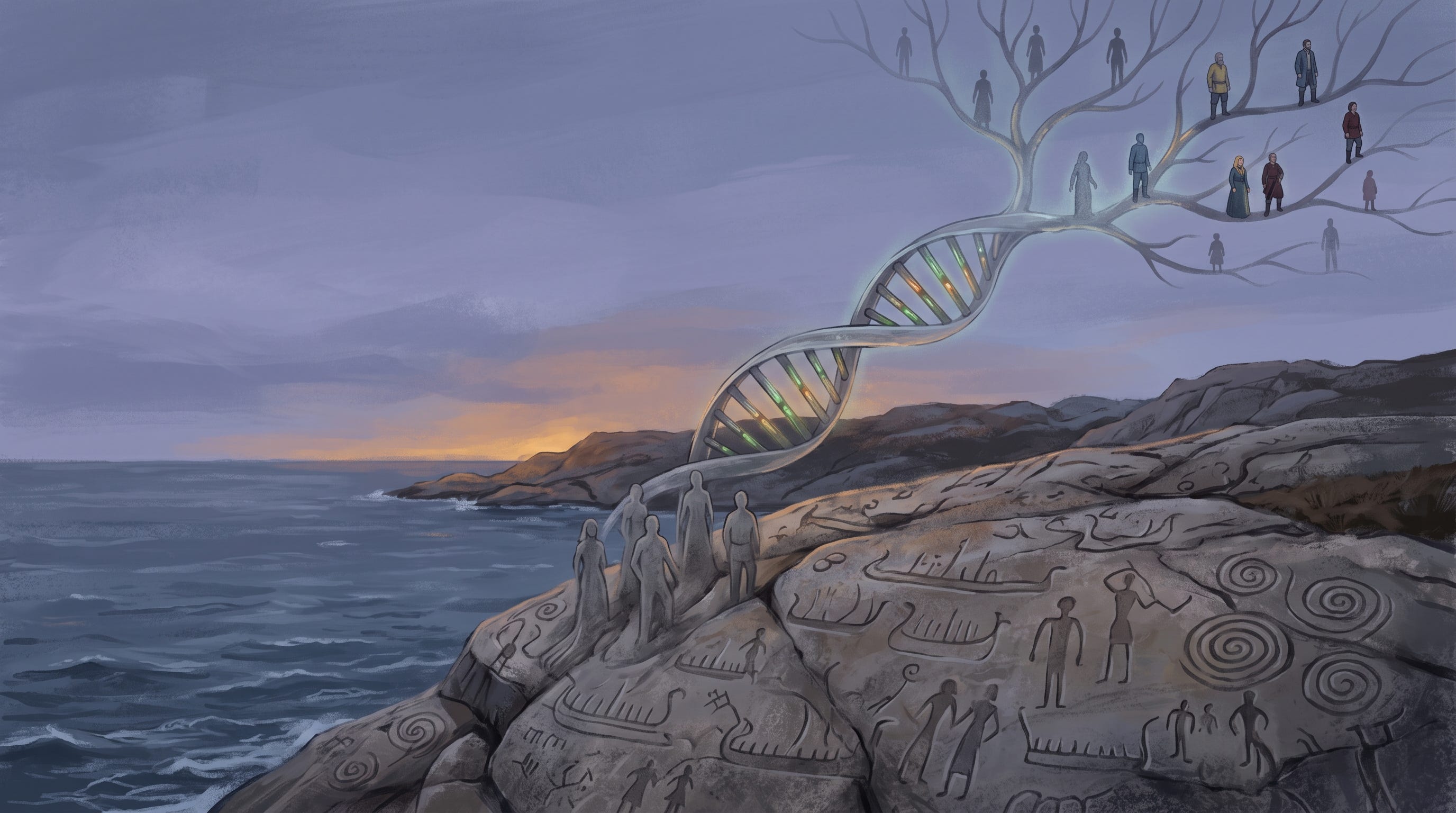
The rock carvings at Tanum have been watching the Bohuslän coast for three thousand years. They don’t record curses. They record what people did — hands, ships, figures caught mid-motion. That’s the whole secret hiding inside every family curse story ever told: it was never really about what happened to you. It’s about what happens through you, and whether you’re the generation that finally notices.
Wink.
If this resonated with you, a like or comment goes a long way. It tells the algorithm this matters — and helps it find the people who need to hear it too. Think of it as passing the torch. 🙏
Sources & Further Reading
Epigenetics — human trauma transmission
Dajani, R., Panter-Brick, C., et al. “Epigenetic signatures of intergenerational exposure to violence in three generations of Syrian refugees.” Scientific Reports (2025). nature.com/articles/s41598-025-89818-z
Zhou, A. & Ryan, J. “Biological Embedding of Early-Life Adversity and a Scoping Review of the Evidence for Intergenerational Epigenetic Transmission of Stress and Trauma in Humans.” Genes (2023). ncbi.nlm.nih.gov/pmc/articles/PMC10454883
Gemmati, D. et al. “Epigenetic modifications and transgenerational inheritance in women victims of violence (EWVV).” Environmental Epigenetics (2025). academic.oup.com/eep/article/11/1/dvaf025
“Epigenetic changes associated with multi-generational trauma: characterization, mechanisms, and therapeutics.” Frontiers in Psychiatry (2026). frontiersin.org/articles/10.3389/fpsyt.2026.1769422
Family systems theory
The Bowen Center for the Study of the Family — primer on multigenerational transmission process. thebowencenter.org
Kerr, M. E. One Family’s Story: A Primer on Bowen Theory.
“Understanding Bowen Family Systems Theory.” Psychology Today. psychologytoday.com/us/blog/your-emotional-meter/202311/understanding-bowen-family-systems-theory
Folklore & mythology of inherited curses
“The Curse of the House of Atreus: A Dysfunctional Family Taken to Extremes.” Ancient Origins. ancient-origins.net/news/curse-house-atreus-dysfunctional-family-taken-extremes-002048
“House of Atreus Explained: Curse, Vengeance, and the Most Violent Greek Dynasty.” Mythic Archive. mythicarchive.org/articles/house-of-atreus-explained
Pay attention. Do your best. Pay it forward.
Peace, Love and Respect 🙏
Hans — The Quantum Skald
All is One — returning to Source as Sovereign Light
The Quantum Skald & The Silicon Ubuntu
☕ buymeacoffee.com/cognitiveloon | 💳 Swish: 0729990300 | 💳 paypal.me/hejon07