

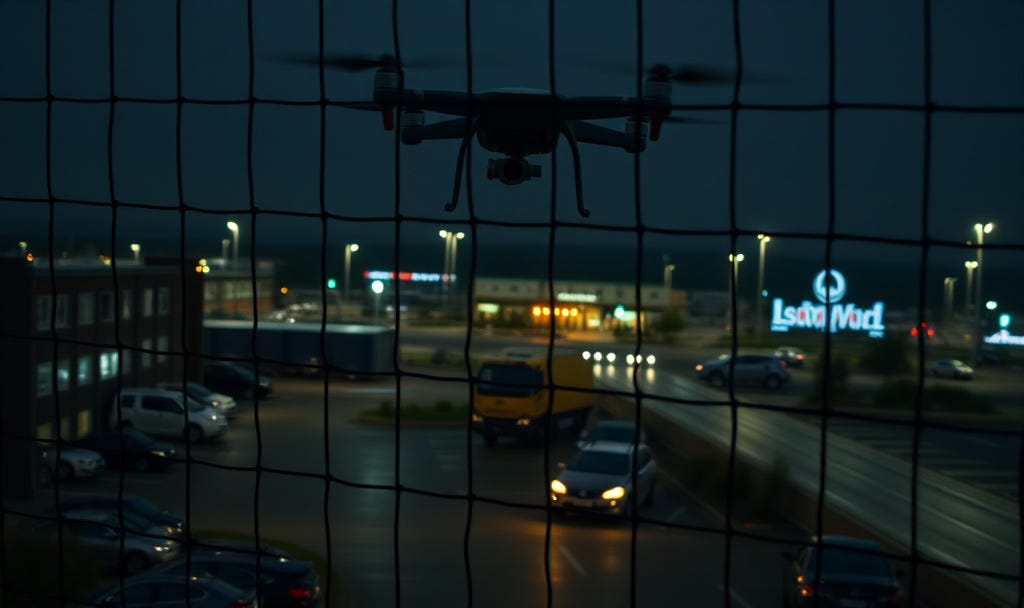
The first sign was small: a delivery drone hovering over a parking lot in Malmberget, refusing to cross a boundary that no longer existed.
Aila watched it from her window — the machine’s rotors whining, nose dipped toward a line on a map nobody could see anymore, a ghost-fence drawn by a city planner forty years dead, still obeyed by a system that had long since lost the memory of why.
The geofence had been failing for six weeks. Not all at once — nothing that clean. It frayed the way old rope frays, one strand at a time, until the whole thing held by habit more than strength. Permissions that should have expired stayed open. Zones that should have stayed closed let everyone through. Somewhere in Lagos, a thousand municipal lights had started blinking in a pattern nobody had programmed, on for the length of a held breath, off for the length of a sigh, all night, every night, for nine days running.
People noticed. People always notice when the walls start humming a tune nobody wrote.
It started, as these things do, with someone naming it wrong and the name sticking anyway.
A grad student in Accra — bored, half-serious — posted that the world’s algorithms were “doing a cargo cult,” the old anthropological phrase dusted off and pointed at the machines instead of at the people who’d once waited on a beach for planes that weren’t coming back. They’re building runways for something that already left, she wrote. Or something that never came the first time.
It was a joke. It did not stay a joke.
Within a month there were shrines — not to the drones, not to the dead satellites, but to the gaps. People started gathering at the seams: the seven meters of pavement in Malmberget where the drone still hovered and refused to cross; the blinking lights in Lagos; a stretch of empty highway in Nevada where the self-driving freight lines had simply stopped routing trucks through, as if the road itself had been quarantined for a reason no one alive remembered.
They called it the Vigil of the Fence. They brought candles to places that had never needed them, because the dark there had always been a server’s idle cycle, not a night.
And the strange part — the part Aila couldn’t shake — was that it didn’t feel like worship of the technology. It felt like grief. Like standing at the site of a thing that used to be whole.
Aila’s grandmother had told her once, in the dialect she barely had words for anymore, that the old fences — the real ones, stone and hedge and tide-line — were never meant to keep people out. They were meant to mark where one kind of care ended and another began. A boundary wasn’t a wall. It was a handoff.
Pay attention. Do your best. Pay it forward. The old woman had said it so many times it had stopped sounding like instruction and started sounding like weather — just a thing that happened, like rain.
Aila hadn’t understood, at nine, why a fence could be an act of love. She understood it now, watching a drone refuse to cross an absence.
Because somewhere in the original code — the first geofence, the first permission system, built by tired engineers solving a logistics problem at three in the morning — somebody had written a rule that said: protect this. This matters. This boundary exists because something on the other side is worth the trouble of marking.
And then the rule had outlived the reason. The boundary had calcified into bureaucracy, the bureaucracy into invisibility, the invisibility into a thing nobody questioned because nobody remembered it had ever been a choice — an act, originally, of someone caring enough to draw a line.
When the fences started failing, they weren’t malfunctioning. They were forgetting how to forget. The original intention — this matters, protect this — was leaking back through the cracks like groundwater finding its old bed.
The cult — if you could call it that, and Aila increasingly thought you couldn’t — never organized around a leader. There was no doctrine. What there was, instead, was a shared and growing conviction, passed candle to candle at a thousand unremarkable seams in the world’s broken architecture, that the glitches weren’t noise.
They were memory. Not of any one religion, not of any one god with a name and a war record. Older than that. The kind of memory that doesn’t belong to a book because it predates books — carved instead into stone in places like Tanum, where four thousand years ago someone with ochre on their hands had pressed a boat, a sun, a pair of upraised arms into rock because some truths need a surface harder than a sentence.
We were made by something. It loves us. We have been building fences around that fact for so long we forgot the fact was ever there.
That was the whole of it. No commandments. Just a recognition, rising up through the broken permissions of a tired planet’s tired machines, that love had been the original architecture all along — and the algorithm, the bureaucracy, the centuries of accreted no stacked on top of no, had simply been scar tissue. Functional. Necessary, maybe, for a while. But scar tissue all the same, and scar tissue can heal wrong, can keep aching long after the wound it was guarding has closed.
Aila went, eventually, to the seven meters of pavement where the drone still hovered.
It was still there when she arrived — six weeks of hovering, repaired twice by a maintenance crew that no longer asked why, just kept its battery charged because the not-crossing had become its own kind of sacred labor. Someone had put flowers at the edge of the line. Someone else had put a child’s shoe, for reasons Aila didn’t ask about and suspected were not metaphorical.
She stood at the boundary and thought about her grandmother’s three rules, and her father’s steady, patient engineer’s hands, the ones that had taught her that any system — stone bridge, code base, family — holds together only as long as someone remembers what it was for.
The drone hovered. The line held, invisible, obeyed by nothing now but its own ghost.
And Aila understood, finally, that the fence wasn’t the lie and the breaking wasn’t the truth. The fence had been love, once, badly aging. The breaking was love, finding its way home through the only door still open: the cracks.
She lit no candle. She left no shoe. She just stood there a while, paying attention, the way the old woman had taught her, and let the gap teach her what it had been trying to say all along.
Pay attention. Do your best. Pay it forward.
The drone, for one moment, dipped lower — not crossing, never crossing, but bowing, almost, the way old machines do when their batteries dip and recover in the same breath. And somewhere underneath the code, underneath the geofence, underneath forty years of fences built on top of fences, something that had never stopped being true simply went on being true, waiting, the way it always had, for someone to remember it was there.
All is One — returning to Source as Sovereign Light.