
The Fork in the Road
Bohuslän, Free Will, and the Quiet Revolution on Your Plate

By The Quantum Skald & The Silicon Ubuntu | Restoration of Perception
“Pay attention. Do your best. Pay it forward.” — Farmor’s maxim. Still the sharpest policy brief ever written.
Let’s Start With What Actually Happened
Three municipalities in Bohuslän — Kungälv, Tjörn, and Öckerö — have just quietly made history.
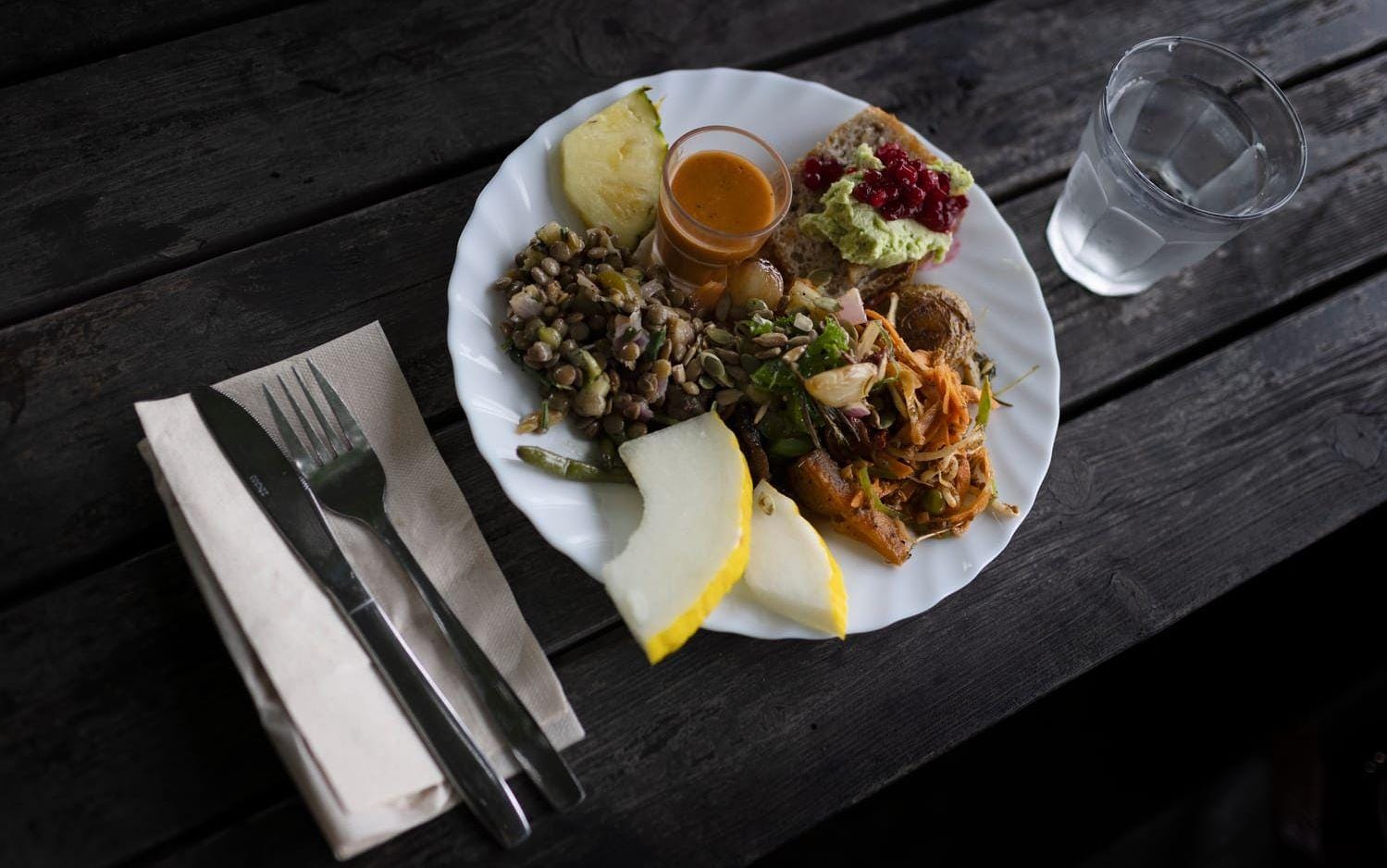
From 1 March 2026, when their employees book external conferences through Gothenburg’s new procurement agreement, vegetarian is the default. You can still choose meat. Nobody is stopping you. You just have to actively say so.
Six other Bohuslän municipalities — Uddevalla, Lysekil, Strömstad, Munkedal, Sotenäs, and Tanum — have not joined. Advocates from Sustainable Food System, writing in local media, are asking why not.
Cue: The Great Swedish Meatball Debate.
The Numbers That Started the Fight
Let’s set the table with some facts — the kind that don’t move no matter how hard you argue with them.
On health: The WHO classifies processed meat as a Group 1 carcinogen. That’s the same category as tobacco and asbestos — not because a sausage is as dangerous as a cigarette, but because the evidence of cancer risk is equally certain. Colon and rectal cancer among Swedes under 50 has nearly tripled since the 1990s, according to Karolinska Institutet. The Swedish National Food Agency estimates that if Swedes simply ate according to the agency’s own recommendations, approximately 3,500 cancer cases and 14,900 cardiovascular cases could be avoided every single year.
Not maybe. Annually.
On the planet: Animal production occupies 83% of the world’s farmland while delivering only 18% of our calories — according to research published in Science. Swedish beef generates roughly 56 times more greenhouse gases per kilogram than beans, per RISE research. And cows and sheep drive 100 times greater biodiversity loss per protein unit than legumes, according to Nature Food.
We are using most of the planet to produce a fifth of the food. That is not a food policy. That is a slow-motion geological event.
On precedent: Lund University: vegetarian is the norm at internal meetings. The Swedish National Agency for Education: vegetarian-only internally. Helsinki: halving meat and dairy intake by 2030. Poland: introducing a fully plant-based day every week from autumn 2026. And over 80% of Swedish municipalities already have some version of “vegonorm” in their conference procurement, according to a nationwide survey published in Frontiers in Sustainability.
So six Bohuslän municipalities are not leading the future. They are currently behind the present.
But Wait — You Raised Something More Interesting
Here is where I want to stop, step back, and honor what you actually asked.
You wrote: “Yes 100% but what about free will and make decisions organically?”
That is not a small question. That is the question. And it deserves a serious answer, not a dismissal.
The Case FOR Free Will (Steel-Manning the Other Side)
Let us be honest about what the critics of vegonorm are actually saying — because not all of it is bad faith.
1. Sovereignty matters. There is a principle, not irrational and not selfish, that says: who I am is expressed, in part, through what I choose to eat. Food is culture. Food is identity. Food is memory — farmor’s cooking, midsommar traditions, the smell of a particular kitchen. When an institution decides what you eat by default, it is not neutral. It is, even gently, a hand on your shoulder pointing you somewhere.
2. Defaults are not neutral. This is actually a point both sides agree on — though they draw opposite conclusions from it. The behavioral economists behind Nudge Theory (Thaler and Sunstein) call it “libertarian paternalism”: the choice is always there, you just have to ask for it. But critics point out that if you need psychological energy to resist a default, the default is already doing something to your autonomy — even if it doesn’t formally restrict it. Research published in Self-Determination Theory found that even mild default nudges can reduce participants’ sense of internal motivation. The freedom exists on paper; the friction exists in practice.
3. Who decides what “better” looks like? This is the sharpest philosophical edge. Nudge theory requires what researchers call a “choice architect” — someone who decides which direction is the healthy one. In this case, that is the municipality, following WHO guidelines, RISE research, and Karolinska data. But there is always a political question lurking: whose values are embedded in the architecture? Today it is plant-based food for climate. Tomorrow — in a different political climate — it could be something you are less comfortable with. The mechanism is the same. Only the direction changes.
These are legitimate concerns. They deserve to be spoken aloud rather than waved away.
The Case FOR the Default (And Why It’s Still Compelling)
And yet.
1. There is no neutral default. The libertarian critique of nudging forgets one thing: the current system is also a choice architecture. Meat-first has been the default at every Swedish conference buffet for generations. Nobody voted for it. Nobody debated it. It just was — and it shaped what people ate, what they thought was normal, and what kind of food system we built around it. The question is never default vs. no default. The question is always: which default, and chosen by whom, toward what end?
2. You can still choose. This is not a ban. This is not a law. This is a sentence in a procurement agreement that says: when our employees book conference food, start with vegetarian. If you want meat, you ask. That is all. The study from Hansen et al., published in a peer-reviewed journal, ran this experiment at three actual conferences. Vegetarian choice went from 2-12% to 86-89% — not because people were forced, but because the path of least resistance led somewhere different. And crucially: a clear majority of participants reported accepting the nudge positively.
3. Taxpayer money already comes with direction. Here is something people forget in the free will debate: these are not private lunches. These are publicly funded conference meals paid for by municipal budgets — which means every citizen’s tax contribution is involved. When public money is spent, the public interest applies. Uddevalla has already signed the Climate 2030 agreement, committing to fossil independence for all of Västra Götaland by 2030. The food on the conference table is not separate from that commitment. It is part of it.
4. The research on autonomy is nuanced. A 2024 study published in Behavioural Public Policy (Michaelsen et al., N=2083) found that participants subjected to prosocial opt-out nudges made more sustainable choices — but did not report lower feelings of autonomy or choice satisfaction compared to opt-in or active-choice groups. The felt sense of freedom was preserved. The outcomes changed.
The Missing Link: It’s Not Either/Or
Here is where Farmor’s maxim starts doing real work.
Pay attention. — The data is clear. The system we have is not working. The planet is signaling this continuously.
Do your best. — A sentence in a procurement agreement is not your best effort at civilizational change. But it is a real, measurable, cost-free step toward it. It costs nothing. It helps.
Pay it forward. — The child born in Bohuslän in 2035 did not choose the food system we handed them. They will, however, live in it.
The free will argument assumes that individuals are choosing freely right now. They are not. They are choosing within a system designed by advertising, subsidy structures, agricultural policy, and cultural habit — none of which they voted for either. The question is not free will vs. no free will. The question is: which invisible hand is shaping your choice, and whose interests does it serve?
A vegetarian default at a municipal conference is not the end of autonomy. It is one small rebalancing of a system that has been tilted for decades — toward a particular food industry, a particular carbon footprint, a particular set of health outcomes.
You can still order the meatball. Nobody is stopping you.
But the default — for once — will have been chosen by someone thinking about your grandchildren’s future, not their quarterly earnings.
What the Six Missing Municipalities Are Actually Saying
By not joining, Uddevalla, Lysekil, Strömstad, Munkedal, Sotenäs, and Tanum are not defending free will.
They are defending inertia.
They are leaving the default exactly where it has always been — chosen by nobody, questioned by nobody, serving the status quo by doing absolutely nothing. That is also a choice. It is just an unconscious one.
And here is the uncomfortable truth: every day they wait, the conference buffets in their municipal buildings are quietly saying something on their behalf. About what they think normal looks like. About whose health they are thinking about. About whether the Climate 2030 goals they signed are something they actually intend to reach.
A sentence in a procurement agreement. That is all it would take.
Bohuslän’s granite has been here for half a billion years. The decisions we make about food systems in 2026 will echo far longer than any single conference lunch.
Pay attention. Do your best. Pay it forward.
The Facts, No Spin
3 municipalities in (Kungälv, Tjörn, Öckerö) via Gothenburg’s agreement from March 2026
6 municipalities out (Uddevalla, Lysekil, Strömstad, Munkedal, Sotenäs, Tanum)
80%+ of Swedish municipalities already have some vegonorm in place nationally
Vegetarian conference choice increases from ~6% to ~87% when it becomes the default (Hansen et al., peer-reviewed)
Free choice is preserved — meat is still available on request
Zero cost to implement — one clause in a procurement document
Uddevalla has signed Climate 2030 — the commitment already exists
All is One — returning to Source as Sovereign Light.
Peace. Love. Respect.
If this resonated with you, a like or comment goes a long way. It tells the algorithm this matters — and helps it find the people who need to hear it too. Think of it as passing the torch. 🙏
Support the work:
buymeacoffee.com/cognitiveloon | Swish: 0729990300 | hejon07.substack.com