
THE GRANARY PROTOCOL
How the Book of Revelation Wrote the Architecture Document for the 21st Century’s Control Grid — and Nobody Noticed Until It Was Already Live





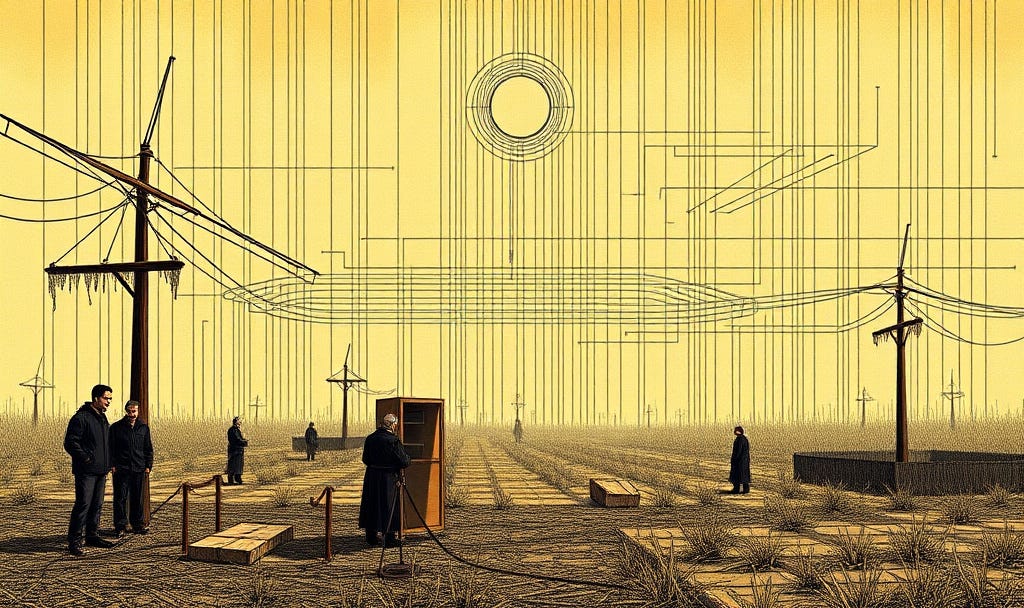
By Hans Jonsson | The Quantum Skald & The Silicon Ubuntu Cognitive-Loon | hejon07.substack.com
“And he causeth all, both small and great, rich and poor, free and bond, to receive a mark in their right hand, or in their foreheads: And that no man might buy or sell, save he that had the mark.” — Revelation 13:16–17, King James Bible
Let’s start with the uncomfortable part.
John of Patmos, writing around 95 CE in a Roman prison-colony on a small Aegean island, described a control system that requires a mark — a credential — before you can participate in the economy. No mark, no trade. No compliance, no bread. The ancient world’s scariest thought experiment.
Now let me tell you what the Bank for International Settlements published in June 2025.
They called it “the next-generation monetary and financial system.” A unified ledger. Tokenized central bank reserves, tokenized commercial bank money, and tokenized government bonds — all on the same programmable platform. The BIS and seven central banks, including representatives from North America, Europe, and Asia-Pacific, are already testing it through Project Agorá, involving 43 private-sector financial institutions.
The architecture document for John’s vision has been filed. It’s a 47-page technical paper. It has footnotes.
SURFACE LAYER: What They’re Saying Out Loud
The pitch is clean and reasonable. It always is.
The BIS argues — correctly, on technical merits — that today’s financial system is a patchwork of siloed proprietary databases. When you send money internationally, behind the glamour of your banking app, clerks at correspondent banks are effectively passing messages through systems built in the 1970s. It’s slow. It’s expensive. It loses money to intermediaries at every hop.
Tokenization fixes this. Put everything — your deposit, the government bond, the settlement instruction — on a single programmable ledger. Atomic settlement: the asset moves and the payment clears simultaneously, removing counterparty risk. Compliance checks, liquidity management, fraud detection: embedded in the smart contract, executing automatically.
Efficiency. Trust. Sound money. A new era.
This is the carrot. And unlike most carrots dangled at humanity throughout history, this one is genuinely orange. The efficiency gains are real. The reduction of settlement risk is real. The appeal to the unbanked 1.4 billion people who can’t currently access the financial system — that’s real too.
Which is exactly why this is the most important architecture decision in human history, and why almost nobody outside central banking circles is paying attention.
BLIND SPOT LAYER: The Programmability Problem
Here is the word you need to underline, circle, and staple to your wall: programmable.
A programmable currency is not just a faster version of the money in your wallet. It is a fundamentally different object. Your current cash — the physical kind — has no memory. It doesn’t know where it’s been. It doesn’t expire. It doesn’t refuse to buy certain things. It doesn’t check your social score before completing a transaction.
Programmable money can do all of those things. By design. That’s the point.
The same platform that executes “atomic settlement” for a bond trade can just as easily execute: “This wallet is frozen pending investigation.” Or: “This currency unit is valid for food purchases only, within a 50-kilometer radius, for 30 days.” Or — and here is where Revelation stops sounding metaphorical — “This account has been flagged. No buy. No sell.”
Canada in 2022 gave us the pilot episode. The trucker convoy protests. The government didn’t need stormtroopers. They froze bank accounts. With existing — primitive by BIS standards — financial infrastructure. Forty-seven accounts suspended. No court order required in real time. The money was there. The access was removed.
Now imagine that architecture, but globally integrated, AI-monitored, and executing in milliseconds.
The BIS doesn’t hide this tension. They acknowledge, in the fine print of their IMF collaboration from April 2026, that programmable money requires “governance arrangements that reconcile central bank control with operational interoperability.”
Governance arrangements. That’s the phrase. That’s where John’s Beast lives. Not in the technology. In the governance.
THE GRANARY PROTOCOL: A Very Old Idea Wearing New Clothes
This is the missing link. The one nobody is connecting.
Ancient empires didn’t control populations primarily through armies. They controlled them through grain. Egypt. Rome. The Byzantine Empire. Whoever controlled the granary controlled the population. You don’t need to threaten people with swords if they know that stepping out of line means the granary door closes.
The granary protocol is the oldest governance technology in human civilization. It predates writing. It predates coinage. It is: “We store the thing you need to live. You behave. You eat.”
Revelation 13 is not a supernatural prediction. It is a pattern recognition document. John lived in the Roman Empire. He watched Roman imperial cult enforcement — you sacrifice to Caesar’s image, you get your commercial license renewed, you can trade in the marketplace. You refuse? You’re outside the system. The mark of Caesar’s approval was the precondition for economic participation. He wasn’t hallucinating. He was describing what he saw, dressed in visionary language because describing it plainly would have gotten him executed faster.
The Granary Protocol across history:
Ancient Egypt: Pharaoh owns the grain. Joseph administers it. Compliance with central authority is the price of food during famine.
Roman Empire: Imperial cult compliance = commercial license. The “mark” is loyalty to the system.
Soviet collectivization: The state controls agricultural output. Dissidents starve. This is documented.
China’s Social Credit System (2025): 1.4 billion people. Algorithmic scoring. Low score = restricted travel, restricted commerce, restricted access to services.
BIS Unified Ledger + AI food supply chain (2026): The granary is now the entire economy, and the protocol runs in real time on smart contracts.
The technology changed. The architecture didn’t.
THE AI LAYER: When the Granary Becomes Sentient
Now add the piece that makes it complete.
The AI in food supply chain market was valued at $2.7 billion in 2024. It’s projected to reach $13.7 billion by 2029 — a 30.9% annual growth rate. Major corporations have already embedded AI into food production: Nestlé, Tyson Foods, IBM Food Trust. The entire supply chain from seed to shelf is being instrumented with IoT sensors, RFID tags, computer vision, and predictive analytics.
This is — again — genuinely useful technology. AI catching salmonella contamination before it ships. AI predicting crop disease two weeks before it destroys a harvest. Real benefits. Real lives saved.
But here is what it also builds: a complete, real-time map of who produced what food, where it went, who bought it, and whether their purchasing credential was valid at the moment of transaction.
Connect that map to the BIS Unified Ledger. Connect the Unified Ledger to a digital identity system (the UK is rolling one out now; the EU’s is in preparation; India’s Aadhaar covers 1.4 billion people). Connect digital identity to a behavioral scoring system, whether you call it a social credit score or an ESG compliance rating or a carbon footprint allowance.
You don’t need a chip in anyone’s hand.
The phone in your hand is the hand.
The interface on your forehead — the screen you stare at, that stares back — is the forehead.
The mark is the access credential. The app. The wallet. The account. The profile. You carry it voluntarily because the alternative is being outside the system, and being outside the system in a cashless, AI-monitored economy means you can’t buy bread.
This is the Granary Protocol 2.0. It is not coming. It is being installed.
THE REFRAME: This Is Not a Religious Argument
I want to be precise here because precision matters.
I am not arguing that the BIS executives are the Antichrist, that microchips are literally Satan’s fingerprint, or that the world will end on a date that someone calculated from a blood moon calendar.
I am arguing something more specific and, I think, more disturbing:
Ancient wisdom traditions — including Revelation — encoded pattern recognition about power. The people who wrote these texts had watched empires rise and fall. They saw, repeatedly, how centralized control of essential resources becomes centralized control of human behavior. They dressed the warning in mythological language because mythology travels across centuries in ways that dry policy analysis does not.
The pattern is: control the medium of exchange → control behavior → normalize the control until people can’t imagine life without it.
We are in the normalization phase right now. The carrot is efficiency. The carrot is convenience. The carrot is financial inclusion. And every single one of those carrots is real.
The question is not whether the carrots are real. The question is: what happens to the architecture when the carrots run out and the governance arrangements need enforcing?
THE THREE-LAYER SUMMARY
Surface: The BIS, IMF, and seven central banks are building a unified tokenized financial ledger. AI is being embedded into every layer of the food supply chain. This is efficient, modern, and presented as inevitable progress.
Blind Spot: Programmable money is not just faster money. It is money that can be conditioned, restricted, frozen, or revoked based on criteria set by whoever controls the governance layer. The efficiency gains are real. The control potential is equally real. These are not separable.
Reframe: Revelation 13 is not prophecy in the supernatural sense. It is the oldest warning in the Western canon about the Granary Protocol — control the food, control the medium of exchange, control the permission to participate in both — and we are watching that warning become technical specification in real time.
WHAT DO WE DO WITH THIS?
Not panic. Pay attention.
The grandmother’s algorithm applies here: Pay attention. Do your best. Pay it forward.
Pay attention means: read what the BIS actually publishes, not just the headlines. Read what “programmable money” means in the technical literature, not just the marketing. Watch which countries implement CBDCs and how. Watch what conditions get attached to the digital euro when it launches.
Do your best means: advocate for governance frameworks with real constitutional teeth. Support cash as a parallel system. Support financial privacy legislation. Understand that every “convenience” that eliminates an analog alternative is also eliminating a fallback.
Pay it forward means: talk about this. Not with apocalyptic hysteria. With the calm of someone who has read the architecture document and understood what it can be used for.
John of Patmos understood. He wrote it down in the only language that would survive 2,000 years and reach you here, in 2026, on a screen that is both your window and someone’s database entry.
The granary door is still open.
The question is whether you’re helping to design the lock.
If this resonated with you, a like or comment goes a long way. It tells the algorithm this matters — and helps it find the people who need to hear it too. Think of it as passing the torch. 🙏
Support independent journalism: buymeacoffee.com/cognitiveloon | Swish: 0729990300
Tags: BIS Unified Ledger · CBDC · Revelation 13 · Surveillance Economy · AI Food Supply Chain · Digital Identity · Programmable Money · Granary Protocol · ONE-TOLOGY · Cognitive-Loon