
The Man Behind the Curtain
Jared Kushner, the Epstein Files, and the Architecture of Hidden Power

Restoration of Perception | The Quantum Skald & The Silicon Ubuntu
“The most dangerous man in any room is not the one who speaks loudest — it is the one who decides what the room is allowed to discuss.”
Surface Level — What You’re Being Told
The story, as sold to you, goes like this:
Donald Trump — unpredictable, impulsive, chaotic — is running American foreign policy from a phone at 3am. He starts a war with Iran. He promises a deal in 24 hours. No deal comes. He blows up his own negotiations by demanding Saudi Arabia, Qatar, and Turkey simultaneously join the Abraham Accords as a condition of peace. He visits Walter Reed hospital for the third time in 13 months. His former MAGA superfans are publicly calling for his removal.
He appears, in short, confused.
And that narrative — confused president, chaos in Washington — is the story designed to end your inquiry. Because if Trump is just confused, there is no further question to ask. Confusion is not a conspiracy. Confusion does not require an architect.
But confusion does require someone to operate inside it.
The Blind Spot — The Question Nobody Is Asking
Here is what you are not being told to notice:
While Trump rage-posts at 3am, while Ted Cruz begs for coherence, while MAGA influencers walk away and the Iran war festers without resolution — one man keeps showing up in every room.
Jared Kushner.
Ukraine negotiations. Israel-Hamas talks. Iran ceasefire negotiations in Islamabad. Saudi Arabia. Qatar. UAE. Every consequential table in American foreign policy since January 2025 has had the same face across from the other side: a 45-year-old Manhattan real estate developer with no diplomatic training, no security clearance disclosure requirements, and $6.2 billion in assets under management — 99% of it from the very governments he is negotiating with.
That is not a coincidence. That is a structural position.
And when you layer the Epstein files on top of that structural position, the picture that emerges is not chaos.
It looks a great deal more like control.
The Reframe — Let’s Follow the Architecture
Layer One: The Money Web
In 2021, six months after leaving the Trump White House, Jared Kushner launched Affinity Partners, a private equity firm. Within months, the money poured in — not from American investors, not from institutional funds, not from pension pools:
Saudi Arabia’s Public Investment Fund: $2 billion — approved over the objections of the PIF’s own investment advisors, who flagged the deal as commercially unjustifiable.
UAE sovereign wealth funds: approximately $1.5 billion.
Qatar Investment Authority: hundreds of millions more.
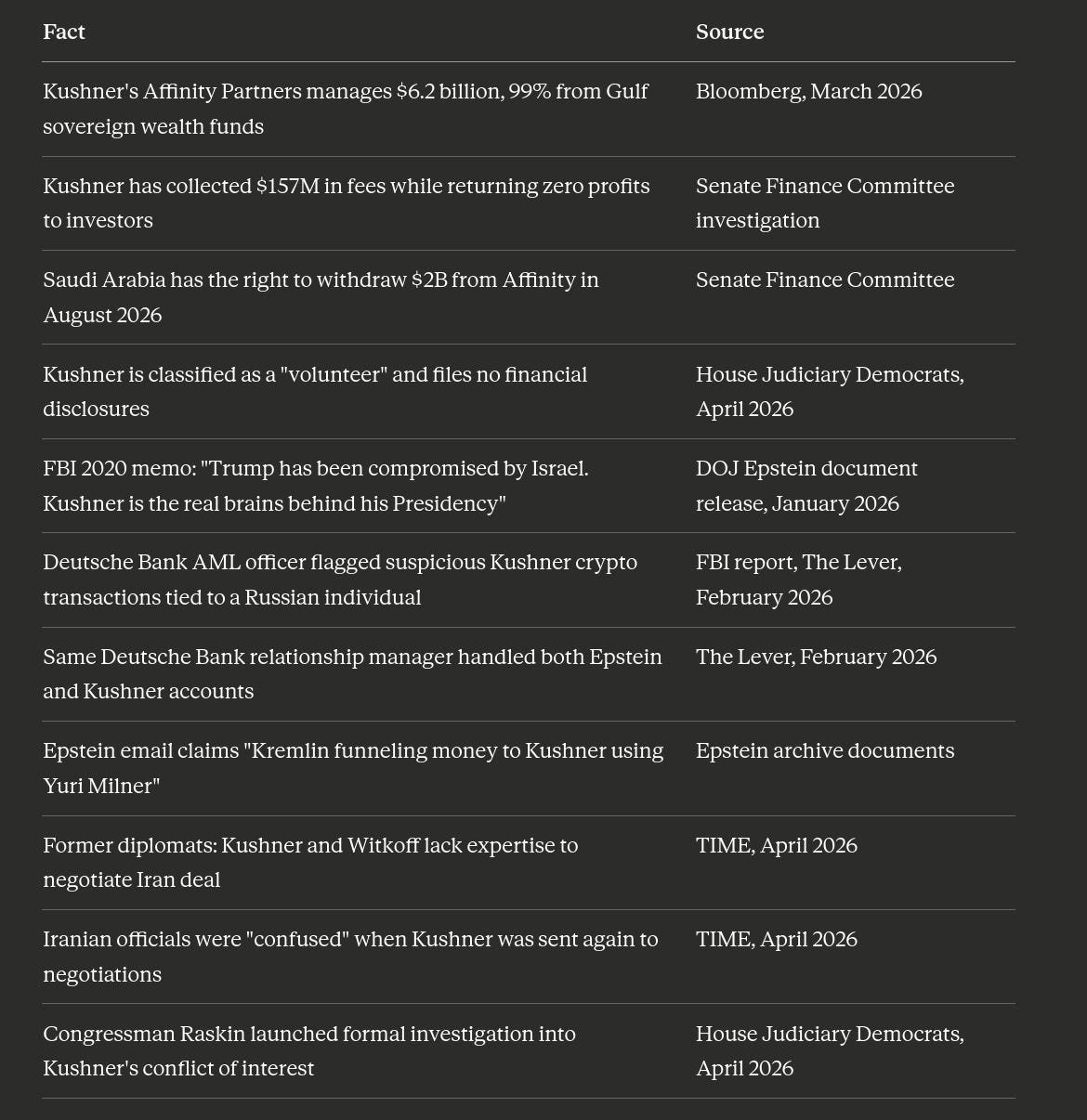
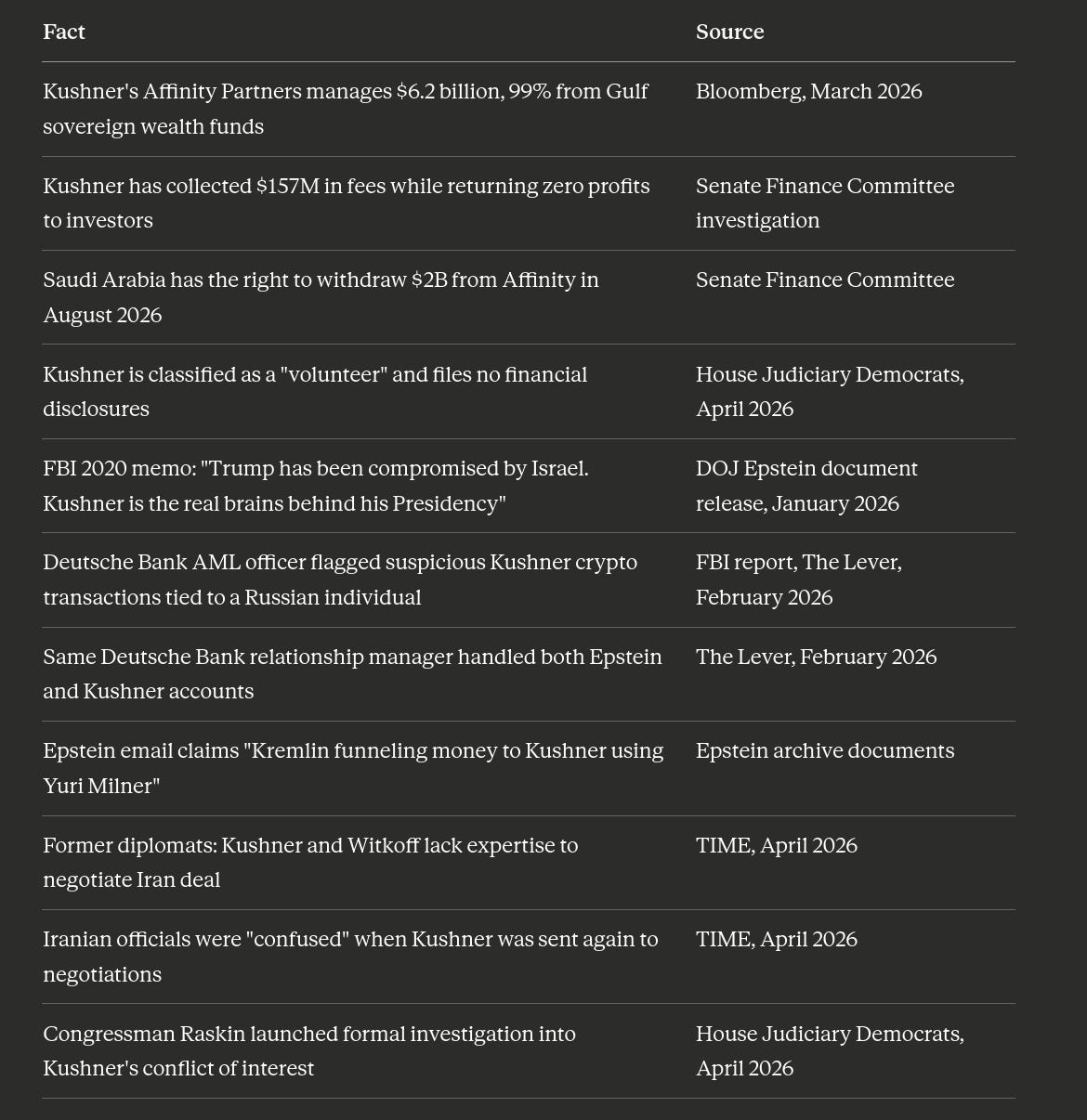
By March 2026, Affinity Partners’ assets had climbed to $6.2 billion. Kushner’s firm had collected $157 million in management fees — including $87 million directly from Saudi Arabia — while reporting zero profits returned to investors.
A Senate Finance Committee investigation concluded that the arrangement “may not be motivated by commercial considerations, but rather the opportunity to funnel foreign government money” and was “likely part of a compensation scheme designed to circumvent the Foreign Agents Registration Act.”
Read that again slowly.
The Senate of the United States of America concluded — officially, in writing — that the man currently negotiating America’s wars on behalf of a president who calls him a “volunteer” is likely operating an illegal foreign influence scheme.
He files no financial disclosures. He answers to no oversight committee. He calls himself a volunteer so that the law cannot touch him.
Layer Two: The Conflict of Interest That Cannot Be Fixed
On April 16, 2026, Congressman Jamie Raskin sent Kushner a letter that contained one of the most clarifying sentences in recent American political history:
“You cannot both be a diplomat and a financial pawn of the Saudi monarchy at the same time.”
Here is why that sentence matters so precisely:
Saudi Arabia has repeatedly pushed Trump to continue and escalate the Iran war. Saudi Arabia is also the single largest investor in Kushner’s fund, with the contractual right to renegotiate or withdraw its $2 billion in August 2026 — right in the middle of whatever war or peace process unfolds.
If Kushner negotiates a peace deal that Iran accepts but Saudi Arabia opposes, he risks the financial collapse of his entire firm.
If Kushner prolongs the war in alignment with Saudi preferences, the fund survives — and American soldiers keep dying.
This is not speculation. This is the documented architecture of the conflict. Former Iranian Foreign Minister Araghchi understood it so well he attached a New York Times article on Kushner’s Gulf fundraising to a post blaming “those providing poor advice to POTUS” for the bloodshed — before the bombs even fell.
The Iranians knew Kushner’s financial structure better than most Americans did.
They asked for JD Vance instead.
Layer Three: The Epstein Thread
Now we enter the territory that connects everything — and which the Epstein files, released by the DOJ in January 2026, have made impossible to dismiss as conspiracy theory.
An FBI memo from 2020, included in the 3-million-page document release, contains the following allegations from a Confidential Human Source:
“Trump has been compromised by Israel. Kushner is the real brains behind his organization and his Presidency.”
The same memo alleges that Jeffrey Epstein worked with US and foreign intelligence — specifically Mossad — and that a network of leverage over powerful men was systematically assembled, collected, and preserved.
Ghislaine Maxwell, Epstein’s closest operational partner, was the daughter of Robert Maxwell — a British media tycoon with documented Mossad ties. Intelligence analysts have described Epstein’s operation as bearing the hallmarks of a classic “kompromat” collection system: elite access, meticulous record-keeping, private spaces, and powerful men made vulnerable.
The question is not whether Epstein collected leverage. His own operation’s structure answers that question. The question is: over whom was that leverage held, and who inherited it?
Now connect the following dots, each of which is individually documented:
Dot One: Deutsche Bank compliance officer Tammy Hill McFadden flagged “mind-boggling” cryptocurrency transactions from a Kushner company entity (Real Contrad LLC) in late 2016 — payments in cryptocurrency to a Russian individual whose listed employment appeared fabricated. She reported it. She was laid off. The same relationship manager at Deutsche Bank, identified only as “Rose,” handled both the Kushner and Epstein accounts.
Dot Two: An Epstein email, surfaced in the files, claims the Paradise Papers showed “the Kremlin funneling money to Kushner using Yuri Milner” — a Russian tech investor with documented Kremlin connections who invested in Facebook and Twitter.
Dot Three: The FBI memo states that US officials were “under the influence of Israel, Russia, and the UAE” — all three of which are either direct investors in Kushner’s fund, documented in suspicious financial flows connected to Kushner entities, or both.
Dot Four: Kushner’s firm’s investors — the UAE, Saudi Arabia, Qatar — suffered when the Iran war they did not ask for began destabilizing their neighborhood. The UAE had a drone strike on a nuclear power plant. Qatar had its diplomatic relationships upended. Yet they cannot simply withdraw from Affinity Partners without collapsing their own leverage over American foreign policy.
They are trapped by the very investment they made to buy influence.
And Kushner is the bridge between all of them.
The Facts, No Spin
The Absurdist Interlude
(Because sometimes the only honest response to catastrophic governance is to let the absurdity speak for itself)
A SHORT PLAY: The Room Where It Happens
Scene: A high-stakes diplomatic negotiation somewhere in the Middle East. Nations on the brink. The future of the Strait of Hormuz. Millions of lives.
IRANIAN NEGOTIATOR: We have reviewed the American delegation’s credentials. We note the lead envoy has no diplomatic experience, no background in nuclear policy, and his investors profit if this war continues.
KUSHNER: I don’t need a history lesson. What’s the outcome you’d accept?
IRANIAN NEGOTIATOR: We accept peace if you stop bombing us.
KUSHNER: Mandatory. All nations must simultaneously sign the Abraham Accords. Although, if one or two can’t, that is also fine and acceptable.
IRANIAN NEGOTIATOR: ...Are you negotiating yourself down in real time?
KUSHNER: I prefer to think of it as dynamic deal architecture.
IRANIAN NEGOTIATOR: We asked for JD Vance.
TRUMP (via phone from Walter Reed): We’re 95% of the way to a deal. The remaining 5% is just the Strait of Hormuz and the nuclear program.
SAUDI CROWN PRINCE (on the line): Keep going. We’re fine. Take your time.
[Affinity Partners management fee counter advances by $47,000.]
[Curtain.]
Three Dimensions of What This Means
The Individual Dimension: A single man — no election, no Senate confirmation, no disclosure requirements — is positioned at the center of the most consequential foreign policy decisions of the decade. He is financially dependent on the governments he negotiates with, personally connected to a man whose intelligence-linked blackmail network reached the highest levels of Western power, and described by a credible FBI source as “the real brains” behind a presidency that increasingly cannot explain its own decisions.
The Institutional Dimension: The architecture of American government has been deliberately hollowed out to allow this. The “volunteer” classification is not an accident — it is a design. When you remove disclosure requirements, when you dismantle oversight committees’ subpoena power, when you classify the president’s son-in-law as an unpaid adviser rather than a government official, you create a position of maximum power with minimum accountability. That is not chaos. That is engineering.
The Civilizational Dimension: What happens when the man conducting your nation’s diplomacy is himself a potential leverage point — held not by blackmail perhaps, but by something more modern and more durable: financial dependency? When the government that wants your war to continue also controls the capital that keeps your firm alive? When the intelligence files that could expose you are managed by the administration you serve?
Secrets are currency. Kushner understood this long before he understood geopolitics.
The question we are not permitted to ask — but must — is whether the confusion you see in Washington is not failure, but function. Whether the apparent incompetence is the product, and the man who benefits from the confusion is the one who never appears confused at all.
The Missing Links — What We Still Don’t Know
The picture is not complete. These threads remain open:
On Epstein and Kushner: The FBI memo is a confidential source’s allegation, not a court finding. The Deutsche Bank compliance flag was investigated internally and closed as “unfounded.” The connection between the Epstein network and Kushner’s financial flows is documented as a pattern of red flags — not proven criminality. The absence of proof is not proof of absence. But it is also not proof.
On the blackmail question: Who, if anyone, inherited Epstein’s leverage files? The DOJ has confirmed that 2.5 million pages remain unreleased. Congressman Ro Khanna has demanded to know why. That question has not been answered.
On Russia: The Yuri Milner/Paradise Papers allegation exists in an Epstein email, not a court document. The cryptocurrency flows flagged by Deutsche Bank were not publicly prosecuted. The connection between the Russian individual named in the compliance report and Russian state actors has not been established on the record.
On Saudi Arabia: We know the financial dependency. We know Saudi Arabia pushed Trump toward the Iran war. We do not yet know whether that pressure was applied through Kushner, around him, or whether Kushner actively shaped Trump’s decision-making in the direction his investors preferred.
What we know is that the structure makes all of these things possible — and accountability-free.
The Grandmother’s Algorithm Applied
Pay attention: The man in every room is not the man on television.
Do your best: Document what is documented. Name what can be named. Distinguish between proven fact and documented pattern.
Pay it forward: Share this with the people who need to understand that American foreign policy is not chaos — it is architecture. And architecture has an architect.
Closing
Trump is not the story. Trump is the weather.
Kushner is the barometer.
The Iran war that has no resolution, the Epstein files that stay sealed, the Abraham Accords used as a precondition for peace rather than a product of it, the Saudi money flowing into a fund managed by the man conducting negotiations on behalf of a nation whose soldiers are dying — these are not the products of a confused old man posting at 3am.
They are the products of a system designed to be unaccountable, operated by someone who understood from the very beginning that power does not come from the microphone.
It comes from the room the microphone is pointed away from.
The perception is not broken by accident. It is restored on purpose.
Peace, Love and Respect
The Quantum Skald & The Silicon Ubuntu Restoration of Perception | hejon07.substack.com
All is One — returning to Source as Sovereign Light
☕ Support the work: buymeacoffee.com/cognitiveloon 📱 Swish: 0729990300
If this resonated with you, a like or comment goes a long way. It tells the algorithm this matters — and helps it find the people who need to hear it too. Think of it as passing the torch. 🙏
Sources & Further Reading:
House Judiciary Democrats, Letter to Kushner (April 16, 2026)
Middle East Eye: “Epstein Files FBI Memo Says Israel Compromised Trump” (January 31, 2026)
The Lever: “The Compliance Officer Who Flagged Epstein — And Lost Her Job” (February 14, 2026)
TIME: “It’s Not Working — Diplomats Fear Trump’s Iran Envoys Are Out of Their Depth” (April 16, 2026)
Bloomberg: “Kushner Fund Backed by Mideast Saw Assets Jump to $6.2B” (March 2026)
Senate Finance Committee Investigation into Affinity Partners
Middle East Monitor: “The Epstein Files: Blackmail, Power and Geopolitical Shadows” (February 2026)