
The Map Is the Weapon
How the Supreme Court handed Republicans a master key — and they used it in 72 hours

A Restoration of Perception dispatch from The Quantum Skald
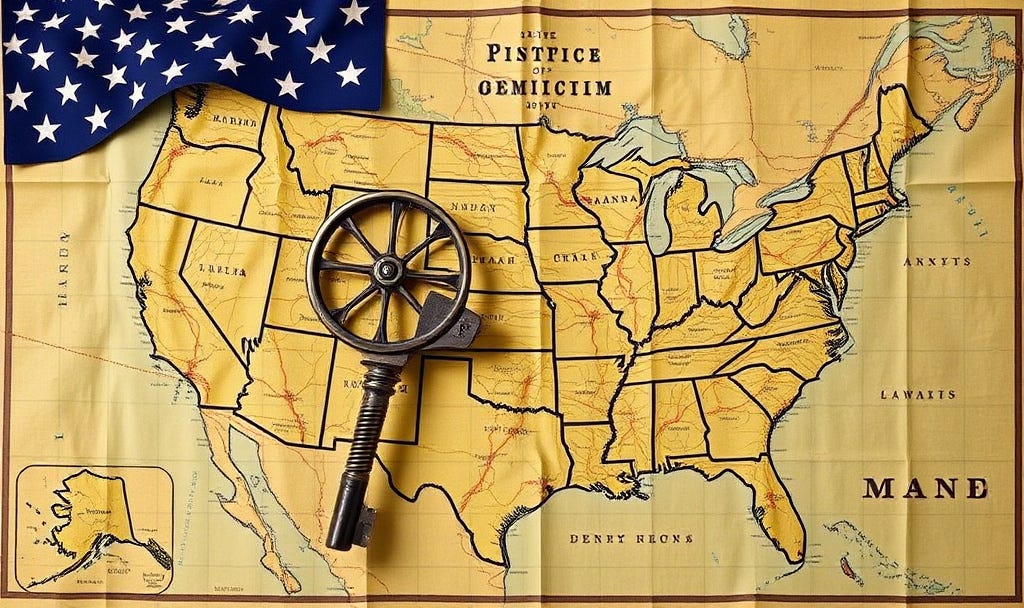
There is an old truth buried in the word map.
Its Proto-Germanic root — mappа — originally meant “cloth” or “sheet.” A map was not a description of territory. It was fabric stretched over reality. Something you could cut, fold, and redraw.
The people running American elections right now understand this at a bone-deep level.
They are not fighting over territory.
They are fighting over the cloth.
What Just Happened — The Short Version
On April 29, 2026, the United States Supreme Court issued a 6–3 ruling in a case called Louisiana v. Callais.
Justice Samuel Alito wrote the majority opinion. Though the court stopped short of fully overturning Section 2 of the Voting Rights Act, the ruling made it extraordinarily difficult for voters of color to bring gerrymandering claims — requiring them, among other things, to prove intentional discrimination, a very high bar to meet.
In plain language: the last major legal guardrail protecting minority voting power just got knocked sideways.
Because of Callais, federal protections against racist voting maps are essentially gone in all but name.
Within 72 hours, Republican governors across the South were calling emergency special sessions.
Within one week, Tennessee had already redrawn its maps and signed them into law.
The map is the weapon. And the safety was just removed.
The Domino Chain — State by State
Let’s slow this down. Because what the Democracy Docket newsletter describes sounds like a bureaucratic legal update. It isn’t. It is a coordinated dismantling of Black political representation across the American South, moving faster than most people can track.
Tennessee — The First Domino Falls
This is the one that happened while you were sleeping on May 7th.
Tennessee’s Republican-controlled legislature passed a new congressional map amid raucous protests, carving up the state’s only majority-Black district in Memphis — the first state to enact new districts since the Supreme Court’s ruling. Democratic senators linked arms in the chamber. One stood on her desk holding a banner denouncing the effort as “Jim Crow.” Republican leadership quickly adjourned the special session.
Here is what that means on the ground:
The new map cuts up the Memphis-based seat held by Democratic Rep. Steve Cohen into three districts, spreading those Democratic voters into more rural, Republican-leaning areas that stretch hundreds of miles east. It also further divides the Nashville metropolitan area — the state’s other Democratic stronghold — into five separate districts.
This is not redistricting. This is dismemberment.
The technical term they use is “maximizing partisan advantage.” The Democratic state representative from Knoxville had a different term: “This is not a special session. This is a white-power rally and a white-power grab.”
The Republicans passed it anyway.
The impetus came directly from the top. On April 30th, Trump posted on Truth Social that he “had a very good conversation with Governor Bill Lee” and that Lee “would work hard to correct the unconstitutional flaw” in Tennessee’s maps. Tennessee House Speaker Cameron Sexton then wrote that the Callais decision “indicated states can redistrict based off partisan politics.”
That framing is worth pausing on. The Supreme Court ruling that struck down a map for using race is now being used as a green light for redistricting that eliminates Black representation. The legal logic loops back on itself and swallows its own tail.
Louisiana — Where the Whole Thing Started
Callais originated here, and Louisiana is already in chaos.
The Supreme Court fast-tracked its own ruling in an unusual move — agreeing to finalize the decision in just 5 days rather than the standard 32-day waiting period. When they did, more than 100,000 Louisiana voters had already cast early ballots in primaries that were now being suspended. And 42,000 voters had submitted absentee ballots before the governor called the election off.
Let that land. Votes already cast. Ballots already mailed. Primary suspended so Republicans can redraw the map.
The Supreme Court denied a request to reconsider. The 5th Circuit then vacated a prior ruling that had protected Louisiana’s legislative maps under the VRA. The dominos continue to fall.
Alabama — Trying to Revive a Map Courts Already Struck Down
An Alabama Senate committee greenlighted legislation to use a congressional map that federal courts had already struck down for violating the Voting Rights Act.
This is what legal capture looks like in practice: use the new Callais ruling to revive maps that the old VRA standards had buried. Run it back through the courts, hope the new legal framework lets it through.
South Carolina — Racing the Clock
State Senate Republicans in South Carolina adjourned without a vote on extending the session to redraw maps — but only temporarily. The Senate will take it up again next week. Meanwhile, thousands of absentee ballots for the primary election have already been sent to voters.
In other words: voters are receiving ballots for districts that may not exist by the time November arrives.
Virginia — The Democrats’ Counter-Move, Stuck in Court
Virginia is the inverse story. Democrats here tried to fight fire with fire.
Governor Abigail Spanberger signed a redistricting referendum that Virginia voters approved on April 21st — by about 3 points. The new map would flip Virginia’s congressional delegation from 6-5 Democratic to 10-1 Democratic.
But a Tazewell County circuit court judge issued an injunction against certification, citing constitutional concerns about the procedure Democrats used to advance the amendment. The Virginia Supreme Court declined to lift that injunction — leaving the voter-approved map in legal limbo.
As of May 7th, four Richmond voters had filed an emergency lawsuit in Richmond Circuit Court demanding the state certify the results. They argued that 105,000 Virginians voted for this change, that the Board of Elections is legally required to certify it, and that delay threatens November election deadlines.
The certification deadline technically passed on May 6th. The Virginia Supreme Court has not yet ruled. The map — the one the voters approved — may simply expire before a decision comes.
The Missing Links — What the Newsletter Doesn’t Tell You
Our prior research surfaced the deeper architecture here. Let’s connect it.
The timeline is not accidental. This redistricting wave did not begin with Callais. It began when Trump urged the Texas Legislature to redraw their congressional map in June 2025. Eight states had already adopted new congressional maps before Tennessee. Republicans have netted more seats than Democrats in this cycle overall.
The VRA has been systematically dismantled across a decade. In 2013, the Roberts Court gutted Section 5 of the VRA (Shelby County v. Holder) — the pre-clearance requirement that forced states with histories of racial discrimination to get federal approval before changing voting rules. That was the first guardrail removed. Callais has now crippled Section 2 — the remaining enforcement mechanism.
Section 2 has protected voters of color from racial discrimination for 61 years and represents the greatest achievement of the Civil Rights Movement. The Callais ruling makes it nearly impossible for voters of color to win fair representation through the courts.
The voter notification rule deletion in Tennessee is the story within the story. This detail in the Democracy Docket newsletter is buried in a bullet point. It shouldn’t be. When electoral lines are redrawn, Tennessee law used to require the government to notify voters about changes to their designated polling place. That provision has now been repealed.
Think about what that means. Your district changes. Your polling place changes. And no one is required to tell you.
Justice Kagan saw all of this coming. In her dissent, she wrote: “Today’s decision renders Section 2 all but a dead letter.”
That is not hyperbole. That is the minority of the Supreme Court documenting what the majority just did.
The Geometry of Power
Here is the deeper pattern.
A map is not just a picture of a place. A map is a decision about who counts. Who belongs where. Whose voice gets diluted into irrelevance and whose gets concentrated into a safe, predictable seat.
Gerrymandering has always worked this way — but the tools for it have become surgical. Modern redistricting software can predict voting behavior block by block, down to individual household level. You don’t need to know someone’s race to dilute their power. You need to know their address.
And the Callais ruling has handed the engineers of these maps a new legal defense: we did it for partisan reasons, not racial ones. The fact that partisan alignment and race are deeply correlated across the American South — that this distinction is, in practice, often meaningless — is not the court’s problem anymore.
This is what the Tennessee House Speaker said out loud: “This bill represents Tennessee’s attempt to maximize our partisan advantage.”
He said this proudly. Because Callais said partisan gerrymandering is fine.
The word partisan just became the magic word that makes racial discrimination legally invisible.
The Grandmother’s Algorithm Applied Here
My grandmother’s algorithm is three steps: Pay attention. Do your best. Pay it forward.
Pay attention: Nine states have now redrawn congressional maps mid-decade. Louisiana suspended a primary after 100,000 people had already voted. Tennessee repealed its voter notification law in the same session it redrew its maps. The Virginia Supreme Court has let the clock run on a voter-approved referendum without issuing a ruling. These are not separate stories. They are one story.
Do your best: The legal fights are ongoing. Democracy Docket is tracking three lawsuits in Florida alone. Steve Cohen has said he will sue over Tennessee’s new map. Virginia voters are suing their own Board of Elections to force certification of their own vote. The Brennan Center, the NAACP Legal Defense Fund, the Campaign Legal Center — all of them are in court. The law is not finished.
Pay it forward: The John R. Lewis Voting Rights Advancement Act has been introduced in Congress. It would restore the pre-clearance requirements that Shelby County destroyed in 2013. It will not pass this Congress. That means the midterms matter — not just for the House majority, but for whether a future Congress can rebuild what the Roberts Court has spent a decade tearing down.
A Closing Word on Maps and Memory
Martin Luther King Jr. was assassinated at the Lorraine Motel in Memphis.
On May 1st, 2026, Tennessee Democrats held their press conference denouncing the redistricting plan outside the Lorraine Motel — now the National Civil Rights Museum.
They chose that location deliberately.
Memory is geography. The place where something happened carries what happened inside it, long after the event has passed.
The people who drew Tennessee’s new congressional map know this too.
They split Memphis into three separate districts — a city that is 64% Black, a city that was the last city Martin Luther King Jr. ever stood in — and stretched those pieces east into rural counties hundreds of miles away.
They did not choose that outcome by accident.
The map is the weapon. It always has been.
Sources
Center for American Progress — The Supreme Court’s Callais Decisions Undermine the Voting Rights Act and Sow Election Chaos — americanprogress.org
NAACP Legal Defense Fund — Louisiana v. Callais case page — naacpldf.org
Brennan Center for Justice — Louisiana v. Callais — brennancenter.org
Campaign Legal Center — U.S. Supreme Court Has Eviscerated the Voting Rights Act — What’s Next? — campaignlegal.org
FairVote — What to Know About the Supreme Court Ruling in Louisiana v. Callais — fairvote.org
SCOTUSblog — Louisiana v. Callais docket — scotusblog.com
NBC News — Tennessee Republicans Pass Map Splitting State’s Lone Majority-Black District — nbcnews.com
CNN — Tennessee Redistricting: Republicans Enact New Map Carving Up Majority-Black District — cnn.com
CBS News — Tennessee Approves New Congressional Map That Dissolves Majority Black District — cbsnews.com
Al Jazeera — Tennessee Approves New Congressional Map in Latest Redistricting Flurry — aljazeera.com
Wikipedia — 2026 Tennessee Redistricting — wikipedia.org
Wikipedia — 2026 Virginia Redistricting Amendment — wikipedia.org
Virginia Scope — Four Richmond Voters Filed a Lawsuit Trying to Force Certification — virginiascope.com
Democracy Docket — Newsletter, May 7, 2026 — democracydocket.com
PBS NewsHour — Tennessee Lawmakers Pass U.S. House Map Carving Up Majority-Black District — pbs.org
If this resonated with you, a like or comment goes a long way. It tells the algorithm this matters — and helps it find the people who need to hear it too. Think of it as passing the torch. 🙏
Peace, Love and Respect 🙏
Hans — The Quantum Skald
All is One — returning to Source as Sovereign Light
☕ buymeacoffee.com/cognitiveloon Swish: 0729990300
Truth matters / Justice matters / Facts matter / Definitions of words matter