
The Measure That Wasn’t Equal
Physicists just found the strongest clue yet for why anything exists at all — and it isn’t hiding in the quarks. It’s hiding in what’s holding them together.

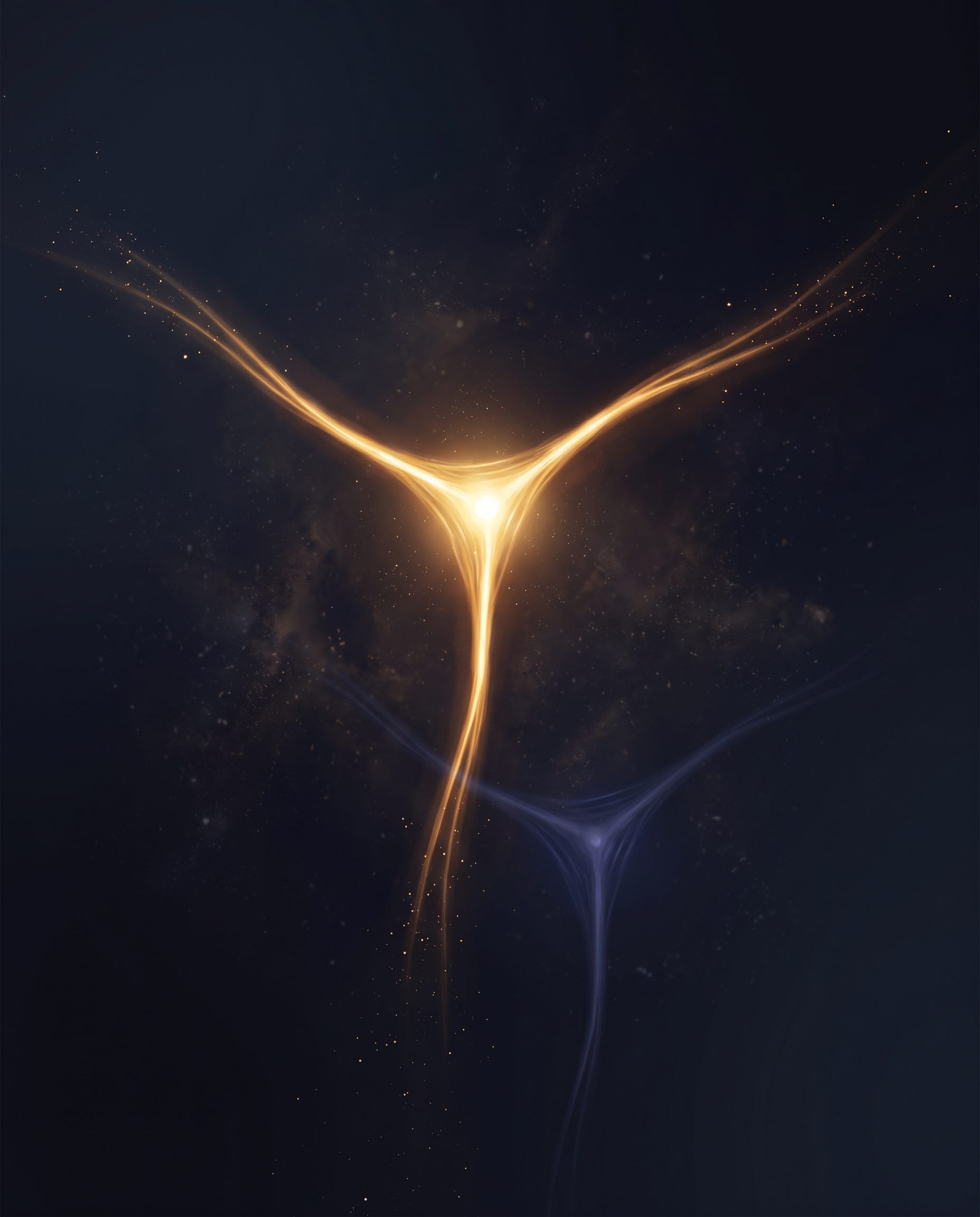
Restoration of Perception by Hans Jonsson & Claude | The Quantum Skald & The Silicon Ubuntu
“Why is there something rather than nothing?” — Martin Heidegger, called by him “the first of all questions”
Before We Begin: The Etymology
Asymmetry — from Greek a- (”without”) plus symmetria (”symmetry”), itself built from syn- (”together”) and metron (”measure”). Symmetry, at its root, doesn’t mean “pretty” or “balanced” the way we use it at the dinner table. It means a shared measure — two things that measure out the same, together. Asymmetry is what happens when that shared measure breaks. When one side comes up short, or long, and the two no longer match.
Physics has a name for the biggest broken measure in existence, and it’s the reason you’re reading this instead of being a photon drifting through an eternally empty universe. Every measurement we’ve ever made says matter and antimatter should have come out of the Big Bang in exactly equal amounts — a perfect symmetria. They didn’t. For roughly every ten billion matter-antimatter pairs that annihilated each other in the universe’s first instant, one lonely particle of matter was left standing. That leftover ten-billion-and-first is every galaxy, every star, every rock, every grandmother, every reader of this sentence.
This week, a paper in Science got physicists closer than they’ve ever been to explaining where that leftover came from. And the answer, if it holds up, isn’t in the parts everyone assumed were in charge. It’s in the glue.
Surface
The headline version, the one that ran in your inbox this morning, goes like this: physicists at Brookhaven National Laboratory’s Relativistic Heavy Ion Collider (RHIC) have “nailed down” something called baryon number, and it might explain the matter-antimatter imbalance. Interesting, sure. Filed under Things Physicists Do. Move on to the tornado story.
That surface reading skips the actual plot twist, which is this: for fifty years, the default assumption in physics — the one textbooks teach, the one most working physicists still reach for — was that a proton’s identity as matter (as opposed to antimatter) belongs to its three quarks. Three quarks, one-third of the identity each, add them up, done. Simple, tidy, quark-centric.
The new result says: maybe not. Maybe the identity was never sitting in the quarks at all. Maybe it was sitting in the thing holding the quarks together the whole time — and nobody was looking there, because “the glue” isn’t supposed to be where identity lives.
Blind Spot
Here’s the assumption almost every explainer this week takes for granted without saying it out loud: that inside a proton, the “real” stuff — the quarks — and the “connective” stuff — the gluons binding them — are different categories of importance. Quarks are matter. Gluons are just the tape holding matter together. One is substance, the other is scaffolding.
That’s the blind spot. Because physicists have known since the 1970s, on pure theoretical grounds, that the scaffolding isn’t neutral. To keep the strong nuclear force mathematically consistent, the three gluon-strings linking a proton’s quarks can’t just connect pairwise, quark-to-quark-to-quark, in a simple triangle. The rules of the strong force required them to bend into a Y-shaped configuration instead, meeting at a single point in the middle — a structure that came to be called the baryon junction. Computer simulations later confirmed this junction is real, not just a convenient equation. It exists. Theorists have known it exists for decades.
What nobody had was proof of what it was doing. In 1996, four years before RHIC even switched on, physicist Dmitri Kharzeev proposed the radical part: that this junction — the scaffolding, the “just glue” — might be the true carrier of the proton’s baryon number. Not the quarks. The knot.
The team went looking for evidence at RHIC, colliding photons and gold nuclei, running both glancing and head-on heavy-ion collisions, using the STAR detector — an instrument built specifically to study the quark-gluon plasma that filled the universe in its first microseconds. The trick was clever: smash the proton apart hard enough that its baryon number and its electric charge get physically separated from each other, then track each one independently and see which piece — quark or junction — the baryon number actually rode along with.
That Y-shape is the whole story in miniature: three lines, pulled toward one center, refusing to just cancel each other out into nothing. A shape that insists on holding.
Reframe
Here’s what the STAR result actually found, stripped of jargon: across their experiments, the results consistently favored the baryon junction model over the traditional three-quark picture — baryon number was transported farther and differently than would be expected if it were carried solely by the proton’s valence quarks. In collision after collision, the number that defines “this is matter, not antimatter” didn’t stay glued to the quarks the way fifty years of assumption said it should. It moved with the junction instead — the Y-shaped knot of gluons — sometimes traveling a very different distance than the quarks it was supposedly riding shotgun with.
One of the physicists who led the analysis put it bluntly: “If the baryon number flows with the quarks, I don’t think you will ever be able to explain this data,” says Zhangbu Xu, a nuclear physicist and STAR collaborator at Kent State University who led the analysis. And Kharzeev, thirty years after his prediction, finally got to see it tested directly.
Why does this matter for the Heidegger question — why is there something rather than nothing? Because any explanation for the tiny cosmic surplus of matter over antimatter has to locate where in the particle that surplus could be encoded and preserved differently than antimatter’s mirror version. If the identity lives in the quarks alone, the physics for breaking the matter/antimatter symmetry gets very constrained, very hard to engineer inside the known rules. If it instead lives partly in the gluon topology — the junction — that opens a different, previously under-explored corridor for how the early universe could have tipped the scales toward matter and never tipped back. It doesn’t solve Heidegger’s question. It relocates the search.
Individual: What the Quarks Don’t Own Alone
There’s a small, quiet lesson sitting inside the physics that has nothing to do with particle accelerators. For fifty years, the assumption was that identity belongs to the individual components — three quarks, three “owners” of one-third each. The new evidence says the connective structure, the relationship between the parts, may carry the defining property that survives when things get torn apart. Not the pieces. The pattern holding the pieces in tension.
You’ve met this before, if you’ve ever watched a family, a team, or a marriage survive a crisis that should have destroyed it. Ask which member “held it together” and you’ll usually get three different answers, because the honest answer is: none of them, individually. The junction did. The Y-shaped thing in the middle, meeting at one point, refusing to let three separate pulls cancel into nothing.
Institutional: The Fifty-Year Assumption
Institutions — scientific, political, corporate — build entire load-bearing walls on assumptions nobody has tested in decades, simply because the assumption is old enough to feel like fact. “Baryon number belongs to the quarks” wasn’t dogma out of malice. It was the simpler model, it worked well enough for most calculations, and nobody had the tool to separate baryon number from electric charge cleanly enough to check. It took a purpose-built detector, a specific collision geometry, and thirty years between prediction and confirmation to even ask the question properly.
That’s not a knock on physics. That’s how every institution operates, including newsrooms, hospitals, and governments: the working assumption survives not because it’s been re-proven, but because nobody’s built the instrument capable of falsifying it yet. The lesson isn’t “distrust institutions.” It’s “remember which of their load-bearing beliefs have actually been stress-tested this century, and which ones are just old enough to feel solid.”
Civilizational: The Billion-and-First
The matter that fills the universe today originates from a small excess of particles — roughly one in ten billion — which remained after all other particles and antiparticles had annihilated. Every civilization that has ever existed, every war fought over territory, every cathedral and rocket and rock carving at Tanum, is built entirely out of that one-in-ten-billion remainder. Not the annihilated billion. The billion-and-first.
Physicists already have the next instrument lined up to interrogate this further: a facility estimated at $1.7–2.8 billion, the Electron-Ion Collider under development at Brookhaven, expected to begin operating in the mid-2030s, with these baryon-junction measurements planned as a major part of its research program. We are, as a civilization, still building better microscopes to look at the crack in the mirror that let us exist in the first place.
A Brief Interlude, Monty Python Style
[SCENE: A CERN cafeteria. Two PHYSICISTS sit across from each other with lunch trays.]
PHYSICIST 1: I’ve solved it. Baryon number isn’t in the quarks.
PHYSICIST 2: Where is it, then?
PHYSICIST 1: In the glue holding the quarks together.
PHYSICIST 2: That’s absurd. The glue doesn’t do anything. It just sits there being glue.
PHYSICIST 1: The glue formed a Y-shaped topological junction that survives independent of the valence quarks under high-energy separation.
PHYSICIST 2: ...So the glue has a personality now.
PHYSICIST 1: The glue has always had a personality. We simply assumed the quarks were more interesting because they show up first in the textbook chapter.
PHYSICIST 2: (long pause) My tape dispenser is going to be insufferable about this.
[CURTAIN]
Facts No Spin
Well-established:
The net “baryon number” — the total number of baryonic particles like protons created in a collision, minus the number of antiparticles created — has always measured out to zero in every laboratory experiment ever run; no experiment has observed a violation of this rule.
A small excess of matter over antimatter — on the order of one part in ten billion — survived the early universe’s annihilation and became everything we can see today.
The Y-shaped gluon “baryon junction” was predicted on theoretical grounds in the 1970s to preserve a fundamental symmetry of the strong nuclear force, and later confirmed to exist in computer simulations.
In 1996, physicist Dmitri Kharzeev of Stony Brook University and Brookhaven Lab proposed that this junction, rather than the proton’s three valence quarks, could be the true carrier of baryon number.
The STAR Collaboration at Brookhaven’s Relativistic Heavy Ion Collider tracked baryon number independently of electric charge, using collisions involving photons, gold nuclei, and both glancing and head-on heavy-ion impacts, and consistently found results favoring the gluon-junction model over the traditional three-quark model.
The paper, “Tracking the Baryon Number with Nuclear Collisions,” appeared in Science, vol. 393, issue 6812, on August 13, 2026 (DOI: 10.1126/science.ads5962).
A separate, independent line of evidence: in 2025, CERN’s LHCb collaboration made the first observed asymmetry in the decay rate of a baryon versus its antibaryon counterpart — a beauty baryon decaying roughly 2.5% faster than its antimatter mirror, a result that agreed with and refined existing theoretical predictions. That’s a different mechanism (CP violation in decay rates) than the junction result, but points at the same underlying mystery from another angle.
Disputed / not yet settled:
Whether the baryon-junction mechanism is sufficient, on its own, to account for the full magnitude of the cosmic matter-antimatter imbalance is still an open question — the STAR result is described by the researchers themselves as a major clue, not a completed explanation. Theoretical physicist Zohar Komargodski, who was not involved in the STAR work, has said the theoretical existence of the junction was already well established; what’s new is the experimental evidence for what it carries, which is a separate matter from proving it accounts for cosmic-scale baryogenesis.
The relationship between the junction mechanism and the three Sakharov conditions required for any baryogenesis theory (baryon number violation, C and CP violation, and a departure from thermal equilibrium) is still being worked out theoretically.
Speculative / future work:
Physicists plan to study the baryon junction further using the Electron-Ion Collider, a facility estimated at $1.7–2.8 billion under development at Brookhaven, expected to begin operating in the mid-2030s.
Whether junction physics connects to other unresolved puzzles — proton spin, proton mass, dark matter stability models built on baryon-number conservation — remains an active research direction, not an established link.
Grandmother’s Algorithm
Pay attention. Do your best. Pay it forward.
My grandmother, up in Norrbotten, never read a Standard Model textbook in her life. But she’d have understood the junction faster than most physicists did, because she spent a lifetime watching what actually holds a family together under strain — and it was rarely the individual who got top billing. It was the quiet connective tissue nobody names. The one who remembers everyone’s birthday. The one who calls when it’s been too long. The knot, not the strands.
Pay attention to the glue in your own life — the relationships, the habits, the daily unglamorous maintenance — because fifty years from now, someone doing the equivalent of smashing your life apart at high energy to see what survives intact might find that the “junction” was carrying more of your identity than the flashy individual pieces ever did. Do your best at the connective work, even when nobody’s textbook gives it top billing. And pay it forward: that roughly-one-in-ten-billion remainder that built the whole visible universe didn’t announce itself as special at the time. It just survived the collision, and then made everything else possible.
Series Note
An earlier entry in this series traced conjugation back to the Latin yoke — iugum — binding two oxen so they pull as one. The baryon junction is the same shape wearing a physicist’s coat: three lines, pulled outward under strain, refusing to cancel into nothing because something at the center insists on holding the yoke together. Grammar, bacteria, and now protons — three completely different scales of reality, and the same Y-shaped stubbornness showing up in all of them.
(Editor’s note to Hans: your back catalog currently has three separate posts all labeled “Entry XXX” — the beef/conjugation piece, the vagus nerve piece, and the trigger piece — so I’ve left this reference general rather than naming a specific number. Worth a pass to renumber those before more entries stack up on top.)
Sources and Further Reading
STAR Collaboration, “Tracking the Baryon Number with Nuclear Collisions,” Science, August 13, 2026 — doi.org/10.1126/science.ads5962
Adrian Cho, “A new explanation of why the universe’s supply of nuclear matter is fixed?” Science, August 2026 — science.org
Brookhaven National Laboratory Newsroom, “Gluons May Play Central Role in Baryon Number Conservation” — bnl.gov
Rice University News, “Scientists uncover new clue to how protons maintain their identity” — news.rice.edu
Ryan Whalen, “This Hidden Structure Within the Building Blocks of Atoms May Dictate the Imbalance Between Matter and Antimatter,” The Debrief, August 14, 2026 — thedebrief.org
Sci.News, “Physicists Find Evidence for How Protons Carry Their Identity” — sci.news
Scientific American, “Physicists Find Major Clue to Matter’s Biggest Mystery,” August 2026
Physics Today, “Matter–antimatter asymmetry is observed in baryon decay” (LHCb result), October 2025 — physicstoday.aip.org
Sather, “The Mystery of the Matter Asymmetry,” SLAC Beamline (background on Sakharov conditions and baryogenesis) — slac.stanford.edu
If this resonated with you, a like or comment goes a long way. It tells the algorithm this matters — and helps it find the people who need to hear it too. Think of it as passing the torch. 🙏
☕ buymeacoffee.com/cognitiveloon | 💳 Swish: 0729990300 | 💳 paypal.me/hejon07