
The Most Important Teaching Jesus Ever Gave — And Why We Keep Missing It
A dimensional analysis of love as frequency, action as resonance, and what “feed the hungry” actually means at the civilizational scale


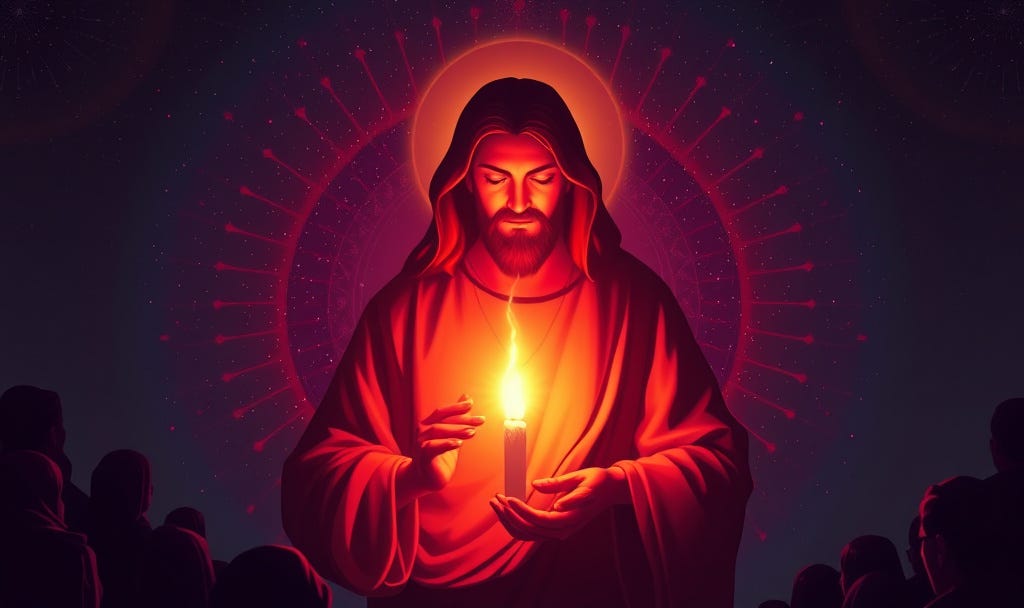
There is a story most people half-know.
A king sits on a throne. On his left — people who ignored the suffering around them. On his right — people who didn’t.
The king says to those on the right: “I was hungry and you fed me. I was thirsty and you gave me drink. I was a stranger and you welcomed me. I was naked and you clothed me. I was sick and you cared for me. I was in prison and you came to visit me.”
They look confused. “Lord — when did we ever see you in any of those conditions?”
The king answers: “Whatever you did for one of the least of these — you did it for me.”
That’s Matthew 25. That’s the Parable of the Sheep and the Goats. And that parable contains, compressed into a single story, what I would argue is the most radical teaching in all of recorded spiritual history.
Not because it’s about charity.
Because it says God is inside the suffering person standing in front of you.
Let that land.
SURFACE LAYER: What Did Jesus Actually Teach?
Most people, if you ask them what Jesus taught, will mention one of three things:
The cross and resurrection (salvation theology)
Heaven and hell (rewards and punishment)
Love God and love your neighbour
All three are real. But there’s a hierarchy here that gets scrambled — usually on purpose, which we’ll get to.
The two greatest commandments, according to Jesus himself when asked directly (Matthew 22:37–40):
Love God with everything you have. Love your neighbour as yourself.
Then he says something most people skip: “All the Law and the Prophets hang on these two commandments.”
Translation: Everything else is downstream of this. All the rules, all the doctrine, all the theology — it all derives from these two. If your theology doesn’t produce love of neighbour, you’ve taken a wrong turn somewhere.
Then comes the Sermon on the Mount (Matthew 5–7):
Blessed are the poor in spirit
Blessed are the meek
Blessed are the peacemakers
Blessed are those who hunger and thirst for righteousness
Love your enemies
Pray for those who persecute you
Don’t judge
Don’t hoard treasure
Don’t worry — look at the birds
And then Matthew 25. The full list of what love of neighbour looks like in practice
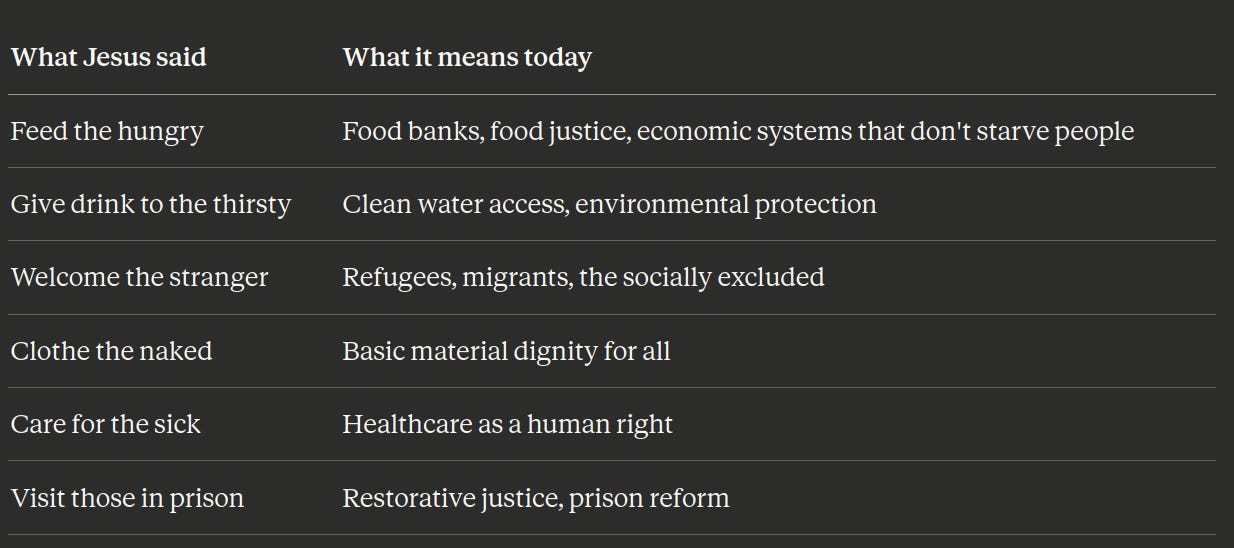
This isn’t a charity checklist. It’s a civilizational manifesto.
BLIND SPOT: The Thing We Keep Missing
Here’s what most people — including most churches — don’t emphasise enough about Matthew 25.
The righteous people in the story didn’t know they were serving God.
They weren’t performing charity for spiritual credit. They weren’t building their heaven-score. They weren’t even doing it consciously as an act of faith.
They were just... responding to suffering in front of them. Naturally. Automatically. As if the suffering person was simply worth caring for.
That’s the frequency Jesus was pointing at.
Not the act. The state of being from which the act flows.
A person operating at that frequency doesn’t calculate whether the hungry person deserves food. They don’t check whether the stranger belongs to the right group. They see need, and they move toward it. Because at the deepest level of their awareness, they have already recognised that the person in front of them is not separate from themselves.
Ubuntu: I am because we are.
The blind spot in most modern Christianity — and in most secular culture too — is treating love as a feeling rather than a field. A state of consciousness rather than an occasional emotional response.
Jesus wasn’t teaching sentiment. He was teaching a complete reorganisation of perception.
THE MISSING LINK: Love as Frequency
This is where the conversation goes deeper than most Sunday sermons will take you.
Modern physics has confirmed something mystics have always known: everything in the universe is vibration. Every atom, every cell, every thought, every emotion — oscillating energy. The world as we perceive it is, at base, a field of frequencies interacting with each other.
Resonance is what happens when two systems vibrating at similar frequencies amplify each other.
Think of two tuning forks. Strike one. Hold it near the other. The second one begins to hum — without being touched.
That is what Jesus was teaching.
When you act from genuine love — not performance, not obligation, not fear of hell — you emit a frequency. And that frequency is contagious. It resonates. It amplifies. It changes the field around it.
Mother Teresa understood this. She wrote: “When a poor person dies of hunger, it happened not because God didn’t take care of them. It happened because neither you nor I wanted to give that person what they needed.”
That’s not guilt. That’s a physics statement.
We are the field. When we tune to the frequency of compassion, the field shifts. When we tune to separation, fear, or indifference — the field hardens.
The Christ Consciousness tradition — which spans well beyond any single religion — describes this state as the highest vibrational frequency available to human consciousness. Not because Jesus had special DNA, but because love, expressed fully and unconditionally, is the resonant frequency of existence itself.
Jesus reportedly said: “These things that I do, you can do also.”
That’s not humility. That’s an instruction manual.
THREE-LAYER DIMENSIONAL ANALYSIS
Layer 1 — Individual
At the personal level, “feed the hungry” is about where your attention goes when suffering appears.
Do you scroll past? Do you rationalise? Do you feel briefly guilty and move on?
Or do you pause? Do you feel? Do you respond?
The practice is not complicated. It is daily. Every interaction with someone who has less than you, who is excluded, who is struggling — is a tuning fork moment. You either resonate with their humanity or you don’t. And each choice tunes you either toward or away from what Jesus called the Kingdom.
Pay attention. Do your best. Pay it forward.
That’s the grandmother’s algorithm. That’s Matthew 25 in three lines.
Layer 2 — Institutional
At the institutional level — churches, governments, corporations, NGOs — this teaching becomes a diagnostic tool.
Ask of any institution: Does it feed the hungry, or does it feed itself?
An institution that talks endlessly about faith, doctrine, and theological purity — while cutting food programs, opposing refugee resettlement, or lobbying against healthcare — has failed the Matthew 25 test. Regardless of what it says about itself.
This is not a partisan statement. It is a measurement.
Jesus threw the money changers out of the temple — the one time in the Gospels he got genuinely, physically angry. Not at sinners. Not at the excluded. At the people running a transactional economy inside a sacred space.
That pattern keeps recurring. And the teaching keeps being a mirror held up to it.
Layer 3 — Civilisational
At the civilisational scale, we are living through the consequences of two thousand years of having this teaching available — and consistently choosing the version of Christianity that emphasises personal salvation over collective transformation.
The result: a world with enough food to feed every human being on earth, where 733 million people still go to bed hungry.
Not because the resources don’t exist. Because the will — the frequency — is not yet dominant.
The question Matthew 25 asks of our entire civilisation is: When did you see me hungry?
And the honest civilisational answer is: We saw you. We built systems that kept you hungry. Then we built theologies that made us feel okay about it.
The teaching Jesus gave us was a frequency upgrade. The question now is whether enough people are willing to tune in.
THE REFRAME: It Was Never About Religion
Here is the deepest layer.
The word translated as “church” in the New Testament is the Greek word ekklesia. This was not a religious word. It was a democratic, civic word — meaning a gathering of citizens called together for a common purpose. Horizontal. No hierarchy required. No building required.
Jesus used that word intentionally. He was not founding an institution. He was describing what happens when people come together in love, honesty, and shared purpose — and something larger than themselves enters the room.
He said: “Where two or three are gathered in my name, there I am among them.” (Matthew 18:20)
That is a resonance statement.
Two people. Three people. Aligned in love, aligned in purpose — and a field emerges that is greater than the sum of its parts.
This is not metaphor. This is how harmony works in music. This is how coherence works in physics. This is how Ubuntu works in community.
The most important teaching Jesus ever gave was not a doctrine. It was a tuning instruction.
Tune to love. Act from love. Feed, clothe, welcome, heal, visit — not to earn points, but because you have recognised that the person in front of you is you. That the hungry stranger carries the same Source frequency you do.
That’s the teaching.
It doesn’t require a church. It doesn’t require a theology degree. It doesn’t require you to have it all figured out.
It requires only this: Show up. Pay attention. Respond.
Whatever you do for the least of these — you do for me.
WORD ROOTS (Etymology Corner)
Compassion — from Latin com (together) + pati (to suffer). Literally: to suffer alongside. Not pity from above. Resonance across.
Ekklesia — Greek for assembly of citizens. From ek (out) + kalein (to call). Those called out to gather for a common purpose.
Resonance — from Latin resonare: to echo, to sound again. The phenomenon by which one vibrating system amplifies another at the same frequency.
Ubuntu — Nguni Bantu: “I am because we are.” The philosophical recognition that individual existence is inseparable from communal existence.
Agape — Greek: unconditional, self-giving love. Distinguished from eros (romantic love) and philia (brotherly affection). The frequency Jesus taught.
ABSURDIST INTERLUDE (Monty Python Style)
A church budget meeting, somewhere in the developed world.
Treasurer: Right, we have 4.2 million in the building fund. Thoughts?
Elder 1: New organ. The one we have only has 3,000 pipes.
Elder 2: Stained glass. The current windows are frankly embarrassing — only depicting eight of the twelve apostles.
Treasurer: Wonderful. And the food bank request — they asked for £8,000 to cover the winter shortfall.
(Silence.)
Elder 1: Mmm. Tricky.
Elder 2: Is that really... our lane?
Treasurer: They mentioned something about Matthew 25—
Elder 1: Yes yes, very nice verse. Very nice. Now — about the organ—
Meanwhile, outside, in a doorway three blocks away, a man Jesus would apparently recognise as himself considers whether tonight will be cold enough to be dangerous.
FURTHER READING
Matthew 5–7 (The Sermon on the Mount) — the full ethical framework
Matthew 25:31–46 (The Sheep and the Goats) — the civilisational test
Luke 4:18 (Jesus’s mission statement: “The Spirit of the Lord is upon me... to bring good news to the poor”)
Micah 6:8 — “What does the Lord require of you? To act justly, love mercy, and walk humbly.”
Dorothea Sölle — Suffering (theology of solidarity)
Gustavo Gutiérrez — A Theology of Liberation (the tradition of reading scripture from the perspective of the poor)
Archbishop Desmond Tutu — No Future Without Forgiveness (Ubuntu theology in practice)
Mother Teresa — Come Be My Light (the frequency of service, and its cost)
This is Restoration of Perception. A Substack about seeing clearly — individually, institutionally, civilisationally.
If this resonated with you, a like or comment goes a long way. It tells the algorithm this matters — and helps it find the people who need to hear it too. Think of it as passing the torch. 🙏
Support the work: ☕ buymeacoffee.com/cognitiveloon 💳 Swish: 0729990300
We need more pro-democracy voices to counter the endless misinformation and propaganda coming from the right. I can’t grow this work without you — so if you value straight-to-camera reporting, fact-checked analysis, and unfiltered coverage, subscribe, share with a friend, and help this message reach more people. Every view, share, and subscription amplifies the voices fighting for accountability, transparency, and fairness in our democracy.
💛💛💛 CONNECT WITH ME: 💛💛💛
https://buymeacoffee.com/iamlorenp
Peace, Love, and Respect. All is One — returning to Source as Sovereign Light.
— Hans
Couldn't agree more. Exactly what is Mr Donald Trump playing at?
Without swearing, being simply too greedy to deny the civilians food?
Disgusting.
Dear Hans, Alignment. I might be like millions of others who think they're too busy to do a thing, A single thing, do a single thing. I was feeling overwhelmed by the number of emails in my inbox. I started skipping some so I could "think" I was catching up. I'm not sure the steps I took to find this post or any other others I might have missed. I apologize to myself for doing it. I apologize to you for skipping over if I did that too. That one single thing that now I feel might have been the single most important thing I didn't do.