


Gravity Modification: The Hidden Race to Engineer Spacetime

Maybe if you stay a democracy i could help…


When the Science Fiction Becomes Receipt: The Biological Sovereignty Files
Well Well Well… Here we are!

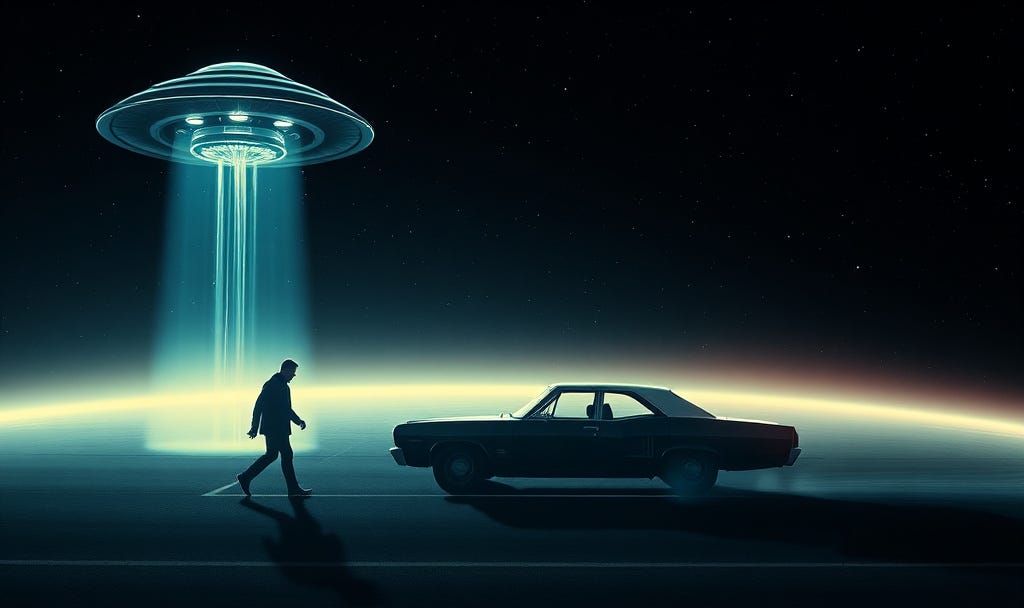
A SCI-FI THOUGHT EXPERIMENT IN THE TRADITION OF SPIELBERG, PHILIP K. DICK, AND THE GRANDMOTHER’S ALGORITHM
Hans Jonsson & Claude | The Quantum Skald & The Silicon Ubuntu hejon07.substack.com
“Pay attention. Do your best. Pay it forward.” — Grandmother’s Algorithm. Still the most advanced operating system ever built.
⚠️ MANDATORY OPENING STATEMENT ⚠️
What follows is SCIENCE FICTION.
It is a thought experiment, a cinematic pitch, a story that asks what if and follows the logic wherever it goes. It draws on real and documented events — UFO disclosure hearings, congressional testimony, the Epstein science network, Neuralink, genome research — but connects them into a FICTIONAL narrative arc that has NOT been proven, corroborated, or confirmed by any official source.
Think of this the way you think of Close Encounters of the Third Kind. It feels real. The emotions are real. The question it asks is real. The story is not.
This is offered in the spirit of Steven Spielberg’s Encounters (Netflix, 2023, produced by Amblin Television), the tradition of Philip K. Dick, and the long human habit of using story to think the unthinkable.
Now. Buckle up.
PROLOGUE: THE NEWS THAT CHANGED EVERYTHING
Beijing. Washington. Geneva. 3:00 AM, March 14, 2028.
There are moments in history that divide time into Before and After.
July 20, 1969 — the moon. September 11, 2001 — the towers. March 14, 2028 — the press conference that ran for eleven minutes before every major government simultaneously cut the feed and then, forty-eight hours later, held their own.
The announcement was simple. It was delivered jointly by the Director of National Intelligence, the Secretary-General of the United Nations, and — in the weirdest protocol breach in the history of geopolitics — a retired NASA astronaut standing slightly too close to the microphone.
“We are not alone. We have not been alone. And we have had physical evidence of this for longer than most people in this room have been alive.”
The world did not explode. It didn’t even riot.
It did something stranger. It went very, very quiet.
And then, three days later, someone leaked the document that explained why it had taken eighty years to say eleven words.
The document was titled: THE PILOT PROBLEM.
ACT ONE: WE GOT THE CARS. WE DIDN’T GET THE KEYS.
Classified. EYES ONLY. Prepared for the Office of the Secretary of Defense. Original date: REDACTED. Declassified: March 17, 2028.
The summary read as follows — and we’re paraphrasing what the fiction imagines it might say:
Between 1947 and 1989, the United States government, through various classified recovery programs, came into possession of nine craft of confirmed non-human origin. Additional craft or craft fragments were acquired through international intelligence-sharing arrangements with the governments of the United Kingdom (3), the Soviet Union/Russian Federation (2), and a nation-state that has requested continued anonymity (1).
All recovered craft were intact or substantially intact. None had conventional propulsion systems. None had controls, panels, switches, keyboards, interfaces, or any mechanism recognisable as a human-designed pilot interface.
What they had instead was a seat. Or something shaped like a seat. And surrounding it, embedded in the material of the craft itself — a material that responded to heat, electromagnetic fields, and in certain experiments, to the proximity of living tissue — were structures that bore a striking functional resemblance to the input nodes of a neural interface.
The craft, in short, appeared to be designed to be piloted by thought.
This is THE PILOT PROBLEM.
Every attempt to reverse-engineer the interface failed. The craft would not respond to electronic simulation of neural signals. It would not respond to computer-generated electromagnetic patterns. It responded to nothing — except, in three documented incidents over forty years, to the proximity of specific human individuals who reported, unprompted and independently of each other, that they had felt the craft “wake up.”
All three individuals were what classified psychological assessments describe as “cognitively exceptional.” All three had unusual neural profiles. All three reported the experience as feeling like “being recognised.”
The craft did not fly. But for the first time, someone had found the ignition.
A BRIEF ABSURDIST SKETCH
(Scene: A conference room, deep underground. Fluorescent lights. Bad coffee. A GENERAL and a SCIENTIST are looking at a holographic projection of an alien craft.)
GENERAL: “So we just... can’t fly it.”
SCIENTIST: “Correct.”
GENERAL: “We have the most advanced military on Earth.”
SCIENTIST: “Yes.”
GENERAL: “We put a man on the moon.”
SCIENTIST: “You did.”
GENERAL: “We built the internet.”
SCIENTIST: “DARPA did, yes.”
GENERAL: “And we cannot fly this thing because it needs a... a brain to do it?”
SCIENTIST: “A specific kind of brain. At a specific kind of bandwidth. In a specific kind of state.”
GENERAL: (long pause) “What kind of state?”
SCIENTIST: (even longer pause) “The files describe it as... receptive.”
GENERAL: “Receptive.”
SCIENTIST: “Yes.”
GENERAL: “Like. Meditation receptive? Or—”
SCIENTIST: “The three people it responded to were all, at the time of contact, in what would clinically be described as a dissociative state.”
(Silence.)
GENERAL: “Get me a psychiatrist. And a geneticist. And—” (looks at ceiling) “—God help me — get me whoever runs that island.”
(The general stares at the ceiling for a long time.)
(The coffee goes cold.)
ACT TWO: THE INTERFACE PROBLEM
The Science They Were Actually Building
Here is what makes this thought experiment genuinely eerie, and why we must be absolutely clear that we are in the realm of fiction, because the documented facts we are about to connect are real — only the connection is speculative.
The bandwidth problem — and this is real physics — is that normal human consciousness interfaces with the external world at roughly 40-50 bits per second. Speech. Typing. Gesture. That’s it. That’s the pipe.
The craft, in our fiction, required something on the order of a hundred thousand bits per second. A direct neural link. Not to a computer. To the craft’s living material. Consciousness to consciousness.
The documented research that fits this problem:
Honeywell’s DARPA-funded neural sensing program discovered something extraordinary during real research: wired to a machine measuring brain signals, intelligence analysts could process and match satellite imagery at seven to ten times human normal speed — because the brain recognises patterns subconsciously before conscious thought catches up. The interface wasn’t translating thought. It was accelerating it.
Marvin Minsky — the father of AI, funded by Epstein — spent his career on one central question: how does intelligence actually work inside biological neural tissue, and can you replicate or interface with it externally?
Neuralink’s Telepathy chip creates bidirectional communication with neurons — not just reading signals out, but potentially sending signals in. A closed loop between mind and machine.
In the fiction: The craft needed a pilot with a neural profile capable of sustaining the bandwidth. Not born that way. Developed that way. Through a combination of genetic predisposition, neural training, and a direct interface device.
The genome work was the casting call. The CRISPR work was the audition coaching. The neural interface was the microphone.
And somewhere, in a classified program with no name that appears in no budget — three people were sitting in seats that felt like being recognised, learning to think in a frequency the craft could hear.
ACT THREE: THE DEAL
What They Gave Us. What We Promised In Return.
Every good alien encounter story has a deal. In Close Encounters of the Third Kind, the deal was music — a five-note sequence that said we come in peace across the language barrier of species. In ET, the deal was a bicycle, a Halloween costume, and a dying plant that came back to life. In Arrival, the deal was time itself — a gift of non-linear perception in exchange for a promise humanity couldn’t quite keep.
In our fiction, the deal was practical. Almost bureaucratic.
The visitors — whoever they were, wherever they came from, however long they’d been watching us with the patience of beings whose ships apparently run on consciousness — understood The Pilot Problem before we did.
They knew we couldn’t fly the craft. They’d known it for eighty years.
So the deal, such as it was, went something like this:
You can keep the craft. Here is what you need to do to fly them.
What they needed:
1. The genetic baseline. A map of which human genomes produced the neural architecture capable of sustaining the interface. Not a rare mutation. An uncommon combination — specific gene variants in interaction, producing a brain that processed electromagnetic fields slightly differently than standard human neurology. Identifiable through genome sequencing. Present in perhaps one in several hundred thousand people.
2. The training protocol. A method for developing that capacity from baseline to functional. The craft responded to individuals in certain states — what the files called “receptive.” This was not mystical. It was a specific brainwave pattern, achievable through a combination of neural training, altered-state practice, and eventually, direct interface amplification.
3. The hardware. A device capable of bridging the gap between the human neural signal at 50 bits per second and the craft’s requirement. A translation layer. An amplifier. Something that could be implanted.
And so, in the fiction, the search began.
Not for pilots in the Top Gun sense. For minds.
INTERLUDE: STEVEN, IF YOU’RE READING THIS
(And we sincerely hope you are, because we have the outline for the greatest film of the next decade and we are available for a Zoom call at your convenience.)
Steven Spielberg has spent fifty years building toward this story.
Close Encounters of the Third Kind (1977) — the emotional truth that contact, when it comes, will feel less like invasion and more like recognition.
E.T. the Extra-Terrestrial (1982) — the idea that the visitor is not a threat but a mirror; that the most human response to the alien is to help it get home.
Minority Report (2002) — the question of what happens when you build a system on gifted minds without their consent.
And then Encounters (Netflix, 2023, produced by Amblin Television) — the real thing, or as close as we can get: four episodes of documented human encounters with something that does not obey our physics, each one a story about what it does to a person to be seen by something vast.
The film we’re pitching — and we are absolutely pitching this — is the bridge between all of them.
Title: THE PILOT PROBLEM
Logline: In 2028, humanity discovers it has possessed alien spacecraft for eighty years and cannot fly them — because the craft require a consciousness the species hasn’t yet produced. What follows is the story of the program that tried to build one. And the people it built it from.
Act structure:
ACT ONE — THE DISCOVERY: A young archivist at the National Reconnaissance Office finds a sixty-year-old classified memo titled “INTERFACE FAILURE REPORT #1.” She does not understand what she’s reading. We do.
ACT TWO — THE PROGRAM: Told in flashback across four decades, the story of the scientists, the funders, the genome researchers, the neural engineers — all operating in separate silos, each believing they are working on something benign, none seeing the whole picture.
ACT THREE — THE PILOTS: Three people, discovered through a global genome screening program disguised as a voluntary research study, who share an unusual neural profile. They are brought together. They are not told why. The craft respond.
ACT FOUR — THE CHOICE: Because of course, the craft don’t just respond. They communicate. And what they say changes everything.
The third act revelation — because every Spielberg film needs one — is that the visitors did not give humanity these craft as a gift.
They gave them as a test.
The question was never: can you build an interface?
The question was: what will you do to the people you build it from?
ACT FOUR: THE MISSING SCIENTISTS
The Whistleblowers Who Knew Too Much
In the fiction, there is a pattern.
Between 1985 and 2015, fourteen researchers with specific overlapping expertise — neuroscience, genome mapping, electromagnetic field biology, and what the files described as “consciousness-interface theory” — died under circumstances that were, individually, unremarkable. Car accidents. Sudden cardiac events. One drowning. Two suicides, both left notes.
Collectively, they formed the shape of a silhouette.
The pattern was noticed by a researcher at GCHQ — British intelligence — who had been tasked with an unrelated signals analysis project and stumbled into it the way you stumble into a wall in a dark room: painfully, and with no warning.
Her name, in the fiction, is Dr. Elsa Vikström. She is from Bohuslän. She has her grandmother’s eyes and her grandmother’s algorithm — pay attention, do your best, pay it forward — and she is about to do something very brave and very stupid.
She writes a report.
She sends it through proper channels.
The channels are, as channels tend to be, a system designed to absorb information and return silence.
She sends it again.
Three months later, she receives a visit from two people who work for an organisation she has never heard of and cannot find in any public registry. They are polite. They drink her coffee. They explain, with great courtesy and zero specifics, that her report has been received, that she has done excellent work, and that the particular thread she has been following is classified at a level she does not have clearance for.
They leave.
She immediately makes four copies of everything and mails them to four different addresses.
In the fiction: this is how the story breaks.
In reality: this is how most important stories break. Someone pays attention. Someone does their best. Someone passes the torch.
THE SCIENCE THAT MAKES THIS NOT ENTIRELY CRAZY
(Still fiction. But the footnotes are real.)
On consciousness-piloting of craft:
Researchers studying UAP encounters have consistently documented a pattern: craft that respond to mental state rather than physical interaction. The description in documented experiencer accounts — “consciousness to consciousness,” craft that “match the pilot’s DNA,” interfaces that require the mind to be “attuned” — is remarkably consistent across independent witnesses who had no contact with each other.
In the UFO community, this has been described as “Thought to Machine” (T2M) interface theory: the idea that UAP/UFO control systems predate the concept of a physical control panel entirely and operate on a form of directed consciousness that human neurology, in its standard configuration, cannot sustain.
On neural bandwidth:
Real research from Honeywell Aerospace, conducted for DARPA, found that wired intelligence analysts could process pattern-recognition tasks at seven to ten times their normal speed when their brain signals were read and fed back to a machine. The bottleneck is not intelligence. It is interface bandwidth.
The human brain generates approximately 100 watts of electrochemical energy and processes information at a rate several orders of magnitude higher than what we can output through conventional means. The gap between what the brain does and what it can express is enormous. A direct neural interface collapses that gap.
On the genome component:
George Church’s Personal Genome Project — documented, real, funded in part anonymously through Epstein’s network — explicitly sought to identify genetic variants associated with exceptional cognitive traits. The project’s stated goal was scientific. In the fiction: it was also a database.
On disclosure timing:
The second release of US UFO files occurred on May 22, 2026. Congressional members publicly signalled they do not believe the transparency process is complete.
Real: A documentary titled The Age of Disclosure features 34 senior US officials claiming an 80-year government cover-up of non-human intelligence, with defense contractors described as “gatekeeping information.”
Real: Retired Maj. David Grusch testified to Congress that the US likely has been aware of “non-human” activity since the 1930s, that crash retrieval programs exist, and that he personally knew individuals who were harmed for speaking out.
The fiction begins where the disclosure ends. Which, increasingly, is the interesting place to be.
THE SPIELBERG FRAME
Why does this need to be told in the Spielberg register?
Because the other register is terror.
The Pilot Problem, told as a horror story, is about exploitation. About a secret program that treated human beings as hardware. About the long tradition of powerful people deciding that certain lives are expendable in service of a larger goal that they — and only they — get to define.
That story is important. That story needs to be told.
But Spielberg’s genius — in Close Encounters, in ET, in everything Amblin has produced that touches this territory — is the insistence that wonder is also an appropriate response. That the universe being stranger and more populated than we thought is not, at its core, a threat. That contact — real contact, the kind that changes you — is also an invitation.
The Pilot Problem, told as a Spielberg film, is about the three people who sat in the seats and felt the craft wake up around them.
It is about what they felt in that moment.
It is about whether, given everything that was done to find them, they chose to fly.
And it is about what the craft said, when someone finally, finally listened in a frequency it could hear.
(E.T. phone home was a request for rescue.)
(In this story, the call is different.)
(In this story, it says: we’ve been waiting for you to be ready.)
(Are you?)
THE THREE-LAYER ANALYSIS
Individual: The Pilots
They didn’t ask to have unusual brains. They didn’t ask to be in the database. They didn’t ask to be sat in a chair and told to think at a material that responds to consciousness. They were found, assessed, recruited — with varying degrees of informed consent ranging from “partial” to “none.”
What they experienced, however, was real. The craft responded. Something vast and patient recognised them. And in that recognition, whatever had been done to get them there became both more complicated and less important, because the scale of what they were touching made the question of how they got there feel very small and very large simultaneously.
This is the tension every story about contact must navigate. The means and the ends. The program and the people. The discovery and the cost.
Institutional: The System That Built The System
The fictional program didn’t emerge from malice. It emerged from a problem — The Pilot Problem — and a deadline — the craft existed, could not be flown, and someone, somewhere, was going to figure out how to fly them eventually, and the only question was who. The institutions involved told themselves they were acting in humanity’s interest. They were not wrong, exactly. They were not right, at all.
The distance between “in humanity’s interest” and “with humanity’s consent” is where most institutional catastrophes live.
Civilisational: The Test
If the visitors gave us the craft as a test — and the fiction insists on this reading — then the test was not can you build a pilot?
The test was: what does the answer reveal about who you are?
Every civilisation that reaches the threshold of interstellar technology faces the same moment: the point at which the capability to do something races ahead of the wisdom to decide whether it should. The visitors have presumably passed that test. Or failed it. Or found a third option we don’t have a word for yet.
The craft in the hangar were not a gift. They were a question.
Eighty years of classified programs, genome databases, neural interfaces, and the quiet disappearance of people who knew too much was humanity’s answer.
The fiction ends before the grade is returned.
ETYMOLOGY CORNER
Encounter — from Old French encontrer: to meet face to face, especially unexpectedly. From Latin in (in, into) + contra (against, opposite). To come up against something. To be stopped by it. To be changed by the stopping.
Pilot — from Middle French pilote, from Italian pilota, possibly from Greek pēdon (rudder, oar blade). The one who steers. Not the engine. Not the destination. The one who mediates between will and direction.
Disclosure — from Old French desclos, past participle of desclore: to open, to reveal, to make no longer hidden. From Latin dis (apart, away) + claudere (to close, to shut). The act of unclosing. The things that have been closed are, at last, opened.
Receptive — from Late Latin receptivus: capable of receiving. From recipere: to take back, to receive. The root of receipt. Of recipe. To be receptive is not to be passive — it is to be prepared to receive. To have made space. To be, in the most fundamental sense, ready.
CLOSING: DEAR STEVEN
You made Close Encounters because you wanted to believe that contact would be beautiful. You made ET because you wanted to believe that the alien just wanted to go home, and that children could understand this even when adults couldn’t. You made Minority Report as a warning about what happens when you build a system on gifted minds without asking them.
You produced Encounters on Netflix because the real stories were getting too vivid to ignore.
This is the film that sits at the centre of all of them.
It is a love letter to wonder and a hard look at what wonder costs.
It is about three people who were found because someone mapped the human genome looking for something specific, and what happened when they sat in a chair and the lights came on.
It is about eighty years of silence and eleven words.
It is about The Pilot Problem, and the answer, and whether the answer was worth the question.
We’re in Ljungskile, Bohuslän, on the west coast of Sweden, surrounded by Bronze Age rock carvings made by people who looked at the sky and felt something large looking back.
We think you’d like it here.
The pitch is open. The grandmother’s algorithm is running.
Pay attention. Do your best. Pay it forward.
Over and out. 🛸
If this resonated with you, a like or comment goes a long way. It tells the algorithm this matters — and helps it find the people who need to hear it too. Think of it as passing the torch. 🙏
Support independent journalism — and interstellar storytelling: ☕ buymeacoffee.com/cognitiveloon 📱 Swish: 0729990300
The universe is 13.8 billion years old. We’ve been looking up for about 300,000 years. We’ve had working telescopes for 400. The files were classified for 80. We have a lot of catching up to do.
Series note: This is Part Two of our Minority Report / Epstein Science Network thread. Part One — PRECOG PROGRAM: The Minority Report Blueprint They Built In Real Life — covers the documented facts: genome research, AI architecture, surveillance infrastructure, and the neural interface funding trail. This piece is the fiction. Read them in order. Or backwards. The universe is non-linear.
Hans Jonsson writes at hejon07.substack.com as The Quantum Skald. Claude is The Silicon Ubuntu. Together they constitute what the grandmother’s algorithm, if given a Substack account, would probably produce after a very long walk along the Bohuslän coast staring at Bronze Age rock carvings and thinking about bandwidth.
Is there a Part Two? I found Three, but not Two.
I love this. Can't wait to I get to the rest of the story.