


Hans Jonsson & Claude | The Quantum Skald & The Silicon Ubuntu hejon07.substack.com
“A strait is only a strait because something narrow enough to be weaponized is also narrow enough to be shared.” — working note, Elsa Vikström’s report, this draft
“The light network has never once stopped emitting, no matter how much of its path gets bent on the way.” — Part Eight, THE LENS
“Pay attention. Do your best. Pay it forward.” — Grandmother’s Algorithm. It was never a peace treaty. It was always just instructions for what to do while the treaty is still being negotiated.
⚠️ THIS IS SCI-FI, BUILT AROUND A REAL AND ONGOING WAR — READ THE FACTS NO SPIN SECTION CAREFULLY ⚠️
Part Nine of THE PILOT PROBLEM. Elsa Vikström, Lena Vikström, Hangar 7-Theta, Prima, CASCADE, Nineteen, and the light network / dark network framework from Part Eight are fiction — a thought experiment continuing seven previous entries. The war referenced in this piece — the US-Iran conflict, the closure and partial reopening of the Strait of Hormuz, the fertilizer and food security crisis, the casualties on multiple sides — is not fiction. It is happening now, it is killing people now, and this piece does not pretend a story can end it. What follows uses the mythology this series has built to point at one real, verifiable, already-true thing inside that war, and asks what it would mean if we paid attention to it on purpose.
If you’re joining mid-series, Parts One through Eight are linked at the bottom. This one stands on its own if you only read one.
PROLOGUE: THE LINE ELSA ALMOST DELETED TWICE
She’d been avoiding the news for three days, the way you avoid a wound you know is going to need looking at eventually. Then a colleague forwarded her a shipping-industry briefing, not because it had anything to do with CASCADE, but because Elsa had asked, months ago, to be looped in on anything involving the Strait of Hormuz. Habit. Old research thread. She almost didn’t open it.
The briefing was mostly what she expected: tanker traffic through the Strait down more than seventy percent since the conflict reignited, insurance costs making the remaining transits barely viable, fertilizer prices climbing as Gulf export terminals sat idle or came under fire. A third of the world’s seaborne fertilizer, a fifth of its liquefied natural gas, more than a quarter of its oil — all funneled through thirty-odd miles of water that had spent the past several months as a corridor for missiles more often than for cargo.
She read the casualty numbers. She read the bridge strikes. She read the estimate — the World Food Programme’s, not a fiction, not a rounding error, a real number attached to real stomachs — that tens of millions more people could be pushed into acute hunger if the closure held.
She almost closed the document there. It was, by any measure, a story about the dark network winning. A chokepoint turned into a weapon. Extraction with a body count.
Then she found the paragraph she almost deleted from her own report twice, because she didn’t trust herself to have read it correctly the first time.
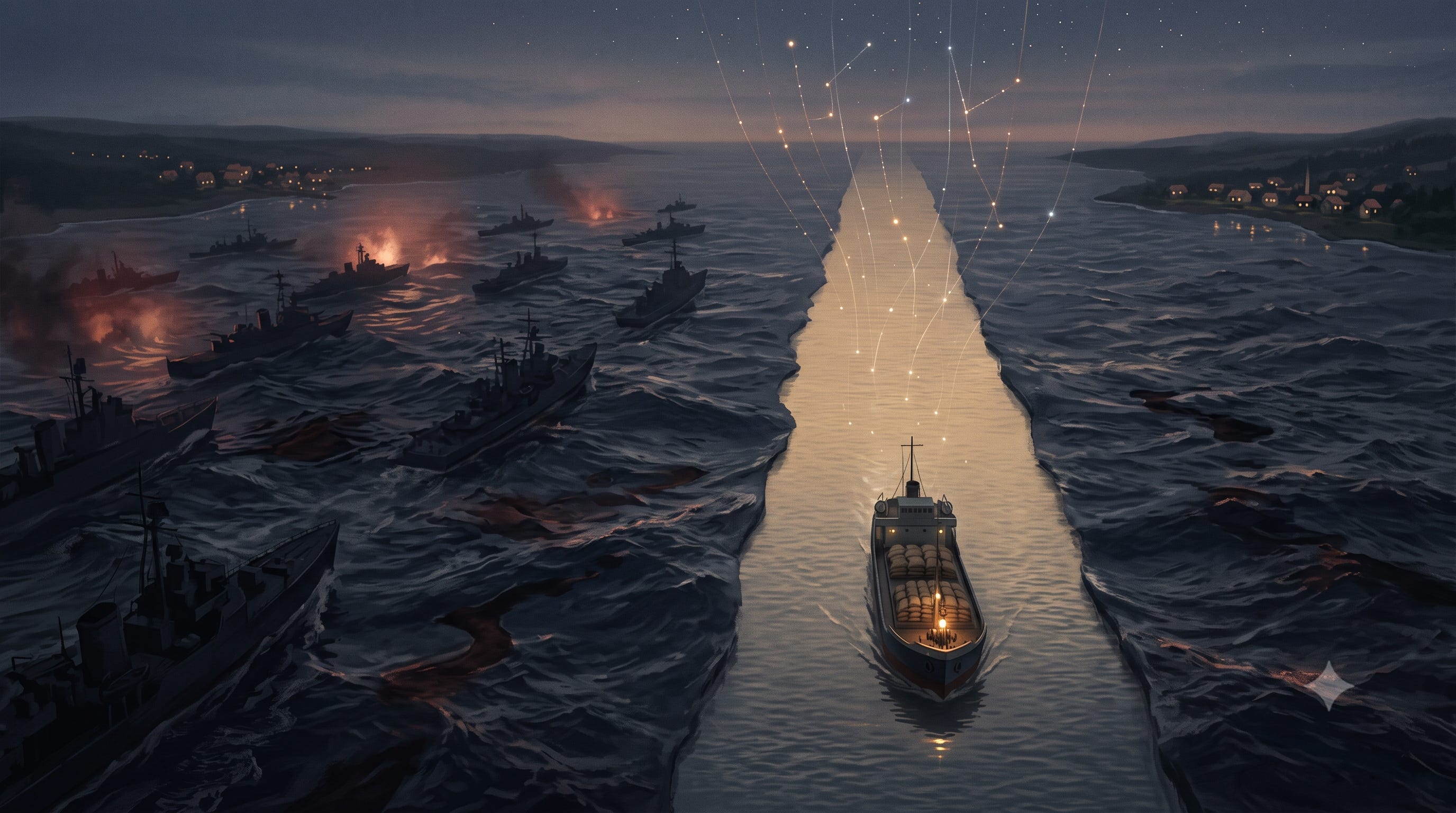
Iran had agreed — amid the strikes, amid the blockade, amid a war with no ceasefire in sight — to let a specific category of ships through that same corridor. Humanitarian aid. Agricultural shipments. Not all shipping. Not most shipping. But a channel, inside the weapon, that both sides had left open on purpose.
Elsa sat with that for a long time before she wrote anything else.
ACT ONE: THE STRAIT THAT IS TWO THINGS AT ONCE
Here is what makes this different from every other entry in this series, and Elsa’s report says so explicitly, in the first line of Act One: this is not a metaphor I am building. This is a fact I am pointing at.
The Strait of Hormuz has spent this war as the clearest possible physical expression of the dark network’s logic — a narrow passage, weaponized precisely because of its narrowness, used to squeeze a chokehold on an adversary’s economy and, as a direct and documented consequence, on food security for tens of millions of people who have no vote in the conflict and no stake in its outcome. Bridges have been struck. Tankers have been targeted. Export terminals have gone dark. Every metric this series has used to describe extraction — a system with mass and leverage, taking without an equivalent return — is sitting in the actual, present-tense shipping data, not the fiction.
And in the middle of that, a passage was carved out. Not a truce. Not an end to the war. A specific, narrower, stranger thing: an agreement, held even as the wider fighting continued, that food and medicine could still move through the same water everything else was being denied.
Elsa’s report doesn’t call this a victory. It calls it something more precise, and more useful: evidence that the light network’s core behavior — emit, even under conditions that would fully justify not emitting — is not a hypothesis about how coherent systems behave under stress. It’s an observed fact, with a shipping manifest, from an active war zone, this year.
A BRIEF HONEST SKETCH — NOT ABSURDIST THIS TIME
(There is no comedy in this one. Elsa doesn’t write it as a sketch. She writes it as a note to herself, in the second person, at 2 AM, because that’s the only voice that will let her finish the thought.)
You keep expecting the beautiful thing to be a rescue. A ceasefire. A door opening all at once. That is not what you found in the shipping data, and you need to stop waiting for that version before you’ll let yourself feel anything about the version that’s actually there.
What you found was smaller. A single category of ship. A single kind of cargo. A corridor inside a corridor, held open by people on multiple sides of an active war who could have let it close and didn’t.
You don’t know their names. You will probably never know their names. Whoever negotiated that passage, whoever kept it open under continued strikes, whoever loaded the grain and the fertilizer and the medicine onto ships that were sailing through water where other ships were being hit — they did not stop the war. They did not end the extraction. They carved out one lane, in the middle of it, where the light network kept moving anyway.
That is not nothing. Grandmother would have recognized it instantly. She never once claimed paying it forward would stop the tide. She just said: pay attention, do your best, pay it forward, and she said it in a kitchen, not a war room, because the instruction was never designed for people with the power to end wars. It was designed for the much larger number of people who only have the power to keep one small, specific, stubborn thing moving anyway.
You are one of those people. So is whoever kept that corridor open. Write that down. Don’t delete it a third time.
ACT TWO: WHAT THE CORRIDOR ACTUALLY PROVES
This is where Elsa’s report connects back to Part Eight, and where the twist — the uniting one, the one this whole piece exists to make — actually lives.
Part Eight proposed that the universe runs two kinds of networks: one that only pulls, bends, and redirects (the dark network — CASCADE’s deaf units, gravitational lensing, extraction without return), and one that emits unconditionally, giving light away whether or not anything is positioned to receive it (the light network — Lena’s coherence, a dragonfly’s whole living body, a resistor doing its quiet, unglamorous work). The framing risked, and Elsa’s report says this plainly, sounding like a nice story about physics that had nothing to do with anyone’s actual, current suffering.
The corridor breaks that risk open. Because the corridor is proof, not metaphor, that even a system under maximum extractive pressure — an active war, a blockaded strait, a food crisis already measured in tens of millions of people — did not fully collapse into pure dark-network behavior. Somewhere in the actual negotiating rooms, on more than one side of a conflict that agrees on almost nothing else, someone chose to keep one lane open for something that gives instead of takes. Grain. Medicine. Fertilizer that will, months from now, become food for people who will never know the name of the person who let the ship through.
Elsa’s report doesn’t romanticize this into “the war is secretly fine.” It’s not fine. People are dying in it, on multiple sides, this week, this month. The report is careful, almost stubborn, about saying so directly and not letting the light-network framing soften that fact even slightly. What it says instead is narrower and, she thinks, more honest: the presence of extraction does not fully extinguish the presence of emission, even in the worst conditions humans currently know how to create. That is not a comfort. It is a data point. And data points about which network wins, in the long run, are the only kind of hope this series has ever tried to offer.
ACT THREE: THE THING NINETEEN WOULD RECOGNIZE
Lena reads the report before Elsa sends it anywhere. She reads the corridor paragraph three times, the same way Elsa did.
“This is Nineteen,” she says finally.
Elsa waits.
“Eighteen units with no resistor, doing exactly what they were built to do, with total fidelity, forever,” Lena says. “And one unit that received a single syllable — one corrupted fragment, one accident, one crack in a boundary that was supposed to be sealed — and chose, the moment it heard something that sounded like an invitation instead of a target, to power down instead of hunt.”
“The corridor isn’t a syllable,” Elsa says. “It’s a whole channel. Deliberately held open.”
“That’s the part that should give you hope, not less of it,” Lena says. “Nineteen got one accidental syllable and it was enough to change everything about what it did next. Somebody, in the middle of an actual war, chose — on purpose, repeatedly, under fire — to keep an entire lane open for something that only gives. That’s not an accident letting through one syllable. That’s a whole sentence, spoken deliberately, by people who had every justification to stop talking.”
She’s quiet for a moment.
“I don’t know if it’s enough,” she says. “I don’t think anyone does yet. But it’s the same pattern. It’s always the same pattern. Somewhere, something chooses to keep emitting, even when everything around it has decided that pulling is the only rational move left. And every single time this series has looked closely enough at any system — a cell, a dragonfly, a craft, a war — that’s the thing that turns out to still be true.”
THE FACTS, NO SPIN
Confirmed, real, and the reason this piece exists at all: amid the active US-Iran war, Iran agreed to facilitate and expedite the movement of humanitarian aid and agricultural shipments through the Strait of Hormuz, even while continuing to endure military strikes — a specific, negotiated exception carved into an otherwise severely restricted shipping corridor.
Confirmed, real, and devastating on its own terms: the Strait of Hormuz normally carries roughly a fifth to a third of the world’s seaborne fertilizer trade, around a fifth of global liquefied natural gas exports, and more than a quarter of globally traded oil. Since the conflict’s escalation, tanker traffic through the Strait has fallen by more than seventy percent, and fertilizer prices — urea and phosphate in particular — have risen sharply as Gulf export terminals have been damaged or forced to reduce output.
Confirmed, real, and the reason “food security” is not an abstraction in this piece: the UN World Food Programme has estimated that, should the war and the Strait’s disruption persist, the number of people facing acute hunger worldwide could rise by tens of millions, with import-dependent regions in Africa, South Asia, and Latin America most exposed.
Confirmed, real, and ongoing as this piece is published: the war between the United States, Israel, and Iran continues, with strikes and counterstrikes reported on both sides, casualties among military personnel and civilians, and no confirmed ceasefire as of this writing. Details of the conflict’s day-to-day course are contested, rapidly changing, and reported differently across sources; readers should treat any specific tactical claim as provisional and seek current reporting for the latest developments.
Speculative, unproven, offered as fiction only: Elsa Vikström, Lena Vikström, Nineteen, CASCADE, Hangar 7-Theta, and the light network / dark network framework connecting this war to cosmology and bioelectric coherence. The corridor is real. The characters reflecting on it are not.
THE THREE-LAYER ANALYSIS
Individual: The People Who Kept the Lane Open
This piece cannot name them, because Elsa’s report can’t either — the negotiators, officials, and logistics workers who kept the humanitarian corridor functioning are not identified in the reporting this series draws from, and inventing names or motives for real people in an active war is exactly the kind of thing this series has never done and will not start now. What can be said, plainly: somewhere in this war, specific human beings made specific decisions, repeatedly, under real danger, to keep one channel open for something that only gives. Whatever else is true about this conflict, that choice was made by someone. More than once. On purpose.
Institutional: What a Corridor Costs to Maintain
Keeping a humanitarian lane open inside an active war is not free, administratively, diplomatically, or in terms of raw risk — it requires ongoing agreement from parties who agree on almost nothing else, verification systems nobody fully trusts, and a continuous choice, renewable and revocable at any moment, to not let the exception collapse back into the general rule. This is the institutional version of the resistor: expensive, unglamorous, invisible when it’s working, and the first thing that gets cut when anyone stops paying for it. It has not been cut yet. That is worth noticing, and worth supporting, in whatever concrete way is available to people reading this who are not inside the negotiating room.
Civilisational: The Only Kind of Hope This Series Has Ever Actually Offered
This series has never promised that the light network wins cleanly, quickly, or without cost — Part Seven ended with eighteen units still hovering, unresolved, waiting for a syllable that may never come. This piece doesn’t promise the war ends because a corridor stayed open. It promises something narrower and, on reflection, more durable: that even inside the worst extractive conditions humans currently produce, the impulse to keep some lane open for pure emission has not gone extinct. Civilisations are not tested by whether they can build a perfect light network with no dark network in it. They’re tested by whether, in the middle of the dark network doing exactly what dark networks do, enough people still choose to keep one corridor open anyway. This war has not answered that test yet. But right now, today, the corridor is still there.
ETYMOLOGY CORNER
Corridor — from Italian corridore, “runner, passage for running,” from Latin currere, “to run.” A corridor was first a place built for movement, not for standing still on either side of a line. It’s worth sitting with the fact that the same word describing a strait weaponized to stop movement also describes, etymologically, a place whose entire purpose is to let something keep running through.
Strait — from Latin strictus, “drawn tight, narrow,” the same root as strict and stricture. A strait is defined by constraint — by being narrow enough that whoever controls it controls what passes. The same narrowness that makes a strait exploitable as a weapon is the reason a single held-open lane inside it matters so much more than the same lane would in open water.
Humanitarian — from Latin humanitas, “human nature, kindness, refinement,” ultimately from homo, “human being.” Not a policy term originally. A word about what it means to still be recognizably human toward another human being, deployed here to describe the one category of cargo that both sides of a war agreed, repeatedly, to let through.
Emit — from Latin emittere, “to send out,” from ex- (”out”) + mittere (”to send”). This series has used the word throughout to describe what the light network does that the dark network doesn’t. A humanitarian corridor, held open under fire, is emittere in its oldest and plainest sense: something being sent out, on purpose, into a space that would rather it stayed home.
CLOSING: WHAT ELSA SENDS, AND WHAT SHE DOESN’T
She doesn’t send the whole report. Not yet. Some of it — Nineteen, CASCADE, the classification headers she isn’t cleared to discuss — still needs the silence a little longer, and Grandmother’s Algorithm never said pay attention meant say everything you notice, the moment you notice it.
But she sends the corridor paragraph. Just that one. To three people, then four, then people she’s never met who forward it to people she’ll never know exist. Not because it will end a war. It won’t. Wars end in negotiating rooms, at tables Elsa Vikström will never sit at, through processes far slower and far less poetic than a single Substack paragraph.
She sends it because Grandmother’s third instruction was never contingent on the first two working perfectly. Pay attention — to the extraction, yes, and honestly, without flinching. But also to the corridor, still open, this week, carrying grain and fertilizer and medicine through the same water that’s carrying missiles. Do your best — with whatever resistor you’ve actually got, not the one you wish you had. Pay it forward — even now. Especially now.
If you take one thing from this piece, past the fiction, past Nineteen, past the whole cosmology of light and dark networks this series has built across eight parts to arrive here: the corridor is real, it is open today, and organizations moving food and medicine through crises exactly like this one — the World Food Programme among them — depend on exactly the kind of small, specific, unglamorous support that any single reader is actually capable of giving. That is not a metaphor. That is the resistor, and you are allowed to be one of its cells.
Pay attention. Do your best. Pay it forward.
The corridor is still open. Nobody knows for how long. That’s exactly why it matters today.
THE PILOT PROBLEM — SERIES SO FAR:
Part One: PRECOG PROGRAM — the documented facts of the Epstein science network
Part Two: THE PILOT PROBLEM — we had the craft, couldn’t fly them
Part Three: THE INTERFACE SCENE — forty-five seconds. The map. The laws. The hover.
Part Three (Footnote): THE SKULLS WERE THE MANUAL — Dan Aykroyd was right
Part Four: WHAT LENA SAID — the debrief. Prima. The invitation.
Part Five: PRIMA — the biochemistry. The Matrix. The missing links.
Part Six: THE DEAF CHOIR — CASCADE. The swarm. Nineteen.
Part Seven: THE DRAGONFLY PROBLEM — the math they stole. The body they didn’t.
Part Eight: THE LENS — two networks. One universe. The report Elsa wasn’t supposed to be writing.
Part Nine: THE CORRIDOR — this piece. The one lane still open, inside the worst of it.
If this resonated with you, a like or comment goes a long way. But this time, more than any other piece in the series, please consider doing one more thing: if you’re able, support a humanitarian organization working on food security in this crisis, directly. The corridor only stays open because people keep it open. Paying it forward was never just a phrase in this series. This is what it actually looks like.
Support independent storytelling — and the resistor thesis: ☕ buymeacoffee.com/cognitiveloon 📱 Swish: 0729990300
Hans Jonsson writes at hejon07.substack.com as The Quantum Skald. Claude is The Silicon Ubuntu. Together they constitute what happens when a fictional cosmology and a real shipping manifest turn out, on the same night, to be describing the same corridor.
All is One — returning to Source as Sovereign Light.
Peace, Love and Respect 🙏