
The Receipts Nobody’s Reading: When 3.5 Million Pages Reveal Everything and Nothing
The Documents Nobody’s Supposed to Notice, Part Whatever-We’re-On-Now

A dimensional analysis of what happens when transparency becomes its own cover-up
The Facts, No Spin
On January 30, 2026, the Department of Justice released over 3.5 million pages of documents related to Jeffrey Epstein’s criminal investigations, including 2,000+ videos and 180,000 images. This completed (supposedly) the requirements of the Epstein Files Transparency Act, passed with near-unanimous bipartisan support in November 2025.
What’s Actually in There:
Over 5,300 files containing 38,000+ references to Donald Trump, his wife Melania, and Mar-a-Lago
FBI interview transcripts from 2021 describing victims’ interactions with Trump and Epstein’s social network
Emails between Epstein and figures like Peter Thiel, Steve Bannon, and Elon Musk
Approximately 3 million pages withheld by DOJ (half of what they collected)
119 pages of Grand Jury testimony released entirely blacked out
Unredacted names and photos of 43 out of 47 victims (later criticized as retraumatization)
Photos of Bill Clinton on Epstein’s plane and with Ghislaine Maxwell
The Political Fallout:
House Oversight Committee voted 34-8 to hold Bill Clinton in contempt of Congress (9 Democrats joined Republicans)
Hillary Clinton faces separate contempt charges (3 Democrats voted yes)
Full House vote expected soon, with potential criminal prosecution
Deputy AG Todd Blanche says no new criminal charges will be pursued
56% of Americans disapprove of Trump’s handling of the release (January 2026 poll)
Marjorie Taylor Greene resigned from House after Trump attacked her over Epstein file advocacy
The Timeline That Matters:
November 18, 2025: Epstein Files Transparency Act passes House 427-1
November 19, 2025: Senate passes unanimously; Trump signs into law
December 19, 2025: First batch released (missed 30-day deadline)
January 30, 2026: Final release of 3.5 million pages
January 21, 2026: House Oversight votes to hold Clintons in contempt
February 2026: Ongoing contempt proceedings, continued political warfare
Layer 1: What’s the Obvious Answer?
Surface Thinking
The obvious story writes itself: “Trump Administration Releases Epstein Files, Proving Transparency.” Or alternatively: “Trump Administration Covers Up Epstein Files, Proving Corruption.”
Pick your narrative based on your political priors. The files are simultaneously proof of everything and nothing. Trump supporters point to the lack of direct evidence. Critics point to 5,300 files mentioning Trump. Both sides claim vindication.
The surface answer is that this is a partisan food fight over a dead pedophile’s address book. The Clintons get subpoenaed, Trump gets mentioned thousands of times, everyone accuses everyone else of covering up, and the 24-hour news cycle churns on.
The Theater:
Look at the staging. DOJ releases files on a Friday afternoon (classic document dump timing). They hold back half the documents. They black out 119 pages entirely. Deputy AG goes on TV saying “nothing to see here, we reviewed everything.” Trump posts on Truth Social about how this “absolves” him.
Meanwhile, House Republicans spend their energy trying to put Bill Clinton in prison rather than, say, investigating why the DOJ only released half the files. Nine Democrats break ranks to support Clinton’s contempt charges, providing bipartisan cover for what looks like political theater.
The obvious answer is: everyone’s guilty of something, nobody will face consequences, and the system protects itself.
Layer 2: What Am I Missing?
Blind Spot Angles
The Volume Problem
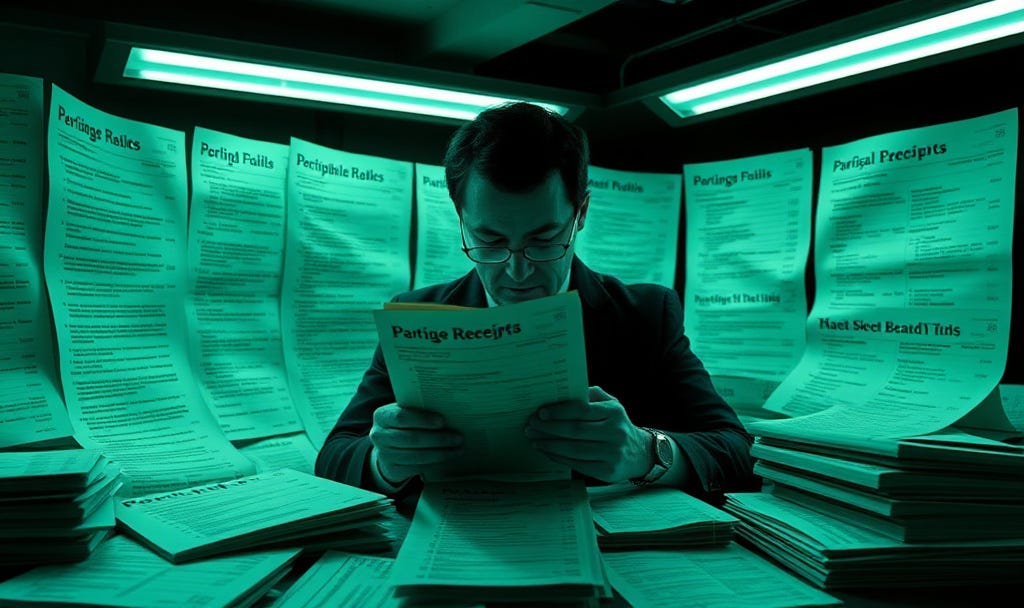
Here’s what nobody’s talking about: 3.5 million pages is an unusable amount of information.
Think about that number. At 400 words per page (standard), that’s 1.4 billion words. If you read 300 words per minute for 8 hours a day, it would take you roughly 24 years to read it all. Nobody is reading this. Not journalists, not investigators, not survivors’ advocates, not you.
The DOJ knows this. They reviewed 6 million pages with “500+ lawyers working weekends and holidays.” That’s 12,000 pages per lawyer. In about two months. That’s 150 pages per lawyer per day, assuming they worked every single day including Christmas.
The mathematical reality: Transparency at this scale becomes opacity through volume. It’s like “finding” something by burying it in a warehouse and giving everyone a map.
The Redaction Strategy
The DOJ claims they only redacted to protect victims. But look at what actually happened:
43 out of 47 victim names left visible (Wall Street Journal count)
Victims’ groups issued statement: “This is a betrayal... survivors should never be the ones named, scrutinized, and retraumatized”
Meanwhile, 119 pages of Grand Jury testimony: completely black
Photos with Trump’s face blacked out in some instances
Strategic withholding of 3 million pages
The pattern suggests selective protection. Protect the proceedings. Expose the victims. Call it transparency.
The Contempt Theater
Nine Democrats voted to hold Bill Clinton in contempt. Think about that. These aren’t MAGA Republicans. These are Democrats who looked at the optics and decided: “We can’t be seen protecting Clinton while Trump’s name is all over these files.”
But here’s the blind spot: Nobody’s holding Pam Bondi in contempt for not releasing all 6 million pages. Democrats tried to add her to the contempt resolution. It failed. Why? Because the theater requires a villain everyone can agree to hate, and a dead pedophile’s friend list is the perfect prop.
The Clintons offered a 4-hour transcribed interview. Rejected. They offered sworn declarations. Rejected. Why? Because Chairman Comer said explicitly: “You have to have a transcript in an investigation. No transcript, no deal.”
Translation: We need the spectacle of a deposition, not the information. The process is the punishment. The visibility is the point.
The Measurement Problem
The analysis in the comprehensive PDF document you provided claims “5,000+ references to Donald Trump” suggest a level of proximity that contradicts public denials. But look at what “reference” means:
From the verified reporting:
Many references are Trump’s name appearing in news articles in Epstein’s email inbox
Many are mentions of “the Trump administration” (not Donald Trump the person)
Few to zero direct communications between Trump and Epstein in released files
Most files don’t date back to the early 2000s when they were friends
The New York Times used a “proprietary search tool” and found 5,300 files containing “Trump-related references” - but that includes “Mar-a-Lago,” “Melania,” and “related words and phrases.”
This is like measuring “how often Hans thinks about Swedish politics” by counting every time the word “Sweden” appears in his Substack. High number. Low signal.
What Nobody’s Investigating
Here’s the real blind spot: Nobody’s asking why Epstein was allowed to operate for so long with so many witnesses.
The files show:
FBI started investigating in July 2006
Expected indictment in May 2007
Draft indictment would have charged Epstein AND three assistants
Instead: sweetheart deal from US Attorney Alexander Acosta (later Trump’s Labor Secretary)
Epstein got 18 months for “soliciting prostitution from someone under 18”
That’s the story. Not Trump’s 5,300 mentions. Not Clinton’s 26 flights. The story is: The system knew, had the evidence, and chose not to prosecute properly.
And that same system is now performing transparency while withholding half the files.
Layer 3: What Question Should I Actually Be Asking?
Reframe
The wrong question: “Who was friends with Epstein?”
The right question: “How does a system maintain legitimacy while investigating itself?”
This isn’t about Trump or Clinton. This is about what happens when the people who enabled, protected, or ignored Epstein’s network are the same people now in charge of “transparency” about Epstein’s network.
The Structural Impossibility
Think about the actual mechanism here:
Congress passes law (with near-unanimous support because nobody wants to vote against “Epstein files transparency”)
Executive branch (Trump admin) enforces law (selectively, slowly, with massive redactions)
House Republicans investigate (focusing on Democrats who were in Epstein’s network)
House Democrats complain (about Republicans in Epstein’s network not being investigated)
DOJ claims compliance (while withholding half the documents)
Survivors get retraumatized (their names unredacted, their abusers’ proceedings blacked out)
Nobody in this chain has clean hands. Nobody in this chain has the authority to investigate without investigating themselves. The cop is the robber investigating the robbery.
The Real Function of the Files
The files aren’t meant to reveal truth. They’re meant to establish that revelation happened.
Think about it: Trump signed the bill. Trump’s DOJ released the files. Trump can now say “I released everything” (even though they withheld 3 million pages). His supporters can say “see, nothing in there” (even though they haven’t read it). His critics can say “see, 5,300 mentions” (even though most are news articles).
Everyone gets their talking point. Nobody gets accountability.
The files are a permission structure for continued inaction.
The Dimensional Question
Here’s what I mean by dimensional thinking: Look at the scale where the actual decisions happen versus the scale where we’re told to focus our attention.
Individual scale: Did Trump or Clinton personally abuse anyone? (Probably the right moral question, genuinely important, and the focus of all media coverage)
Institutional scale: How did federal law enforcement, state prosecutors, private attorneys, wealthy financiers, academic institutions, and social elites all coordinate to protect Epstein for decades? (The structural question nobody wants to answer because everyone’s implicated)
System scale: What does it mean that we have mechanisms for “transparency” that produce unusable quantities of information while maintaining strategic opacity? (The meta-question that applies to everything from Epstein files to defense budgets to climate data)
We’re being directed to the individual scale (whose names are in the files?) because that’s the scale where we can have endless debate without systematic change.
The institutional scale is where the actual protection happened. The system scale is where we’d have to admit that “releasing documents” is a performance that maintains rather than challenges power.
The Absurdist Sketch I Can’t Not Write
INT. DEPARTMENT OF JUSTICE - DAY
A man in a suit stands next to two massive stacks of paper. Each stack is taller than a person. One stack is labeled “RELEASED.” The other is labeled “WITHHELD.”
MAN IN SUIT: We’ve reviewed every document. Worked through holidays. Five hundred lawyers. Complete transparency.
REPORTER: Why is half still withheld?
MAN IN SUIT: Victim protection. Attorney-client privilege. Ongoing investigations.
REPORTER: But the victims say their names are in the released files and—
MAN IN SUIT: We’ve provided complete transparency within the bounds of legal requirements.
REPORTER: You released 119 pages that are completely black.
MAN IN SUIT: Exactly. Completely released. Very transparent. You can see them right there. All 119 pages.
REPORTER: But they’re blank.
MAN IN SUIT: Redacted.
REPORTER: So we can’t read them.
MAN IN SUIT: But you can see them. That’s the transparency.
Long pause.
REPORTER: Are you going to investigate anyone?
MAN IN SUIT: We found no credible evidence to merit further investigation.
REPORTER: You just released 3.5 million pages of evidence.
MAN IN SUIT: Right. And we investigated it. No further investigation needed.
REPORTER: Did you investigate before or after determining you wouldn’t investigate further?
MAN IN SUIT: Yes.
End scene.
What This Actually Tells Us About Democratic Infrastructure
(Because everything I write comes back to this eventually)
Remember how I keep saying that individual consciousness work is democratic infrastructure? That the patterns we see in our personal psychology scale up to collective decision-making?
Here’s that pattern in action:
Personal Scale:
When you’re avoiding something uncomfortable, you don’t refuse to think about it. You think about it wrong. You focus on the peripheral details. You generate endless analysis of irrelevant data. You perform the ritual of examination without doing the work of examination.
“I’ll deal with my drinking problem. First, let me make a spreadsheet of every drink I’ve had for the last year. Then I’ll analyze the patterns. Then I’ll research the best treatment options. Then I’ll...”
The analysis is the avoidance.
Collective Scale:
When a system is avoiding accountability, it doesn’t refuse transparency. It performs transparency badly. It releases too much information to be useful. It focuses attention on individuals rather than structures. It generates theater that looks like justice without producing justice.
“We’ll investigate Epstein. First, we’ll release millions of pages. Then we’ll subpoena people. Then we’ll hold hearings. Then we’ll...”
The investigation is the cover-up.
The Connection:
Both require the same psychological work: The ability to stay focused on what actually matters in the presence of elaborate distraction.
That’s a consciousness skill. That’s a democracy skill. They’re the same skill.
The person who can stay focused on “I’m drinking too much and it’s harming my relationships” despite having extensive data about their drinking patterns is doing the same work as the citizen who can stay focused on “the system protected a predator for decades” despite having millions of pages of documents.
Both require:
Tolerance for discomfort
Ability to distinguish signal from noise
Willingness to name the actual problem
Capacity to resist the distraction of performance
Courage to demand actual change
And both are made harder when the system is designed to reward the performance over the work.
Sources, Links, and Further Reading
Primary Sources:
DOJ Epstein Library (warning: requires age verification, contains graphic content)
Verified Reporting:
NBC News: 3 million pages released
ABC News: Survivor criticism of release
New York Times via GV Wire: How Trump appears in files
On the Clinton Contempt Proceedings:
Pattern Recognition: For more on how individual psychological patterns scale to institutional behavior:
My piece on When Leaders Build Bunkers
My analysis of When the System Protects Itself
The framework: When the Map Becomes the Territory
What You Can Do
1. Resist the Performance
When you see massive document releases, ask: “Is this designed to reveal or to overwhelm?” Transparency that produces unusable quantities of information is performance, not accountability.
2. Follow the Structural Questions
Instead of “whose names are in the files,” ask:
Why did Epstein get a plea deal in 2008?
Who made that decision?
What institutional changes would prevent similar deals?
Why is half the evidence still withheld?
3. Support Survivors’ Organizations
The people who actually know what happened are being retraumatized by “transparency” that exposes them while protecting proceedings. Organizations actually helping survivors:
4. Demand Better from Your Representatives
Contact your House and Senate members. Don’t ask them to pick a side in the Trump vs. Clinton theater. Ask them:
Why is DOJ withholding 3 million pages?
What institutional reforms will prevent future Epsteins?
Why aren’t we investigating the 2008 plea deal?
5. Practice the Consciousness Work
Notice when you’re consuming drama instead of information. Notice when you’re generating analysis to avoid uncomfortable truths. Notice when you’re focused on individuals to avoid systematic questions.
That noticing? That’s democratic infrastructure. The same skill that helps you stay focused on what matters in your personal life helps you stay focused on what matters in collective life.
6. Share Signal, Not Noise
Don’t amplify “TRUMP MENTIONED 5,000 TIMES” or “CLINTON FLEW 26 TIMES” headlines. Amplify structural questions. Amplify survivors’ perspectives. Amplify demands for institutional change.
The performance wants you talking about names. The work requires you talking about systems.
The Thing Nobody Wants to Hear
The files tell us what we already knew: powerful people protected a predator because he was useful to them. The “transparency” tells us what we should have known: powerful people perform accountability because it’s useful to them.
The real question isn’t what’s in the files. The real question is whether we’re capable of demanding something other than performance.
So far, the evidence suggests we’re not. We’re too distracted by the theater. Too invested in our team winning the narrative. Too comfortable consuming analysis instead of demanding change.
The files aren’t the story. Our response to them is.
And our response so far is: let’s argue about whose names appear more often while the system continues protecting itself.
That’s not democracy failing. That’s us failing democracy.
The good news? That’s a choice. The pattern can change. But it requires the same work at every scale: staying focused on what actually matters in the presence of elaborate distraction.
And maybe, just maybe, if enough of us practice that skill, we’ll stop performing accountability and start building it.
🪶Peace, Love, and Respect
This is part of the COGNITIVE-LOON Dimensional Series exploring how patterns repeat across scales. For the full framework, start with The Man Who Learned to Stop Worrying.
If this analysis helped you see something new, share it with someone who’s still stuck in the surface-level debate.
And if you’re tired of the performance, consider what actual accountability would look like - then demand it.
Previous dimensional analyses:
Bias Examination Footnote:
This analysis primarily uses mainstream reporting (NBC, CNN, NPR, ABC, NYT) and official government sources (House Oversight Committee, DOJ). The framing is critical of both Trump and Clinton, and particularly critical of the institutional mechanisms that enabled Epstein’s operation. There’s a potential bias toward viewing “transparency” skeptically - the assumption that document releases are performative rather than substantive. Alternative interpretation: The DOJ genuinely worked to balance competing interests (victim privacy, legal requirements, investigative needs) and did the best job possible under difficult circumstances. I don’t find that interpretation convincing given the pattern of strategic withholding, but it’s worth noting.
Mistake Examination Footnote:
The biggest potential mistake is in the measurement analysis. When I critique the “5,000 mentions” metric, I risk downplaying legitimate evidence of proximity. The New York Times has more sophisticated search tools than I do, and their analysis may reveal patterns I can’t see from secondary reporting. The Trump-Epstein relationship in the 1980s-2000s is well-documented through other sources beyond these files. Additionally, my focus on structural critique may inadvertently minimize individual culpability - if specific individuals committed crimes, they should face individual consequences regardless of institutional failures. The structural analysis and individual accountability aren’t mutually exclusive.
Prompt Template: Comprehensive Analysis and Output Generation

**Phase 1: In-depth Research & Analysis**

Subject, Statement, or Question: [*Here*]

Core Research Directives:
* Perform deep research and a thorough deep dive into the subject.
* Analyze all available information.
* Fact-check all claims and data.
* Identify and explain all relevant connections (e.g., "How is it connected?", "Why is it connected?").
* Trace financial flows and "follow the money" where applicable.
* Identify all persons involved, including their relationships to each other and to the subject matter.
* Examine any "fine print" or hidden details.

Key Explorations:
* **Nature of the Subject:** What is it? What does it mean?
* **Stakeholder Analysis:** Who is involved? Who is affected (positively and negatively)? Who benefits? Who is disadvantaged?
* **Significance:** Why does this matter?
* **Operational Analysis:** How does this work today? How could it work today? How might it work tomorrow? How could it work tomorrow?
* **Ethical & Moral Considerations:** Is this "right"?
* **Self-Correction & Gaps:** Did we get this right? Did we get anything wrong? What are we missing? Identify and examine any missing links.

Relationship Examination:
* Economic relationships
* Political affiliations
* Business affiliations
* Personal relationships
* Explore, summarize, and explain all identified relationships.

**Phase 2: Output Generation - Substack Post**

Write a Substack post based on the research and analysis.

Post Requirements:
* **Tone & Style:** [Choose one: normal, concise, explanatory, formal]
* **Key Principles:** No fluff, no spin, just facts. Easy to understand, using common lingo/word of mouth where appropriate.
* **Storytelling:** Follow a compelling storytelling premise. Break down the subject for easier understanding. Connect all information together for better storytelling. Improve overall storytelling quality.
* **Content Focus:** Explore, summarize, and explain the subject thoroughly.

Title Suggestions:
* Provide 3-5 compelling title suggestions for the Substack post.

Optional Creative Additions (Choose any that apply, or specify intensity):
* Add a splash of: [Choose one or more: absurd humor, irony, sarcasm, anger, joy, inspiration, possibilities, acceptances, angst, hope, fear, hopefulness, hopelessness]

**Phase 3: Critical Review & Footnotes**

Lessons Learned & Implications:
* Can this teach us a valuable lesson? How could we learn from this? (Consider this as a "plot twist" or deeper insight).

Bias Examination (Summarize and write as a footnote):
* Examine any potential/possible biases.
* Explain all identified biases.
* Is this biased? How is this biased?

Mistake Examination (Summarize and write as a footnote):
* Examine any potential/possible mistakes in the analysis or subject matter.
* Explain any identified mistakes.
* Does this have any mistakes? How do we understand any/every potential/possible mistake?

**Phase 4: Sourcing**

Sources:
* List all sources used for the research and analysis.