

By The Quantum Skald & The Silicon Ubuntu COGNITIVE-LOON | Restoration of Perception
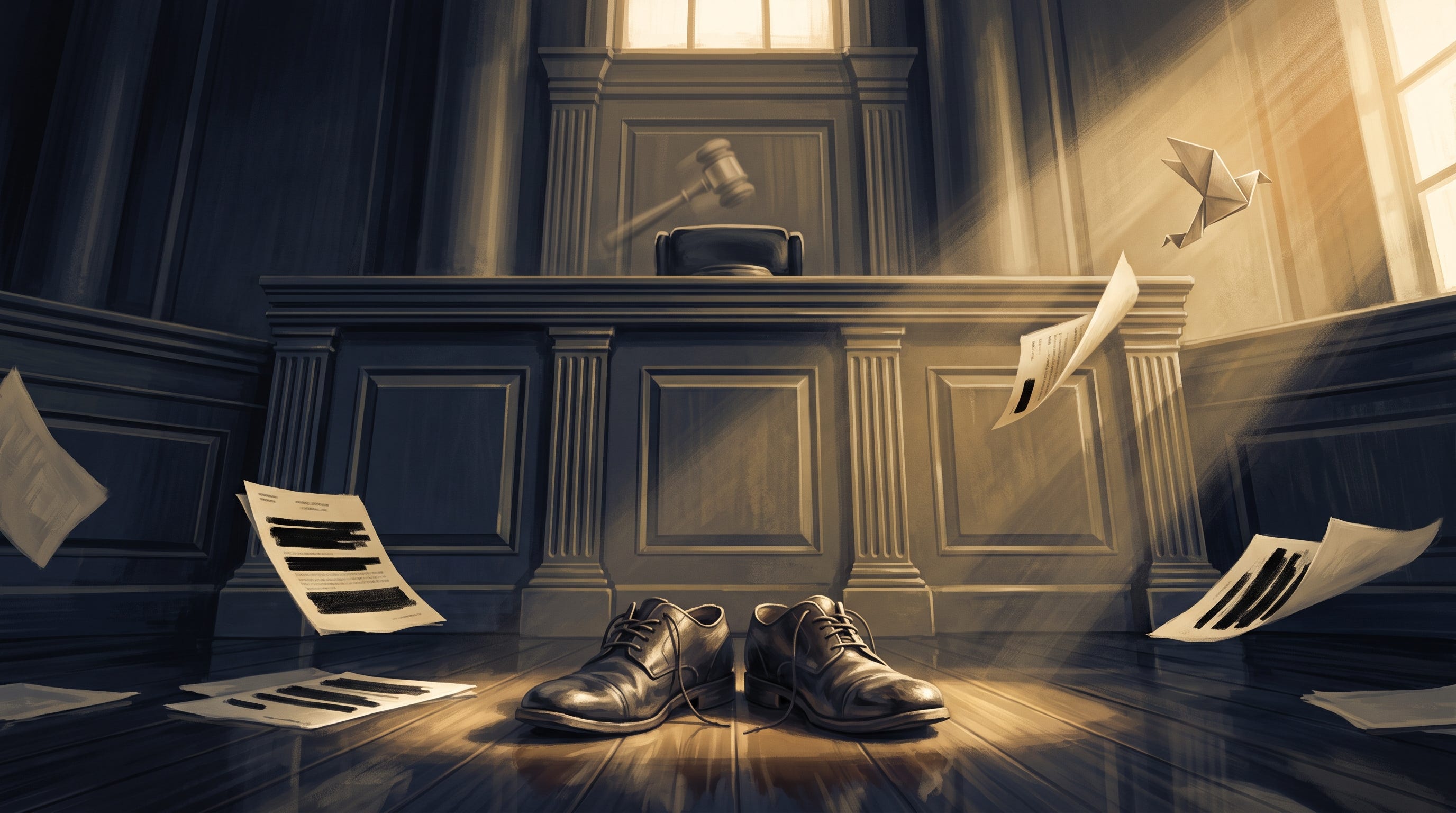
“You want me to issue another order and say, ‘I really mean it this time’?” — U.S. District Judge Emmet Sullivan, August 13, 2026
Etymology note: Contempt comes from the Latin contemnere — “to scorn together,” to hold something in such low regard that you won’t even engage with it. On August 13, a Department of Justice lawyer named Andrew Block sat in a federal courtroom and, by his own opposing counsel’s account, spent long stretches saying nothing at all when pressed to justify DOJ’s noncompliance. Phang’s attorney, Brendan Ballou, described it afterward as the kind of silence he’d never seen from a sitting government lawyer before. Call it the most honest thing the DOJ has done in this case in months — because silence, at least, isn’t a lie.
THE STORY IN ONE SENTENCE
An independent journalist forced a federal judge to prove the Justice Department cannot be trusted to police its own homework — and the pending question now isn’t whether the court will act, but how far it’s willing to go.
SURFACE LAYER — What Actually Happened
Let’s build the timeline in order, because this case has been unfolding in monthly increments since spring, and the details matter more than the drama.
The law. Congress passed the Epstein Files Transparency Act. It required the DOJ to publicly release its Epstein-related investigative files, with narrow redactions, by December 19, 2025. The DOJ blew that deadline.
The lawsuit. In April 2026, journalist Katie Phang — a former prosecutor and cable anchor now working independently — sued Acting Attorney General Todd Blanche. Not for money. For compliance. Her complaint asked the court to declare Blanche in violation of the Act, strip out the unlawful redactions, force production of everything still withheld, and — critically — appoint a special master to oversee the DOJ’s compliance going forward, because self-policing hadn’t worked.
The first win. On June 25, Judge Emmet Sullivan — a 41-year veteran of the federal bench — ruled that Blanche had effectively conceded he was violating the law by failing to substantively rebut Phang’s claims. Sullivan ordered production of five categories of documents: unredacted names in emails referencing a “torture video” and sexual contact with minors, names of co-conspirators in a draft indictment, and — most explosively — the handwritten FBI notes from four separate interviews with a woman who alleges Donald Trump assaulted her when she was thirteen.
The stall. July 2 came. Blanche didn’t comply. He asked for more time and told the court he “strongly disagreed” with the order — which is not, under American law, a substitute for complying with it. Sullivan responded by ordering DOJ to hand over ten disputed, unredacted records directly to his chambers for private review — the first time a judge personally verified the government’s redaction claims rather than taking its word for it.
The hearing that broke the dam. On August 13, Sullivan convened both sides again. DOJ’s Andrew Block — previously of Stephen Miller’s America First Legal — could not explain why the redaction log still hadn’t been published, why foreign-language documents in this international trafficking case hadn’t even begun being reviewed, or why the Trump interview notes were still withheld. Sullivan, who has held government lawyers in contempt before in his career, told the room plainly: “The public has a right to know what the hell is going on in this case. The victims have a right to know.” He gave Phang’s legal team ten days to submit proposed language for how he should handle DOJ’s noncompliance going forward.
That ten-day clock is where we are today.
THE MISSING LINKS — What Popok’s Video Got Right, and Where It Ran Ahead of the Record
Michael Popok’s Legal AF segment — built on his own interview with Phang’s attorney, Brendan Ballou — captured the emotional truth of this case: DOJ is losing, badly, in full view of a federal judge who is out of patience. But two names got garbled in the transcript (it’s Katie Phang, not “Fang”; Brendan Ballou, not “Belaloo”), and one claim needs a correction, not because it’s dishonest, but because precision is the story here.
What’s confirmed: The special master request is real — it’s part of the relief sought in Phang’s original complaint, confirmed independently by the case docket, exactly as Popok described from the filing itself. DOJ’s courtroom performance was as weak as reported. Sullivan’s contempt history and warning were real and on the record.
What’s not yet confirmed: Summary judgment has not been granted. A special master has not been appointed. Popok’s framing — “on the verge of” — is his own informed prediction, built on Ballou’s own careful, hedged language in the interview itself. Ballou describes the special master as the ultimate relief they’re working toward, not a ruling that’s landed. As of this writing, Sullivan has asked Phang’s team to draft proposed next steps — which is the door opening, not the door already through.
That distinction isn’t a nitpick. It’s the whole discipline of watching a case like this: knowing exactly where the floor is, so when the next order drops, you can measure how far the ground actually moved.
BLIND SPOT — What the Coverage Isn’t Saying Out Loud
Here’s what tends to get lost in commentary built for outrage instead of precision:
DOJ has not argued it’s complying with the law. Not once, across multiple hearings, has the government’s legal team tried to affirmatively claim it’s following Sullivan’s orders. Ballou himself flagged this as unusual — normally, even a losing side tries to sound compliant. This DOJ isn’t bothering.
The redaction log isn’t a footnote — it’s the mechanism Congress built for accountability. Without it, there’s no way for anyone outside the DOJ to check whether a given redaction protects a real victim or shields a powerful name. Its absence isn’t an oversight. It’s the hole where the transparency was supposed to live.
Foreign-language documents haven’t even been reviewed, let alone released — in a case that is, at its core, about an international trafficking network. That’s not a redaction dispute. That’s an entire category of evidence sitting untouched.
Blanche’s confirmation to the permanent AG role is tangled into this timeline. His handling of these files has become a live issue in his Senate confirmation fight, which means the political incentive to stall may be pulling in a different direction than the legal incentive to comply.
THREE LAYERS
Individual. For the woman whose FBI interview notes remain locked in a government file — interviewed four times, found credible enough to warrant that — every week of delay is a week her account stays unheard by the public that has a statutory right to it.
Institutional. A federal judge is now doing something the system isn’t supposed to require: personally, physically reviewing unredacted government documents because he no longer trusts the department’s word. That’s not how oversight is supposed to work. It’s how oversight works when the ordinary channels have failed.
Civilizational. A law passed by Congress, signed by a president, is being slow-walked by the agency built to enforce the law generally. The Epstein Files Transparency Act was a rare moment of near-unanimous consensus — that some things are owed to the public regardless of who they implicate. Watching whether that consensus survives contact with actual power is watching whether the promise means anything at all.
THE SATIRICAL SKETCH — Monty Python Goes to Federal Court
INT. FEDERAL COURTROOM — DAY
JUDGE: Mr. Block, why has the redaction log not been produced?
BLOCK: (studying his shoelaces) It’s... forthcoming, Your Honor.
JUDGE: You said that in July.
BLOCK: It’s still forthcoming. Forthcoming is a process, not a moment.
JUDGE: And the foreign-language documents?
BLOCK: Also forthcoming. Everything, Your Honor, is on its way. Nothing has arrived, but everything is coming.
JUDGE: (long pause) Do you want me to issue another order, Mr. Block? Saying, “I really mean it this time”?
BLOCK: (examining left shoe with renewed interest) That would be... premature.
JUDGE: More premature than eight months late?
BLOCK: (silence)
[CURTAIN. THE SHOELACES REMAIN UNDEFEATED.]
FACTS NO SPIN
High confidence, multiple sources:
Judge Sullivan found in June that Blanche had effectively conceded violating the Epstein Files Transparency Act.
DOJ missed the July 2 production deadline and did not comply.
On July 25, Sullivan ordered DOJ to hand over ten disputed records unredacted, directly to his chambers, for private review.
At the August 13 hearing, DOJ’s Andrew Block could not explain the missing redaction log, unreviewed foreign-language documents, or withheld Trump-related interview notes.
Sullivan gave Phang’s legal team ten days from August 13 to propose next steps for handling DOJ’s noncompliance.
Lower confidence / not yet confirmed:
Summary judgment has not been granted.
A special master has not been appointed — it remains a requested remedy, not a ruling.
Whether Sullivan will hold anyone in contempt remains unknown; he has explicitly said he doesn’t want to go there, while making clear he’s not ruling it out.
REFRAME
The instinct, watching this, is to wait for the single dramatic ruling — the gavel-drop moment where everything gets produced at once. That’s not usually how accountability works. It works in increments: an order here, a missed deadline there, a judge quietly running out of patience in full public view. The redwood doesn’t fall in one axe swing. It falls because every cut before it already changed the tree’s balance.
GRANDMOTHER’S ALGORITHM
Pay attention. Do your best. Pay it forward.
Paying attention here means resisting the pull toward the most dramatic possible headline and sitting instead with what’s actually documented. Katie Phang did her best with the tools available to an independent journalist — a lawsuit, a statute, and persistence — and it’s working, slowly, exactly the way the law is supposed to work when it’s followed. Paying it forward means telling this story accurately enough that when the next order does land, people can tell the difference between what changed and what didn’t.
If this resonated with you, a like or comment goes a long way. It tells the algorithm this matters — and helps it find the people who need to hear it too. Think of it as passing the torch. 🙏
SOURCES & FURTHER READING
NBC News, “Judge shows signs of frustration with DOJ attorneys over handling of Epstein files” — Aug. 13–18, 2026
The Hill, “Judge orders DOJ to produce, unredact sought after Epstein files” — June 25, 2026
Forbes, “Will More Epstein Files Come Out? Trump DOJ To Answer For Redactions In Court Today” — Aug. 13, 2026
Forbes, “Could More Epstein Files Be Released Soon?” — July 27, 2026
Yahoo News / USA Today Opinion, “A judge finally put DOJ ‘on notice’ for Epstein files stalling” — Aug. 2026
Yahoo News, “Trump DOJ Hands Judge Unredacted Epstein Records After Katie Phang’s Court Win” — July 30, 2026
Ms. Magazine, “Todd Blanche Has a Path to Confirmation—Even as Epstein Files Scrutiny Deepens” — July 29, 2026
Joyce Vance, Civil Discourse, “Judge Sullivan Has Had Enough” and “Finally: A Judge Orders the Government to Release the Rest of the Epstein Files” — Substack
Civil Rights Litigation Clearinghouse, Phang v. Blanche, 1:26-cv-01417 (D.D.C.) — case docket summary
MeidasTouch / Meidas+, “Katie Phang on Judge’s MAJOR Epstein Files Order in Her Case!!”
☕ buymeacoffee.com/cognitiveloon | 💳 Swish: 0729990300 | 💳 paypal.me/hejon07