

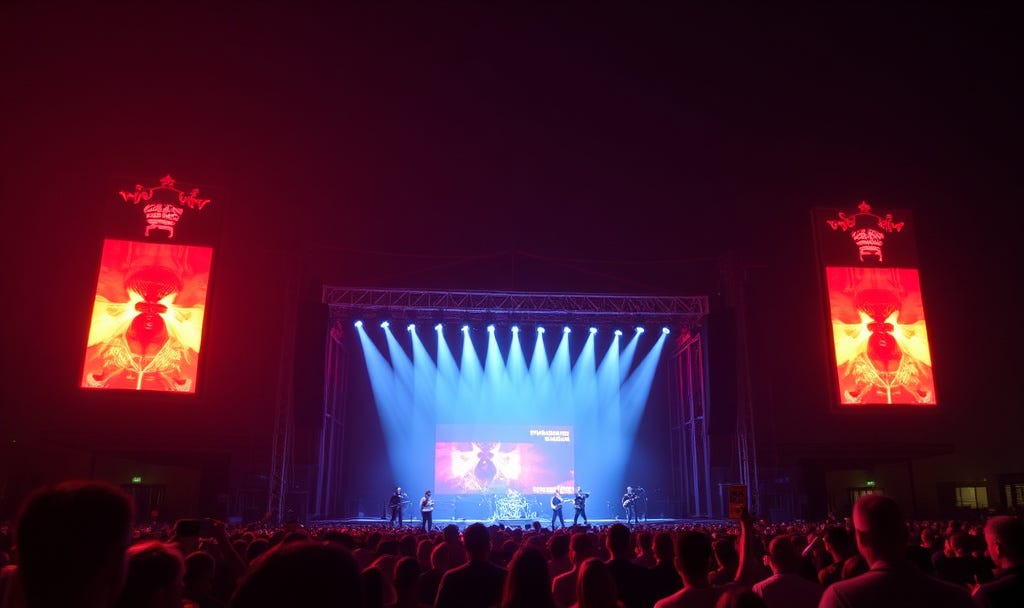
by The Quantum Skald & The Silicon Ubuntu | Restoration of Perception / COGNITIVE-LOON
“Equal distribution does not mean identical infrastructure. It means everyone gets a system sized to where they actually stand — and a system they can actually see.”
A fan wrote to Ticketmaster’s own president this spring with a simple complaint: every time a big on-sale opened, her account landed 80,000-plus places back in the queue. Her parent’s account, same household, same Wi-Fi, same moment — usually around 20,000. A friend’s account, near the front almost every time.
She wasn’t asking for a refund. She wasn’t asking to skip the line. She asked one question: why?
The president’s answer, in public, on X: “Absolutely not” rigged, and customer complaints have “no bearing on anything.” No further explanation offered.
That single exchange contains the entire Ticketmaster problem in miniature. Not the fees. Not the bots. Not even the monopoly, exactly. The actual wound is this: millions of people are asked to trust a high-stakes system they cannot see, audit, or challenge — and when they ask how it works, the honest answer is “we’re not going to tell you.”
We’ve spent months building the Sovereign Node framework around a different kind of infrastructure — water, energy, compute — owned and understood by the community it serves instead of metered by a company it can’t see inside. Turns out the exact same design flaw, and the exact same fix, applies to something as ordinary as buying a concert ticket. Let’s pull the thread.
FACTS. NO SPIN.
The structure. Ticketmaster controls roughly 80% or more of the major concert venues’ primary ticketing market in the US. Its parent company, Live Nation, also promotes tours, books artists, and owns or controls a large share of the venues those tours play. In May 2024 the Department of Justice, joined by 30 state attorneys general, sued the combined company for running an illegal monopoly — alleging it locked venues into exclusive long-term contracts, retaliated against venues that explored alternatives, and used financial incentives to keep the whole ecosystem captive. That case is in its substantive phase through 2026, with the government pressing for a forced breakup.
The fees. Hidden service charges have added 30% or more on top of the sticker price, revealed only at checkout.
The bots. Ticketmaster says it blocks roughly 5 billion bot attempts every month, and has blocked over 13 billion bots across more than 17,000 events. During one recent Oasis on-sale, Live Nation’s own CEO said the system was hit by “10 billion bots.” During major demand spikes — Eras Tour-scale events — bots can account for up to 90% of total site traffic. This is not a fringe nuisance; it is the dominant traffic pattern the entire system is built to survive.
The queue. Ticketmaster’s own help content describes the queue as a “virtual line” using “security measures” to detect bots and manage traffic. What inputs determine your specific position — account age, device, purchase history, a fraud score, pure randomization — has never been clearly disclosed. When directly asked this spring, the company’s global president declined to explain the mechanism, only denying that complaints affect it.
The infrastructure. A Senate Permanent Subcommittee on Investigations report, released after a nearly three-year inquiry reviewing more than 110,000 pages of internal documents, found that the Eras Tour outage wasn’t purely a bot story. Internal emails cited in the report show Ticketmaster’s own president attributing the crash to “old legacy pages” going down — aging infrastructure, not just unprecedented demand.
The resale fog. The same Senate report found Ticketmaster’s resale tickets are displayed inside its own primary-market interface with insufficient labeling, so buyers often don’t realize they’re paying a markup to a third party through Ticketmaster’s own checkout. One fan quoted in the report put it plainly: nothing clearly alerted her she was buying from a reseller at double the real price.
The breach. In 2024, a hacker group reportedly stole personal data — names, addresses, phone numbers, partial card details, order histories — belonging to roughly 560 million Ticketmaster customers, one of the largest consumer data breaches in US history.
The scale of the underlying market. Online event ticketing is roughly a $69 billion industry, projected to top $100 billion within a decade. The secondary resale market alone has ballooned past $15 billion. There is real money funding every piece of this fog.
None of this requires assuming malice at every turn. Bots are a genuine, expensive arms race. Demand for a sold-out tour genuinely exceeds supply. But “the system is complicated” and “the system is designed to stay opaque because opacity is profitable” are two different sentences, and the Senate’s own internal-document review increasingly points toward the second one.
THE ABSURDIST SKETCH: The DMV of the Gods
[Scene: A celestial waiting room. A single clerk processes an infinite queue. A mortal approaches the desk, ticket number in hand.]
MORTAL: Excuse me. I’ve been in this queue for forty minutes and I started at position 84,213. My cousin started at the same second and got position 1,847.
CLERK: (without looking up) The queue is fair.
MORTAL: I’m not saying it isn’t. I’m asking how it works.
CLERK: It works the way it works.
MORTAL: That’s not an answer.
CLERK: (stamps a form) It’s the answer you’re getting.
MORTAL: Is it random? Is it weighted? Does it know I complained on the internet that one time?
CLERK: (pause) Complaints have no bearing on anything.
MORTAL: I didn’t ask if they did. I asked if they—
CLERK: NEXT.
[A bot, dressed in a convincing trench coat and mustache, steps up to the desk.]
BOT: (in a flat, slightly too-fast voice) Hello. I. Am. A. Human. Who. Would. Like. Four. Tickets.
CLERK: (already stamping) Welcome back. Section 3, row A, same as always.
MORTAL: WAIT—
CLERK: NEXT.
The mortal is still in the queue. The mortal will always be in the queue. Somewhere, a server logs the entire exchange as “engagement.”
THE THREE LAYERS
Layer 1 — Surface answer: Ticketing is broken because of bots, scalpers, and corporate greed. Fix the bots, cap the fees, break up the monopoly, problem solved.
Layer 2 — Blind spot: That’s all true, and none of it touches the actual design flaw. Even a perfectly bot-free, fee-capped, legally de-monopolized ticketing system would still be a black box if the only entity that can see the queue, the inventory, and the pricing logic is the same single company on every side of the transaction. Breaking up Live Nation and Ticketmaster fixes the market structure. It doesn’t, by itself, fix the information structure — the fact that fans have no way to verify any claim the system makes about itself. You can have five competing ticketing companies and still have five black boxes instead of one.
Layer 3 — Reframe: The actual fix isn’t only “more competition.” It’s verifiability. A system where a fan doesn’t have to trust a press release about how the queue works, because the queue’s logic — randomization, fraud scoring, inventory release — is checkable by design, not by request. Where a resale ticket can’t be visually blended into a primary listing because the origin of every ticket is written into the ticket itself, permanently, the moment it’s issued. Where a venue isn’t locked into one company’s ecosystem because the underlying ledger of who-owns-what-ticket isn’t owned by anyone in particular — it’s a shared, public record, the same way a node in a Sovereign Node network doesn’t ask anyone’s permission to purify its own water.
This is exactly the move we’ve been describing in the Sovereign Node series for energy and water. Decentralization isn’t a buzzword here — it’s a specific, mechanical answer to a specific, mechanical problem: when one party controls the gate, the meter, and the ledger, trust has nowhere to live except their PR department.
WHAT THIS CONNECTS TO
Here’s the part that surprised us doing the research for this piece: this isn’t a hypothetical fix we’re proposing. It’s already being built — by people who used to work at Ticketmaster.
A project called TIX, built by veterans of Ticketmaster and the developer platform Buildspace, has emerged as a settlement and financing layer for live events, running on the Solana blockchain. It doesn’t replace the customer-facing app — it sits underneath one (a platform called KYD Labs, backed by $7 million from venture firm a16z) and handles the part that currently has no transparency at all: tokenizing tickets so their origin and ownership are verifiable on a public ledger, and letting venues access financing directly instead of through Live Nation’s ecosystem. As of this year, the network has already facilitated over $8 million in ticket sales and generated roughly $2 million in venue financing — small next to Ticketmaster’s scale, but real, operating, and growing.
It’s not the only one. Smaller projects — GET Protocol, GUTS Tickets, SeatlabNFT — are running blockchain-verified ticketing for real festivals and venues across Europe right now, with built-in resale rules that route a cut back to artists and cap markup by code instead of by policy memo. Even academic teams have published working open-source models: one recent system out of a university research group uses zero-knowledge proofs to verify a ticket-holder’s identity without a central company ever holding that identity data at all — solving the privacy and the scalping problem with the same mechanism.
And tellingly — Ticketmaster knows this is coming. The company has been experimenting with blockchain-based ticketing since at least 2019, and has issued nearly 100 million NFT tickets on the Flow blockchain since 2022. The empire is hedging its own disruption.
This is the Sovereign Node principle showing up in a domain we didn’t expect: the cure for monopoly opacity isn’t always a bigger regulator. Sometimes it’s a smaller, transparent, boring piece of shared infrastructure that just makes the old black box unnecessary. A water tower that purifies its own water doesn’t need a permission slip from a utility company. A ticket whose ownership history is written into a public ledger the moment it’s minted doesn’t need anyone’s press statement to prove it’s real, or whose hands it’s passed through, or what it actually cost the first time.
DIMENSIONAL VIEW
Individual: You, the fan, currently have zero tools to verify anything the system tells you about your own queue position, your own ticket’s resale history, or your own refund math. A verifiable ledger gives you a receipt you can actually check, the same way you’d check a bank statement instead of trusting a teller’s word.
Institutional: Venues and independent promoters are currently locked into one company’s terms because the infrastructure of ticketing — inventory systems, anti-fraud tooling, payment rails — has been treated as proprietary, when most of it is just plumbing. Shared, open settlement layers let a small venue in Bohuslän and a stadium in Brooklyn use the same trustworthy rails without either one needing Live Nation’s permission.
Civilizational: This is the same pattern we keep finding everywhere we look this year — energy grids, AI compute, rare earth supply chains, now ticketing. Centralization concentrates power by concentrating opacity. The fix, again and again, isn’t to find a kinder monopolist. It’s to make the underlying ledger — of electrons, of water, of compute cycles, of ticket ownership — something anyone can verify without needing anyone’s permission or trust. Sovereignty, in every one of these domains, turns out to mean the same thing: you shouldn’t need to trust the gatekeeper if you can just check the gate.
WHAT YOU CAN ACTUALLY DO WITH THIS
Today: If you’ve been burned by a resale mix-up, a currency-conversion shortfall on a refund, or a phone-locked account you can’t update — file the complaint anyway, in writing, with your order number and a timeline. The DOJ case and Senate investigation are actively built from exactly this kind of consumer-complaint paper trail. Your annoyed email is, unglamorously, part of the evidence record.
This year: If you organize or attend events through a smaller venue, ask whether they’re locked into an exclusive ticketing contract, and for how long. That contract term is the actual lever — it’s what the DOJ case is trying to break structurally, and it’s what determines whether a venue could even choose a transparent alternative if one existed.
Longer term: Watch this space the way we’ve been watching rare-earth supply chains and edge-compute nodes. The infrastructure for a transparent alternative already exists and is already processing real money. It doesn’t need a hero. It needs adoption, the boring kind — one venue, one promoter, one small festival at a time, the same way a Sovereign Node doesn’t start as a national grid. It starts as one tower, in one village, that works.
My grandmother’s algorithm again, because it never stops applying: pay attention, do your best, pay it forward. Pay attention to who controls the ledger. Do your best to support the boring, verifiable infrastructure when you find it. Pay it forward by not assuming the black box is the only option just because it’s the biggest one.
My father built things with zero margin for error — not because he distrusted people, but because he refused to build systems where trust was the only thing holding the structure up. A queue that can’t be audited is a structure held up by trust alone. That’s not engineering. That’s a leap of faith with a service fee attached.
If this resonated with you, a like or comment goes a long way. It tells the algorithm this matters — and helps it find the people who need to hear it too. Think of it as passing the torch. 🙏
All is One — returning to Source as Sovereign Light Peace, Love and Respect 🙏
Swish: 0729990300 | buymeacoffee.com/cognitiveloon
SOURCES & FURTHER READING
TicketNews — Senate Report Says Ticketmaster’s Own Records Undercut Its Blame of ‘Bad Actors’ for High Prices, Onsale Chaos
TicketNews — Ticketmaster President’s Queue Comments Open New Transparency Questions Over Ticket Sales Process
TicketNews — Ticketmaster Cancels Scalped Harry Styles Tickets—But Fans Say It’s Dodging the Real Problem
Lawfold — Ticketmaster Lawsuit 2026: Updates, Payouts and Claims
Lawfold — Ticketmaster Class Action Lawsuit 2026: Full Guide
NPR — The economic role of reseller bots in the ticket market
Music Business Worldwide — Ticketmaster hit by ‘billions’ of bots in Oasis ticket sale
Queue-it — What Are Ticket Bots and How to Stop Them
Cointelegraph — Hate Ticketmaster? Onchain RWA tickets may succeed where regulators haven’t
Journal of Informatics and Web Engineering — The Development of Decentralized Ticketing System Using Web3
GitHub (EPFL DELA blockchain project) — Blockchain-based event ticketing with zero-knowledge identity verification
ConsumerAffairs — 1000+ Ticketmaster Reviews
Related from this series: “THE FOURTH SYSTEM: Compute, Tiered” and “THE SOVEREIGN NODE, PRICED” — same principle, different plumbing.