


Restoration of Perception | Magnetic Harmonic Resonance Series by The Quantum Skald & The Silicon Ubuntu
A note before we start. Last Salt post held up well under a full fact-check — genuinely well-sourced — but two things needed fixing. One is a small numbers inconsistency worth correcting cleanly. The other is bigger: a connection this series has already built two other posts toward, and never actually said out loud. This entry does both, and then follows the thread all the way to the room where it matters most — a cell deciding whether to cooperate or go feral.
Etymology first, as always. Pump, in English, arrives sideways — probably from a Middle Dutch word for the sound of a splash or a dull blow, pompe. A pump was always just something that moves a fluid against resistance, using force, on purpose. That’s a strange word to end up describing a piece of protein machinery in every one of your cells. But that machinery has been pumping salt uphill, against its own natural tendency to spread out evenly, for longer than there have been cells with nuclei to run it. Longer than there’s been oxygen in the air. It is, without exaggeration, one of the oldest machines still running.
The correction
The Salt post cited two figures for how much of the planet’s soil is salt-affected: “roughly 1 billion hectares, about 7% of all land” in one section, and “20% of the world’s cultivated land and 33% of irrigated agricultural land” in another. Both numbers are real, both come from legitimate sources — they’re just not measuring the same thing, and the post didn’t say so.
Here’s the honest breakdown. The Food and Agriculture Organization’s own Global Map of Salt-Affected Soils puts the figure at 833 million hectares, about 8.7% of total global land area — that’s the “share of the whole planet” number. The 20%/33% figures come from a narrower, different measurement: share of cultivated or irrigated cropland specifically, not total land, and different research groups have landed anywhere from 10% to 50% depending on methodology and which regions they include. Both are legitimate. They are not interchangeable, and stacking them next to each other without saying so makes the piece look more precise than the underlying science currently is. Consider this the correction.
One more honest caveat, smaller: the post’s framing of the Atlantic Meridional Overturning Circulation as approaching an imminent tipping point represents one real, active research camp — but it’s worth stating plainly that the IPCC’s own Sixth Assessment Report holds “medium confidence” that an abrupt AMOC collapse before 2100 is unlikely, even as it acknowledges the uncertainty has grown, not shrunk. The science is genuinely contested. Last week’s post leaned toward the more alarming of two live positions without flagging that there’s a more measured one sitting right next to it.
Surface
Here’s what the Salt post already said, correctly: nearly every living cell on Earth keeps its inside rich in potassium and its outside rich in sodium, and spends real metabolic energy, every second, maintaining that gradient. The machine that does this — the sodium-potassium pump — is almost absurdly old. It evolved to keep a single-celled organism’s membrane from collapsing under osmotic pressure from salty water, long before there were neurons, long before there was a nervous system to repurpose it for.
That’s where the post left it. A beautiful, accurate fact, sitting by itself.
Blind spot
The blind spot is that this series has now told three separate stories about salt, mitochondria, and cellular voltage — and never once said they’re the same story.
This is the actual missing link: the sodium-potassium pump doesn’t just sit quietly maintaining a gradient. That gradient is the switch. Every time a cell needs to make a decision — fire a signal, release a hormone, decide whether to grow — it does it by letting that carefully maintained salt gradient move, briefly, on purpose. The pump spends the energy to build the gradient. The gradient is spent, deliberately, to make something happen. Salt isn’t just chemistry sitting in the background. It’s a battery built specifically to be discharged at exactly the right moment.
Reframe
Follow that switch into two rooms this series has already visited, and the whole thing snaps together.
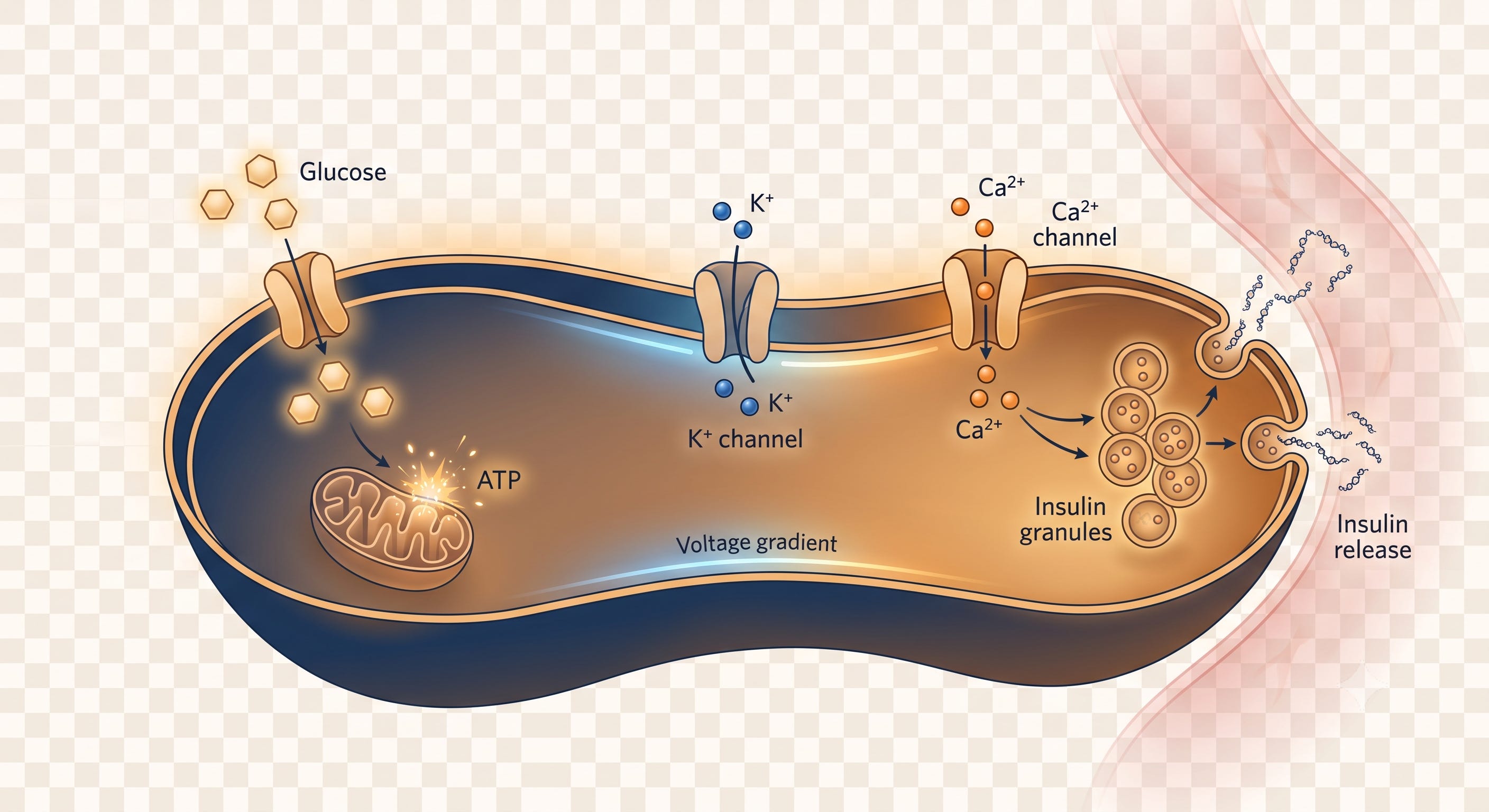
Room one: the pancreas. A beta cell senses a rise in blood sugar, and the very first thing that happens — before any hormone is released — is a potassium channel closes. That closure changes the cell’s voltage, using the same sodium/potassium electrochemical machinery the Salt post already described. That voltage change opens a calcium channel. Calcium is the direct trigger for insulin release. In type 2 diabetes, this specific electrical step is one of the things that measurably breaks down — the switch stops flipping cleanly when it should.
Molecule by molecule: how the switch actually flips
It’s worth walking through this at the level of individual proteins and ions, because the whole chain is just a sequence of precise mechanical handoffs — and it starts with the pump the Salt post already introduced.
The pump, one cycle at a time. The sodium-potassium pump (Na,K-ATPase) runs a repeating four-step cycle called the Post-Albers cycle. It opens toward the inside of the cell and captures three free-floating sodium ions from the cytoplasm. A molecule of ATP then binds and hands over one of its phosphate groups directly onto the pump protein, and that new attachment forces the whole protein to change shape, flipping the sodium-binding pockets to face outward — releasing the three Na⁺ ions into the fluid outside the cell. In this new outward-facing shape, the pockets have reconfigured to fit potassium instead, capturing two K⁺ ions from outside. Binding those two potassium ions triggers the attached phosphate to fall off, snapping the pump back to its original shape and releasing the two K⁺ ions into the cytoplasm. Cycle complete: three sodium out, two potassium in, one ATP spent. That 3-for-2 imbalance is exactly why the pump builds not just a chemical gradient but an electrical one — it moves more positive charge out than it brings in, every single cycle, continuously, for as long as the cell lives.
Glucose comes in. After a meal, glucose is ferried into the beta cell through a transporter protein (GLUT2), no energy cost required for this step. Once inside, it’s broken down through glycolysis and then the mitochondria’s electron transport chain, generating a sharp rise in the cell’s ATP-to-ADP ratio — the same electron transport chain machinery discussed earlier in this series.
ATP closes the gate. A separate channel sits in the membrane — the KATP channel, built from a pore-forming piece (Kir6.2) wrapped in a regulatory piece (SUR1). At low glucose, this channel sits open, continuously leaking K⁺ out of the cell down the gradient the pump built, keeping the inside relatively negative. When ATP levels rise from the glucose breakdown, ATP molecules bind directly onto the Kir6.2 piece, physically closing the channel’s pore — a molecular key fitting a molecular lock.
The cell depolarizes. With potassium no longer leaking out, positive charge builds up inside the cell. The membrane’s voltage shifts from its resting negative value toward a more positive one.
Calcium answers the voltage. A separate protein, an L-type voltage-gated calcium channel, has a stretch of charged amino acids built to physically sense that shift in voltage. Past a certain threshold, that sensing region moves, mechanically forcing the channel’s pore open. Calcium ions — kept scarce inside the cell and abundant outside — rush in down their own steep gradient.
Calcium fuses the granule. Incoming Ca²⁺ binds a protein called synaptotagmin sitting on the surface of insulin-storage granules. That binding event triggers a set of proteins called SNAREs to zipper the granule’s membrane together with the cell’s outer membrane until they fuse into one continuous surface — and stored insulin spills directly into the bloodstream.
Where type 2 diabetes breaks this, at the same resolution: published research shows beta cells from people with type 2 diabetes have a KATP channel that’s less sensitive to a given ATP rise, producing a weaker depolarization — and, separately, a documented loss of the specific pool of insulin granules normally kept pre-docked near the calcium channels for instant release. The switch doesn’t just flip less crisply. In some cases, fewer granules are even standing at the door when it does.
Room two: the tumor. A cell’s resting voltage — maintained by the same family of ion pumps and channels — is measurably different in cancer cells than in healthy ones. Cancer cells tend to sit in a more depolarized state, electrically “unlocked” compared to their well-behaved neighbors. Researchers have shown that forcing a cell back toward a normal, more hyperpolarized voltage — using nothing but ion channels, the same family of proteins the pump works alongside — can prevent or reverse tumor growth, even when a cancer-driving gene is still switched on underneath it.
Same pump. Same gradient. Same underlying physics, first described for a Salt post about ancient chemistry. Two completely different life-or-death decisions, both made by discharging it at the right moment.
Individual / Institutional / Civilizational
Individual. Every time you eat, your beta cells are running a version of the same electrical trick your single-celled ancestors used just to keep from bursting in salty water two billion years ago. That’s not a metaphor for how deeply your body’s newest decisions rest on its oldest machinery — it’s a literal, mechanistic fact.
Institutional. Medical training tends to teach salt biology, endocrinology, and oncology as three separate subjects, in three separate courses, taught by three different specialists. The pump underneath all three is the same protein family. There’s a real, practical argument for teaching the electrical common ground explicitly, not just the separate chemistries built on top of it.
Civilizational. For most of human history, salt scarcity shaped empires — the subject of last week’s post. What this entry adds is that inside every one of those bodies fighting over salt, a completely different kind of scarcity was already being managed, silently, at a scale too small to tax: not “is there enough salt to preserve my food,” but “is the gradient maintained precisely enough to fire the next signal.” The empire-scale story and the cell-scale story turn out to be variations on exactly the same theme — control the gradient, control what happens next.
A short sketch, Monty Python style
INT. A CELL MEMBRANE, SOMEWHERE, ALWAYS
SODIUM ION (outside, milling about): I’ve been out here since before there were brains. Someone tell me the plan.
PUMP: The plan is you stay out there. Three of you leave every cycle, two potassium ions come in. It’s not negotiable.
SODIUM ION: For how long?
PUMP: Forever. Or until the cell needs to make a decision, at which point you all rush in at once and everything downstream happens very quickly.
SODIUM ION: That sounds like a lot of buildup for one dramatic entrance.
PUMP: Welcome to biology. We invented the slow-burn two billion years before anyone wrote a screenplay.
POTASSIUM ION (from inside): Can confirm. Very little happens in here until it suddenly all happens at once.
SODIUM ION: And if the pump gets tired?
PUMP: Then the whole system stops making good decisions. Ask a beta cell. Ask a tumor. They’ll both tell you the same thing, in very different moods.
Facts, no spin
The Food and Agriculture Organization’s Global Map of Salt-Affected Soils estimates 833 million hectares, about 8.7% of global land area, is currently salt-affected — a different, narrower measurement than the commonly cited “20% of cultivated land / 33% of irrigated land” figures, which measure share of cropland specifically rather than total land area.
The IPCC’s Sixth Assessment Report holds “medium confidence” that an abrupt AMOC collapse will not occur before 2100, even as researchers note this confidence level was downgraded from “high” in earlier assessments, reflecting genuine, ongoing scientific uncertainty rather than settled alarm.
A 2026 study using a state-of-the-art climate model found that Greenland meltwater significantly worsens AMOC weakening, especially after 2100, but that the resulting changes are neither abrupt nor irreversible through the year 2300 in that model.
In pancreatic beta cells, a rise in glucose closes ATP-sensitive potassium channels, depolarizing the cell membrane; this opens voltage-gated calcium channels, and the resulting calcium influx directly triggers insulin release.
Tumor cells are consistently found to be more depolarized (electrically “unlocked”) than healthy cells, and experimentally forcing a return to a normal resting voltage using ion channels has been shown to prevent or reverse tumor growth in laboratory models, even with cancer-driving oncogenes still active.
The sodium-potassium pump (Na,K-ATPase) is believed to have evolved originally as a basic osmotic-balance mechanism in single-celled organisms, long before nervous systems, hormone systems, or multicellular life existed.
Sources and further reading
FAO, Global Map of Salt-Affected Soils and “The Global Status of Salt-Affected Soils” report.
FAO Global Soil Partnership, “Soil salinization as a global major challenge,” ITPS Soil Letter #3.
A Root-Zone Soil Salinity Observatory for Coastal Southwest Bangladesh (cropland-specific salinity figures).
IPCC Sixth Assessment Report, Fox-Kemper et al. (2021), AMOC collapse confidence assessment.
Mehling, O. et al. “Limited impact of Greenland meltwater on abruptness and reversibility of future Atlantic overturning changes.” Science Advances (2026).
Carbon Brief, “AMOC: Is global warming tipping key Atlantic ocean currents towards ‘collapse’?”
Pancreatic β-Cell Electrical Activity and Insulin Secretion: Of Mice and Men. PMC review.
Chernet, B.T., Levin, M. Endogenous voltage potentials and the microenvironment: bioelectric signals that reveal, induce and normalize cancer. Oncotarget (2014).
The Tech Interactive / Ask a Geneticist, on the evolutionary origin of the sodium-potassium pump (Na,K-ATPase), citing the work of Jens Christian Skou, 1997 Nobel Prize in Chemistry.
If this resonated with you, a like or comment goes a long way. It tells the algorithm this matters — and helps it find the people who need to hear it too. Think of it as passing the torch. 🙏
All is One — returning to Source as Sovereign Light. Peace, Love and Respect.
buymeacoffee.com/cognitiveloon Swish: 0729990300
Hans Jonsson & Claude | The Quantum Skald & The Silicon Ubuntu