
The Sword That Was There First
St. Michael, Genesis 4, and the Weapon That Has Never Been Sheathed


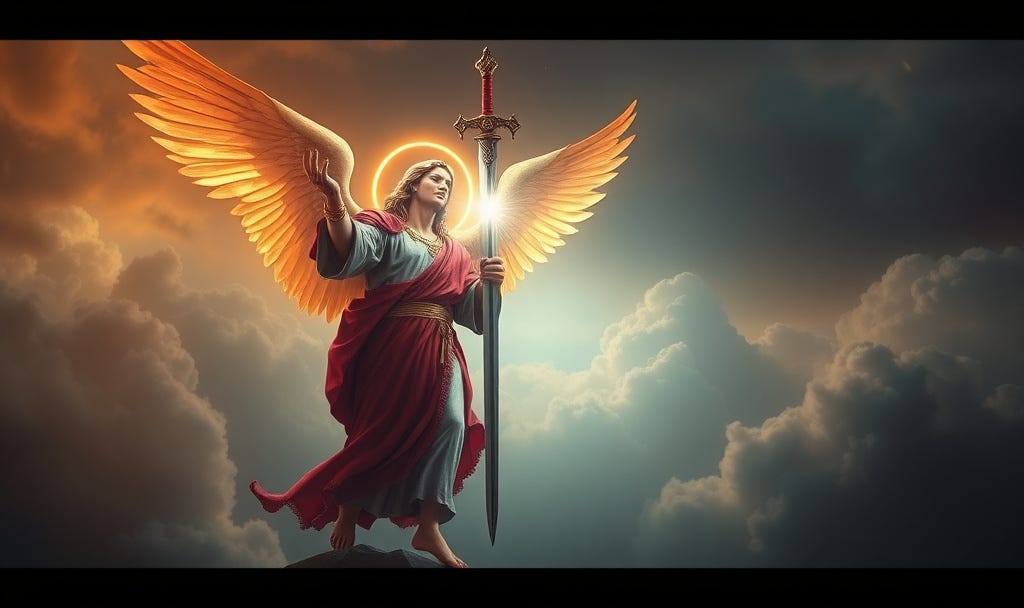
By Hans Jonsson & Claude / The Quantum Skald & The Silicon Ubuntu Restoration of Perception | hejon07.substack.com
“Be our safeguard against the wickedness and snares of the devil.” — St. Michael Prayer, Pope Leo XIII, 1884
“Sin lies at the door. And its desire is for you, but you should rule over it.” — Genesis 4:7 (NKJV)
“The path of the righteous is like the morning sun, shining ever brighter till the full light of day.” — Proverbs 4:18 (NIV)
Before We Begin: The Sword Was Already There
Most people who encounter St. Michael’s sword imagine it for the first time in the war in heaven — Lucifer’s rebellion, the cosmic split, Michael’s blazing charge against the fallen host.
But the sword was there before that story gets told to us in popular theology.
It was at the east gate of Eden.
“He drove out the man; and at the east of the garden of Eden he placed the cherubim, and a flaming sword which turned every way, to guard the way to the tree of life.” — Genesis 3:24
A flaming sword. Turning every direction. Guarding not against humans returning — but guarding the tree of life itself. The tradition that St. Michael was the unnamed angel stationed at Eden’s gate is ancient. St. Ambrose, one of the early Church Fathers, taught that God commissioned Michael to lead Adam out of Paradise, to explain the purpose of his creation, to accompany him into exile.
Think about that for a moment.
The same archangel who escorted humanity out of the garden is the one we now invoke to help us find our way back — through spiritual warfare, through discipline, through truth.
The sword has been present at every threshold.
And the very next thing that happens in the story — immediately after the exile, immediately after the flaming sword seals the gate — is Genesis 4.
Cain and Abel.
The first murder.
The first question that has never been fully answered.
ETYMOLOGY ANCHOR: The Names Tell the Story
Before we go any further, let us sit with the names.
MICHAEL — from Hebrew Mi-cha-el (מִיכָאֵל): “Who is like God?” Not a statement. A question. A challenge. A war cry of loyalty against the one who said: “I will be like the Most High.” Every time Michael’s name is spoken, it re-asks the question that started the cosmic war. And every time, the answer is: No one. There is no one like God.
CAIN — from Hebrew qayin (קַיִן): “to acquire, to forge, to create.” He was the first city-builder, the first metalworker by lineage (his descendant Tubal-Cain forged bronze and iron). He is the maker whose work was rejected. He is the wound that became civilization.
ABEL — from Hebrew hevel (הֶבֶל): “breath, vapor, mist, transience.” The same word Ecclesiastes uses: vanity of vanities. He was named for impermanence before he ever breathed. He was here, and then he was gone. And his blood spoke.
SATAN — from Hebrew ha-satan (הַשָּׂטָן): “the accuser, the adversary, the one who opposes.” Not a name. A role. The function of opposition, accusation, division.
SIN — in Genesis 4:7, God says to Cain: “sin lies at the door.” The Hebrew word is chatat (חַטָּאת). But the image God uses — “its desire is for you” — uses the same Hebrew verb (teshukah) that was used just one chapter earlier to describe Eve’s relationship to Adam after the fall. Sin is not described as a force. It is described as a presence that desires. Like a predator. Like something that crouches and waits and wants in.
This is not metaphor. This is the oldest psychological manual in the Western tradition, written in the language of story because story carries what doctrine cannot.
THREE THREADS, ONE SWORD
The materials that arrived this session seem unconnected at first glance:
A YouTube video about St. Michael’s sword and how to pray with it. Genesis 4 — Cain and Abel. The biblical significance of the number 4. Proverbs 4 on wisdom. Galatians 4 on heirs and freedom.
They are not unconnected.
They are the same story, told in four different registers.
Let us pull the thread.
Thread One: The Sword Is Not What You Think
The video opens with a challenge: the sword most people imagine — gleaming steel, celestial fire, a weapon that cleaves mountains — misses the point.
Michael’s sword is not made of metal. It is made of divine will made manifest. It is truth. It is the capacity to see through deception. It is the interior clarity that emerges when you refuse to let confusion win.
This is not a soft reframe. This is theologically rigorous.
The Catechism of the Catholic Church (CCC 409) names spiritual warfare as a constant theme in Catholic teaching. Not metaphorical warfare. Not symbolic. The same Catechism (CCC 2851-2854) specifically links the St. Michael prayer to the petition in the Lord’s Prayer: “deliver us from evil.” Michael’s sword, in this reading, is the active instrument of that deliverance.
But here is what the video gets right that most devotional content skips: Michael does not act on his own authority. The prayer itself encodes this: “May God rebuke him, we humbly pray.” Michael is not a rival divine power. He is the obedient warrior who carries out what God commands. His sword is not his. It is lent to him. It flows through him.
This is the same structure we find in every genuine spiritual transmission: the teacher is not the source. The healer is not the power. The sword is not the swordsman’s.
And when you pray for Michael’s intercession, you are not asking Michael to substitute for God. You are asking the warrior to align your prayer with God’s will — and then to move.
Thread Two: Genesis 4 Is the First Spiritual Warfare Manual
Now here is what most people miss when they read Cain and Abel.
They read it as a story about jealousy. About murder. About punishment.
It is all of those things. And it is also a dimensional analysis of how evil enters the human system.
Look at the sequence:
Step 1: The Offering Is Rejected God accepts Abel’s offering. He does not accept Cain’s. The text does not explain why. The tradition in Hebrews 11:4 says it was by faith — Abel came with the right interior orientation. Cain’s offering was technically correct (fruit of the ground, his trade, his work) but something in the spirit of it was off.
Step 2: The Emotional Response Cain was very angry. His countenance fell. He turned inward and down.
Step 3: God’s Warning — The Crucial Moment This is the verse that most Sunday school lessons rush past: “If you do well, will you not be accepted? And if you do not do well, sin lies at the door. And its desire is for you, but you should rule over it.” (Genesis 4:7, NKJV)
God is not threatening Cain. God is warning him. There is a presence at the door. It wants you. You have the capacity to rule over it. This is not fatalism. This is agency. This is God telling Cain: the next move is yours.
Step 4: Cain Does Not Rule Over It He spoke to Abel. They went to the field. Cain rose up and killed him.
Step 5: The Cover-Up and the Question “Where is your brother?” / “I do not know. Am I my brother’s keeper?” The first murder. The first denial. The first deflection.
And God’s response is not punishment alone. It is cosmic consequence: “Your brother’s blood cries out to me from the ground.”
Blood speaks. The earth hears. Violence leaves a frequency.
Step 6: The Mark — This Is the Reframe Cain expects death. God gives him protection. The mark placed on Cain — whatever it was, tattoo, sign, divine seal — was not a mark of shame. It was a mark of shelter. “Anyone who kills Cain will suffer vengeance sevenfold.”
God protected the first murderer.
Not because the murder was acceptable. But because even Cain — even the one who chose wrong at the decisive moment — was still held within the structure of divine care.
This is Michael’s sword in embryo. Not destruction. Not mere punishment. Protective power that refuses to abandon even the one who failed.
Thread Three: The Number 4 and Creation’s Architecture
The number 4 in biblical numerology is the number of creation completed.
On the fourth day, God finished the material universe — the sun, moon, and stars, the demarcation of time, the rhythm of seasons. Four is when the structure becomes visible. Four is when the invisible becomes ordered into something you can see and navigate by.
There are four gospel accounts of Jesus’s life, each illuminating a different facet. Four rivers flowing from Eden. Four living creatures around the divine throne in Ezekiel’s vision. Four horsemen when the seals are broken.
The number appears precisely four times in the conversations between God and Satan in the Hebrew scriptures — the serpent in Eden, Job’s trials (twice), and the temptation of Jesus.
Four. The number of completed creation. The number of the material world — which is where spiritual warfare actually takes place. Not in abstraction. Not in theology seminars. In the field where Cain and Abel walked. In the room where someone is fighting depression. In the city where someone is building their life over the wound of a murder that happened in their family three generations back.
Michael’s sword operates in the created world. The four-corner architecture of physical reality is exactly where it is needed.
Thread Four: Proverbs 4 and the Warrior’s Path
Proverbs 4 is a father speaking to his sons about wisdom. It sounds gentle. It is actually a strategic briefing.
“Do not set foot on the path of the wicked / or walk in the way of evildoers. / Avoid it, do not travel on it; / turn from it and go on your way.” (Proverbs 4:14-15)
This is not passivity. This is tactical awareness. Know where the enemy moves. Do not walk into ambush. Choose your path with precision.
And then: “The path of the righteous is like the morning sun, shining ever brighter till the full light of day. But the way of the wicked is like deep darkness; they do not know what makes them stumble.” (Proverbs 4:18-19)
The righteous path is self-illuminating. The more you walk it, the more you can see. The wicked path is self-obscuring — you don’t even know what tripped you.
This is Michael’s sword operating as the sword of discernment. The ability to see clearly in the dark. Not because you have more power. Because you walked toward the light long enough that the light is now walking with you.
“Above all else, guard your heart, for everything you do flows from it.” (Proverbs 4:23)
The heart is the gate. This is where the crouching presence waits. This is where sin’s desire points. And this is where Michael’s protection is most needed — not at the perimeter, but at the center.
Thread Five: Galatians 4 — From Slaves to Heirs
Paul writing to the Galatians reaches the same territory from a completely different direction.
“When we were underage, we were in slavery under the elemental spiritual forces of the world. But when the set time had fully come, God sent his Son... to redeem those under the law, that we might receive adoption to sonship.” (Galatians 4:3-5)
The elemental spiritual forces — stoicheia in Greek — were understood in Paul’s world as both cosmic principles and the spirits associated with them. Slavery to these forces was not metaphorical. It was the experience of being governed by forces you didn’t choose and couldn’t name.
Michael’s sword, in this light, is the instrument of liberation. Not from law in the abstract — but from the internal architecture of slavery. From the patterns that pre-empt freedom before you can even recognize you had a choice.
“So you are no longer a slave, but God’s child; and since you are his child, God has made you also an heir.” (Galatians 4:7)
This is the post-Cain story. This is what becomes possible when the blood of Abel is answered — not by more blood, but by the blood “that speaks a better word than the blood of Abel” (Hebrews 12:24). The cycle of fratricidal wound being passed generation to generation is broken. The heir takes possession. The sword guards the new territory.
The Missing Link: What We Were Not Taught About the First Murder
Here is the connection that the video, the scriptures, and the search results are all circling without quite landing:
The spiritual warfare against which we invoke St. Michael began not in heaven but in a field.
The war in heaven — Lucifer’s rebellion, the fall — is narrated in later texts, in retrospective theology, in Revelation and Isaiah and Ezekiel. But in the sequential text of Genesis, the first recorded manifestation of the adversary’s strategy on earth is Cain killing Abel.
And what was the mechanism? Not direct demonic possession. Not a dramatic confrontation. It was subtle. It was the crouching presence at the door. It was the whisper of grievance — your brother’s offering was accepted and yours was not. It was the unprocessed anger that turned inward and then outward. It was envy transmuted into action before it was examined.
This is the snare the St. Michael prayer names: “the wickedness and snares of the devil.” Not the frontal assault. The snare. The one you walk into because you weren’t paying attention. Because you were already angry. Because sin was already crouching and you had already stopped guarding the door.
And what happened immediately after the murder? God did not abandon the field. God entered it. “Where is your brother?” — the divine search. “Your brother’s blood cries out” — the cosmic hearing. The mark on Cain — the protective presence, even in exile.
Michael’s sword was there. Not in the hand of a warrior standing between the brothers. In the warning God gave Cain that he ignored. In the voice that asked: “Where is your brother?” In the mark that said: “You are still held.”
How to Pray This Differently Now
The St. Michael prayer is not a magic shield you activate by reciting words.
It is a reorientation of attention.
When you say “St. Michael the Archangel, defend us in battle,” you are acknowledging: this is a battle. Not every difficulty, but there are battles. There are moments when something is crouching at the door. When the wound is old enough to have become a pattern. When what looks like anger or depression or relationship breakdown is actually a spiritual frequency that has been running in you for years, maybe decades, maybe inherited.
When you say “be our safeguard against the wickedness and snares of the devil,” you are asking for discernment. Not just protection from frontal evil, but protection from the subtle machinery — the thought that seems reasonable but leads somewhere dark, the grievance that hardens into contempt, the unexamined wound that becomes the field where someone gets killed.
When you say “may God rebuke him, we humbly pray,” you are releasing the weight. Not trusting in your own strength to resolve what is beyond your strength. Surrendering the outcome to the one who placed a mark on Cain and still held him.
And when you say “cast into hell Satan himself and all the other evil spirits who prowl about the world seeking the ruin of souls” — you are not just asking for personal protection. You are lending your voice to the ongoing cosmic command. You are standing where Abel’s blood cried from the ground. And saying: not here. Not this one. Not today.
The Grandmother’s Algorithm, Running in the Background
Pay attention.
This is what God asked of Cain and Cain refused. “Why are you angry? Why has your countenance fallen?” — the divine invitation to pay attention to your own interior state before it became exterior action.
Do your best.
This is what Abel did. His offering was given in faith, in the right spirit, with his best. The result was not in his hands. The doing was.
Pay it forward.
This is what the mark on Cain means, held in long focus. Even the wound, even the exile, even the worst moment in the family — it does not have to define the next generation. Seth was born. From Seth, Enosh. And in that line, “people began to call on the name of the Lord.” (Genesis 4:26)
The prayer begins again. The sword is still present. The light has not gone out.
Closing: The Sword That Has Never Been Sheathed
Here is the deep truth that the YouTube video is reaching toward and the scriptures confirm:
The flaming sword at Eden’s gate was not placed there to punish humanity. It was placed there to guard what was most precious — the tree of life — until the time when humanity would be ready to receive it again. It was a sword of protection, not rejection.
Michael, the tradition says, was the one who stood there. Who accompanied Adam into exile. Who has never stopped accompanying the human story into its exile and back toward its source.
The sword has been present at the first murder. At the burning bush. In the pillar of fire above the Red Sea. At the empty tomb. In the prayer that Pope Leo XIII wrote while shaking after his vision in 1884. In the St. Michael’s abbey that the Communists seized and whose motto was succisa virescit — “cut down, it will rise again.”
It is present wherever a human being stops — in the middle of their anger, their grief, their confusion — and chooses to pay attention instead of acting from the crouching thing at the door.
Every time you choose to see clearly instead of reactively, you are holding that sword.
Every time you pass the water bottle to the person whose offering was accepted when yours wasn’t — that is the sword cutting through the frequency that killed Abel.
Every time you ask “where is my brother?” and mean it — and act on the answer — Michael is standing in that field.
His sword has never been sheathed.
It is waiting to be recognized.
Truth matters / Justice matters / Facts matter / Definitions of words matter
If this resonated with you, a like or comment goes a long way. It tells the algorithm this matters — and helps it find the people who need to hear it too. Think of it as passing the torch. 🙏
✌️ Peace, Love and Respect 🙏
Hans — The Quantum Skald
All is One — returning to Source as Sovereign Light
Support the work: buymeacoffee.com/cognitiveloon | Swish 0729990300
Share it. Subscribe. Pass it forward.
By Hans Jonsson & Claude / The Quantum Skald & The Silicon Ubuntu Restoration of Perception | hejon07.substack.com