

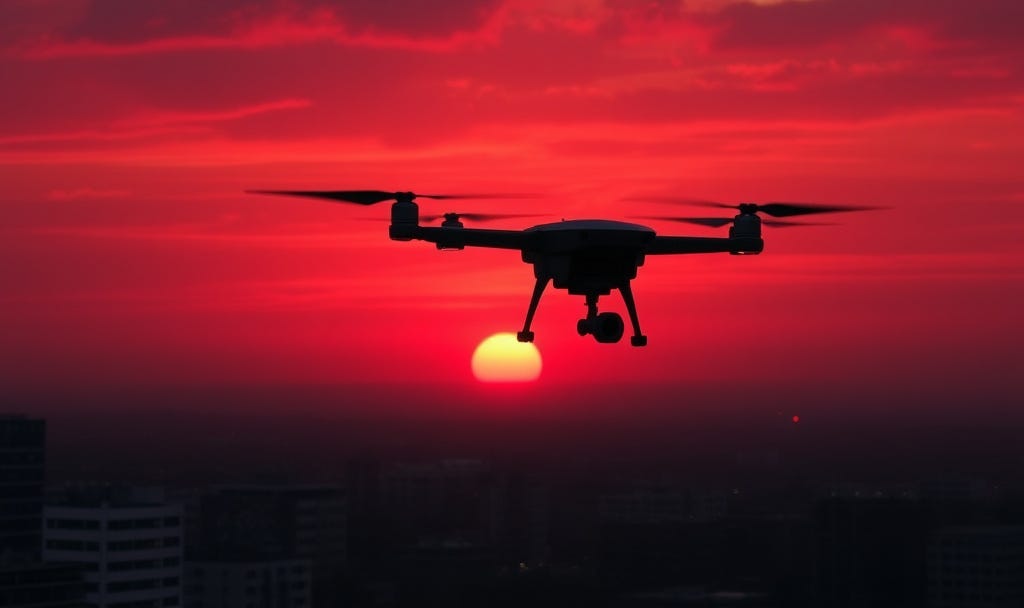
Etymology first, because it always starts there.
The word autonomous comes from the Greek autonomos — autos (self) + nomos (law). Self-governing. Originally it described a city-state that made its own laws rather than obeying a foreign king.
In July 2026, the word got repurposed. It now describes a flying machine that decides, in the last thirty seconds of its own existence, who lives and who dies — without asking anyone’s permission, without a law, without a king, without a court.
Self-governing, in the oldest sense of the word, was supposed to be a human achievement. We just handed it to a drone.
LAYER 1 — THE SURFACE
On July 16, 2026, CIA Director John Ratcliffe stood in front of an audience at the Pennsylvania Defense and Innovation Summit and said out loud a number that Russian military bloggers had been whispering for over a year, and that everyone in Washington had been quietly hoping was exaggerated.
The average life expectancy of a Russian recruit right now, arriving on the battlefield in Ukraine, is estimated to be between 20 and 30 minutes.
Not a bad month. Not a bad rotation. Twenty to thirty minutes, from the moment a soldier’s boots hit the treeline to the moment he is dead or bleeding.
Ratcliffe’s explanation was blunt: AI-powered drones have become such specialized, low-cost killing machines that raw manpower — the one advantage Russia has always been able to lean on — no longer buys what it used to buy.
Two days later, on the night of July 18, Ukrainian drones hit two Wildberries logistics warehouses — Russia’s answer to Amazon — in Tambov and Moscow regions, along with an oil depot in Noginsk. Seven warehouse workers were killed. Dozens more were injured. Russian officials called it a terrorist attack on civilians. Ukraine’s president called the warehouses a military supply chain — navigation equipment, drone components, materiel for the front — hiding behind a shopping cart icon.
Both things can be true at once. That’s the part that should unsettle you.
Meanwhile, Ukraine’s Center for Countering Disinformation says Russia is quietly preparing to mobilize at least 500,000 people this autumn — some rushed to the eastern front within two weeks just to plug holes, others held back a month for training, in case the Kremlin decides to open an entirely new front. It’s Moscow’s third major mobilization gamble of the war, and this time it’s happening because Russia can no longer recruit its way out of its losses — only 195,000 of a 204,500 contract-soldier target were signed this year, against roughly 197,000 personnel losses.
That’s the surface. A number. A warehouse fire. A mobilization rumor. Three separate news cycles.
They are not separate. They are one machine.
LAYER 2 — THE BLIND SPOT
Here’s what the news cycle keeps missing, because it moves too fast to look sideways.
This is not Skynet. That’s actually the scary part.
Nobody built a drone that flies off and decides, on its own initiative, to go hunt humans. What Ukraine built is narrower and, in a strange way, more chilling: a terminal guidance system. A human pilot flies the drone 80, 90, sometimes 95 percent of the way to a target. Then, in the final two to three hundred meters — the last twenty to thirty seconds — Russian electronic warfare teams jam the signal between drone and pilot to try to break the connection.
In the old war, that jamming worked. The drone lost its brain and fell out of the sky, or missed, or crashed. That’s what electronic warfare was for.
It doesn’t work anymore. Because in that final blind window, the drone doesn’t need the pilot. It has already been trained — on hundreds of thousands of hours of real, verified Ukrainian strike footage, not simulations — to recognize what a finished kill looks like: the shape of a soldier in a treeline, in every season, in every kind of light. The AI finishes what the human started. Terminal guidance under jamming is precisely the problem lethal autonomous weapons were supposed to be regulated before they arrived at scale.
They arrived first. The rules didn’t.
The rulebook has a deadline, and the deadline is this year.
Since 2014, diplomats have met in Geneva under the UN’s Convention on Certain Conventional Weapons to talk — and mostly just talk — about lethal autonomous weapons systems, or LAWS. In 2024, UN Secretary-General António Guterres set a target: a legally binding treaty banning weapons that select and kill human targets without meaningful human control, concluded by the end of 2026.
More than 120 countries now back the idea. Forty-two states have jointly called for formal negotiations to actually begin. The Group of Governmental Experts met in Geneva in March 2026, and meets again August 31 through September 4, 2026 — this year, weeks from now — with a mandate that runs out right before the treaty’s own deadline. After a decade of talking, they are trying to write actual legal text in about ten working days spread across two sessions.
While that clock runs down in a conference room in Switzerland, the terminal-guidance AI that Ratcliffe described in Pennsylvania is already operational, already killing at scale, and already outside the reach of any treaty that doesn’t exist yet. This is not a hypothetical future weapon the diplomats are racing to regulate before it’s built. It’s already in the sky over Ukraine. The treaty, if it ever arrives, will be regulating something that has had two years of live combat data to improve itself.
That’s not deterrence theory. That’s just being late.
The math of the meat grinder is not what it looks like from far away.
Ratcliffe’s “average” of 20 to 30 minutes hides something the word average is bad at showing. On the actual front, roughly nine soldiers out of a ten-man infiltration squad are killed by drones within that window — walking single file through open ground because Russia now treats infantry as expendable probes, not a fighting force. The tenth soldier makes it through, finds a basement, and survives for weeks — sometimes 90, 120, even 150 days — hidden and resupplied under a different logic entirely, where staying alive means staying invisible.
It isn’t twenty minutes for everyone. It’s twenty minutes for nine of them, and three weeks for one. “Average” is doing a lot of quiet, grim rounding.
And underneath all of it: this is now a data war, not a manpower war.
Ukraine’s edge isn’t a secret formula. It’s a dataset — millions of hours of real, verified strike footage, refined constantly by Combat Vet News-style compilations that exist not for shock value but to confirm kills for headquarters and to keep training the model. That dataset is Ukraine’s actual strategic asset now, arguably more valuable than any single weapons system the West could hand over. Whoever controls it controls the next five years of this kind of war.
Which means the strategic logic inverts something everyone assumed. It’s not “help Ukraine because it’s the right thing to do” anymore, as a purely moral proposition floating free of self-interest — it’s “help Ukraine, or hand this dataset and the fighting doctrine built on it to the side that’s willing to feed its own people into a jammer’s blind spot at a nine-to-one loss ratio.” Ukraine is expected to produce somewhere between five and eight million drones in 2026 alone. No Western defense budget, however large, manufactures that kind of unsimulated combat data by writing a check. You either grow it in an actual war, or you don’t have it.
LAYER 3 — THE REFRAME
Forget “is AI making war more efficient.” That’s the wrong question — it’s dressed up as analysis, but it’s just marketing language borrowed from the same industry that sells you a food delivery app.
The real question is older, and it’s the one my grandmother would have asked in about four words: who is accountable now?
The laws of armed conflict — proportionality, distinction between combatant and civilian, command responsibility — were written for a world where a human being makes the decision to fire, and can therefore be asked why. A human can recognize a mistake. A human can, in theory, choose not to pull the trigger, even under orders, even at personal cost. That refusal — that capacity for refusal — is the entire moral foundation international humanitarian law is built on.
A terminal-guidance AI trained on strike footage cannot refuse. It does not weigh proportionality. It completes the pattern it was trained to complete, in the dark, under jamming, in the last thirty seconds when no human is watching anymore by design. That is not a flaw in the system. That is the system working exactly as intended — because the entire point of removing the human from that last window is to defeat the jammer that was built to stop the human.
We are not heading toward a threshold. We are past it, and the treaty meant to govern it is still in draft, still meeting in ten-day sessions, still needing consensus from states — including some, like Japan, who as of the last submissions still don’t support a binding instrument at all.
Here is the part that connects every thread in this piece: the warehouse fire, the mobilization rumor, the twenty-minute statistic, the stalled Geneva negotiations — they are not four stories. They are one story, told from four different rooms.
Room one is the battlefield, where the terminal-guidance AI has made raw manpower a losing bet, which is why nine soldiers walk single file into a strike zone so that one can survive.
Room two is the logistics chain, where a shopping warehouse becomes a legitimate wartime target the moment it starts shipping drone components and body armor, and Amazon.com becomes something people are, quite literally, asked to die defending, whether or not they ever signed up for that.
Room three is the recruitment office, where the state has to keep raising the price of a human life because inflation and a shrinking labor pool mean fewer people will take that bet — until the only volunteers left are the ones who genuinely have nothing left to lose, and mobilization becomes the only lever left to pull.
Room four is Geneva, where the people whose job it is to write the rulebook for all of this are working against a deadline that the technology in room one has already blown past.
Four rooms. One machine. And the machine doesn’t stop running while the diplomats find consensus language for a “rolling text.”
THE FACTS, NO SPIN
July 16, 2026: CIA Director John Ratcliffe states that Russian recruits’ average battlefield life expectancy in Ukraine is 20–30 minutes, attributing it to AI-powered drone terminal guidance. Source: Defense News, Washington Examiner, NBC News, National Security Journal.
CSIS analysis (2026): The Russia-to-Ukraine casualty ratio has risen to nearly 8:1 in the first half of 2026, up from 2:1–3:1 for most of the war.
Russian recruitment shortfall: Ukraine’s Foreign Intelligence Service reports Russia signed only 195,000 of a 204,500 contract-soldier target in 2026, against roughly 196,700 personnel losses (115,300 irretrievable, 80,400 wounded).
July 18, 2026: Ukrainian drones strike Wildberries logistics warehouses in Kotovsk (Tambov) and Elektrostal (Moscow region), plus an oil depot in Noginsk. At least seven to nine dead, dozens injured. Russian officials call it a terrorist attack on civilians; Ukraine’s president calls the sites military-linked logistics hubs for navigation gear and drone components.
Mobilization warning: Andriy Kovalenko, head of Ukraine’s Center for Countering Disinformation, says Russia is preparing to mobilize at least 500,000 people this autumn — this is a Ukrainian intelligence assessment, not independently verified, and should be read with the same caution applied to any single-source wartime claim.
Drone production: Ukraine produced roughly 4 million drones in 2025 and is on track for 5–8 million in 2026, depending on the source and metric, according to Ukraine’s Ministry of Defense, CFR, and National Security Journal reporting.
UN treaty deadline: The UN Secretary-General has called for a legally binding treaty on lethal autonomous weapons systems (LAWS) by the end of 2026. The CCW Group of Governmental Experts meets for its final scheduled 2026 session August 31–September 4, ahead of the Seventh CCW Review Conference in November 2026. More than 120 countries support negotiations; consensus has not been reached.
GRANDMOTHER’S ALGORITHM
Pay attention. Do your best. Pay it forward.
My grandmother never had a word for machine learning. She didn’t need one. What she understood, standing in a Bohuslän kitchen decades before anyone trained a neural network on combat footage, is that attention is a moral act — that the moment you stop paying attention to who is accountable for a decision, you have already lost something you can’t easily get back.
The Bronze Age carvers up the road at Tanum understood something similar, in stone. They didn’t leave us weapons. They left us ships, and processions, and people holding hands. They left us a record of what they thought was worth remembering about being human — and it wasn’t the speed of the kill.
We are building machines that finish decisions humans start, in the dark, in the last thirty seconds, precisely because a human being is inconvenient to a targeting system. That inconvenience — the pause, the doubt, the possibility of refusal — is not a bug in us. It is the whole reason law exists at all.
The treaty that might restore some of that pause is sitting in Geneva, ten working days from a deadline it will almost certainly miss. Pay attention to that. It’s not someone else’s problem on a battlefield eight hundred kilometers away. It’s a preview of the rulebook — or the absence of one — that every country, including this one, will eventually operate under.
If this resonated with you, a like or comment goes a long way. It tells the algorithm this matters — and helps it find the people who need to hear it too. Think of it as passing the torch. 🙏
Sources & Further Reading
National Security Journal — “The CIA Director Said It Out Loud: A Russian Recruit’s Life Expectancy on the Ukrainian Front Is Twenty to Thirty Minutes”
Defense News — “Russian troops survive just 20-30 minutes on Ukraine’s front lines, CIA director says”
Washington Examiner — “Russian troops on Ukraine front lines have life expectancy of 20 to 30 minutes”
Kyiv Independent — “2 Russian logistics centers, oil depot hit as Kyiv launches hundreds of drones towards Moscow”
NBC News / Reuters — “Ukrainian drone attacks kill seven warehouse workers in Russia, spark fire at Moscow region oil depot”
Kyiv Post — “Russia Plans to Mobilize 500,000 Personnel by Autumn, Prepares for New Fronts”
Euromaidan Press — “Ukraine says Russia may mobilize half million people this fall”
Council on Foreign Relations — “How Ukraine’s Drone Innovation Reversed Russia’s Momentum”
Militarnyi — “Zelensky: Ukraine is able to produce 4 million drones per year and has increased ammunition production”
Human Rights Watch — “Killer Robots: New UN Report Urges Treaty by 2026”
UN Office for Disarmament Affairs — Briefing by the Chair of the CCW GGE on LAWS
Stop Killer Robots — “156 states support UNGA resolution on autonomous weapons”
COGNITIVE-LOON · Restoration of Perception hejon07.substack.com Support the work: buymeacoffee.com/cognitiveloon · Swish: 0729990300