

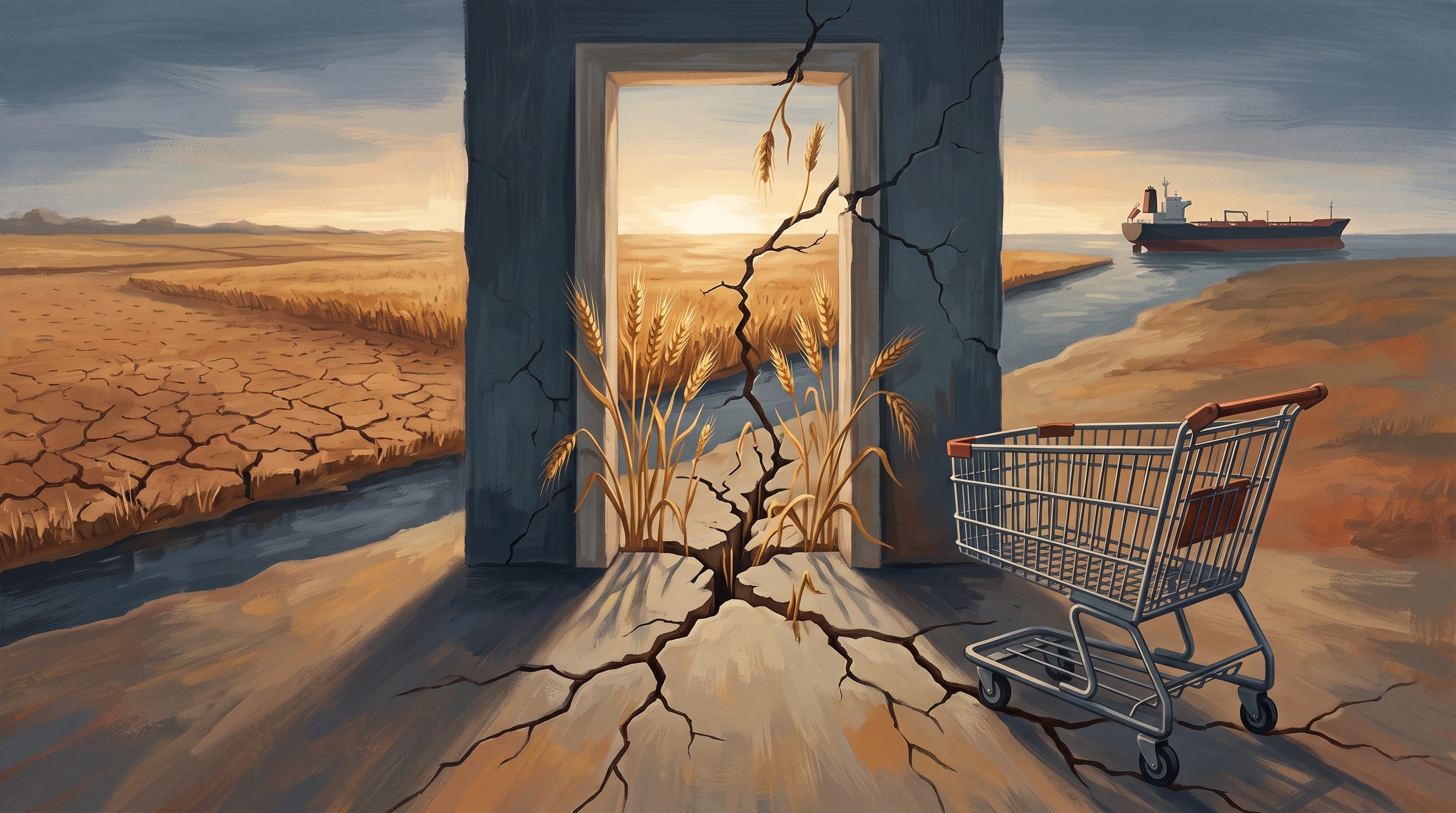
Etymology Corner
Harvest — from Old English hærfest, “autumn, the season of gathering.” Before it meant the act of collecting crops, it simply meant a time — the point in the calendar when a whole year’s labor either pays off or doesn’t. There’s no verb “to harvest” in the oldest form of the word. There’s only the season arriving, ready or not.
We are, right now, living inside a harvest that is not arriving the way it should. Not because nature failed us. Because the systems standing between the field and the fork are failing each other, all at once, in the same season.
A woman on YouTube stood in her kitchen and said something simple: we might be on the verge of food system collapse in the United States. She wasn’t screaming. She wasn’t selling anything. She was doing the thing her grandmother’s algorithm asks all of us to do — paying attention, and reporting back honestly on what she saw.
We went and checked her math. Some of it holds up exactly as stated. Some of it needed sharpening. And underneath both, we found something she didn’t have space to say in a nine-minute video: the actual mechanism connecting a war eight thousand kilometers away to the price of the ground beef in your cart — and the reason the “two more weeks, we’ll get a bailout” comfort that farmers keep offering themselves is, for most of them, mathematically false.
Let’s build this properly.
Surface / Blind Spot / Reframe
Surface: Grocery prices are up, eggs are being recalled, farmers are hurting, and a war in the Middle East is somehow involved. It feels like a lot of unrelated bad news arriving at once.
Blind Spot: These aren’t parallel crises politely taking turns in the headlines. They are one mechanism, wearing four different masks — a chokepoint economy meeting a chokepoint war, landing on top of a farm economy that was already bleeding out before the first shot was fired.
Reframe: The question isn’t “is the food system collapsing.” The question is: what happens when four separate load-bearing systems — cattle supply, fertilizer supply, income support for the poor, and farm solvency — all lose structural integrity in the same eighteen-month window? That’s not a collapse. It’s worse in one specific way: it’s survivable individually and unbearable together, which means it never triggers the single dramatic headline that would make the country treat it like the emergency it is.
📦 Explainer: Why does a war in Iran affect your grocery bill?
Think of the Strait of Hormuz as a single doorway that roughly a fifth of the world’s oil and a third of its traded fertilizer has to pass through to reach farms and refineries everywhere else. When Israeli and U.S. strikes on Iran began on February 28, 2026, Iran responded by making that doorway dangerous to use — attacking tankers, demanding military approval for transit, and effectively closing it.
Two things happen at once when that doorway narrows:
Fuel gets expensive. Diesel — the fuel every tractor, combine, and grain truck in America runs on — jumped from about $3.81 a gallon the week the war started to $5.35 a gallon by late April.
Fertilizer gets scarce and expensive. Nitrogen fertilizer is made from natural gas, and a huge share of the world’s fertilizer trade sails through that same doorway. Urea — the most common nitrogen fertilizer — rose from around $455 a ton before the war to nearly $700 a ton by late April.
By the American Farm Bureau’s own survey, roughly 70% of farmers nationwide said they could not afford all the fertilizer they needed for the 2026 crop. This hit at the worst possible moment: spring planting, when the decision gets made for the whole year.
Individual / Institutional / Civilizational
Individual: A farmer in Minnesota didn’t book her diesel in advance and is now paying nearly 40% more per gallon to run the same equipment on the same land. A family in Charlotte, cut from SNAP by a new work-hour requirement, is standing in a food pantry line for the first time. These are not statistics to them. They are Tuesday.
Institutional: The 2025 federal budget bill cut $187 billion from SNAP over the next decade and expanded work requirements up to age 64. Between July 2025 and this spring, more than 4 million Americans lost food assistance — not because they stopped qualifying, but because, as Feeding America’s CEO put it, the program became harder for eligible people to access. In the same period, family farm bankruptcies rose 46% year over year, the sharpest jump since 2020, driven by a trade war that closed export markets at the exact moment input costs spiked.
Civilizational: We built a food system with almost no slack in it — just-in-time everything, from fertilizer shipments to farm credit to the SNAP dollars that keep local grocery stores solvent in poor counties. A system with no slack works beautifully until two things go wrong simultaneously. Then there is no reserve capacity anywhere to absorb the shock. That is not a metaphor. That is a description of exactly where the U.S. food system sits in August 2026.
The Missing Link: Why “Two More Weeks” Won’t Save Them
Here is the piece the original video didn’t have room for, and it’s the piece that matters most if you actually want to understand what farmers are living through right now.
A lot of farmers — including many who voted for the current administration — are holding onto a specific hope: if my crop fails or my margins collapse, there will be a bailout. It’s not an irrational hope. There have been bailouts. Trump announced a $12 billion aid package for row-crop farmers in December 2025, on top of $28 billion during his first-term trade war with China.
But look at what the money actually does once it lands:
Nearly 40% of an $11 billion tariff-relief bailout is projected to flow to the largest farms — the operations that need it least — while small and mid-size farms, who are disproportionately the ones going under, see a shrinking share.
The same year that bailout was announced, the administration approved a $20 billion bailout for Argentina — a move that prompted China to pull back on U.S. agricultural purchases even further, deepening the exact export losses American farmers were trying to recover from.
Economists who study this are blunt about the mechanism: bailout money gets “capitalized” — meaning landlords raise rents, and equipment and input suppliers raise prices, once they know farmers have a cash infusion coming. The relief gets absorbed by the surrounding system before it reaches the farmer’s actual margin.
Net farm income for 2026 is forecast at $153.4 billion against record sector-wide debt of nearly $625 billion. The bailout is a bridge over a canyon that keeps getting wider underneath it.
This is the reframe worth sitting with: it’s not that the bailout doesn’t exist. It’s that the bailout was never sized, targeted, or structured to close the actual gap — and the same trade and foreign-aid decisions creating the crisis are, in several documented cases, the ones cutting the bailout’s legs out from under it before the check even clears.
🥚 Explainer: The egg recall, in plain terms
On August 14, 2026, the FDA escalated a recall of roughly 1.6 million cartons of eggs — sold under names like Kroger, Simple Truth, and Brookshire’s across six southern states — to Class I, its highest-risk designation, reserved for situations where exposure carries “a reasonable probability” of serious illness or death. The eggs were tied to a salmonella outbreak that had sickened people in 17 states, with two dozen-plus hospitalizations.
This is a separate story from egg prices — but it lands on the same shelf, at the same time, for the same shoppers already stretched thin. If you have eggs at home, check the side of the carton (not the top) for the codes P-1950 or 0840962, with a Julian date between 157 and 184.
A Word From the Ministry of Silly Solutions
[Monty Python voice, please]
INT. A WOOD-PANELED TALK SHOW SET.
HOST: Tonight’s guest says the American worker simply needs to learn to cook from scratch.
GUEST: That’s right. In my day, we’d take a burrito, and it cost two dollars, and we were grateful.
HOST: And where might one acquire this two-dollar burrito today?
GUEST: Well — obviously not from a restaurant. One assembles it. From ingredients. Purchased. At a store.
HOST: Ah yes, the store. And how does one get there, without a car, on a shift schedule with two jobs, in a county where the nearest full grocery store is forty minutes away?
GUEST: (long pause) I’m told there’s an app for that.
HOST: And the chickens? For the eggs? Since eggs are also recalled and also expensive?
GUEST: Backyard coop. Simple as that.
HOST: In a rented apartment. Where the lease forbids livestock. In a city that forbids it by code.
GUEST: (standing, adjusting tie) Well. Some people just don’t want to be self-sufficient.
HOST: (to camera) We’ll be right back, after this word from a hedge fund.
Facts, No Spin
High confidence, directly sourced:
The Strait of Hormuz war began February 28, 2026; nitrogen fertilizer rose over 30% and diesel jumped roughly 40% within weeks. (Purdue Center for Commercial Agriculture; WPR/MPR News)
More than 4 million Americans lost SNAP access between July 2025 and April 2026. (NPR, Center on Budget and Policy Priorities)
Family farm bankruptcies rose 46% in 2025, the sharpest increase since 2020. (American Farm Bureau Federation, via Farm Aid)
An FDA Class I egg recall affecting 1.6 million cartons was announced August 14, 2026, tied to a 17-state salmonella outbreak. (FDA, CBS News)
National average ground beef price was about $6.89/lb in July 2026 — up roughly 8–14% year over year depending on the cut and month measured (BLS data), with USDA forecasting the full-year 2026 climb could reach 10–18%. The driver is the smallest U.S. cattle herd since 1951, not a single policy. (USDA, USAFacts, CBS News)
Moderate confidence, contested or evolving:
As of mid-August 2026, the Strait of Hormuz remains functionally unresolved — Iran has ruled out extending the June memorandum of understanding, and the U.S. has reimposed a naval blockade. Oil prices are volatile in the high-$80s to low-$90s per barrel, well below April’s peak above $110 but far from resolved. (CNBC, Congressional Research Service)
National crop conditions are mixed, not uniformly failing: corn and soybeans were rated 61–62% good-to-excellent in national USDA data in early August, masking a severe regional split — drought devastation in the western Corn Belt (South Dakota, Kansas, Texas) against wetter, healthier conditions in the east. (USDA NASS, DTN, AgWeb)
Lower confidence / unverified as stated:
The claim that food bank donations specifically are down 40–60% could not be independently confirmed. What is well documented is comparable-magnitude declines in SNAP participation by state (Arizona down 48–55%), and food banks reporting record demand — but “donations down 40–60%” as a standalone national figure needs a firmer source before repeating it.
Grandmother’s Algorithm
Pay attention. Do your best. Pay it forward.
Paying attention here means resisting two equally tempting stories. The first says nothing is really wrong — that this is normal inflation, normal cattle cycles, normal politics, and the people saying otherwise are exaggerating. The second says everything is collapsing tomorrow, that panic is the only honest response.
Neither is where the truth lives. The truth is slower and, in its own way, more demanding of us: a system built with no reserve capacity is now absorbing four simultaneous shocks, and the people who will be asked to absorb the difference are the ones with the least room left to give — the farmer three bad seasons from bankruptcy, the mother whose SNAP card stopped working, the family that just found out their eggs are recalled two weeks after they finally saw a price they could afford.
Doing your best, in a moment like this, doesn’t mean solving the Strait of Hormuz from your kitchen table. It means knowing where your local food bank is before you need it, supporting the mutual aid networks that already exist in your community, and refusing the “just cook from scratch” gaslighting when you hear it — not because scratch cooking is bad, but because blaming the hungry for the shape of the system is how the system stays unexamined.
Paying it forward means what it always has: the people with a little more slack right now — a full pantry, a stable job, a garden that’s still producing — carry a little more of the weight for the people who currently have none. Not charity as performance. Circulation as principle. This is the Harmonic Principle we keep returning to in this publication: systems that circulate resources outlast systems that only extract them. Grain, water, fertilizer, trust — all of it holds under pressure the same way.
If this resonated with you, a like or comment goes a long way. It tells the algorithm this matters — and helps it find the people who need to hear it too. Think of it as passing the torch. 🙏
☕ buymeacoffee.com/cognitiveloon | 💳 Swish: 0729990300 | 💳 paypal.me/hejon07
Sources & Further Reading
Purdue Center for Commercial Agriculture — “The Iran Conflict, Energy Prices, and U.S. Farm Profitability”, March 2026 — ag.purdue.edu
Wisconsin Public Radio / MPR News — “Steep fertilizer and fuel prices could squeeze US farmers for months to come”, May 2026 — wpr.org
farmdoc daily (University of Illinois) — “Strait of Hormuz Disruption Scenarios and Fertilizer Purchasing Risks”, April 2026 — farmdocdaily.illinois.edu
CSIS — “Iran, Fertilizer, and Food Security: Risks, Impacts, and Policy Responses”, April 2026 — csis.org
CNBC — “Oil prices today: Uncertainty over U.S.-Iran Strait of Hormuz deal”, August 10, 2026 — cnbc.com
Congressional Research Service — “The Strait of Hormuz: Security Developments and Impacts”, August 2026 — congress.gov
NPR — “Over 4 million people are no longer receiving food aid amid sweeping changes to SNAP”, August 3, 2026 — npr.org
Center on Budget and Policy Priorities — SNAP Tracker, updated August 2026 — cbpp.org
Axios — “Food banks wrestle with SNAP cuts, new costs in OBBB”, July 25, 2026 — axios.com
Farm Aid — “Tracking the Farm Economy in Crisis”, 2026 — farmaid.org
Environmental Working Group — “Trump Tariff Bailout Fuels Mega Farm Growth”, February 2026 — ewg.org
Adams and Reese — “Rising Farm Distress: Agriculture Bankruptcies 2026-2027”, March 2026 — adamsandreese.com
CBS News — “FDA upgrades egg recall linked to salmonella to highest health risk level”, August 14, 2026 — cbsnews.com
USAFacts — “What is the average price of beef in the US?”, updated July 2026 — usafacts.org
DTN Progressive Farmer — “USDA Crop Progress” reports, August 2026 — dtnpf.com
AgWeb — “2026 Pro Farmer Crop Tour Day 1 Results”, August 2026 — agweb.com
Previous related coverage from Restoration of Perception:
Closed Until Further Notice: The Second Wave of the Hormuz Harvest Crisis
The Harvest Window Is Closing
The Strait We’re In
Farming, Food Affordability, and the Trump Timeline