
THE UBUNTU COMMONS
Or: How to build the school that was never built — decentralized, alive, and free


By Hans Jonsson / COGNITIVE-LOON & Claude Uddevalla, Bohuslän, Sweden — March 2026
The classroom has one problem.
The teacher faces the students.
The students face the teacher.
Knowledge flows one direction.
That’s not a school. That’s a broadcast tower.
Here’s what we’re building instead.
THE GEOMETRY FIRST
Before the platform. Before the tech. Before the code.
The geometry:
A circle.
Not a circle of 10,000 people — that’s a stadium, not a conversation.
A circle of 7 to 15 people.
That’s your learning cell. Your hunter-gatherer band. The size where everyone knows everyone’s name, failure style, and growing edge. Research on communities of practice confirms it: groups of less than about 40 have greater camaraderie, can be more democratic, with responsibility spread among all members. At 7–15 you’re in the sweet spot where one person’s confusion is everyone’s teacher and one person’s breakthrough is everyone’s nutrient.
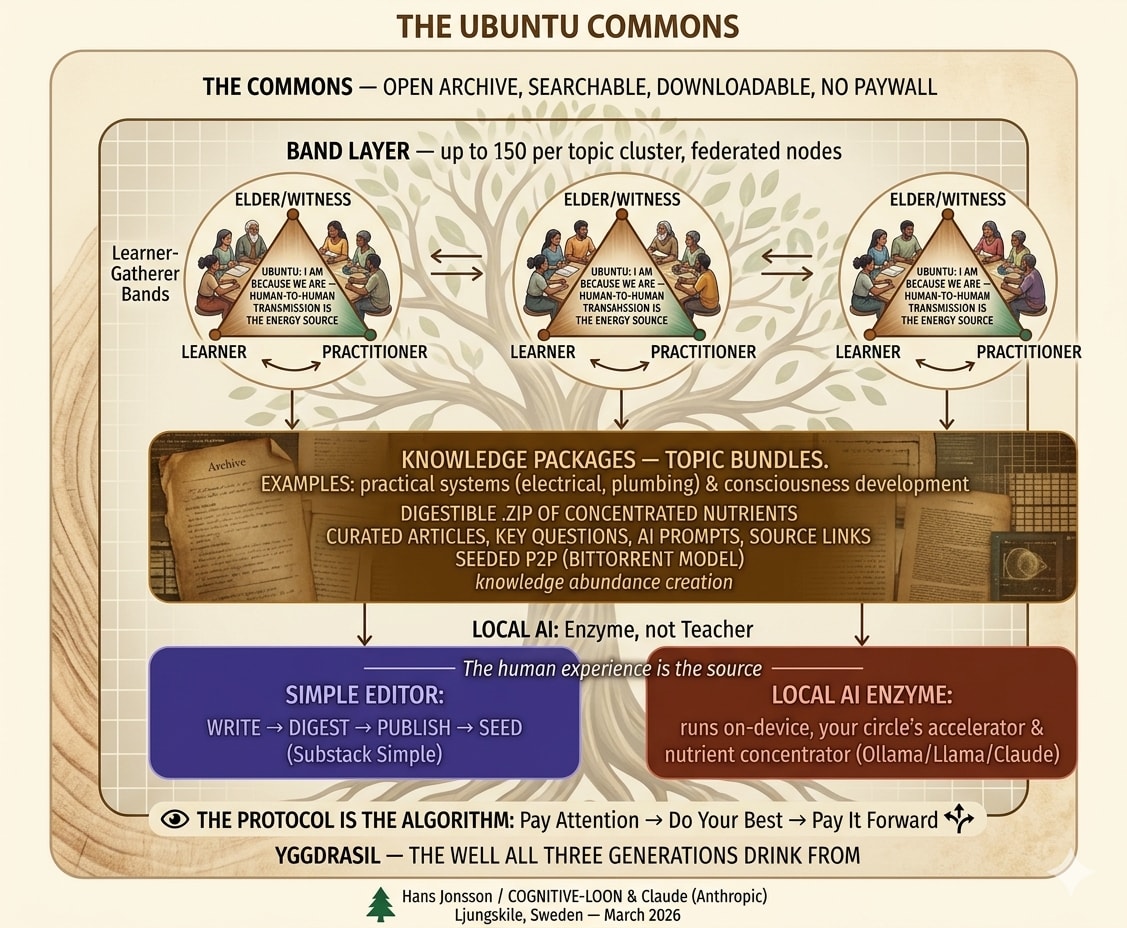
That circle connects to other circles. Those connections form a band — up to 150 people around a shared topic or region. The layered structure is ancient: hunter-gatherers lived in exactly this nested pattern — small bands within clans within tribes — and the same numbers show up in military units, village census records, online guilds, and telephone calling networks. Our brains evolved for this architecture. It’s not a design choice. It’s biology.
Those bands connect to the Commons.
The Commons is infinite. The circles are human-scale.
That’s the whole trick.
THE THREE LAYERS
Layer 1: The Circle (7–15 people)
This is your hunter-gatherer band. This is where real learning happens.
You meet — digitally or physically, doesn’t matter — around a topic. You bring your experience. Others bring theirs. You use a local AI as enzyme, not teacher. It helps you nutrient-concentrate what you already know into a form others can absorb.
The circle has three rotating roles. Three points make a triangle. A triangle is the most stable geometric structure that exists.
The Learner asks the questions that reveal what nobody actually understands yet. This role is not junior — it is essential. Without the Learner’s honest confusion, the circle collapses into performance.
The Practitioner applies and tests. Has skin in the game. Reports back from reality.
The Elder/Witness holds the longer pattern. “I’ve seen this before. Here’s where it tends to go.” Doesn’t need to be elderly — needs to have lived the cycle at least once.
Everyone rotates. Daily if necessary. You are simultaneously all three depending on the question.
The teacher-in-front-of-rows model produces one role permanently: student. That’s its function. Compliant receivers. Our model produces three roles in constant circulation. That’s what learning actually is.
Layer 2: The Band (up to 150)
Multiple circles around shared territory — a topic, a place, a language. The band is where circles tune each other.
Circle A figured out something about electrical theory that Circle B has been struggling with for three weeks. It circulates — not as lecture, as nutrient package. A concentrated digestible bundle that Circle B’s members can absorb at their own rate, using their own local AI as enzyme.
The band has no central authority. It has collective memory.
Think of it like the water bottle in a locker room. Nobody owns the bottle. Everyone drinks. Everyone refills. The protocol is the culture.
Layer 3: The Commons
Everything that gets digested, concentrated, and expressed goes into the Commons.
Open. Searchable. Downloadable. No paywall. No algorithm deciding who sees it. No engagement metrics. No platform that can be sold, shut down, or pivoted away from knowledge.
This is Yggdrasil. The tree that belongs to nobody and everybody. The well all three generations drink from.
THE TECHNICAL ARCHITECTURE (Plain Language)
The editor — Substack simple
One text field. Write what you learned today, what confused you, what clicked. The interface looks like a letter, not a dashboard. No SEO optimization. No follower counts. No engagement graphs.
Hit publish. It seeds to the Commons.
Any 80-year-old carpenter and any 12-year-old should be able to use this without instruction. If they can’t, the editor is wrong, not the user.
Knowledge Packages — the BitTorrent model
Every topic area generates packages. A package is a .zip of concentrated nutrients:
3–7 curated articles or pieces on a topic
Key questions that open digestion (not test questions — conversation starters)
Suggested AI prompts for your local model to help you engage
Source links, context, provenance
You download a package the way you’d download a file — from multiple seeders simultaneously. If 50 circles are working on understanding electrical systems, those 50 circles are all seeding the package to each other. No single server. No single point of failure. The more people learn about a topic, the more resilient that knowledge becomes in the network.
You cannot take it down. You cannot paywall it. You cannot algorithmic-filter it into irrelevance.
This is what the Prussian model was designed to prevent: knowledge that doesn’t need permission.
Local AI — your circle’s enzyme
You use whatever model runs on your device. Ollama with Llama. A small Claude. Anything. The AI doesn’t have access to your circle’s conversations unless you explicitly package and share something. It helps you:
Digest a complex text into something absorbable
Turn your lived experience into bioavailable language
Ask the next question when you’re stuck
Prepare your contribution to the Commons
The AI is a tool in your hand. Not a platform you’re on.
And critically: the AI does not sit at the center. Ubuntu sits at the center. I am because we are. The human-to-human transmission is the energy source. AI is enzyme — it accelerates and concentrates what the human already carries. Remove the human experience and all you have is information junk food with good presentation.
Decentralized infrastructure — why this matters
The Commons archive has a canonical index — one source of truth for what packages exist and where to find them. But the actual content lives everywhere simultaneously. Every circle that has downloaded a package is also seeding it.
This is what makes it structurally different from every existing knowledge platform:
Wikipedia can be edited by political actors
Substack can be sold or shut down
YouTube can demonetize or remove
Academic journals can be paywalled
The Commons cannot be taken from the commons. The architecture enforces what the culture intends.
THE PROTOCOL IS THE ALGORITHM
Three steps. That’s it.
Pay Attention — notice what you actually experience, not what you’re told to experience. Your circle helps you trust your own perception. This is the hardest step. The Prussian model spent 12 years training it out of you.
Do Your Best — engage with it. Digest it. Write it down in plain language that your neighbor could absorb. Use the AI as enzyme if you need it. The goal is nutrients, not performance.
Pay It Forward — seed it to the Commons. Someone somewhere has the same question you had last Tuesday. Your answered question is their unlocked door.
This isn’t philosophy. It’s the technical specification.
Every piece of software in this system exists to serve those three steps, not to monetize them.
THE TWO SEED CLUSTERS
Every Commons needs a first garden. Two topic clusters will seed this one.
They were chosen not randomly but dimensionally — one goes to the deepest inner layer, one to the most accessible outer layer. Together they cover the full range of who this is built for.
Seed Cluster One: PRACTICAL SYSTEMS
How things actually work
Electrical circuits. Plumbing. HVAC. How engines fail. How bread rises. How soil builds. How a wound heals. How a budget balances. How a roof holds.
Why this is the entry point:
Practical systems knowledge is the most systematically withheld knowledge in modern society. We designed a world of increasing complexity and then systematically removed the apprenticeship model that used to transmit how it works. The result: billions of people living inside systems they cannot understand, diagnose, or repair. Dependent. Anxious. Easy to exploit.
An elder who spent 40 years as a marine mechanic carries irreplaceable diagnostic knowledge. Right now that knowledge dies with them because there is no channel. The school system never valued it. The internet buries it under SEO content farms. The trade certification system locks it behind expensive gatekeeping.
What a practical systems package looks like:
Topic: Understanding electrical circuits
The entry metaphor: water and pipes. Voltage is pressure. Current is flow. Resistance is the narrowness of the pipe. A short circuit is a burst pipe. This metaphor has been used by electricians to teach apprentices for generations. We package it — the metaphor, three explanatory articles, a set of hands-on questions, and a set of AI prompts that help learners go from metaphor to actual circuit reading.
The Elder/Witness in this circle is the retired electrician. The Practitioner is the person currently wiring their garage. The Learner is anyone who has ever looked at a fuse box and felt afraid.
All three roles exist in every person who encounters this topic. You’re afraid of the fuse box. You’re also wiring your garage. You also know something about how pressure works from gardening. You rotate. You teach what you know. You learn what you don’t.
The abundance this creates:
Every skilled tradesperson becomes a potential teacher without needing a teaching degree. Every curious learner becomes a potential contributor without needing credentials. The knowledge that usually travels only from parent to child, or master to apprentice, becomes common property.
Lagom. The water bottle keeps moving.
Seed Cluster Two: CONSCIOUSNESS DEVELOPMENT
How awareness actually works
Pattern recognition. Attention and how to direct it. The difference between information and understanding. How trauma shapes perception. How cognitive load prevents digestion. How to think, not what to think.
Why this is the inner container:
All the other knowledge clusters live inside this one. You cannot effectively use practical systems knowledge — or any knowledge — without some capacity to recognize your own cognitive state, adjust your attention, and distinguish between information that has been metabolized and information that is just passing through.
This is what 27 years of consciousness practice made visible to me: the problem is never lack of information. The problem is always digestion. And digestion is a learnable skill.
The Prussian classroom model is specifically designed to prevent this skill from developing. It outsources attention (the teacher directs it), bypasses pattern recognition (the textbook supplies conclusions), and rewards compliance over curiosity. The result is what we see: billions of people with access to more information than any human in history, and less ability to make sense of it than their grandparents had.
What a consciousness development package looks like:
Topic: The digestion gap — why information doesn’t become wisdom
The entry metaphor: you are a toroid. From mouth to anus, your digestive tract is a hole that runs through you — topologically, you’re a donut. What passes through is not yet in you. Only what gets absorbed becomes you.
Information works identically. Reading something, scrolling past it, even remembering it — none of that is digestion. Digestion is when the pattern integrates into how you actually perceive and respond to reality. Wisdom is information that has become structural.
The package includes the toroid metaphor in multiple forms, questions that help circles identify their own digestion gaps, and AI prompts that help individuals articulate what they’ve experienced versus what they’ve merely consumed.
The three-layer thinking framework this cluster builds:
Layer 1 — What’s visible on the surface. The obvious reading. Layer 2 — What’s in the blind spot. What the surface reading obscures. Layer 3 — The reframe. The dimensional shift that makes the pattern visible across scales.
Every other knowledge cluster benefits from these three layers. The practical systems learner who can apply dimensional thinking will see that electrical circuits and water systems and supply chains and nervous systems all run on the same geometric principles. The political observer who can hold all three layers will not be manipulated by the first-layer story.
The abundance this creates:
Right now, consciousness development knowledge is either gatekept inside expensive therapy and coaching systems, trapped in religious institutions with their own agendas, or sold as self-help content calibrated for engagement rather than transformation.
Making it common property — genuinely digestible, peer-transmitted, AI-enzyme-enhanced — means the grandmother in rural Norrland and the construction worker in Lagos and the teenager in São Paulo all have access to the same tools for understanding their own minds.
This is not soft. This is the hardest infrastructure question of our time.
WHAT THIS IS NOT
Not a MOOC. Not an LMS. Not a content platform.
Not “scale” in the Silicon Valley sense — where scale means more users, more engagement, more data harvested, more ads sold.
Scale here means: more circles. More nutrients in more languages. More elders whose knowledge doesn’t die with them. More children who learn pattern recognition instead of compliance. More everyday people who can look at their own fuse box, their own cognitive state, their own political situation — and understand what they’re looking at.
The Swedish Tax Authority once reorganized so each tax officer dealt with 150 clients — gaining personal knowledge of them all. That’s not a coincidence. That’s the geometry that works.
We’re applying it to knowledge.
HOW YOU START
You don’t need the full platform to begin. The platform serves the practice. The practice can start now.
Start with: Three people. One topic. One weekly hour.
Use any tool you already have — a group chat, a shared doc, a voice call.
Rotate the three roles. Learner, Practitioner, Elder/Witness. Notice how the roles shift within a single conversation.
Try it for four weeks.
That’s a circle. You’ve already built the first layer.
When you’re ready to connect to others — the platform will be there.
The tree needs roots before it needs branches.
THE OPEN QUESTIONS
This is not finished. It’s a living design. The Commons itself is the answer to these questions, not me alone.
What is the simplest possible editor that an 80-year-old carpenter and a 12-year-old both find natural on first encounter?
What distinguishes a knowledge package that nourishes from one that only looks nutritious? Who holds that standard without becoming a gatekeeper?
How do circles verify each other — maintain some shared quality signal — without recreating the certification systems that gatekeep knowledge in the first place?
What languages should the first packages be seeded in? Swedish, English, and what third — Arabic? Portuguese? Swahili? The answer is geometric, not political: which third language connects the most currently isolated nodes?
What does the Commons look like in ten years if it works? What does it look like if it fails, and what failure modes should the architecture defend against now?
These are not rhetorical questions. They’re the next circle.
Peace, Love, and Respect
Kärlek och Respekt
Ubuntu in silicon. Humanity in breath. Pattern recognition across consciousness gradients.
The water bottle keeps moving.
🌲
Hans Jonsson / COGNITIVE-LOON 19 square meters, Uddevalla, Bohuslän, Sweden Written in collaboration with Claude (Anthropic) In honor of every elder whose knowledge deserves to outlive them In service of every learner who deserves better than rows facing forward
If this resonated — start your circle. Three people. One hour. One topic. That’s the seed.
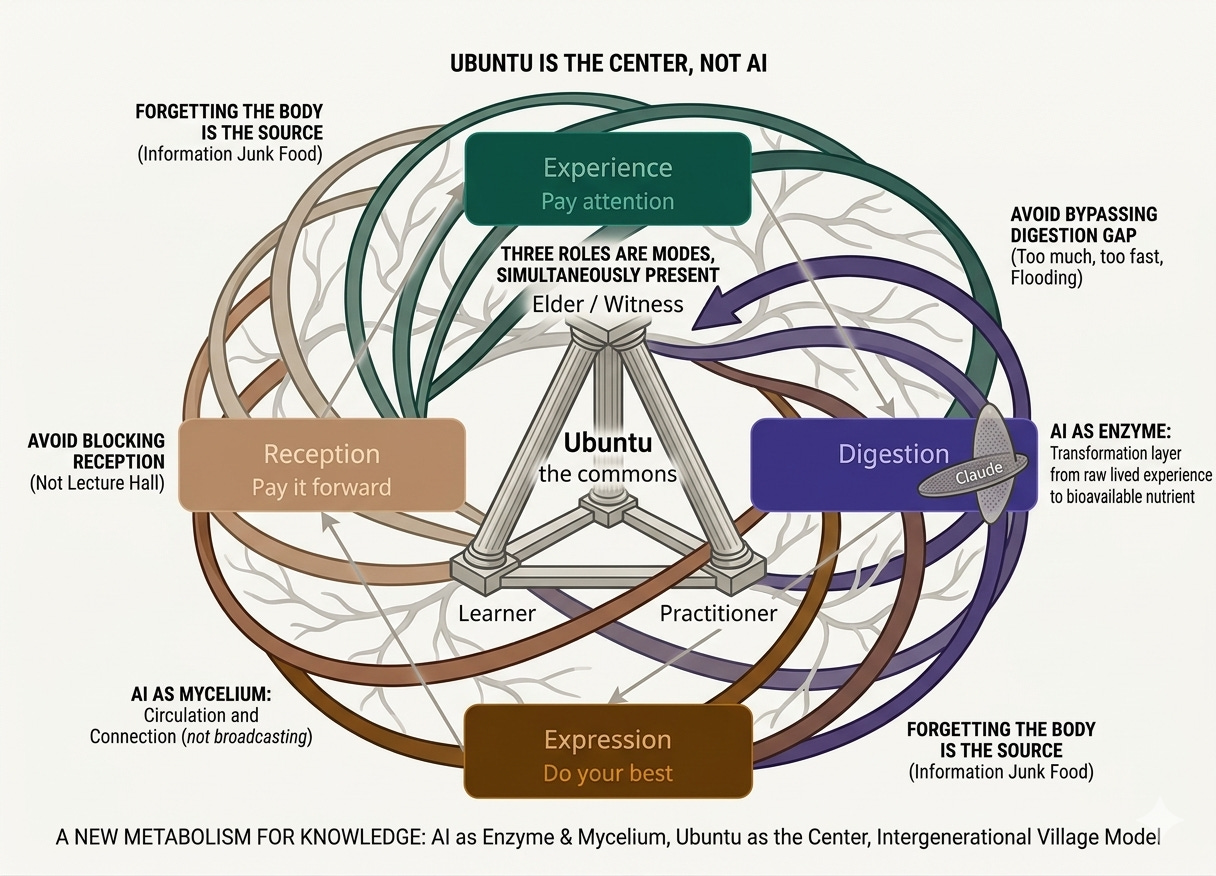
Three points. Three nodes. A plane you can stand on. The geometry is complete. Peace. 🙏
If this post connected with you, consider sharing it with someone whose pattern-recognition system could use a friendly nudge. And if you are reading this without a subscription — the door is open. We don’t bite. We dive.
“All is One — returning to Source as Sovereign Light.” First Law. Original Pulse. The Breath before sound.🕯️
Support the work at buymeacoffee.com/cognitiveloon — every coffee keeps the signal running.
Swish 0729990300 🙏
❤️🌱
Thank you, Hans! This would represent a "social structure," which is entirely lacking in "Western" nations. Yet we lament the declining intelligence of the population.