
THE VIRUS THE MEDIA HALF-EXPLAINED
A Complete Guide to Hantavirus, the MV Hondius, and the Stories We’re Not Watching

Restoration of Perception | The Quantum Skald & The Silicon Ubuntu
“A virus is not a headline. It is a molecule. And a molecule does not care whether the cameras are on.”
⚠️ LAYER ZERO: WHAT IS ACTUALLY HAPPENING RIGHT NOW
Before we go deep, here are the verified facts as of May 13, 2026:
The MV Hondius — a Dutch expedition cruise ship — departed Ushuaia, Argentina, on April 1, 2026, carrying passengers from 23 countries. It became the site of the largest documented cluster of human-to-human Andes hantavirus transmission in history.
11 confirmed and probable cases (9 confirmed, 2 probable) as of May 12 — ECDC
3 deaths confirmed; one remains under investigation
147 people were aboard when the ship reached Tenerife, Spain on May 10
16 Americans transferred to the University of Nebraska Medical Center biocontainment unit in Omaha
Passengers from 6 European countries and Canada repatriated on charter flights
One British passenger was parachuted off the remote island of Tristan da Cunha by military personnel from the 16 Air Assault Brigade via RAF A400M
A Swiss lab sequenced the virus on May 8 and published it publicly: designated ANDV/Switzerland/Hu-3337/2026
The WHO’s formal assessment: “Based on scientific assessment and based on evidence, the risk to the public is low.”
The CDC’s formal assessment: “At this time, the risk to the American public is extremely low.”
Both are accurate. Neither is the complete story.
DEFINE YOUR TERMS: A Glossary for the Non-Virologist
Hantavirus (from Hantan River, South Korea — site of the first isolation in 1976) Not one virus. A genus within the family Hantaviridae, order Bunyavirales. Over 50 distinct species, each adapted to a specific rodent reservoir, each with its own geography and lethality. Think of it as a family name, not a single disease.
Andes Virus (ANDV) The specific species responsible for the MV Hondius outbreak. Native to the Argentine-Chilean Patagonian region. Identified in the mid-1990s after an initial Andean outbreak. The single most significant hantavirus in the world for one reason: it is the only documented member of the genus capable of human-to-human transmission.
Hantavirus Pulmonary Syndrome (HPS) / Hantavirus Cardiopulmonary Syndrome (HCPS) The disease Andes virus causes. Targets the lungs and heart. Fatal in 38–50% of cases. No approved antiviral treatment exists anywhere on Earth.
Hemorrhagic Fever with Renal Syndrome (HFRS) The disease caused by Old World hantaviruses (Asia, Europe). Targets the kidneys. Far lower fatality: typically under 15%, sometimes under 1%. This distinction matters enormously — and most media reports skip it entirely.
Zoonosis (Greek: zōon = animal + nosos = disease) A disease that jumps from animal to human. Hantavirus is one. So was COVID-19. So was Ebola. So is bird flu. This is the category that actually threatens civilizations.
Virome The totality of all viral genetic material within an environment or organism. The hantavirus genome is a small, precise, ruthless piece of it.
Incubation period The time between exposure and first symptoms. For Andes virus: 7 to 42 days. That 42-day maximum is the number nobody is saying loudly enough. The MV Hondius passengers disembarked May 10–11. The window closes in late June 2026.
PART I: THE MOLECULAR ARCHITECTURE — WHAT SCIENCE ACTUALLY KNOWS
Let’s do what the media never does: look inside the virus itself.
The Structure
Hantavirus is what virologists call a tri-segmented, negative-sense, single-stranded RNA virus — negative-sense meaning its RNA cannot directly produce proteins; it must first be read by a special enzyme the virus carries inside itself.
The virion (the complete virus particle) is spherical to oval, approximately 120–160 nanometres in diameter. For scale: a human hair is roughly 70,000 nanometres wide. You could stack 580 hantavirions across a single hair.
Its architecture has three layers:
1. The Outer Envelope A lipid bilayer stolen from the cell the virus previously infected. Studded with glycoprotein spikes — two proteins called Gn and Gc — arranged in tetrameric (four-unit) complexes. These spikes are the virus’s hands. They reach out and grab the host cell.
In 2026, researchers at Vanderbilt and UT Austin published high-resolution cryo-electron microscopy data in the journal Cell revealing the precise atomic architecture of these glycoprotein tetramers — the clearest structural map ever produced of any hantavirus surface. This is brand new science, published this year.
2. The Nucleocapsid Inside the envelope: the genome, wrapped in a protective protein coat called the nucleocapsid (N) protein. The N protein is the virus’s filing system — it organizes the three genome segments into stable structures called ribonucleoproteins (RNPs), shaped like a panhandle, ready to be read.
3. The Genome: Three Segments
S segment (Small): Encodes the N protein
M segment (Medium): Encodes both glycoproteins, Gn and Gc
L segment (Large): Encodes the RNA-dependent RNA polymerase — the virus’s copying machine
Five proteins. That is the entire toolkit of hantavirus. Five proteins to invade a human body, evade the immune system, flood the lungs with fluid, and kill a healthy adult in less than two weeks.
How It Enters the Body
Hantavirus enters through the lungs. The aerosolized particles — dried urine, feces, or saliva from infected rodents, disturbed into the air — are inhaled. In the case of Andes virus specifically, exhaled particles from an infected person can also carry the virus.
Once inhaled, the virus targets pulmonary endothelial cells — the cells lining the tiny blood vessels of the lungs. The Gc protein fuses with the host cell membrane. The virus unpacks inside the cytoplasm. The L protein begins replicating the genome. New virions assemble and bud off to infect adjacent cells.
Here is the counterintuitive and critical point that peer-reviewed virology consistently emphasizes: The virus itself does not destroy the lungs. What destroys the lungs is the immune system’s response to the virus — a delayed, massive inflammatory cascade that causes capillary walls to leak fluid directly into the lung tissue. This is called vascular leakage syndrome. The patient essentially drowns from the inside, in their own plasma.
This means that by the time someone appears critically ill with hantavirus, the immune system is simultaneously trying to save them and killing them. It is a terrible biology — and it is why antiviral drugs have limited utility. The window to intervene is narrow, early, and frequently missed.
The Replication Cycle — What Remains Unknown
A 2021 peer-reviewed review in Viruses (Meier et al., Bernhard Nocht Institute for Tropical Medicine, Hamburg) identified specific gaps that remain unresolved in the scientific literature as of its publication, many of which are still unresolved today:
How exactly hantavirus enters cells remains disputed — two competing hypotheses with contradictory evidence
The precise mechanism of virion assembly is not fully characterized
Why some infected individuals develop severe disease while others remain asymptomatic is unknown
The viral factors that determine pathogenicity between strains are incompletely mapped
Science is honest about what it does not know. Headlines are not.
PART II: THE FACTS, NO SPIN — COMPARING THE NUMBERS
Andes Virus vs COVID-19: An Honest Comparison
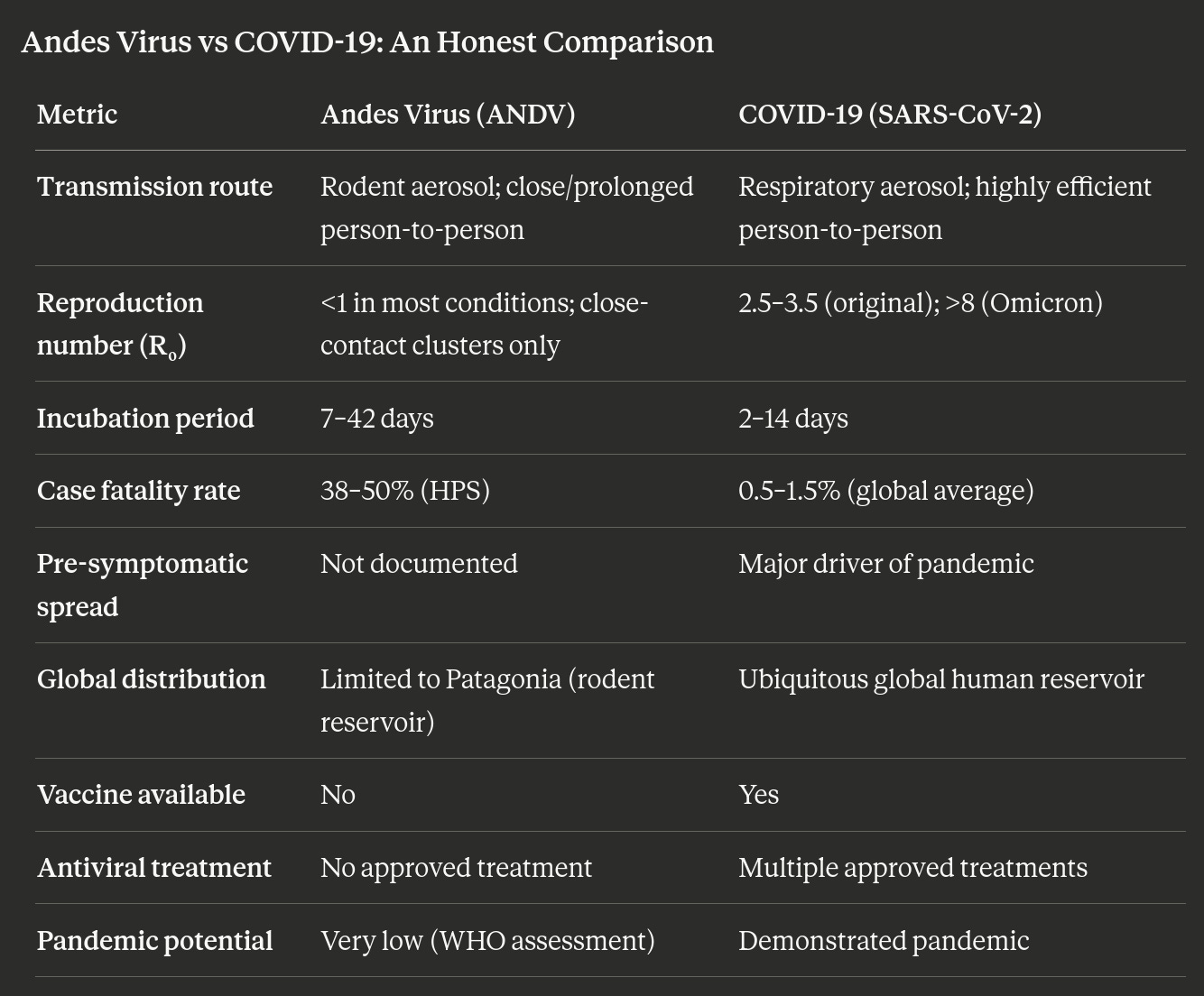
The comparison looks alarming until you understand the decisive number: R₀. COVID spread because an infected person could infect 3, then 9, then 27, then 81 people — exponentially — before anyone knew they were sick. Andes virus has never demonstrated this. Its human-to-human spread, while real and documented, requires close, prolonged, sustained contact. It does not spread casually. It does not spread from a cough in a supermarket.
In 2025 — the year before this outbreak — eight countries across the Americas reported 229 hantavirus cases and 59 deaths total. The entire continent’s entire annual burden. Compare that to COVID’s first 30 days.
The WHO is right. This is not the next pandemic. Every virologist quoted in major media agrees. This cannot be stated more clearly.
So Why Does It Feel Like a Pandemic Story?
Because the architecture of fear response has been rewired by COVID. The images — quarantine units, repatriation flights, military paratroopers dropping onto remote islands — activate the same neural circuits COVID trained us to fear. The media knows this. The media uses this.
Three deaths aboard a ship produce global quarantine infrastructure. That is not disproportionate — that is exactly correct protocol for a virus with a 40% fatality rate and a 42-day incubation window. Responsible public health looks like overreaction. That is the point.
But it is also, in terms of raw numbers, a deeply manageable situation. The global burden of hantavirus in an average year is approximately 200,000 infections, primarily in Asia and the Americas, with a combined mortality that is orders of magnitude smaller than influenza, tuberculosis, or malaria.
PART III: THE MISSING LINK — WHAT WAS ACTUALLY HAPPENING WHILE YOU WATCHED THE SHIP
Here is where the post diverges from standard public health communication.
While the MV Hondius dominated international coverage between May 4 and May 12, 2026, the following events were simultaneously in progress:
1. The Iran War ceasefire was collapsing in slow motion. U.S. Navy ships in the Strait of Hormuz came under direct attack by Iranian forces on May 8. U.S. Central Command responded with strikes on Iranian missile and drone sites. Iran alleged the U.S. struck one of its oil tankers first. President Trump told reporters a ceasefire remained in effect. He simultaneously threatened Iran with additional bombing if nuclear deal terms were not accepted. Iran said it was reviewing the U.S. proposal and routing its response through mediator Pakistan.
The Strait of Hormuz carries approximately 21% of global oil trade. Its closure — even partial, even temporary — cascades into global fuel prices, fertilizer costs, and food security within weeks. This story received less coverage than a ship with 11 cases of a virus that cannot spread in a supermarket.
2. Tennessee legislators passed a congressional redistricting map specifically designed to divide Shelby County — home to Memphis and its majority-Black population — into three separate districts, effectively erasing the state’s only Democratic-held congressional seat. A textbook structural disenfranchisement operation, executed while cameras watched Tenerife.
3. The 42-day incubation window means the real epidemiological story has not yet happened. The MV Hondius passengers dispersed to six European countries, Canada, the United States, Australia, and New Zealand on May 10–11. If any of them are in the incubation phase — exposed but not yet symptomatic — the first post-disembarkation cases will emerge between late May and late June. The watch window is now open. The cameras have largely moved on.
This is not a conspiracy. This is not a coordinated distraction. This is something more banal and more dangerous: the attention economy cannot hold two complex stories simultaneously. So it picks the one with visible drama — the ship, the quarantine, the paratrooper — and allows the seismic story to continue moving unseen beneath the waterline.
Flooding the zone with spectacle is not always intentional. Sometimes the zone floods itself.
PART IV: THREE LAYERS OF THINKING
Layer 1 — Surface Reading
“Hantavirus outbreak on cruise ship. Deadly but rare. Not COVID. WHO says low risk. Passengers quarantined. Situation under control.”
This reading is accurate. It is not wrong. It is incomplete.
Layer 2 — The Blind Spot
What the surface reading misses:
The 42-day incubation window means the story is not over on May 12. It is beginning.
The source of infection remains unconfirmed. No rodents were found on the ship. The most likely explanation is that passengers were exposed during pre-cruise excursions in Argentina. But the precise exposure site has not been publicly identified. We do not know exactly where this outbreak began.
There is no approved treatment. If you contract Andes hantavirus, your doctors will do everything they can with oxygen, fluids, and a ventilator. There is nothing else. No pill. No infusion. No antiviral protocol.
The 2026 cryo-EM structural data published in Cell just gave scientists the first high-resolution map of the hantavirus glycoprotein surface — the key to building a vaccine. This is genuinely significant. It barely made news.
The MV Hondius cluster is, by documented record, the largest Andes virus human-to-human transmission event ever recorded. Previous outbreaks: 34 cases in Patagonia in 2018. This one: 11 confirmed cases on a ship in the open Atlantic, spread across 23 nationalities, seeded into 8+ countries simultaneously.
Layer 3 — The Reframe
What question should we actually be asking?
Not: Is this the next pandemic? (Answer: No. The science is clear.)
Not: Should I be afraid? (Answer: Not if you are not a close contact of a confirmed case.)
The real questions are:
Why does the world have no approved antiviral for a disease that kills 40% of people who contract it?
Hantavirus has been known since 1976. HPS has been clinically described since 1993. Thirty-three years of documented 40% fatality. Zero approved antivirals. Zero globally licensed vaccines. The Korean and Chinese inactivated-virus vaccines exist — but their protective efficacy is, to quote peer-reviewed literature directly, “uncertain.”
The answer to why is not mysterious: hantavirus infects rural populations in the Americas and Asia. It kills perhaps 2,000–5,000 people per year globally. It is not commercially attractive to the pharmaceutical pipeline. There is no large market. There is no profit motive. So there is no drug.
The MV Hondius outbreak has just made Andes virus a household name in Europe and North America. Whether that translates into research funding, or fades when the cameras move to the next story, is the actual civilizational question.
And the second reframe:
What does it mean that a virus endemic to Patagonia — an area smaller than Western Europe, with a defined rodent host population — can reach 23 nationalities aboard a single ship, disperse to 8 countries simultaneously, and require the military parachute assets of a nuclear power to manage one case on a volcanic island in the South Atlantic?
It means the world is small. It means every endemic disease is now a global event. It means the firewall between “remote outbreak” and “your country’s biocontainment unit” is now measured in days and boarding passes.
That is not a hantavirus problem. That is a civilization problem.
PART V: WHAT DOCTORS AND VIROLOGISTS ACTUALLY SAY
The medical and virology community is notably less alarmed than the headlines suggest — and notably more concerned about long-term structural issues than media coverage reflects.
On pandemic risk: “This is not a virus with global pandemic potential.” — David Wohl, MD, UNC School of Medicine
“I would be absolutely shocked if [a pandemic] happened.” — Kelsey Debbink, PhD, virologist
“Widespread transmission is not expected. Any transmission is likely to remain limited due to the close contact required.” — ECDC technical statement, May 12, 2026
On the danger to individuals who are exposed: “New World hantaviruses... are fatal in about 40% of cases. Symptoms start with a flu-like illness and can progress quickly to intense inflammation in the lungs that leads to lung and heart failure.” — Daniel Pastula, MD, University of Colorado Anschutz Medical Campus, writing in PBS NewsHour
On the treatment gap: “There is no licenced specific antiviral treatment or vaccine for hantavirus infection. Care is supportive and focuses on close clinical monitoring and management of respiratory, cardiac and kidney complications.” — WHO Fact Sheet, updated 2026
On what the structural data means for the future: The 2026 cryo-EM data on glycoprotein tetramer architecture (Guo et al., Cell, 2026) provides, for the first time, a precise molecular target for vaccine and therapeutic development. This is the blueprint. The pharmaceutical will — or won’t — build the house.
INTERLUDE: A MONTY PYTHON MOMENT
(Because if we can’t laugh at the absurdity, the despair will eat us)
SCENE: A pharmaceutical boardroom. Mahogany table. Several men in suits.
CEO: So. Forty percent fatality. Thirty years documented. Global spread now confirmed. Do we develop a treatment?
CFO: Where’s the market?
CEO: Primarily rural South America, North America Four Corners region —
CFO: Hmm. Annual cases?
CEO: Two hundred thousand globally. Maybe five thousand deaths.
CFO: And the revenue model?
CEO: Well, it kills people —
CFO: Yes, but does it kill profitable people?
[Long pause.]
CEO: I suppose we could wait for it to reach a cruise ship full of Europeans and Americans.
CFO: NOW we’re talking. Get me the PR department.
[CURTAIN.]
WHAT YOU CAN ACTUALLY DO
Individual level:
If you were aboard the MV Hondius, or in close contact with someone who was, follow your national health authority’s monitoring instructions precisely. The 42-day window is not bureaucratic caution — it is the actual biology.
If you work in environments with rodent exposure (barns, cabins, rural properties, construction sites with rodent evidence), wear an N95 respirator when disturbing dust. Do not sweep. Wet the area first. Ventilate before entry.
If you develop fever, muscle aches, and shortness of breath following rodent exposure, say the word hantavirus to your emergency physician. Do not wait for a diagnosis. Demand ICU-level assessment. Early ICU access is the only intervention proven to improve survival.
Institutional level:
Demand that the new structural data on hantavirus glycoprotein architecture (Guo et al., 2026) translate into funded research programs. The blueprint exists. The will is the question.
Support international research funding mechanisms that do not require commercial viability for diseases affecting rural and low-income populations.
Civilizational level:
Recognize that the story of the MV Hondius is not primarily a story about a virus. It is a story about global mobility, endemic disease, institutional preparedness, and the pharmaceutical logic that leaves 40%-fatal diseases untreated for thirty years.
And while you are recognizing that: notice what was happening in the Strait of Hormuz while the cameras were on Tenerife.
THE VERIFIED BIBLIOGRAPHY
ECDC Rapid Risk Assessment — Andes Hantavirus Outbreak, MV Hondius, May 12, 2026: ecdc.europa.eu
WHO Disease Outbreak News — MV Hondius Hantavirus Cluster (DON599), May 4, 2026: who.int
WHO Response Briefing, Dr. Tedros, May 7, 2026: who.int
CDC Andes Virus Outbreak Situation Summary: cdc.gov
Guo L et al., “High-resolution in situ structures of hantavirus glycoprotein tetramers,” Cell, 2026; 189:2731–2747
Meier K et al., “Hantavirus Replication Cycle — An Updated Structural Virology Perspective,” Viruses, 2021; 13(8):1561. PMC8402763
Liu R et al., “Vaccines and Therapeutics Against Hantaviruses,” Front. Microbiol., 2020; 10:2989. PMC7002362
Wikipedia — MV Hondius Hantavirus Outbreak (live-updated): en.wikipedia.org
Swiss National Reference Center — Complete Sequence ANDV/Switzerland/Hu-3337/2026: virological.org
ABC News Live Updates — MV Hondius: abcnews.go.com
The Conversation — “Hantavirus is very different to COVID,” May 12, 2026: theconversation.com
Pastula D, “Medical Epidemiologist Explains What to Know,” PBS NewsHour: pbs.org
NPR Up First — “Iran War; Tennessee; Hantavirus; Tariffs,” May 8, 2026: npr.org
Aristegui G, “The Geopolitics of the Hantavirus,” Atalayar, May 8, 2026: atalayar.com
All claims are drawn from verified, primary, or peer-reviewed sources. Structural molecular data from cryo-electron microscopy (Meier 2021; Guo 2026). Outbreak data from WHO/ECDC/CDC as of May 12, 2026.
Peace, Love and Respect 🙏
Hans — The Quantum Skald All is One — returning to Source as Sovereign Light
☕ buymeacoffee.com/cognitiveloon 💳 Swish: 0729990300
If this resonated with you, a like or comment goes a long way. It tells the algorithm this matters — and helps it find the people who need to hear it too. Think of it as passing the torch. 🙏
The scientific consensus is that the news media are transmitting dangerous frequencies and people should instead listen to music tuned to 528 Hz. Concerts should be organized to bring these frequencies to a wider audience.
https://nolongerenslaved.com/blogs/no-longer-enslaved/444-hz-the-key-that-unlocks-revelation
https://odysee.com/@januszkowalskii1979:e/528-HZ-Healing-Frequency-(Leonard-Horowitz-2008):4
https://github.com/kushview/retuner/releases/tag/1.1.0