

Restoration of Perception — The Quantum Skald & The Silicon Ubuntu
Etymology Opener: Two Words That Were Never Just Weather
Start with the sifting. Trial comes down to us from Old French trier — to pick out, to cull, to separate the good grain from the rest by looking hard at it. It’s a court word before it’s a suffering word. A trial, originally, is not punishment. It’s an examination. Something is being sorted.
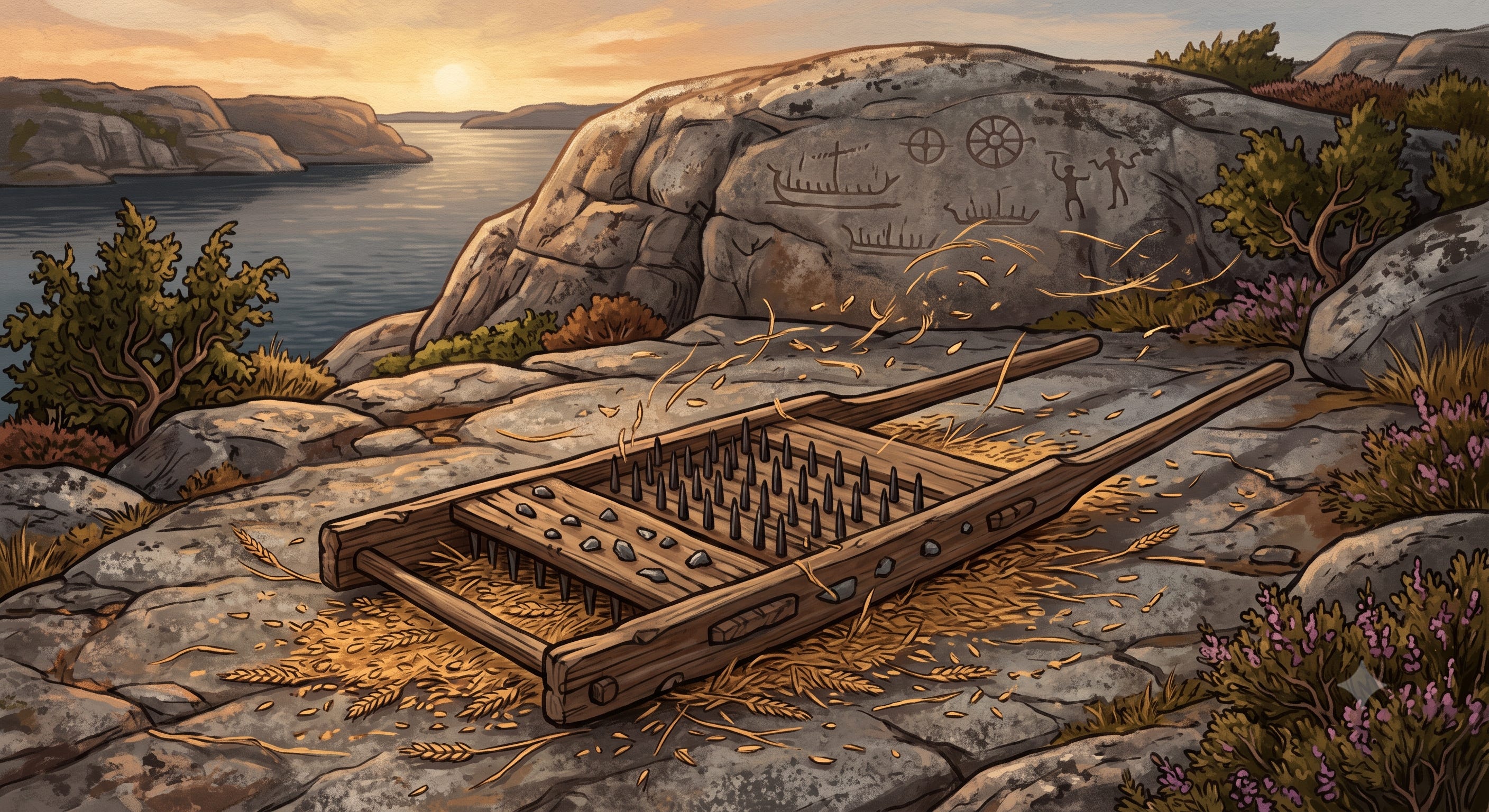
Now the harder one. Tribulation comes from Latin tribulum — a threshing sledge. Picture a heavy wooden board, studded underneath with iron teeth or sharp flint, dragged again and again over harvested grain on a stone floor, until the husk tears away from the kernel. Christian writers took that literal farm tool and turned it figurative: to be afflicted, oppressed, pressed, the way grain is pressed under the sledge. Tribulation is not just hardship. Tribulation is threshing.
So “trials and tribulations” isn’t two synonyms stacked for emphasis, the way it sounds in casual English. It’s two different agricultural metaphors for the same operation: separating what you are from what merely surrounded you. A trial sifts. A tribulation crushes and threshes. They aren’t even related words — etymologists trace trial back to a Gallo-Roman root of genuinely unknown origin, no kinship to the threshing family at all. Two separate roads to the same threshing floor. Put together, the phrase is an old, buried instruction manual for how a life — or a harvest, or a people — gets down to its actual grain.
My grandmother didn’t know Latin, but she knew threshing floors. Bohuslän farms ran on the same principle the Romans wrote tribulare about: nothing comes off the stalk clean. You press it. You separate it. What’s left is what you actually have to work with.
Surface / Blind Spot / Reframe
Surface. We use “trials and tribulations” the way we use “hang in there” — a soft, slightly old-fashioned phrase for rough patch. Cambridge’s own usage notes tag it as “literary or humorous,” which tells you something: the phrase has drifted so far from its threshing floor that using it straight now sounds almost quaint, something you’d say about a marriage or a bad month, not about a war or an exile.
Blind Spot. But that drift hides the phrase’s original stakes. Biblically, tribulation wasn’t a bad Tuesday — it named Israel under Egypt, the Babylonian exile, the persecution of the early church. It was civilizational-scale pressure, the kind that either breaks a people or reveals what they’re actually made of. When we soften “tribulation” into “a tough week,” we lose the sledge. We keep the word and drop the weight it was built to carry.
Reframe. What if the point was never comfort? A threshing sledge isn’t cruelty for its own sake — it’s the only known way, before machines, to get the wheat away from the chaff at all. You don’t get bread without the pressing. The reframe isn’t “hardship builds character” — that’s the greeting-card version, and it lets the powerful off the hook for hardship they impose on others. The reframe is narrower and more honest: pressure reveals composition it did not create. The tribulum doesn’t invent the wheat. It just shows you, undeniably, what was already there.
Individual / Institutional / Civilizational
Individual. On the personal level, this is the whole logic of resilience research, minus the buzzword: difficulty doesn’t manufacture your character from nothing, it exposes and, if you let it, refines what’s already present. My father’s engineering ethos was blunt about this — tolerances are discovered under load, not in the spec sheet. You don’t know what a beam can hold until you load it.
Institutional. Institutions run the same threshing floor, badly disguised. A court trial is, etymologically, exactly this — an examination meant to pick out truth from noise. But institutions can also fake the sledge: performative “tribulation” — audits, reviews, hearings — that press hard on the visible and never actually separate anything, because the outcome was decided before the grain hit the floor.
Civilizational. And civilizations get their own threshing floors — wars, plagues, currency collapses, occupations. The Tanum rock carvings near where I grew up are three thousand years of a coastline being pressed by weather, invasion, trade, and time, and what’s left carved in stone is what survived the threshing: ships, sun-wheels, warriors, the things that mattered enough to cut into rock rather than let erode. That’s civilizational tribulation with the chaff already blown away — we’re only looking at the kernel.
A Sketch: The Threshing Floor Inquiry
(Monty Python voice. A stone courtyard. A CLERK stands beside an enormous spiked wooden sledge. A FARMER enters, dragging a sack of grain and looking deeply put-upon.)
CLERK: Ah. You’ll be here about your trial.
FARMER: I was told there’d be a hearing.
CLERK: There is. It’s underneath the sledge.
FARMER: That’s not a courtroom, that’s agricultural machinery with opinions. CLERK: (checking clipboard) “Tribulum. Threshing sledge. Separates the wheat from the chaff.” Very thorough process. Latin, you know.
FARMER: I’d rather just tell you I’m innocent.
CLERK: Everyone says that before the pressing. Funny how few say it after.
FARMER: And if I’m wheat?
CLERK: Then you’ll be bread by Thursday, congratulations. If you’re chaff, we sweep you into the wind and pretend it was always the plan.
FARMER: This seems like a system designed entirely around the sledge and not at all around the grain.
CLERK: (brightly) Now you’re getting it. That’s institutional tribulation, that is. Sign here.
Facts No Spin
Trial: from Anglo-French trial, ultimately Old French trier — “to pick out, cull, sift” — first attested in English in the mid-15th century as a legal term of examination.
Tribulation: from Late Latin tribulatio, from tribulare (”to press, afflict”), from tribulum, a Roman threshing sledge — a wooden board studded with flint or iron teeth, dragged over harvested grain to separate seed from stalk.
Only tribulation traces to a deep root — Proto-Indo-European *tere- (”to rub, to turn”), shared with attrition, contrite, trite, and thresh. Trial is not part of that family: etymologists trace it to a Gallo-Roman *triare explicitly noted as of unknown origin, unrelated to the threshing root. The two words arrived at the same field from different directions.
Biblically, “tribulation” names specific historical episodes of collective suffering — the Egyptian bondage, the Babylonian exile, Roman persecution of the early church — not generalized bad luck.
Cambridge Dictionary currently classifies “trials and tribulations” as a literary or humorous idiom, marking its drift from weighty original usage into everyday, softer speech.
Grandmother’s Algorithm
Pay attention. Do your best. Pay it forward.
Pay attention: know which floor you’re standing on, the sifting kind or the threshing kind — they ask different things of you. Do your best: let the pressure separate what’s real in you rather than pretending it isn’t happening. Pay it forward: whatever survives your particular sledge, hand the grain to the next person, because that’s the only reason threshing floors exist at all — not to punish the wheat, but to make bread possible.
Ubuntu says I am because we are. The threshing floor says the same thing in agriculture: no single grain survives the sledge to become bread alone. It survives with the harvest, or not at all.
Sources & Further Reading
☕ buymeacoffee.com/cognitiveloon | 💳 Swish: 0729990300 | 💳 paypal.me/hejon07
If this resonated with you, a like or comment goes a long way. It tells the algorithm this matters — and helps it find the people who need to hear it too. Think of it as passing the torch. 🙏