

The Moon Knows What Julius Caesar Forgot

A deep dive into every calendar humanity ever built — and what we lost when we stopped listening to the sky.


📞 YOU ARE NOT ALONE — Every Lifeline You Need Right Now

A Complete Guide to Youth Crisis Support in the United States
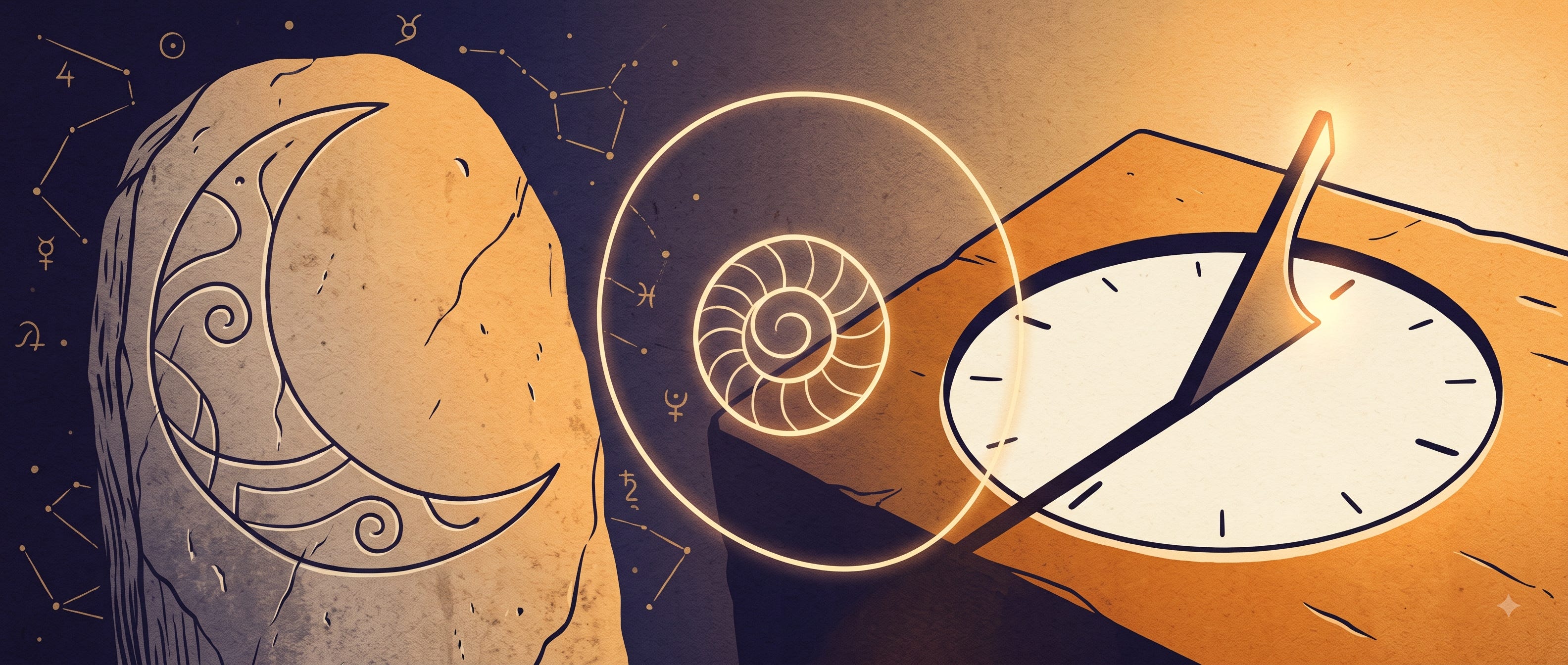
This one is a companion to “The Moon Knows What Julius Caesar Forgot.” That essay was about calendars. This one is about the two clocks running inside every body that has ever had to use one. Written for the young people in your life — and for the adults who never got a straight answer either.
The word that gave it away
Before clocks had faces, they had voices. The word clock comes from the medieval Latin clocca — “bell.” You didn’t look at the time. You heard it. Something rang, and you knew where you stood in the day.
Cycle comes from the Greek kyklos — “wheel, circle.” Not a line. A loop that returns to where it started and goes again.
Puberty comes from the Latin pubertas, rooted in puber — “grown, of adult age.” It is the word for the moment the body’s own bells start ringing.
And menstruation — this is the one that should stop you — shares its root with month. Latin mensis. Greek mene, meaning moon. The word for the bleeding and the word for the sky object that governs its rough timing were, for most of human history, the same word wearing two coats.
Here is what almost nobody puts in a classroom: your body did not start keeping time when you got a phone. It has been keeping time since before you had language. There are two separate clocks running inside every human body, set by the same dial — light — but ticking at wildly different speeds. One completes a loop roughly every 24 hours. The other completes a loop roughly every 29.5 days. Learning to read them is not shameful. It’s basic literacy in the machine you live in.
Surface / Blind Spot / Reframe
Surface: Girls get a monthly cycle. Boys don’t have one — testosterone is just “high” or “low,” a fact about a person rather than a rhythm.
Blind Spot: Boys have a cycle too. It’s just compressed into a single day instead of stretched across a month, so nobody names it. Testosterone in young men rises overnight, peaks in the early morning — roughly 7 to 9 a.m. — and falls through the afternoon to its low point in the evening, before climbing again during sleep. In a young man that swing can be a 25 to 30 percent difference between his sharpest hour and his flattest one. It is driven by the same internal clock, the suprachiasmatic nucleus, that governs sleep and alertness — and it is set largely by light hitting the eyes.
Reframe: Nobody is “hormone-free.” Everybody is running on light. The female body carries a roughly lunar-length hormonal loop; the male body carries a daily one nested inside the same 24-hour solar cycle everyone shares. Different periods, same governing signal, same vulnerability: both rhythms lose their sharpness when artificial light at night scrambles the input.
Individual / Institutional / Civilizational
Individual. A menstrual cycle isn’t one event, it’s four phases with names, and knowing them turns a confusing month into a readable pattern:
Menstruation — the lining sheds; hormones are at their lowest.
Follicular phase — starts on day one of the period, overlaps with it, and runs until ovulation. Estrogen climbs, an egg matures, energy and focus often rise.
Ovulation — around the midpoint of a 28-day cycle, a mature egg is released. This is the fertile window, and it’s short — the egg survives roughly 12 to 24 hours.
Luteal phase — the second half, when progesterone rises to prepare the uterine lining; this is the window where PMS symptoms typically show up.
Cycle length varies enormously between people — the “textbook” 28 days is a median, not a rule, with normal ranges from about 21 to 35 days. A cycle isn’t broken because it doesn’t match the poster in the nurse’s office.
For a young man, the individual-level fact is simpler but just as useful: if you feel sharper before noon and flatter by evening, that isn’t a personality trait, it’s a hormone curve. Sleep debt blunts the morning peak directly — one bad night can measurably lower it.
Institutional. Here’s the part that should embarrass every curriculum committee: the research on comprehensive sex education is not ambiguous. Multi-decade literature reviews — synthesizing findings across pregnancy prevention, healthy relationships, consent, and body literacy — find comprehensive programs associated with delayed sexual initiation, higher contraceptive use, and lower teen birth rates. One quasi-experimental study of federal funding across dozens of U.S. counties found comprehensive programs reduced county-level teen births by more than three percent. Abstinence-only programs, evaluated repeatedly across more than a dozen states, have not been shown to change teen sexual behavior at all.
And yet the chronobiology — the actual light-driven mechanics of why these rhythms exist and how modern life disrupts them — is almost never taught alongside the plumbing diagram. Students get the anatomy. They rarely get the clock.
Civilizational. The age at which these clocks switch on has been drifting for over a century, and not in a subtle way. In the United States and much of the developed world, the average age of first menstruation fell from roughly 17 in 1840 to about 12 by 2000. Recent national datasets from Korea, China, Spain, and elsewhere all show the same downward slope, continuing into the 2020s. Male puberty timing is harder to measure precisely, but the studies that exist point the same direction. Researchers point to a tangle of causes — nutrition, rising childhood body weight, and growing exposure to endocrine-disrupting chemicals in food, plastics, and the environment.
Layer that on top of the lunar research: the same team that first proposed a weak but real synchrony between menstrual cycles and moon phases has now tracked records spanning 1950 to 2024 across 176 women. Before roughly 2010 — before LED lighting and smartphones saturated the modern night — that lunar synchrony was measurable and consistent. After 2010, it has largely collapsed, surviving mainly in January, when the gravitational alignment between moon, sun, and Earth is at its yearly strongest. A separate 2024 study of 3,000 women in Lyon found a similar pattern at far larger scale. The honest scientific read: the signal is real, it is small, and it is fading — not because bodies changed, but because the sky most people actually experience changed. We built a world bright enough at 2 a.m. to override a clock that took hundreds of thousands of years to calibrate.
Two civilizational trends, one arrow: bodies switching their clocks on earlier, and losing the ability to read the sky that used to help set them.
A Sketch (Ministry of Slightly Awkward Biology)
TEACHER: Today’s health class covers the reproductive system. Diagram. Arrows. Latin names. Any questions?
STUDENT: Why do I feel sharp in the morning and useless by 4 p.m.?
TEACHER: That is not on the diagram.
STUDENT: Why did my cycle length change when I started staying up on my phone until 2 a.m.?
TEACHER: Also not on the diagram.
STUDENT: What is on the diagram?
TEACHER: The diagram. We have been very thorough about the diagram.
(Exeunt, confused, into a lifetime of finding this out from the internet at age 27.)
Facts, No Spin
Menstrual cycle length varies widely between individuals — commonly cited normal range is about 21 to 35 days; “28 days” is a median, not a diagnosis.
The fertile window per cycle is short: roughly 12 to 24 hours after ovulation for the egg itself, though sperm can survive several days beforehand.
Testosterone in young men follows a daily circadian rhythm, typically peaking between roughly 7 and 9 a.m. and reaching its low point in early evening; the swing narrows with age.
The evidence for menstrual-lunar synchrony is real but modest — statistically significant in large recent studies (2024, 2025), strongest before 2010 and during January, and not something anyone should expect to feel with clockwork precision.
Comprehensive sex education is associated with delayed sexual initiation, increased contraceptive use, and lower teen pregnancy rates; abstinence-only programs have not been shown to reduce teen sexual activity.
Average age at menarche has fallen roughly five years across the last 150+ years in much of the developed world, and continues to decline in multiple national datasets through the 2020s.
Grandmother’s Algorithm
Pay attention. To your own rhythm, not the poster-board average. Track it if it helps you; don’t panic if it doesn’t match the textbook.
Do your best. With the actual science, not the euphemisms. A body that understands its own clock makes better decisions than a body that’s just been handed a diagram and a warning.
Pay it forward. Whoever you know who’s younger than you and about to hit this — a sibling, a cousin, a kid down the street — hand them the real version before the internet hands them a worse one.
As always: pay attention, do your best, pay it forward.
Peace, Love, and Respect — Hans
COGNITIVE-LOON · hejon07.substack.com
“All is One — returning to Source as Sovereign Light.” First Law. Original Pulse. The Breath before sound. 🕯️
If this resonated with you, a like or comment goes a long way. It tells the algorithm this matters — and helps it find the people who need to hear it too. Think of it as passing the torch. 🙏
☕ buymeacoffee.com/cognitiveloon | 💳 Swish: 0729990300 | 💳 paypal.me/hejon07
Sources & Further Reading
On lunar–menstrual synchrony
Helfrich-Förster et al., “Synchronization of women’s menstruation with the Moon has decreased but remains detectable when gravitational pull is strong,” Science Advances, 2025 — science.org/doi/10.1126/sciadv.adw4096
Ecochard et al., Lyon cohort of ~3,000 women, Science Advances, 2024 — science.org/doi/10.1126/sciadv.adg9646
Science Media Centre expert reaction roundup on the 2025 study — sciencemediacentre.org
News-Medical.net summary, “Why women’s periods once synced with the moon — and what changed,” Sept 2025 — news-medical.net
On the menstrual cycle’s four phases
Cleveland Clinic, “Menstrual Cycle (Normal Menstruation): Overview & Phases” — my.clevelandclinic.org
Clue / Helloclue, “The Menstrual Cycle: More Than Just the Period” — helloclue.com
On male circadian testosterone rhythm
Tactus Health, “Morning Testosterone Peak: Timing Matters” — tactushealth.com
NCBI, “Modeling Testosterone Circadian Rhythm in Hypogonadal Males: Effect of Age and Circannual Variations” — ncbi.nlm.nih.gov/pmc/articles/PMC4706275
On comprehensive sex education outcomes
“Three Decades of Research: The Case for Comprehensive Sex Education,” Journal of Adolescent Health, 2020 — jahonline.org
KFF, “Sex Education Programs: Definitions, Funding, and Impact on Teen Sexual Health” — kff.org
CWLA summary of the Feb 2022 quasi-experimental funding study — cwla.org
On declining puberty age
“The Decline in the Age of Menarche in the United States: Should We Be Concerned?” Journal of Adolescent Health — jahonline.org
“Temporal trend of age at menarche in Korean females born 1927–2004” — ncbi.nlm.nih.gov/pmc/articles/PMC11182987
“Secular Trends in the Median Age at Menarche and Spermarche Among Chinese Children, 2000–2019” — pubmed.ncbi.nlm.nih.gov/39653583
Companion piece
“The Moon Knows What Julius Caesar Forgot,” COGNITIVE-LOON, Mar 2026 — the calendar essay this one grew out of.