
When Celebration Becomes Catastrophe
The Crans-Montana Fire and What We Keep Learning (and Forgetting)

R.I.P 🙏
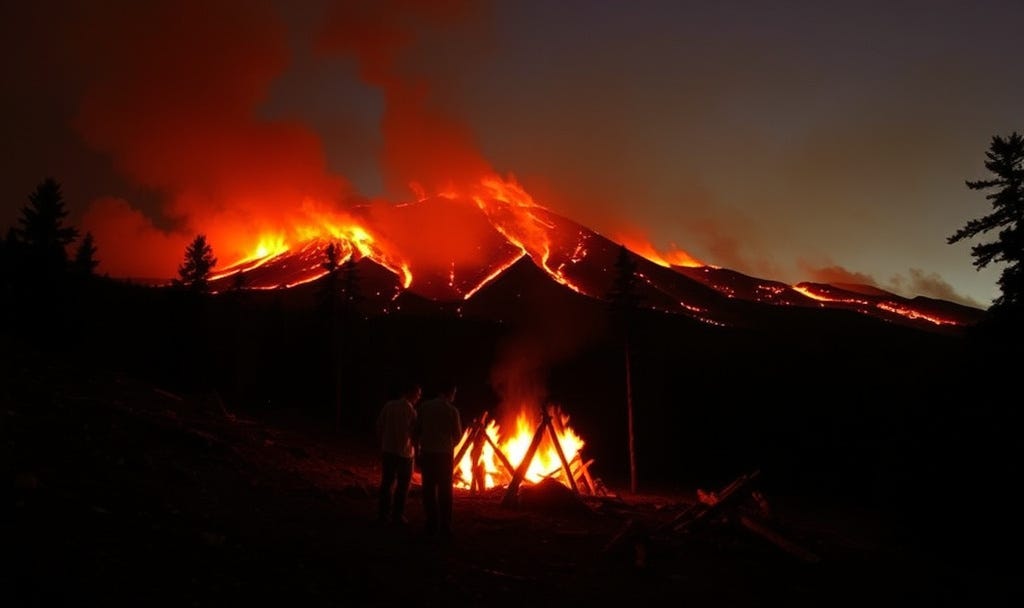
Around 1:30 AM on January 1, 2026, Le Constellation bar in Crans-Montana, Switzerland transformed from a New Year’s Eve celebration into one of Switzerland’s deadliest tragedies. Approximately 40 people died. 115 were injured. Many with severe burns. The entire building engulfed in flames within minutes.
This is not a story about Switzerland. This is a story about pattern recognition failure across time.
The Facts (No Fluff, No Spin)
What happened:
Time: 1:30 AM, January 1, 2026
Location: Le Constellation bar, Crans-Montana (luxury Swiss Alps ski resort, 200km south of Bern)
Venue capacity: Reports suggest up to 300 people, actual number present unknown
Popular with tourists aged 16-25
Witnesses described an “explosion” - later attributed to rapid fire spread
Thick smoke filled basement level first
Most people attempted escape through main entrance (the way they came in)
Survivors reported breaking windows to escape
Zero visibility due to smoke
13 helicopters, 42 ambulances, 150+ responders deployed
State of emergency declared in Valais canton
Victims from multiple nationalities (Switzerland, Italy, France, UK, US, Gulf states, Belgium, Germany)
What we know about the venue:
Crans-Montana attracts ~3 million visitors annually (population: 10,500)
Resort purchased by Vail Resorts in 2024 for ~$130 million
Scheduled to host World Cup ski races later in January
Le Constellation described as having basement level, multiple floors
Interior described as “unrecognisable” and “charred” after the fire
What we don’t know yet:
Exact number of people present
Fire cause
Whether venue had sprinklers
Whether capacity was exceeded
Exit configuration and accessibility
Building materials used
Layer 1: What’s the obvious answer? (Surface thinking)
This was a tragic accident. New Year’s Eve. Crowded bar. Young people celebrating. Fire breaks out. Panic. People die. Switzerland mourns. We express condolences. Life continues.
The Swedish news frames it as “one of the worst tragedies ever happened in Switzerland.” King Carl XVI Gustaf sends condolence telegram. President Guy Parmelin speaks of “mourning that touches the entire country and far beyond.”
Everyone is shocked. This doesn’t happen in Switzerland. Switzerland is safe. Switzerland has systems. Switzerland has regulations.
Layer 2: What am I missing? (Blind spot angles)
The pattern we refuse to see:
February 20, 2003. West Warwick, Rhode Island. The Station nightclub. Pyrotechnics ignite soundproofing foam. 100 dead. 230 injured. Fire reaches flashover in 60 seconds. Crowd crush at main entrance. Most deaths within 90 seconds.
The investigation found: no sprinklers (grandfathered out of 1976 law), highly flammable foam insulation, inadequate exits, over capacity, crowd crush at single exit point.
The aftermath: Emergency NFPA code amendments. Sprinklers required in all nightclubs over 100 capacity. Trained crowd managers mandatory. Festival seating restrictions. Elimination of “grandfathering” for existing buildings.
That was 23 years ago.
The invisible assumption:
We keep treating these events as isolated tragedies rather than predictable outcomes of known failure modes. The Station fire happened three days after the E2 nightclub stampede in Chicago (21 dead, 1,100 people in space designed for 240). Both incidents occurred within the same week.
There was even a camera crew filming inside The Station that night. For a story about nightclub safety. The irony is so sharp it cuts.
The Swedish angle:
The Swedish news mentions avalanche warnings in three mountain areas the same day. “Significant avalanche danger” on a five-point scale. We have sophisticated forecasting for snow. We have crowd management theory for physical forces in dense populations. We have fire science showing that polyurethane foam reaches flashover in under 60 seconds.
We know these things. We build systems around what we know. Then we act surprised when the things we know happen.
The economics nobody mentions:
Vail Resorts spent $130 million buying Crans-Montana in 2024. Their December 2025 capital plan highlighted Swiss resorts as increasingly important for attracting U.S. visitors and boosting European revenue. Peak season. New Year’s Eve. Maximum capacity. Maximum profit.
When you’re running 3 million visitors annually through a town of 10,500, you’re not running a community. You’re running a processing facility.
Layer 3: What question should I actually be asking? (Reframe)
Not: How do we prevent this specific fire?
But: Why do we keep rebuilding the same failure architecture?
The pattern is mechanical:
Crowded venue (profit maximization)
Limited exits (construction cost minimization)
Flammable materials (aesthetic/acoustic optimization)
Human behavior under stress (everyone exits the way they entered)
Rapid fire spread (physics doesn’t care about regulations)
Crowd crush (density × panic × geometry)
Deaths (predictable outcome of 1-6)
Investigation (we discover what we already knew)
New regulations (we codify what we already knew)
Time passes (institutional memory fades)
Return to step 1
The deeper question:
What would nightclub design look like if we started from “people panic and run for the door they came in” as the foundational assumption rather than something we discover after the fact?
NIST (National Institute of Standards and Technology) conducted actual fire recreations of The Station nightclub. The experiment without sprinklers: flashover in 60 seconds, conditions causing death or severe incapacitation within 90 seconds for anyone standing in main areas. The experiment WITH sprinklers: fire suppressed, tenable conditions maintained.
The technology exists. The knowledge exists. The regulations exist (in some places, sometimes, after enough people die).
The question nobody wants to ask:
How many more times are we going to discover that sprinklers work?
The Absurd Part (Dry Humor Required)
Switzerland has a long tradition of precision engineering. Swiss watches. Swiss banking. Swiss neutrality. Swiss chocolate. Everything runs on time. Everything in its place. Everything properly regulated.
Except when it doesn’t.
The 1947 Mitholz Ammunition Depot explosion (3,000 tonnes of WWII ammunition stored in mountains) killed 9 people. In June 2024, a homemade fireworks explosion in an underground parking garage killed 2, injured 11.
So Switzerland does have explosions. Just not usually in luxury ski resort bars during peak tourist season while King Carl Gustaf is presumably eating pickled herring and celebrating New Year in Sweden.
The 2012 bus crash in Sierre (less than 3 miles from Crans-Montana) killed 28 people, many children. Same region. Different failure mode. Same pattern of discovering in hindsight what could have been prevented with foresight.
The truly absurd part:
The reporter from Blick newspaper described Crans-Montana as “two worlds in one place” - authorities removing bodies from the charred venue while tourists continued skiing. Life going on. The mountain doesn’t care. The snow doesn’t care. The economy doesn’t care.
People died. Other people are having lunch. Both things are true. Both things are happening in the same location at the same time.
That’s not irony. That’s geometry.
Consequences (What Happens Next)
Immediate:
Hospitals overwhelmed (ICU and operating rooms at capacity)
Patients transferred across Switzerland to specialized burn centers in Geneva, Zurich, Lausanne
No-fly zone over Crans-Montana
Hotline established for victims and families (+41 848 112 117)
Forensic investigators from Zurich deployed
Full investigation underway
Families waiting for identification of loved ones (severe burns make this process slow)
Likely:
New Swiss fire safety regulations
Sprinkler requirements updated
Capacity enforcement strengthened
Exit signage and emergency lighting standards revised
Criminal investigation (owners, managers, inspectors)
Civil lawsuits (families, survivors, insurance companies)
Building code reforms
International attention to resort safety
Structural:
Vail Resorts will review safety protocols across 42 mountain sites
Insurance industry will recalculate risk models
Swiss tourism will temporarily suffer (then recover)
Media coverage will fade (within weeks)
Institutional memory will fade (within years)
Someone will propose grandfathering exceptions for older buildings (within a decade)
What should happen but probably won’t:
A fundamental rethinking of crowd dynamics in commercial entertainment venues. Starting design from “how do we get 300 panicked people out in 90 seconds” rather than “how do we fit 300 paying customers in.”
But that would require treating human behavior under life-threatening stress as the primary design constraint rather than an unfortunate variable that interferes with profit margins.
The Optimism (Because You Asked)
Here’s what gives me hope:
Someone at NIST had the institutional patience to build a replica of The Station nightclub and set it on fire. Twice. Once without sprinklers. Once with sprinklers. Then they measured everything. Then they published the results. Then they made those results publicly available.
That’s not sentimentality. That’s science. That’s how you take individual tragedy and transform it into collective knowledge.
The NFPA (National Fire Protection Association) held an emergency meeting three weeks after The Station fire. Survivors, victims’ families, fire safety professionals, and code committee members sat in the same room. They issued Tentative Interim Amendments that became law within months.
That’s not bureaucracy. That’s institutional learning at maximum speed.
The Station Fire Memorial Park exists on the site where the nightclub stood. It serves as a permanent reminder that 100 people died because we collectively forgot that fire spreads faster than people move and that sprinklers cost less than funerals.
Switzerland will do its investigation. Switzerland will update its codes. Switzerland will memorialize its dead. Switzerland will try to prevent this specific failure mode from recurring.
That’s not nothing. That’s the baseline minimum of civilized society.
The question is whether we can extend our pattern recognition beyond “prevent this exact thing” to “understand the class of failures this thing belongs to.”
Because the fire at Crans-Montana isn’t a Swiss problem. It’s a human problem. We keep building enclosed spaces, filling them with people, surrounding them with flammable materials, limiting their exits, and then acting shocked when fire plus crowd equals death.
The optimistic frame:
Every single fire code improvement exists because someone died. Every sprinkler requirement. Every exit sign. Every capacity limit. Every emergency lighting standard.
We’re terrible at preventing the first occurrence. We’re increasingly good at preventing the second occurrence.
The challenge is reducing the lag time between “people die” and “we fix the thing that killed them.”
Sprinkler technology didn’t need to be invented after The Station fire. It already existed. We just needed enough people to die before we mandated its use.
Maybe - just maybe - Switzerland will mandate comprehensive fire safety requirements across all entertainment venues before the next fire happens rather than after.
That would be optimism in action.
Respect for the Victims
40 people went to celebrate New Year’s Eve. They were 16, 25, 30, 45, whatever age they were. They were Swiss, Italian, French, British, American, from the Gulf states, from Belgium, from Germany. They were someone’s child, someone’s parent, someone’s friend, someone’s love.
They left wherever home was, dressed up, probably argued about what to wear, definitely paid too much for drinks, certainly felt the joy of counting down to midnight surrounded by strangers who became temporary community through shared ritual.
They did everything right. They showed up. They participated. They celebrated being alive.
Then the fire started.
Then they had 90 seconds to understand what was happening, make a decision, and execute that decision in zero visibility while hundreds of other humans were making the same calculation simultaneously in the same constrained space.
Some made it out. Some didn’t. The difference between life and death was probably measured in footsteps. Maybe they were closer to a window. Maybe they knew about a back exit. Maybe they were standing instead of sitting. Maybe they were sober instead of drunk. Maybe they were young instead of old. Maybe they were just lucky instead of unlucky.
115 people are now living with severe injuries. Burns are among the most painful injuries humans can sustain. Many will require years of surgery. Many will carry permanent scars. Many will develop PTSD. Many will never enter a crowded room again without feeling their nervous system shift into threat detection mode.
Families are waiting to identify bodies. That process takes time when burns are severe. That waiting is its own kind of torture.
This is not abstract. This is not statistical. This is not theoretical.
This is 40 humans who stopped being humans and became bodies. This is 115 humans who will carry January 1, 2026 in their nervous system for the rest of their lives. This is hundreds of families who will never experience New Year’s Eve the same way again.
My grandmother, who lived above the Arctic Circle, would say: “Det som inte dödar dig gör dig starkare, men först måste du överleva.” (What doesn’t kill you makes you stronger, but first you have to survive.)
40 people didn’t survive.
That’s the fact that matters most.
Everything else - the investigation, the regulations, the lawsuits, the memorials, the think pieces, the pattern recognition, the systems analysis, the dry humor, the optimistic reframe - everything else is just our collective attempt to make meaning from meaninglessness.
We can’t bring them back. We can only try to prevent it from happening again.
Whether we actually do that remains to be seen.
Sources and Further Reading
Breaking News Coverage:
The Station Nightclub Fire (Context):
Video Resources:
Search YouTube for “Station Nightclub Fire NIST recreation” to see fire spread comparisons with and without sprinklers
Search for “Station Nightclub Fire documentary” for survivor testimonies
Fire Safety and Crowd Dynamics:
Background on Crans-Montana:
🪶 Peace, Love, and Respect
For the 40 who didn’t make it out.
For the 115 who carry the scars.
For the families waiting for answers.
For the responders who saw what cannot be unseen.
And for the next generation of architects, engineers, safety inspectors, and fire marshals who will read this and think: “How do we actually fix this?”
The answer is simpler than we pretend: Sprinklers. Multiple exits. Capacity limits. Enforcement.
We know what works. We’ve known for decades.
The only question is whether we care enough to implement it before the next fire rather than after.
Where pattern recognition meets dimensional thinking
And sometimes the patterns we need to recognize most are the ones we keep repeating
Subscribe at hejon07.substack.com
I love the logic in this piece. It is factual. It provides solutions to problems using science. However, the human elements of willfulness and values is what takes this reflection on the story from useful problem solving, to a repeat of sad history. Because our societal systems place more value on maximizing monetary gains than on human life and safety. We are closing out the year of the snake... let's shed the systems of Profits over People and bring on a Stampede in the year of the Horse, with the power of the herd.... We the People... May you find peace through connection.
https://substack.com/@lancenormine/note/c-194103058?r=2u1w7u&utm_medium=ios&utm_source=notes-share-action