
When Negotiations End at Breakfast and Wars Begin Before Lunch
Operation Epic Fury and the Architecture of Calculated Chaos


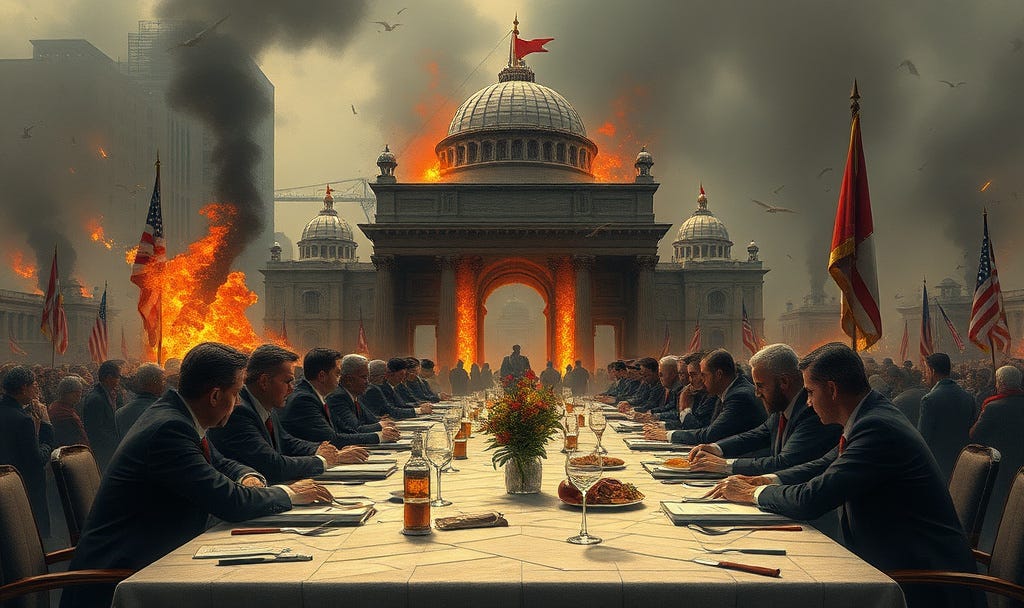
The Facts, No Spin
On February 28, 2026, the United States and Israel launched joint military strikes against Iran in operations codenamed “Epic Fury” (US) and “Roaring Lion” (Israel). The timing is... let’s call it “interesting.” Just 27 hours earlier, Oman’s Foreign Minister announced a “breakthrough” in nuclear negotiations, with Iran agreeing to never stockpile enriched uranium and accept full IAEA verification. He said peace was “within reach.”
Then we dropped bombs.
Here’s what happened in 48 hours:
Saturday, February 28, 2026 (1:15 AM ET): US and partner forces began striking targets to dismantle Iran’s security apparatus, prioritizing locations posing imminent threats
Saturday morning: Iranian state TV confirmed Supreme Leader Ayatollah Ali Khamenei was killed in airstrikes on his Tehran compound
Saturday-Sunday: Iran responded by attacking Israel and 11 countries including UAE, Qatar, Bahrain, Saudi Arabia, Kuwait, Jordan, and Iraq
Sunday, March 1: Three US service members killed in action in Kuwait, five seriously wounded—first American casualties
Current death toll (as of Sunday afternoon): Preliminary figures show 201 dead in Iran, at least nine in Israel, three US soldiers killed
And the single most horrifying number: 165 students killed when the Shajareh Tayyebeh girls’ elementary school in Minab was struck, with 96 others injured.
The Three-Layer Thinking Framework
Layer 1: What’s the Obvious Answer? (Surface Thinking)
The official narrative goes like this: Iran was close to nuclear weapons capability. Trump struck Iranian nuclear facilities in June 2025 during the “Twelve-Day War,” claiming the attack “completely and totally obliterated” Iran’s key enrichment facilities. But just last weekend, Trump envoy Steve Witkoff said Iran is “probably a week away from having industrial-grade bomb-making material”.
So if we “obliterated” their program eight months ago, why are we bombing them again?
Trump says this is about regime change. In his Truth Social video, he told Iranians this is their “only chance for generations” to take over their government. Netanyahu calls it “the realization of a 40-year goal to strike a decisive blow against the Iranian regime”.
The surface answer: We’re preventing nuclear proliferation and supporting democracy.
Layer 2: What Am I Missing? (Blind Spot Angles)
Timeline Paradox: Let’s map the actual sequence of events.
June 13, 2025: Israel launched unilateral strikes against Iranian nuclear and military facilities, killing IRGC commanders and nuclear scientists
June 22, 2025: US conducted Operation Midnight Hammer, using fourteen GBU-57A/B “bunker buster” bombs from B-2 bombers and Tomahawk missiles
June 24, 2025: Ceasefire took effect after 12 days. Iran reported 610 citizens killed, Israel claimed 28 killed
February 2026: Three rounds of nuclear negotiations occurred throughout February, with the US setting a deadline for Iran’s final proposal by end of month
February 27, 2026: Breakthrough announced. Iran agrees to terms.
February 28, 2026: We attack.
Now here’s the blind spot most analysis is missing: Nobody wanted this war.
A poll before June 2025 found 53% of Trump voters said the US shouldn’t get involved in the Iran-Israel conflict. A Washington Post poll found 45% opposed strikes, 30% unsure, only 25% supported military response.
Saudi Arabia, UAE, and other Gulf states refused to allow their airspace for attacks on Iran. When Iran retaliated by striking their territory, the UAE reported dealing with 137 missiles and 209 drones in 24 hours, with Dubai airport hit.
So who benefits from this timing?
The Nuclear Contradiction: IAEA Director-General Rafael Grossi condemned the strikes and told the UN Security Council that armed attacks on nuclear facilities should never take place. He said the agency had no proof of a systemic effort by Iran to move into nuclear weapons.
After the June strikes, Trump claimed obliteration. DNI Tulsi Gabbard said it would take “years” to rebuild. Pentagon assessed “one to two years.” But Grossi said Iran could resume enrichment in “a matter of months”.
Which assessment was accurate? Because if it’s months not years, then June’s “obliteration” was... what exactly? Expensive theater?
The School Strike Problem: The Shajareh Tayebeh primary school was struck during daylight hours with approximately 170 schoolgirls inside. The Israeli military said it’s not aware of its forces operating in the area. US Central Command said it was looking into reports of civilian harm.
So who hit the school? And if neither US nor Israel claims responsibility, what does that tell us about coordination, intelligence, or targeting protocols?
Layer 3: What Question Should I Actually Be Asking? (Reframe)
Here’s the reframe: What if this isn’t about nuclear weapons at all?
Consider the actual sequence of incentives and decisions:
Netanyahu’s Position: Israel does not have military capabilities to target Iran’s deeply buried and hardened nuclear facilities. Netanyahu’s determination to “eliminate” the program, despite lacking conventional capabilities, suggests he sought to pull the United States into conflict to target facilities beyond Israel’s reach.
Trump’s Position: Second term president who ran on no new wars, facing declining support for Middle East intervention, conducting negotiations with Iran while simultaneously building up the largest military force in the region since the 2003 invasion of Iraq.
Iran’s Position: In negotiations brokered by Oman, reportedly agreed to zero stockpiling of enriched uranium, full IAEA verification, and irreversible downgrade of current enrichment—exactly what the US has demanded for years.
Intelligence on Meeting: Intelligence showed Khamenei would be at a meeting with senior Iranian officials on Saturday morning, and the strike was timed accordingly. This was one reason the attack took place during daytime hours.
So the real question isn’t “Why did we attack Iran?”
The real question is: Why did we attack Iran 27 hours after they agreed to our terms, using intelligence about a specific meeting that accelerated the timeline, during daytime hours when civilian casualties would be highest?
The Absurdist Sketch
Scene: A negotiating table. Two diplomats sit across from each other. A massive clock on the wall shows 11:30 AM, Thursday, February 27.
IRANIAN DIPLOMAT: So we agree to zero stockpiling, full verification, irreversible downgrade to lowest enrichment levels?
US DIPLOMAT: That’s exactly what we’ve been asking for.
IRANIAN DIPLOMAT: Excellent. When do we sign?
US DIPLOMAT: (checks phone) About... (doing mental math) 26 hours from now, you’ll be bombed.
IRANIAN DIPLOMAT: I’m sorry, what?
US DIPLOMAT: Yeah, we got intelligence that all your top leadership will be in one place tomorrow morning. Prime opportunity. Can’t miss it.
IRANIAN DIPLOMAT: But we just agreed to everything you asked for.
US DIPLOMAT: Right, but here’s the thing— (flips through notes) our president said your program was “obliterated” eight months ago, but our envoy said last week you’re a week away from bomb-grade material, and our Pentagon said it would take two years to rebuild but your IAEA guy said months, so really, who even knows what’s true anymore?
IRANIAN DIPLOMAT: (slowly) So you’re going to bomb us... because you can’t agree on whether the last time you bombed us worked?
US DIPLOMAT: When you put it like that, it sounds ridiculous.
IRANIAN DIPLOMAT: It IS ridiculous!
US DIPLOMAT: (sympathetically) I know. But look at it from our perspective. We spent billions positioning two aircraft carriers, assembled the largest strike force since 2003, and if we just... make peace... that’s a lot of sunk costs. Plus there’s this girls’ school we’re probably going to accidentally hit—
IRANIAN DIPLOMAT: What?!
US DIPLOMAT: Sorry, spoiler. Point is, the logistics are already in motion. Peace was within reach, but war is on schedule.
IRANIAN DIPLOMAT: This is insane.
US DIPLOMAT: Welcome to the 21st century, where negotiations are performance art and the timeline is made up.
Curtain
Dimensional Storytelling: Patterns Across Scales
Let me show you something about how systems collapse at every level simultaneously.
Individual Scale: A Tehran resident who asked to be identified only as Roxana said some people who had taken part in past protests celebrated Khamenei’s death—but a friend was later shot in the back and leg by security forces as young people danced in the street. Her friend could not go to hospital in fear of arrest.
That’s the individual pattern: celebration is punishable, medical care is a trap, joy requires hiding.
Institutional Scale: The initial strike targeted a meeting of senior Iranian officials. Intelligence showed Khamenei would be at that meeting, and the strike was timed accordingly. 48 senior Iranian officials were killed, far more than anticipated.
That’s the institutional pattern: a single strike can decapitate an entire government structure when you time it to catch everyone in one place.
Systems Scale: Iran experienced a near-total internet shutdown starting around 2 AM ET Saturday, with national connectivity falling to just 4% of normal levels. Despite the internet blackout, videos of people celebrating Khamenei’s death in Karaj, Qazvin, Shiraz, Kermanshah, Isfahan, and Sanandaj were circulated. Footage also showed security forces opening fire on celebrants in the streets.
That’s the systems pattern: information control breaks down precisely when you need it most, because the very act of enforcing control reveals the thing you’re trying to hide.
International Scale: Iran targeted 27 bases in the Middle East where US troops are deployed as well as Israeli military facilities. The UAE, Qatar, Bahrain, Saudi Arabia, Kuwait, Jordan, and Iraq all reported attacks.
That’s the international pattern: retaliation spreads to everyone within striking distance, regardless of their actual involvement in the initial attack.
Now here’s the dimensional insight: these aren’t separate events at different scales. They’re the same collapse pattern expressing itself through different sized systems.
When you bomb a negotiating partner 27 hours after breakthrough, you’re not just attacking a state—you’re attacking the concept of negotiated settlement itself. And that attack ripples:
Individuals learn that compliance brings no safety
Institutions learn that centralized meetings are death traps
Systems learn that connectivity is vulnerability
International actors learn that proximity is liability
You’ve just taught everyone at every scale that cooperation is more dangerous than conflict.
The Constitutional Question (That Nobody’s Asking)
Here’s a fun fact: Operation Epic Fury was preceded by the largest US military buildup in the Middle East since the 2003 invasion of Iraq. This buildup took weeks. It involved two aircraft carriers, dozens of warships, and massive logistics.
During this entire buildup, Congress... did nothing.
Trump didn’t seek authorization. He didn’t need to, apparently. The War Powers Resolution gives him 60-90 days to conduct military operations without Congressional approval.
But here’s what makes this constitutionally bizarre: negotiations were happening simultaneously with the military buildup. Three rounds in February alone. So Trump was building the largest strike force in 23 years while his envoys were negotiating uranium enrichment limits.
That’s not dual-track diplomacy. That’s Schrödinger’s foreign policy: simultaneously at war and at peace until somebody observes the result.
The Founders gave Congress the power to declare war specifically to prevent this kind of executive unilateralism. The whole point was: one person shouldn’t be able to commit the nation to military conflict without deliberation and consent.
But we’ve engineered around that. We don’t “declare war” anymore—we conduct “military operations.” We don’t seek Congressional approval—we notify them afterward. We don’t debate the wisdom—we assess the tactics.
Definition Check: What is “war”?
The Constitution doesn’t actually define it. But if “war” means “sustained military operations against another sovereign state with the goal of destroying its government,” then we’re definitely at war with Iran.
If “war” means “Congress voted on it,” then we’re definitely not.
Welcome to the definitional paradox where words mean whatever lets you avoid constitutional constraints.
The Consequences Nobody’s Modeling
Let me walk you through what I’m watching for in the next 4-6 weeks:
1. The Succession Crisis
Iran established a three-person council consisting of President Pezeshkian, the chief of the judiciary, and one of the jurists of the Guardian Council to temporarily assume all leadership duties. Iranian law requires a new leader must be determined “as soon as possible,” but given wartime conditions, this will take place at the earliest opportunity.
The blind spot: this isn’t a succession crisis, it’s a legitimacy crisis. Khamenei ruled for 37 years. He was the revolution. Every institution, every power structure, every competing faction was balanced against his authority.
Remove him and you don’t get smooth succession—you get a power vacuum that every faction will try to fill simultaneously while under military attack.
2. The Rally-Around-the-Flag Problem
Standard political science says external attack produces domestic unity. Citizens rally around the government when facing foreign threat.
Except: footage showed security forces opening fire on celebrants in the streets and crowds were toppling statues of Ayatollah Khamenei in southern Iran.
So some Iranians are celebrating while others are mourning and the government is shooting both.
That’s not rally-around-the-flag. That’s civil war dressed up as foreign conflict.
3. The School Strike Blowback
165 elementary school girls killed in a daylight strike on a school. Neither Israeli nor US military claims responsibility or acknowledges operating in that area.
This will be the photo that defines the conflict in the Global South. This will be Iran’s propaganda victory for the next decade. This will be the recruiting tool for every anti-American movement from Pakistan to Palestine.
Nine people were killed in Karachi, Pakistan when protesters attempted to storm the US Consulate. That’s before the full school death toll was even confirmed.
4. The Nuclear Proliferation Paradox
If you’re North Korea watching this, what lesson do you learn?
Iran agreed to zero stockpiling, full verification, and irreversible downgrade—and got bombed anyway.
So the lesson is: never negotiate away your nuclear program, because the moment you do, you lose your deterrent and become vulnerable to regime change operations.
We just taught every would-be nuclear power that building the bomb is survival insurance.
The Optimist’s Case (Because We Need One)
A young man inside Iran who works in tourism said: “Everything in Iran will get cured if the regime is removed. We are filled with anger and our hope is freedom. We fundamentally are a people just chasing freedom, like your values in the West”.
Maybe he’s right.
Maybe the Iranian people really will seize this moment. Maybe the security forces will refuse to fire on protesters. Maybe the Revolutionary Guard will fracture. Maybe a democratic movement will emerge from the chaos.
Videos showed Iranians pouring into the streets in celebration, dancing, chanting about freedom. That’s real. That’s not propaganda.
The historical record isn’t encouraging—Mike McFaul pointed out we’re four for 17 on using military force for democratic regime change, with most successes requiring boots on the ground—but historical patterns aren’t deterministic.
Iran has:
A young, educated population
A history of democratic movements
A civil society that’s been preparing for this moment
A regime that just lost its entire senior leadership in 24 hours
Maybe this time is different.
Maybe Trump’s gamble pays off, and in six months we’re watching a democratic Iran emerge from the ashes, and this essay will look foolish for doubting.
I genuinely hope so.
But hope isn’t a plan, and chaos isn’t a strategy, and killing 165 schoolgirls isn’t a path to democratic legitimacy.
What We’re Actually Watching
From 27 years of consciousness practice, here’s what I see:
This isn’t about Iran’s nuclear program. It never was.
This is about the fundamental question of whether negotiated settlement is possible in a world where military power can always override diplomatic progress.
We just demonstrated that breakthrough agreements made on Thursday can be bombed into irrelevance by Saturday morning. We just taught everyone watching that cooperation is a sucker’s game.
That’s the real nuclear weapon we detonated: trust in the negotiating process itself.
And here’s the dimensional insight that nobody’s putting together:
At every scale—from individual relationships to institutional agreements to international treaties—the pattern is the same: when violence is available as an option, it outcompetes negotiation every time.
Not because it’s more effective. Because it’s faster.
Negotiations take time. Building consensus takes time. Democratic process takes time.
But dropping a bomb? That’s 1:15 AM to mission complete.
And in a world where speed is power, the patient approach always loses to the violent approach.
Until it doesn’t.
Until the costs of violence become so catastrophic that even the fastest military option becomes too slow to prevent systemic collapse.
165 schoolgirls. Three American soldiers. 201 Iranians dead. Nine Israelis killed.
And we’re 48 hours in.
Trump says the operation is “ahead of schedule” and will last four weeks or so.
So buckle up. We’re just getting started.
The Real Educational Moment
The lesson here isn’t about foreign policy or military strategy.
It’s about what happens when we abandon process for outcome.
The Constitution says Congress declares war. We abandoned that process for the outcome of executive efficiency.
International law says nuclear facilities shouldn’t be attacked. We abandoned that process for the outcome of weapons elimination.
Diplomacy says agreements made in good faith should be honored. We abandoned that process for the outcome of regime change.
And at every level, we told ourselves: the outcome justifies the process violation.
But here’s the thing about systems: process IS outcome.
The way you achieve a thing determines what thing you actually achieved.
If you achieve peace through war, you didn’t achieve peace—you achieved temporary exhaustion.
If you achieve democracy through bombing, you didn’t achieve democracy—you achieved imposed submission dressed up in democratic language.
If you achieve security through violating every norm and law and agreement, you didn’t achieve security—you achieved a world where norms and laws and agreements no longer protect anyone.
Including you.
That’s the dimensional pattern you see when you zoom out far enough: every shortcut is a long-term trap.
Sources, Links, and Further Reading
Official Statements:
US Central Command statements on Operation Epic Fury
Israeli Defense Forces official communications
Iranian state media (IRNA, Fars News) reports
White House Truth Social posts and press briefings
Timeline Verification:
NPR: “U.S.-Israeli strikes in Iran continue into 2nd day”
Al Jazeera: “US, Israel bomb Iran: A timeline of talks and threats”
Wikipedia: “2026 Israeli–United States strikes on Iran”
CSIS: “Operation Epic Fury and the Remnants of Iran’s Nuclear Program”
Casualty Reporting:
Al Jazeera death toll tracker (updated hourly)
NBC News live updates
CBS News casualty confirmations
Military Times service member casualties
Background Context:
Arms Control Association: “Israel and U.S. Strike Iran’s Nuclear Program”
Council on Foreign Relations: “Iran’s Conflict With Israel and the United States”
European Union Institute for Security Studies: “Israel and Iran on the brink”
Al Jazeera Centre for Studies: “Twelve Days of Inferno”
International Reactions:
Washington Post live coverage
CNBC international response tracking
Fox News regional developments
SOF News operational details
All sources accessed March 1, 2026. Quotes and statistics verified against multiple outlets where available. Claims about casualties, timelines, and official statements cross-referenced with primary sources.
Final Thought
We’re watching a masterclass in how democracies die: not with a single catastrophic failure, but with a thousand small abandonments of process, each justified by urgent circumstances, each creating the conditions that make the next abandonment necessary.
Whether you support these strikes or oppose them, whether you believe they’ll lead to Iranian freedom or regional catastrophe, the question that should haunt us is simpler:
Did we have to bomb the breakthrough?
Because if the answer is yes—if negotiations succeeded and we bombed anyway—then we’ve admitted that diplomacy is theater and violence is policy.
And if the answer is no—if we could have waited, could have verified, could have given the agreement a chance—then we’ve admitted that we chose speed over certainty and power over process.
Either way, we’re watching the architecture of calculated chaos.
And 165 schoolgirls paid the price for our inability to choose patience.
Definitions matter.
🪶Peace, Love and Respect
🌀
🙏
Hans Jonsson writes on consciousness, dimensional thinking, and the patterns that connect individual psychology to civilizational dynamics. This is his 590th article since launching in March 2025. If you found value in this analysis, consider subscribing for daily explorations of how we think about how we think.