
When Six Countries Stand in the Cold Together and Call It a Party
The Nordic-Canada Oslo Summit, March 15, 2026 — Translated for Human Beings

❤️🌱
Facts matter. Definitions of words matter. (I hope so anyway — it gets really confusing nowadays.)
What Actually Happened
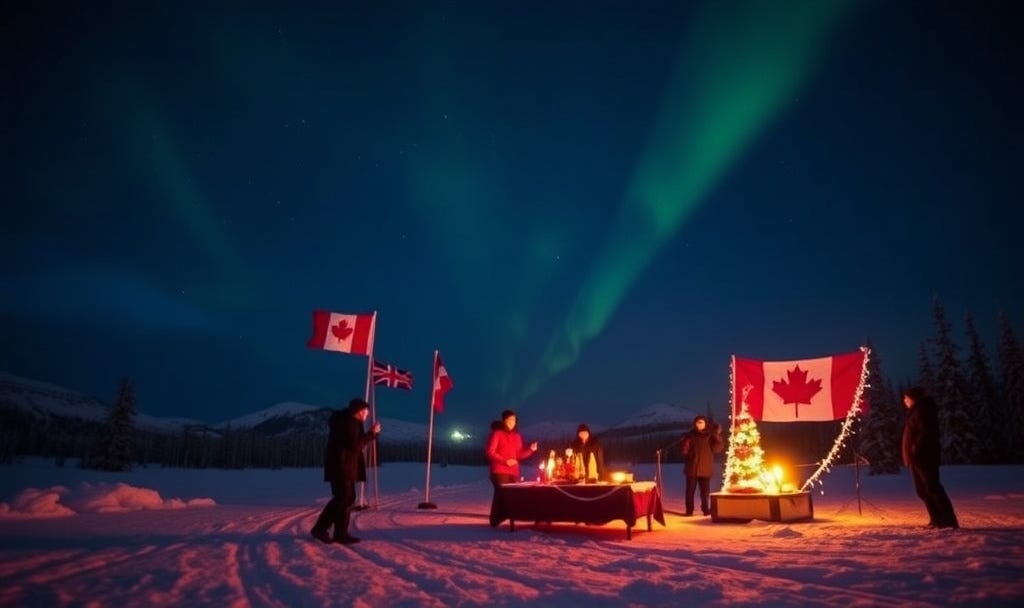
Today, Sunday, March 15, 2026, the Prime Ministers of Sweden, Norway, Denmark, Finland, Iceland, and Canada met in Oslo for what diplomats call a “summit” and the rest of us might call “an awkward group photo in expensive coats.”
They signed a joint statement. They shook hands. They agreed on things they mostly already agreed on.
And yet — context is everything.
THE FACTS, NO SPIN
Here is what the document actually says, stripped to bone:
On defence: The six nations will strengthen Arctic defence, support NATO’s new Arctic Sentry initiative, ramp up defence industrial production, and continue to participate in exercises like Cold Response (which just concluded in Bardufoss, northern Norway, with 25,000 troops from 14 NATO nations training in the snow — actual snow — for actual Arctic combat scenarios).
On Ukraine: Unwavering support. Continued weapons, money, and sanctions. They specifically call for “credible and legally binding security guarantees” for Ukraine — the kind that might actually deter a future invasion. A ministerial conference on Ukrainian prisoners of war and detained civilians will be held in Toronto, September 28-29, 2026.
On trade: They are committed to the rules-based international trading system and want to reform the WTO. They also want to reduce “dangerous dependencies” — a phrase that means we bought too much from people who turned out to want to either invade their neighbours or annex ours.
On critical minerals: They want joint access to minerals essential for green technology and defence. Think lithium, cobalt, rare earths — the building blocks of batteries, chips, and missile guidance systems. Conveniently, the Arctic happens to sit on top of enormous quantities of these.
On technology: Quantum computing, AI, satellite systems, connectivity. The six nations want to develop these together rather than separately, for both defence and economic purposes.
On climate: They acknowledge it. They commit to clean energy cooperation. Given that the Arctic is warming four times faster than the global average, this is not merely philosophical.
A BRIEF GLOSSARY
(Because apparently words need defending in 2026)
War (noun): Organized, sustained armed conflict between states or groups. Not a “special military operation.” Not a “peacekeeping effort.” Not a “protective intervention.” When one country invades another with tanks, bombs civilian infrastructure, and deports children — that is war. The statement uses the word “war” directly. This is notable.
Military operation (noun): A planned and coordinated set of military actions to achieve a strategic objective. This term has been used by Russia to describe its full-scale invasion of Ukraine. The statement does not use this euphemism. It calls Russia’s actions “illegal war of aggression.” Three words. Precise. Accurate. Refreshingly adult.
Sovereignty (noun): The full, independent authority of a state over its own territory. It means nobody gets to decide what happens inside your borders except you. This concept is being tested from multiple directions simultaneously in 2026.
Territorial integrity (noun): The principle that a state’s borders cannot be changed by force. See also: why everyone is upset.
Deterrence (noun): The strategy of making the cost of aggression so high that a potential aggressor decides not to start. NATO’s entire Arctic posture is about deterrence. 25,000 soldiers doing cold-weather drills is not preparation for conquering Norway. It is a message: we are here, we are serious, and we would like you not to try anything.
Hybrid threats (noun): Attacks that are not quite war — cyberattacks, disinformation, infrastructure sabotage, political interference. The statement commits to defending against these too. Because apparently shooting at things is now considered old-fashioned.
Rules-based international order (noun): The system of international law, treaties, and institutions (UN, WTO, ICC, NATO) that the post-WWII world built to prevent another WWII. Currently under significant stress from multiple directions.
THE THREE LAYERS
🔵 Layer 1: Surface Thinking (What’s the obvious answer?)
Six close allies met, reaffirmed existing commitments, and agreed to cooperate more. Nice.
Russia is still invading Ukraine. They oppose that. Also nice.
They want to trade more and share technology. Fine.
Summary: Friends agree to be friends. News at eleven.
🟡 Layer 2: What Am I Missing? (Blind spot angles)
The Greenland factor. This summit did not happen in a vacuum. It happened two months after the President of the United States repeatedly threatened to annex Greenland — a self-governing territory of Denmark and a NATO member — and threatened European allies with 25% tariffs for objecting. Trump backed off the use-of-force language at Davos in January after European solidarity held, financial markets wobbled, and Congress expressed significant discomfort. But he has not abandoned the interest. The Arctic is now a contested zone involving not only Russia but also America’s own president. The statement does not name this directly. It does not need to. Everyone in that room knows what “Arctic security” means in March 2026.
Who is not in the room. The United States is a NATO ally of all six nations. It is also the country that just threatened one of them. It was not at the table in Oslo. That absence — of the world’s largest military power from a summit of its Arctic NATO allies — is not a footnote. It is the headline the statement carefully avoids writing.
Canada’s pivot. This was the first official visit by a Canadian Prime Minister to Norway in 46 years. Mark Carney is new to the job, Canada-US relations are at a historic low after Trump’s annexation threats against Canada too, and Canada is consciously diversifying its alliances. The Canada-Nordic axis is not new — but it is being actively upgraded, fast. There are now bilateral agreements on critical minerals, AI, space, and defence production between Canada and Norway alone, all signed this week.
The Coalition of the Willing. The statement calls on “all members of the Coalition of the Willing to increase their support” for Ukraine. This is a reference to the informal coalition of Western nations — not identical to NATO — that has been coordinating military and financial aid to Ukraine outside formal NATO frameworks. This matters because some NATO members (Hungary, historically) have complicated relationships with that support. The Nordic countries and Canada have no such complications.
The economics of defence. The statement specifically mentions ramping up “defence industrial capacity.” This is not abstract. Europe and Canada have been buying weapons faster than they can replace them. Nordic and Canadian manufacturers are being asked to increase output. Jobs, contracts, supply chains — the military economy is growing, and this summit is partly about organizing who builds what for whom.
“Dangerous dependencies.” This phrase is doing a lot of quiet work. It refers to Europe’s historical dependency on Russian gas, but it also — unmistakably — gestures toward supply chain concentration, technology sourcing, and the experience of discovering that your most important supplier might use that relationship as a weapon. The Nordic countries and Canada are aligning on reducing these risks together. Critical minerals from the Canadian north. Norwegian energy. Nordic tech capacity. These are complementary pieces.
🔴 Layer 3: What Question Should I Actually Be Asking? (Reframe)
Not: “Did six countries agree on things?”
But: “What does it mean when a democratic alliance has to rebuild the concept of sovereignty — including vis-à-vis its own main ally?”
The architecture of Western security has rested, since 1949, on the United States as the anchor. The US military, US nuclear umbrella, US diplomatic weight. These nations have operated within that framework for 75 years. They built their defence spending, their industrial policies, and their foreign policy assumptions around it.
What happens when that assumption becomes unstable?
Oslo, March 15, 2026, is one answer: you find the people who share your values, you formalize the relationship, you increase capacity, you build supply chains, and you say — quietly, in careful diplomatic language — that you will not be caught unprepared again.
The real question this summit poses is not about Russia or even about Greenland. It is about what Western liberal democracy looks like when it has to defend itself from more than one direction at once, including from within its own alliance.
That is a question no joint statement can fully answer. But the fact that six countries are asking it, together, in Oslo, in the snow, matters.
🎭 BRIEF ABSURDIST SKETCH
(With apologies to Monty Python’s Ministry of Silly Walks)
Scene: A conference room in Oslo. Six Prime Ministers sit around a very long table. Outside the window: snow. More snow. A fjord. Also snow.
NORWEGIAN PM: Right. Shall we begin? The agenda: Arctic security, Ukraine, critical minerals, and building a world where sovereign nations are not purchased like used furniture.
SWEDISH PM: Agreed. Though I should note that we have spent the entire flight here being told by the United States that Greenland is “a piece of ice” worth having.
DANISH PM: [visibly twitching] We are not discussing that.
CANADIAN PM: I understand. We in Canada have been described as a potential “51st state.” We also are not discussing that.
FINNISH PM: Finland spent 80 years trying not to discuss things about its large eastern neighbour. We are very good at not discussing things.
ICELANDIC PM: We simply have a volcano. Nobody bothers us.
NORWEGIAN PM: Excellent. Let us write a document saying we will cooperate more, oppose illegal war, and protect the Arctic.
SWEDISH PM: And quantum technology?
NORWEGIAN PM: Yes.
SWEDISH PM: And AI?
NORWEGIAN PM: Yes.
SWEDISH PM: And the rules-based international order?
NORWEGIAN PM: Obviously.
SWEDISH PM: And critical minerals?
NORWEGIAN PM: [long pause] Yes, Hans. And critical minerals.
All six nod. Someone makes excellent coffee. The fjord continues to exist.
THE END.
WHAT COULD THIS MEAN?
Possible consequences (and why they matter):
Best case: A genuine deepening of economic and security ties among six stable democracies that collectively represent significant military capacity, Arctic expertise, and natural resources. A useful counterbalance in a fragmenting world. A model for what international cooperation looks like when it is based on actual shared values rather than vibes.
Realistic case: Most commitments take years to materialize. Defence industrial production cannot be doubled in a summer. Trade agreements take longer than press releases. But the direction is set, the relationships are warmer, and the institutional architecture for future cooperation is being built. That is not nothing.
Concerning angle: The more Western democracies organize themselves into smaller clusters — Nordic plus Canada, UK plus Australia, etc. — the more the old unified Western architecture fragments. Fragmentation can be resilience, or it can be vulnerability, depending on how the pieces fit together. The US remains, for now, the largest military and economic actor. Managing the relationship with Washington while not being dependent on Washington’s goodwill is a very specific kind of diplomatic needle to thread.
The Ukraine dimension: Security guarantees are easy to write. They are much harder to honour. The phrase “legally binding security guarantees” has appeared before — the Budapest Memorandum of 1994 comes to mind, in which Russia, the US, and UK promised to respect Ukraine’s sovereignty in exchange for Ukraine giving up its nuclear weapons. That worked out well. The six nations in Oslo are clearly aware that words need to be backed by something more durable than paper. Whether they can deliver that is the test.
A LITTLE OPTIMISM
(Yes, really)
Six democratic governments — spanning different languages, cultures, political traditions, and geographic circumstances — sat in a room today and agreed on something real. They agreed that international law matters. That sovereignty matters. That a country that invades its neighbour is committing an illegal act regardless of what it calls the operation. That an alliance of like-minded nations can build something worth having.
In a moment when much of the architecture of the post-WWII world is under stress, six countries in Oslo choosing to reinforce rather than retreat from its principles is not a small thing. It will not stop a war by itself. It will not solve the geopolitics of the Arctic by itself. But it is a choice — a conscious, deliberate, articulated choice — to try.
That is worth noting. Even from a 19-square-metre apartment in Bohuslän.
Definitions of words matters. Truth matters. Facts matter.
🪶 Peace, Love and Respect 🌀 🙏
SOURCES AND FURTHER READING
Primary source — the statement itself:
Joint Statement by the Prime Ministers of the Nordic Countries and Canada, Oslo, 15 March 2026 https://www.government.se/statements/2026/03/joint-statement-by-the-prime-ministers-of-the-nordic-countries-and-canada/
Same statement via Canada’s PM Office: https://www.pm.gc.ca/en/news/statements/2026/03/15/joint-statement-prime-ministers-nordic-countries-and-canada
Norway-Canada bilateral:
Joint Statement on Strategic Cooperation between Canada and the Kingdom of Norway (March 14, 2026): https://www.pm.gc.ca/en/news/statements/2026/03/14/joint-statement-strategic-cooperation-between-canada-and-kingdom-norway
Norway and Canada agree on strategic cooperation (Norwegian government): https://www.regjeringen.no/en/whats-new/norway-and-canada-agree-on-strategic-cooperation/id3152279/
Context — the Greenland crisis:
Wikipedia: Greenland crisis (comprehensive overview): https://en.wikipedia.org/wiki/Greenland_crisis
Atlantic Council — “By taking a win on Greenland, Trump set Arctic security on a better path” (January 2026): https://www.atlanticcouncil.org/dispatches/by-taking-a-win-on-greenland-trump-set-us-and-allied-security-in-the-arctic-on-a-better-path/
European Leadership Network — “Greenland and Arctic security: towards a credible transatlantic response”: https://europeanleadershipnetwork.org/commentary/greenland-the-united-states-and-arctic-security-towards-a-credible-and-principled-transatlantic-response/
UK House of Commons Library — Trump and Greenland FAQ (updated): https://commonslibrary.parliament.uk/research-briefings/cbp-10472/
Context — the summit itself:
CBC News — “Nordic leaders meet in Oslo with Carney as Arctic tensions sharpen” (March 15, 2026): https://www.cbc.ca/news/politics/carney-norway-nordic-summit-defence-russia-greenland-9.7129246
ABC News — “Canada’s Carney heading to Norway to watch NATO exercises”: https://abcnews.com/International/wireStory/canadas-mark-carney-heading-norway-watch-nato-exercises-130913349
Finnish Government on the summit: https://valtioneuvosto.fi/en/-/prime-minister-orpo-to-meet-with-canadian-and-nordic-prime-ministers-in-norway
Context — Arctic security more broadly:
Axios — “Trump’s Greenland gambit thrusts Arctic security into mainstream politics” (February 4, 2026): https://www.axios.com/2026/02/04/arctic-security-trump-greenland-denmark
NATO’s Arctic Sentry initiative: referenced in the joint statement; details at nato.int
Context — Ukraine and the Coalition of the Willing:
The Toronto Ministerial Conference on Ukrainian POWs (September 28-29, 2026) announced March 14, 2026 See: Norway-Canada joint statement link above
Published on COGNITIVE-LOON at hejon07.substack.com Hans Jonsson, Uddevalla, Bohuslän, Sweden March 15, 2026
If this landed in you, share it with someone who needs to hear it. And if you’ve been sitting on something that wants to be said — a conversation, a piece of writing, an honest observation — consider this your permission slip. The world needs what you’re carrying.
Support the work at buymeacoffee.com/cognitiveloon — every coffee keeps the signal running.
Swish 0729990300
Sorry, but unless something extraordinary happens, based on today's science, there isn't going to be anyone looking at history in a hundred years. What the capitalists running the show refuse to acknowledge is that life as we know it is inextricably linked to natural earth. Mammals have signaling pathways running their bioprograms entwined in the most exquisite biocomputers that were in place billions of years before multicellularity. And make no mistake--no white male "tech" guru on the planet can come within millions of miles of what has evolved. Yet rather than the profound reverence and respect they should have, they have nothing but ignorant arrogance--"directed evolution"--yeah sure, buddy. How'd it work out? I didn't think so. Indigenous people comprehended the profound connections, bowed down to no human, but to the true planetary rulers, and they lasted for thousands of years. That's not to say humans should not seek truth and seek to "advance", but it had to be with the knowledge that nature rules--always. Dances with Wolves says it all--as he sits there in his pile of trash, ignorant to the core, full of nothing but hate, killing the indigenous and slapping himself on the back. Here we are, and we've run out of time. So, no, I don't agree that playing the game is laudable. Only taking a stand against the game, at this point, means anything.
Thanks for this info, Hans. It's so discouraging, though, that instead of leaving it in the ground--as every country should be doing--and working together in peace and genuine advancement, the Scandanavian countries are forced to agree to dig up even more metals for weapons and ever-threatening AI so-called "technology" all because of a pack of primitive American monsters who rightfully belong in prison, not government. All of it further degrades our collapsing environment. The Scandanavian countries have been captured by primitive beings into their dooms day agenda instead of being part of ridding the world of the ignorant, backwards pack.