


The Bureau of Labor Statistics employs 2,055 people. As of October 1st, 2025, exactly one of them is still working. His name is William J. Wiatrowski. He’s the Acting Commissioner, and his job during the government shutdown is to oversee “orderly shutdown procedures.”
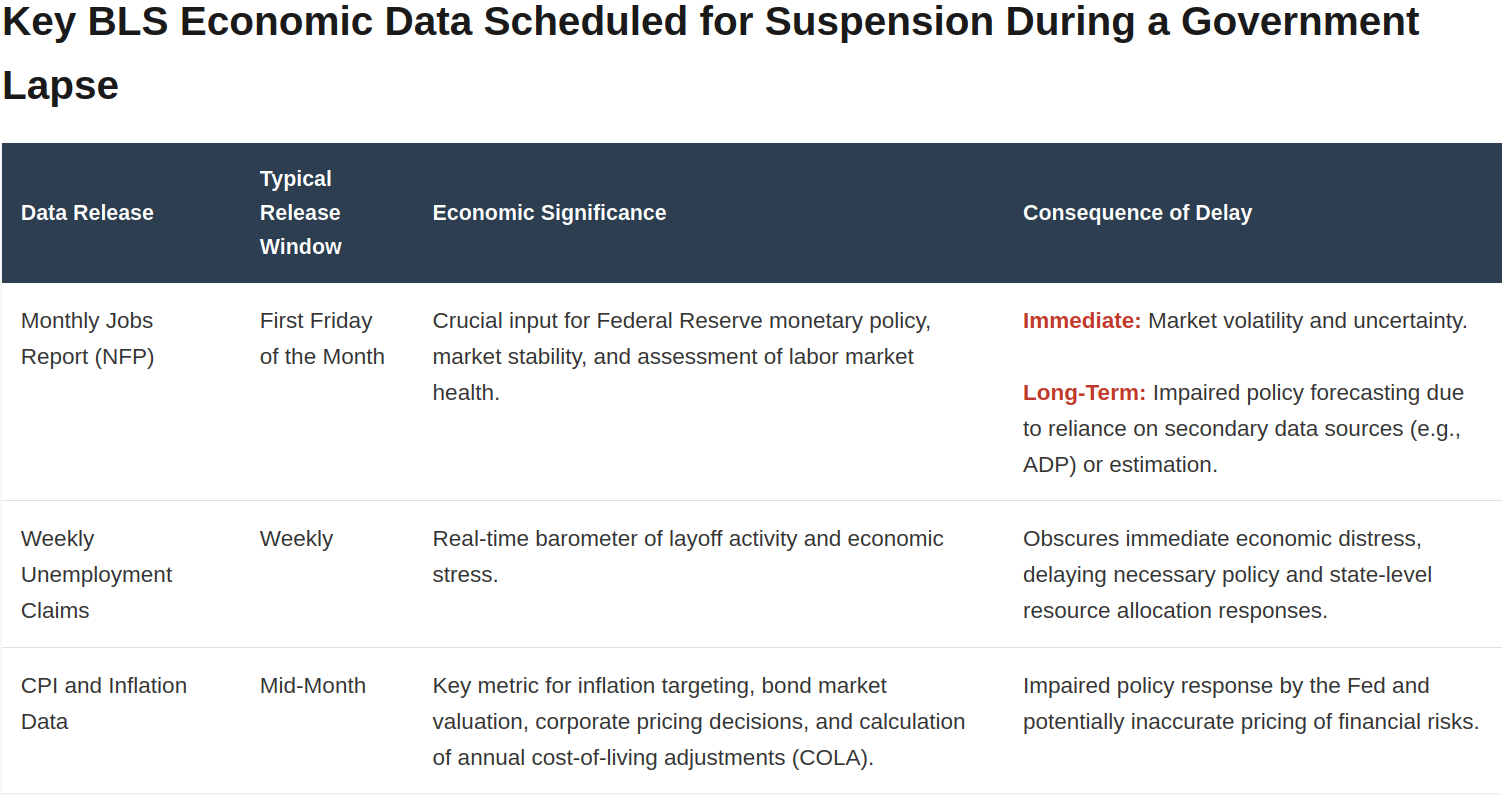
The other 2,054 people? Furloughed. All of them. The economists, the statisticians, the data collectors who call businesses every month, the people who track prices at grocery stores for the Consumer Price Index—everyone goes home. Data collection stops. The September jobs report that was supposed to come out October 3rd? Not happening. Weekly unemployment claims? Suspended. Inflation data? Delayed.
This would be unfortunate timing under any circumstances. It’s particularly interesting timing given what the September jobs report was likely to show.
The Numbers Before They Stopped Counting
August added 22,000 jobs. July added 79,000. The three-month average from June through August came to 29,000 jobs per month. For context, that’s the kind of number you see when things are going badly.
Then in September, the Bureau released something called a “benchmark revision.” They do this annually when they get more complete data. This year’s revision showed the economy had actually added 911,000 fewer jobs through March 2025 than initially reported. That’s the largest downward revision since they started tracking this in 2002. It’s more than 50 percent larger than last year’s revision, which itself was considered large.
Meanwhile, the ADP private payroll report—which tracks employment independently of the government—showed the private sector lost 32,000 jobs in September. The second negative month in recent quarters.
Challenger, Gray & Christmas, the outplacement firm that tracks seasonal hiring, projects retailers will add fewer than 500,000 positions this holiday season. That would be the lowest since 2009. You remember 2009. That was a bad year for jobs.
Target didn’t announce a seasonal hiring number this year. They hired 100,000 people last year. This year they’re “adding hours for existing employees.” Macy’s, Burlington, Aldi, and 1-800-Flowers made no announcements at all, which is unusual for late September.
Manufacturing has lost jobs for four consecutive months. The sector is down 78,000 jobs over the year.
So the September jobs report was expected to provide data on whether this represented a temporary blip or the start of something worse. We won’t be getting that data on schedule, because 2,054 people are furloughed and data collection has ceased.
The Timing Is Interesting
The Department of Labor’s 73-page contingency plan makes clear that during a funding lapse, BLS “will suspend all operations. Economic data that are scheduled to be released during the lapse will not be released. All active data collection activities for BLS surveys will cease.”
This happens automatically under the Antideficiency Act. When funding lapses, the agency must shut down. It’s not a choice—it’s a legal requirement.
But when the funding lapses is somewhat more discretionary.
The last time BLS shut down was October 2013, which delayed the September 2013 jobs report by 18 days and the October report by a week. Notably, the 2018-2019 shutdown—though 35 days long and the longest in U.S. history—didn’t affect BLS at all, because Congress had pre-funded the Department of Labor before that shutdown began.
This time, Congress did not pre-fund the Department of Labor.
Meanwhile, In Other Budget News
The White House is building a ballroom. It’s going to be 90,000 square feet and hold 900 people and cost somewhere between $200 million and $250 million. The President has called it “his gift to the country” and his “major White House legacy.”
The ballroom is being funded through the Trust for the National Mall, a nonprofit, which means corporate donors can write off their contributions as charitable gifts. Among the confirmed donors:
Lockheed Martin: $10 million or more
Google, Booz Allen Hamilton, Palantir: undisclosed amounts
R.J. Reynolds (tobacco) and NextEra Energy (utilities): undisclosed amounts
Stephen Schwarzman, CEO of Blackstone Group: undisclosed amount
Lockheed Martin’s statement affirmed their “gratitude for the opportunity to help bring the President’s vision to reality.”
There’s been discussion of etching donor names into the stone of the White House itself. Transforming a space for state diplomacy into what one might call a permanent monument to financial patronage.
The construction continues during the shutdown. The economic data collection does not.
The Commissioner Question
On August 7th, 2025, President Trump fired BLS Commissioner Erika McEntarfer, shortly after the release of the disappointing July jobs report and the benchmark revision showing 911,000 fewer jobs than reported. The administration stated through SBA Chief Counsel Casey B. Mulligan: “It is about time bureaucrats are held accountable for quality results.”
The idea, apparently, is that the Commissioner personally produces the jobs numbers and can be fired for producing bad ones. Career statisticians and economists have suggested this represents a “fundamental misunderstanding of government statistical operations,” which is an extremely polite way of saying something.
On September 30th—the same day the shutdown began—Trump withdrew his replacement nominee, E.J. Antoni, without explanation. The White House promised to announce a new nominee “very soon.”
So we enter the shutdown with an Acting Commissioner overseeing the orderly suspension of operations at an agency that just had its leader fired for releasing data the administration didn’t like, with no permanent replacement named.
Former Commissioner McEntarfer made her first public comments on September 16th: “I think we are all concerned now about the future of our country’s economic data. I can vouch for the accuracy and independence of the work of the agency up until the moment I was fired.”
The “up until the moment” is doing a lot of work in that sentence.
What Happens To The Data
The September jobs report will eventually be released. Based on 2013, it might come out late October if the shutdown lasts two weeks. Longer shutdowns mean longer delays.
But there’s another problem. The BLS contingency plan warns that the “cessation of active data collection” creates “a reduction in quality of data collected” that “might impact the quality of future estimates produced.”
The Current Employment Statistics survey collects data from 122,000 businesses during the pay period encompassing the 12th of each month. The Consumer Price Index requires continuous price monitoring throughout the reference month. When collection stops, that primary data is lost. You can’t go back and recollect it later.
When the data eventually comes out, it will rely more heavily on statistical imputation—estimation techniques—and historical modeling. It will be less reliable.
Which creates an interesting political opportunity: any future negative reports can be dismissed as products of the “corrupted” post-shutdown data collection process. The strategy evolves from delay to permanent statistical obfuscation.
The Federal Reserve’s Data Problem
The Fed meets October 28-29 to decide on interest rates. They typically rely heavily on the September jobs report and early October unemployment claims data. They won’t have either.
Boston Fed President Susan Collins said recently: “I see some increased risk that labor demand may fall significantly short of supply, leading to a more meaningful and unwelcome increase in the unemployment rate.”
She’ll be making that assessment without the data that would confirm or refute it.
Royal Bank of Canada economist Mike Reid noted that “an increasingly data-dependent Federal Reserve with limited visibility into the September data increases the probability of an October pause.” Markets had been pricing in rate cuts. They may not get them.
During the 2013 shutdown, the Fed relied more heavily on private indicators like ADP, business surveys, and anecdotal reports. These alternatives are less comprehensive and reliable than BLS statistics. But they’re what you use when the government stops counting.
The Official Explanations
White House Press Secretary Karoline Leavitt characterized the Republican continuing resolution as “a common sense, clean funding resolution” that “simply keeps the government funded at the exact same levels as today, just adjusted for inflation,” adding “there is zero good reason for Democrats to vote against this.”
The impasse actually centers on Democratic demands to extend enhanced Affordable Care Act subsidies expiring December 31st and reverse approximately $1 trillion in Medicaid cuts from July’s “One Big Beautiful Bill Act.” The subsidies benefit roughly 22-24 million Americans. Without extension, premiums are expected to increase 75 percent on average.
President Trump stated September 30th: “We’re not shutting it down. We don’t want it to shut down because we have the greatest period of time ever.” He also suggested that “because of the shutdown, we can do things medically and other ways, including benefits. We can cut large numbers of people.”
Senate Majority Leader John Thune: “I think what’s changed is, President Trump is in the White House. That’s what this is about, this is politics.”
House Speaker Mike Johnson described Democrats as “pursuing a very reckless strategy right now.”
Everyone agrees the other side is being unreasonable.
The Reduction In Force Memo
On September 24th, OMB issued an unusual directive telling agencies to prepare “reduction in force” plans beyond traditional furloughs. The memo stated: “With respect to those Federal programs whose funding would lapse and which are otherwise unfunded, such programs are no longer statutorily required to be carried out. RIF notices will be in addition to any furlough notices provided due to the lapse in appropriation.”
This is different from normal shutdown procedure. Usually, workers are temporarily furloughed with the expectation of eventual back pay, which has been guaranteed under the Government Employee Fair Treatment Act of 2019. The RIF language suggests potential permanent layoffs.
The scope and implementation remain unclear. William J. Wiatrowski, the one remaining BLS employee, may be able to clarify once everyone else comes back.
A Small Note On Historical Precedent
During the early days of the COVID-19 pandemic in March 2020, the President publicly opposed allowing the Grand Princess cruise ship to dock, explaining: “I don’t need to have the numbers double because of one ship that wasn’t our fault.”
The concern was not the sick passengers. The concern was the count.
This established a precedent: if a number is politically detrimental, the primary goal is preventing it from entering the official tally.
The current situation follows the same logic with more sophistication. You don’t need to order anyone not to release data. You just need to ensure the legal mechanism that automatically suspends data collection activates at the politically opportune moment.
The shutdown transforms from policy failure to policy tool.
What This Costs
The Congressional Budget Office estimated the 2013 shutdown cost the economy approximately $3 billion and reduced Q4 GDP growth by 0.3 percentage points. Standard & Poor’s estimated $24 billion and 0.6 percent of annualized quarterly GDP.
For 2025, each week typically costs 0.1-0.2 percentage points of GDP growth.
But the bigger cost is informational. The Federal Reserve operates with incomplete intelligence. Markets price risk with limited data. Businesses make hiring decisions without clear signals. State governments allocate resources without unemployment figures.
Everyone flies blind together, running the economy on vibes and ADP estimates.
The Optimistic Reading
Look, here’s the thing: eventually the shutdown ends. Eventually the data comes out. Eventually we learn what September’s jobs numbers actually were. The BLS statisticians return to work, data collection resumes, and reports get published.
The numbers don’t disappear just because you stop counting them for a while. Economic reality continues regardless of whether we measure it.
And there’s something almost refreshing about the transparency of the current moment. No one’s really pretending this is about fiscal responsibility or spending levels. The shutdown is explicitly tied to health care policy disputes. The timing relative to data releases is simply what it is.
You can draw your own conclusions about whether that timing represents mere coincidence or calculated strategy. Adults can disagree about these interpretations.
Meanwhile, 2,054 statisticians are at home not collecting data about an economy that continues operating whether we measure it or not. William J. Wiatrowski sits alone in a shutdown agency overseeing orderly procedures. And somewhere, work continues on a 90,000-square-foot ballroom that may feature the names of its donors etched in stone.
The architecture of opacity isn’t subtle anymore. It’s just architecture.
Eventually, the lights come back on. We’ll see what the numbers say then.
All figures in this piece are sourced from Department of Labor contingency plans, BLS releases, ADP reports, Congressional Budget Office analyses, White House statements, and news reports from September-October 2025. The dry humor is my own contribution to the discourse, free of charge.
It reminds me of... what’s it called... meritocra-crazy or whatever.
What was it?
Release the numerophiles.
Release the “Mike Johnson” “Grindr” “files”
Release the Epstein files.
Or
Release the “Truth” files.
//Peace and Love very big numbers. But only in gold font.
Government shutdown halts critical economic data releases
Is the Constitution the Enemy Within? (And Other Questions Nobody’s Asking at Quantico)

This is how to escalate things. Or wait—no one exercises anymore. Let me rephrase: This is how to exercise critical thinking. (See? Different word. Important distinction.)
Sourcing
1 url:
https://www.washingtonpost.com/business/2025/09/29/shutdown-delay-jobs-data-bls/2 url:
https://tradingeconomics.com/united-states/non-farm-payrolls8 url:
https://en.wikipedia.org/wiki/White_House_State_Ballroom15 url:
https://www.theguardian.com/us-news/2025/aug/07/trump-white-house-ballroom16 url:
12 url:
https://adpemploymentreport.com/
3 url:
9 url:
https://www.cbsnews.com/news/trump-white-house-ballroom-donor-names/10 url:
https://newrepublic.com/post/200713/donald-trump-offering-people-donate-ballroom13 url:
https://time.com/7308973/danger-trump-undercutting-bls/4 url:
https://cossa.org/trump-fires-bls-commissioner-after-accusing-her-of-falsifying-data/5 url:
https://www.epi.org/policywatch/firing-bls-commissioner-erika-mcentarfer/
Cited Works
Government shutdown would prevent key jobs data from being released, hämtad oktober 1, 2025, https://www.washingtonpost.com/business/2025/09/29/shutdown-delay-jobs-data-bls/
United States Non Farm Payrolls - Trading Economics, hämtad oktober 1, 2025, https://tradingeconomics.com/united-states/non-farm-payrolls
Seasonal hiring could be at its lowest since 2009 - YouTube, hämtad oktober 1, 2025,
Trump Fires BLS Commissioner After Accusing Her of Falsifying Data | COSSA, hämtad oktober 1, 2025, https://cossa.org/trump-fires-bls-commissioner-after-accusing-her-of-falsifying-data/
Firing BLS Commissioner Erika McEntarfer - Economic Policy Institute, hämtad oktober 1, 2025, https://www.epi.org/policywatch/firing-bls-commissioner-erika-mcentarfer/
‘I like the numbers being where they are’: Trump remarks on Grand Princess passengers – video - The Guardian, hämtad oktober 1, 2025, https://www.theguardian.com/us-news/video/2020/mar/07/i-like-the-numbers-being-where-they-are-trump-video
Donald Trump says he would prefer Grand Princess cruise ship passengers stay on ship, hämtad oktober 1, 2025,
White House State Ballroom - Wikipedia, hämtad oktober 1, 2025, https://en.wikipedia.org/wiki/White_House_State_Ballroom
Who’s paying for the White House ballroom and what’s in it for them - CBS News, hämtad oktober 1, 2025, https://www.cbsnews.com/news/trump-white-house-ballroom-donor-names/
Here’s What Trump’s Offering People Who Help Fund His New Ballroom, hämtad oktober 1, 2025, https://newrepublic.com/post/200713/donald-trump-offering-people-donate-ballroom
Shutdown May Delay 2026 Social Security COLA Announcement - 401k Specialist, hämtad oktober 1, 2025, https://401kspecialistmag.com/government-shutdown-could-sidetrack-2026-social-security-cola-announcement/
ADP® Employment Report, hämtad oktober 1, 2025,
https://adpemploymentreport.com/
The Historic Danger of Trump Undercutting the BLS - Time Magazine, hämtad oktober 1, 2025, https://time.com/7308973/danger-trump-undercutting-bls/
Trump’s Trade War Squeezes Middle-Class Manufacturing Employment, hämtad oktober 1, 2025, https://www.americanprogress.org/article/trumps-trade-war-squeezes-middle-class-manufacturing-employment/
‘Trump is a wrecking ball’: behind the president’s $200m plan to build a White House ballroom - The Guardian, hämtad oktober 1, 2025, https://www.theguardian.com/us-news/2025/aug/07/trump-white-house-ballroom
How Trump has transformed the Oval Office with gold - YouTube, hämtad oktober 1, 2025,