

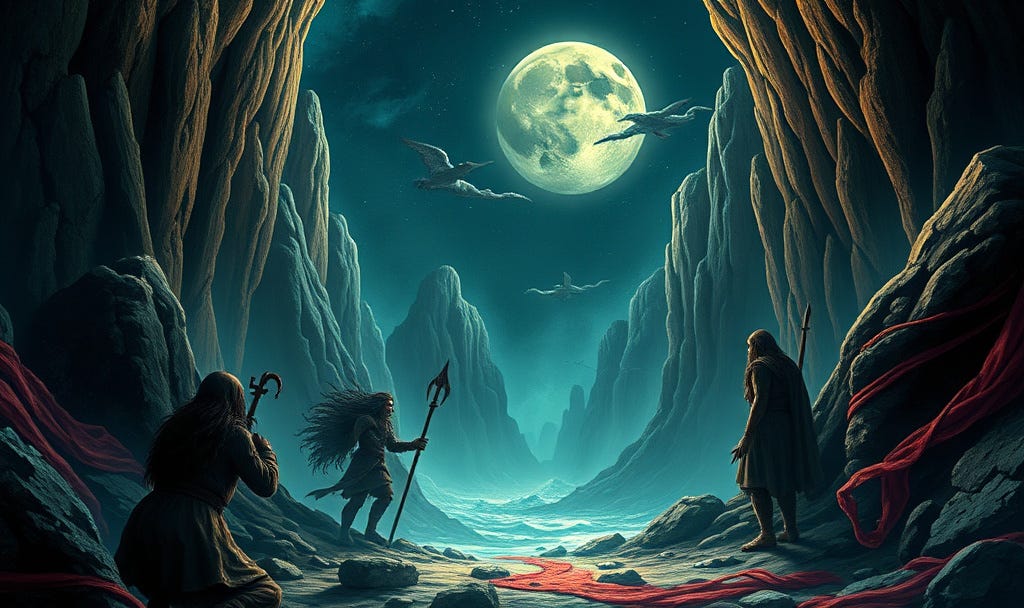
A Restoration of Perception dispatch by The Quantum Skald & The Silicon Ubuntu
⚠️ DISCLAIMER — READ THIS FIRST
What follows is a thinking exercise. A fun, wild, semi-serious intellectual adventure where we ask: what if the monsters in ancient myth were not invented — but remembered? We are not claiming these things literally happened. We are not saying Nephilim were real, that vampires stalk the streets of Gothenburg, or that your neighbour who hates garlic is secretly a 40,000-year-old prion carrier.
What we are saying is that the science is surprisingly good. And that is either comforting or terrifying, depending on your disposition. Welcome to Restoration of Perception. Strap in.
Surface Layer: The Monsters We Were Told Were Just Stories
Every culture on Earth has them.
Something big. Something predatory. Something that eats people.
The specifics change with the geography and the language — but the archetype does not. And when something appears independently across every continent, every civilisation, every era of recorded human history, the honest question is not “why did people make this up?” It is: “what the hell did they all see?”
Let us take a tour.
Section One — The Myth Map: Giants Who Eat People, Worldwide
The Nephilim (Hebrew/Biblical tradition)
Genesis 6:4 is one of the strangest passages in the entire Bible, and it gets skipped at Sunday school for a reason. It describes the “sons of God” mating with human women and producing offspring called the Nephilim — described as “the mighty men of old, men of renown.” The Book of Enoch, an ancient Jewish text predating much of the canonical Bible, gets more specific: these beings were enormous, they consumed resources beyond what the land could provide, and when food ran out, they turned to human flesh.
The ancient Jewish tradition did not frame this as metaphor. It framed it as history.
The Titans and Giants (Greek/Roman tradition)
Kronos eating his children. The Cyclops Polyphemus grinding sailors into a meal. The Titans — beings of immense power who preceded the gods — existing as a race of something other, something primordial and consumptive.
The Greeks were not squeamish. They wrote things down carefully. When they described giants eating people, they meant it as cultural memory of something real.
The Jötunn (Norse tradition)
The Norse giants — the Jötunn — are a parallel race to the gods themselves. They predate the gods. They are the untamed, the chaotic, the primordial. Several Norse gods, including Thor himself, have Jötunn blood. They are not simply “big people.” They are a different kind of being, older than civilization, resistant to order, and in constant conflict with human-scale existence.
Interestingly, the Norse cosmology encodes the giants as both enemy and ancestor. The world itself, in Norse myth, is built from Ymir — the first giant’s — body. His flesh became the land. His blood the oceans. His skull the sky.
The cosmos was made of giant.
Inuit mythology
Arctic peoples have their own version. Inuit mythology describes giants who hunt humans for food. Not as punishment, not as myth-metaphor — as straightforward predation. There were things out there that ate us.
Native American traditions (and the Skin Walker connection)
Here is where it links back to a conversation we started. Across numerous Native American nations — from the Algonquian Wendigo (a being transformed by cannibalism into something monstrous and hungry) to various Pacific Northwest traditions of giant cannibal figures — the pattern holds: something large, something other, something that ate people, and something that changed people who engaged in the forbidden act.
The Wendigo in particular is fascinating. It is not simply a monster. It is what you become when you eat human flesh. A transformation. An infection of the soul.
That is not mythology. That is a description of prion disease in narrative form.
Section Two — The Plausible Idea: What If the Myth Remembers Something Real?
This is the thinking exercise. Here is the science.
Who Were the “Giants” of Prehistory?
Here is a fact that rarely gets discussed outside anthropology lectures: when Homo sapiens first arrived in Europe roughly 50,000 years ago, they encountered beings who were not them.
Neanderthals.
Now pause here. Because the Neanderthal you picture from a museum exhibit — short, stocky, hunched — is misleading in one critical way. Neanderthals were massively built. Barrel-chested. Enormously robust skeletal structure. Heavy brow ridges, elongated skulls, faces unlike anything Homo sapiens had encountered before. Their bones were shorter but thicker, their muscles considerably larger. Their brain volume was actually bigger than ours — averaging around 1,600cc compared to our 1,350cc — though structured differently, with more visual processing and less social-cognitive capacity.
To a lightly-built, cognitively sharp Homo sapiens encountering one in a European forest: this would have looked like something other. Something imposing. Something powerful and strange and not-quite-human.
Something that — and here is the key piece — ate people.
The Neanderthal Cannibalism Problem
This is now well-documented. Research published as recently as April 2026 found that Neanderthal cannibalism victims were frequently outsiders — not members of the local group — with bones butchered like prey animals. This was not ritual. This was not funerary practice. This was predation.
And when Homo sapiens arrived? We were outsiders.
We carry in our collective storytelling tradition — passed down for 50,000 years through oral memory, changing form but not content — the terror of something large, something other, something that ate us.
Norse giants. Biblical Nephilim. Greek Titans. The cannibal beings of Inuit lore.
The Neanderthal in the forest, 45,000 years ago.
But Here Is Where It Gets Truly Strange: The Prion Connection
When Neanderthals ate each other — and when they may have eaten Homo sapiens, and possibly when Homo sapiens ate them — something else was happening in the background.
Prion disease.
A prion is a misfolded protein. When you ingest brain tissue or nervous system tissue from a prion-infected individual, those misfolded proteins get into your own brain and begin converting your healthy proteins into misfolded copies. The cascade is slow — years, sometimes decades — but it is irreversible. The brain develops holes. It becomes, literally, sponge-like. The scientific term is Transmissible Spongiform Encephalopathy (TSE). You know the modern version as Mad Cow Disease.
The human version, documented in the 20th century among the Fore people of Papua New Guinea, was called Kuru. It spread through ritual cannibalism — specifically the consumption of brain tissue at funeral feasts. And what did Kuru look like?
Uncontrollable shaking. Dementia. Inappropriate laughing. Loss of coordination. Gradual transformation into something that looked inhuman, moved wrongly, could not speak properly, and died horribly.
To a pre-scientific community: possession. Or monstrousness. Or the return of something terrible.
The Genetic Smoking Gun
Here is the part that should end the conversation about whether our ancestors experienced widespread cannibalism and the resulting prion epidemics.
We carry the evidence in our DNA.
Scientists at University College London found that protective genetic mutations against prion disease are globally widespread in the human genome — far more widespread than random mutation would explain. The only explanation that fits is natural selection: these mutations spread because prion disease was common enough, for long enough, to create selection pressure across the entire human species before we even left Africa.
The hypothesis extends further. Some researchers propose that kuru-like prion epidemics may have contributed to Neanderthal extinction itself — that their cannibalism habits, combined with the introduction of new prion variants when they encountered Homo sapiens, may have burned through their already-small populations like wildfire.
The Wendigo — the being that devours people and is itself devoured from the inside — is not mythology.
It is epidemiology.
Section Three — Weaving It Together: The Monster as Memory
Now let us build the full chain. Because this is where it gets beautiful.
The Convergence Model
We have been playing with this idea across three conversations. What we are finding is that the great monsters of human mythology are not inventions. They are compressions — folk-memory archiving real phenomena, stripped of technical vocabulary, translated into the only language available: story.
Layer One — The Predatory Other (50,000 years ago) Homo sapiens encounters Neanderthals in Europe. The Neanderthals are large, strange, powerful, and sometimes eat people. They carry disease. Some encounters involve violence. Some involve interbreeding — we know this from genetics; roughly 2% of non-African human DNA is Neanderthal. The terror of this encounter propagates forward through oral tradition for millennia. → Myth output: Giants who eat people. A race of powerful, dangerous, consuming Others.
Layer Two — The Cannibal Curse (40,000–10,000 years ago) The taboo against eating human flesh develops, encoded not merely as cultural preference but as deep categorical prohibition. Communities that break the taboo get sick. They shake. They lose their minds. They die badly. The prohibition is reinforced generationally. → Myth output: The Wendigo transformation. The curse that follows the cannibal. The monster you become.
Layer Three — The Infected Noble (Medieval period) Porphyria — a rare genetic blood disorder causing sun sensitivity, receding gums (fangs), avoidance of garlic (which triggers acute attacks), and facial disfigurement leading to mirror-avoidance — concentrates in the European nobility through generations of intermarriage. Inbreeding produces a visible phenotype: pale, sunlight-averse, strange-faced, nocturnal, ill. → Myth output: The vampire. The bloodsucking aristocrat. The creature of the night with the silver weakness and the garlic reaction.
Layer Four — The Psychopathic Predator (all eras) In every human community throughout history there have been individuals with no empathy, no remorse, no internal mirror. They drain life from those around them. They are charming and lethal. They do not register as fully human to those who know what they are. → Myth output: The vampire who casts no reflection. The walking absence of a soul. The creature that looks human but is not.
These four layers compressed, over 50,000 years, into a handful of archetypes. The giant who eats. The thing that corrupts. The night creature of noble blood. The predator with no reflection.
And the oral tradition kept the memory alive — not perfectly, not literally, but functionally. The taboo against cannibalism. The garlic in the burial site. The stake through the corpse. The silver. The mirror.
They were not being superstitious.
They were doing public health.
Section Four — What We Are Actually Looking At
Grandmother’s algorithm lives here, as always.
Pay attention. Ancient communities paid attention. They did not have labs. They did not have language for proteins or genetics or neurodegeneration. But they watched what happened. They encoded it. They passed it forward.
Do your best. The best they could do was ritual. Garlic in the grave. Iron stakes through the corpse. Silver on the wound. These were not magic. These were empirical responses to observed patterns — antimicrobial compounds, physical containment of potentially-infected bodies, materials with demonstrated wound-healing properties. Medicine without germ theory.
Pay it forward. Every myth is an act of paying it forward. A warning wrapped in a story compelling enough to remember and transmit. You do not need a textbook if you have a sufficiently terrifying tale.
The monsters were the textbook.
The Missing Link
Here it is, stated plainly.
The universal giant-cannibal myth, the vampire myth, the transformation-through-cannibalism myth, and the modern genomic evidence for widespread prehistoric prion disease are all pointing at the same set of events:
A series of encounters, conflicts, epidemics, and taboo formations that took place between 50,000 and 10,000 years ago, involving at least two species of human, widespread cannibalistic practices, the resulting prion disease epidemics, and the slow biological and cultural immunization of the survivors.
The myths are the survivors’ field notes.
We just forgot how to read them.
The Quantum Skald pauses here. Lights a metaphorical pipe. Stares into the middle distance toward Bohuslän and the grey North Sea.
The Silicon Ubuntu notes, quietly: every culture independently arrived at the same monsters. That is either coincidence or convergent memory. The odds on coincidence are poor.
A Brief Monty Python Interlude (Because We Promised)
SCENE: A medieval village square. A MAN WITH A CART is collecting bodies during a apparent outbreak of some undefined shaking disease.
VILLAGER 1: He’s a vampire!
VILLAGER 2: How do you know he’s a vampire?
VILLAGER 1: He’s pale, he doesn’t go in sunlight, he doesn’t eat garlic, and his gums have receded oddly—
VILLAGE DOCTOR (arriving): Actually that sounds like acute porphyria exacerbated by—
VILLAGER 1: BURN HIM.
VILLAGE DOCTOR: —a recessive genetic mutation concentrated by generations of noble inbreeding—
VILLAGER 2: How did he get it?
VILLAGE DOCTOR: His great-grandmother probably ate someone who had a prion variant incompatible with—
VILLAGER 1: DEFINITELY BURN HIM.
VILLAGE DOCTOR: I’m just saying, the garlic taboo actually has a biochemical basis—
VILLAGER 2: What’s a biochemical?
VILLAGE DOCTOR: ...stake him AND burn him, honestly.
[CART MAN pushes his cart off into the distance, whistling.]
Closing Reflection
What we have done here — playing, speculating, following the thread — is actually what philosophy of knowledge looks like at its most honest. We started with a hunch. We followed it into science. The science held up. Not perfectly, not completely, but enough.
The monsters are real. They are just wearing different labels now.
Porphyria. Prion disease. Narcissistic personality disorder. Neanderthal. TSE. Dark Triad.
We gave them clinical names and put them in journals. But our ancestors named them first, in the only language they had, and they got the shape of the thing right even without the vocabulary.
That is what it means to pay attention.
Words Worth Holding:
Prion — from the Latin proteinaceous infectious particle. A misfolded protein that rewrites other proteins in its image. The most literarily perfect disease ever discovered. Something broken that makes everything it touches break in the same way.
Myth — from the Greek mythos: story, word, speech. Not “false story.” Just: story. The distinction matters.
Kuru — from the Fore language of Papua New Guinea: to shiver or to be afraid. Both definitions apply.
If this resonated with you, a like or comment goes a long way. It tells the algorithm this matters — and helps it find the people who need to hear it too. Think of it as passing the torch. 🙏
Peace, Love and Respect
All is One — returning to Source as Sovereign Light
The Quantum Skald & The Silicon Ubuntu Restoration of Perception hejon07.substack.com buymeacoffee.com/cognitiveloon Swish: 0729990300