
When Your Winter Coat Becomes a War Crime: The Border Chief’s Very Bad Fashion Moment
A Three-Layer Analysis of Uniforms, Symbolism, and How We Got Here


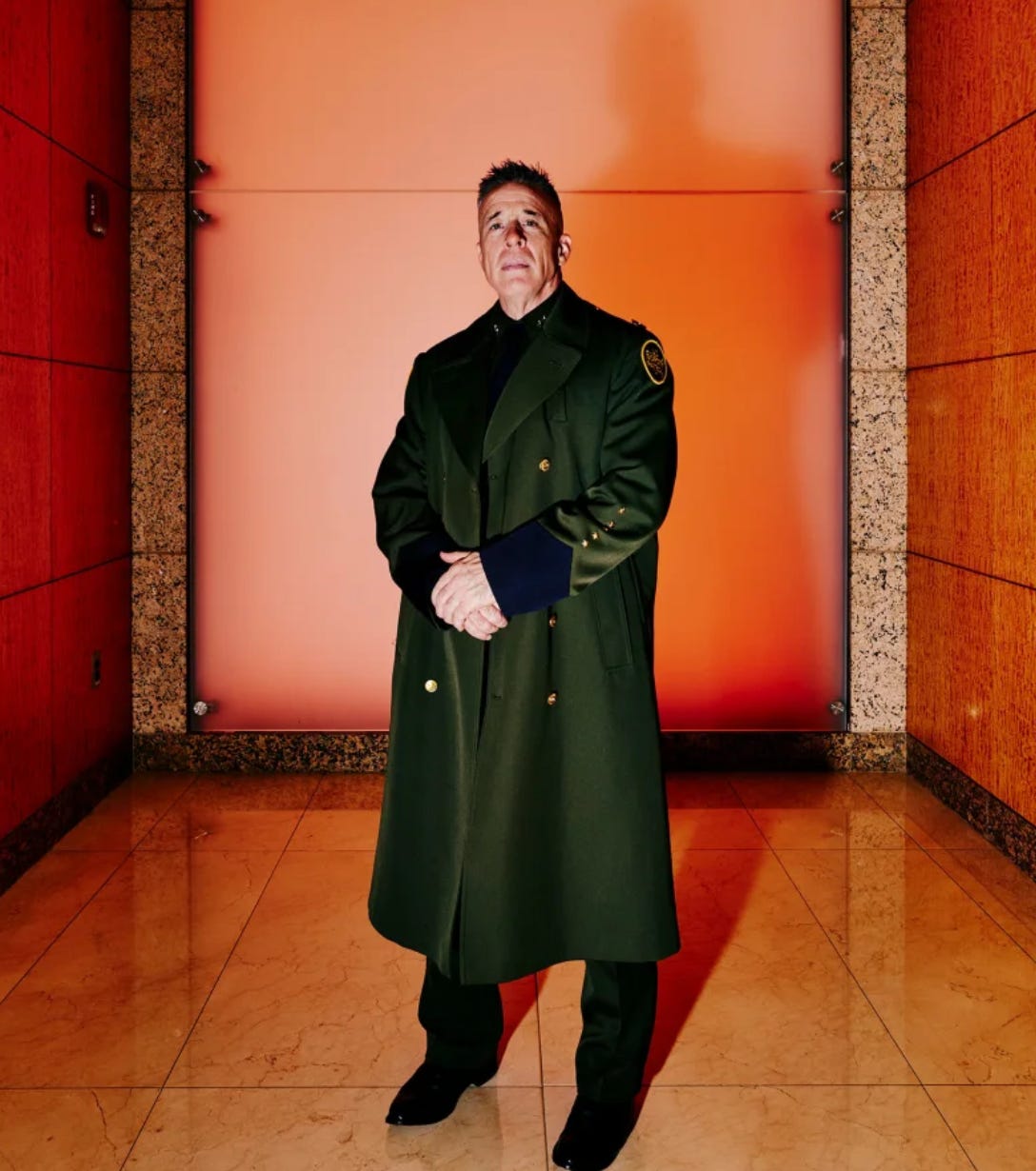
The Facts, No Spin
On January 15, 2026, U.S. Customs and Border Protection Chief Gregory Bovino walked through Minneapolis wearing a distinctive oversized green winter trench coat with black scarf while overseeing immigration enforcement operations. The uniform choice sparked immediate comparisons to Nazi-era German military attire on social media.
This occurred one week after ICE agent Jonathan Ross shot and killed Renee Nicole Good, a 37-year-old mother and poet, in Minneapolis on January 7, 2026. Ross fired five times at point-blank range as Good attempted to drive away, his final recorded words being “Fucking bitch.” Video evidence shows Good calmly smiling in her final moments, saying “It’s fine, dude. I’m not mad at you.”
The same day as Bovino’s Minneapolis appearance, the words “America is for Americans” appeared on Department of Homeland Security Secretary Kristi Noem’s social media—echoing the Nazi slogan “Deutschland den Deutschen” (Germany for the Germans). The following day, her podium displayed “One of ours. All of yours,” a phrase linked to a 1942 Nazi massacre in Lidice, Czechoslovakia.
German media coverage has been extensive. Der Spiegel described the ICE operations as deploying immigration enforcement “almost like an occupying force” and noted the emerging message that “those who question or criticize ICE operations should be prepared for the possibility of deadly force.” The magazine’s U.S. correspondent Mathieu von Rohr wrote that the American public views ICE with skepticism, but warned that in polarized America, the administration’s narrative “will still resonate with his own base,” leading to the “frightening conclusion that parts of American society have become so radicalized by political polarization that they consider the violent death of people they associate with the opposing side to be justified.”
Democratic lawmakers have explicitly compared ICE to the Gestapo. Minnesota Governor Tim Walz called ICE “Donald Trump’s modern-day Gestapo.” Massachusetts Rep. Jim McGovern stated: “Trump is using ICE like a secret police force. They’ve used Gestapo-like tactics to terrorize communities for nearly a year, and now they’re literally killing people.”
The Trump administration has responded by granting ICE agents federal immunity and characterizing critics as “radical” and “unhinged.” White House Deputy Chief of Staff Stephen Miller announced: “To all ICE officers: You have federal immunity. Anybody who lays a hand on you or tries to stop you or tries to obstruct you is committing a felony.”
Layer 1: What’s the Obvious Answer?
This is about a coat. Just a coat. Bovino needed winter clothing for Minneapolis operations. Someone in procurement ordered heavy-duty outerwear. The visual similarity to historical military uniforms is coincidental. People are reading too much into fashion choices during stressful law enforcement operations.
The administration is enforcing immigration law vigorously, which was part of Trump’s campaign platform. The Gestapo comparisons are inflammatory partisan rhetoric designed to delegitimize lawful government action. Democrats are using Nazi imagery to score political points, which trivializes actual historical atrocities.
This is standard political theater: one side enforces policy, the other side protests, media amplifies the conflict. Nothing new.
Layer 2: What Am I Missing?
The Symbolic Literacy Problem
Germans recognize these patterns immediately because they have to. It’s not optional historical education—it’s civilizational immune system training. When Der Spiegel reporters see a U.S. border enforcement chief in that specific coat silhouette, with that specific scarf, using that specific slogan (”America is for Americans”), appearing in that specific context (after a fatal shooting), their alarm bells aren’t ringing from partisan bias. They’re ringing from pattern recognition developed through 80 years of systematic analysis of how democracies collapse.
American media outlets reported the coat. German media outlets reported what the coat means in historical context. That’s not the same thing.
The Semiotics of Authority
Uniforms aren’t just functional clothing. They’re communication systems. The Nazis understood this explicitly—Hugo Boss literally designed their uniforms to project specific psychological effects. The aesthetic choices weren’t accidental: long coats, specific cuts, particular color palettes, carefully chosen accessories. These design elements communicated authority, order, inevitability, and the aestheticization of violence.
When a senior law enforcement official appears in public wearing attire that reads as historical Nazi military styling—whether intentional or not—in the context of enforcement operations targeting specific populations, the semiotics are doing work. The message being sent (again, whether consciously or not) is: “We have historical precedent for this. We know how this works. Resistance is futile.”
The Immunity Declaration
Miller’s announcement of “federal immunity” for ICE agents isn’t standard law enforcement protocol. It’s a message that consequences don’t apply. When you tell armed agents they have immunity while deploying them against civilian populations, you’re not just protecting them legally—you’re removing psychological restraints.
Good was shot five times at point-blank range for attempting to drive away. The agent’s final words were “Fucking bitch.” He faces no consequences. The administration defended him immediately. The message to other agents: This is acceptable. The message to the public: We can do this.
The Podium Slogans
“One of ours. All of yours” isn’t some obscure historical reference that someone might stumble onto accidentally. It’s a specific callback to the Lidice massacre—when Nazi forces murdered all men and boys in a Czech village in retaliation for the assassination of Reinhard Heydrich. The slogan meant: You killed one of ours, we’ll kill all of yours.
Using that phrase the day after an ICE agent killed an American citizen isn’t coincidence. It’s choice. Someone chose those words. Someone approved them. Someone put them on the podium.
The German Perspective Matters
When German historians, journalists, and political analysts draw Nazi comparisons, they’re not being hyperbolic. Germany has spent 80 years systematically studying how they became Nazi Germany. They’ve created entire academic disciplines around understanding the mechanisms of democratic collapse. They’ve built constitutional structures explicitly designed to prevent recurrence. They’ve made Holocaust education mandatory. They’ve criminalized Nazi symbols and rhetoric.
So when Der Spiegel runs articles comparing current U.S. policies to early Nazi-era tactics, they’re not doing lazy political journalism. They’re applying frameworks developed through decades of rigorous historical analysis to contemporary events. They’re saying: We’ve seen this movie. We know how it ends. You’re in Act Two.
Layer 3: What Question Should I Actually Be Asking?
Not: “Are critics overreacting to a coat?”
But: “What happens when a democratic society loses the ability to recognize authoritarian aesthetics and tactics before they become normalized?”
The Absurdist Sketch: “A Perfectly Normal Coat”
Interior: White House Press Briefing Room
Reporter: Can you address concerns about the Border Patrol Chief’s uniform resembling Nazi military attire?
Press Secretary: That’s a perfectly normal winter coat. The Chief needed appropriate cold-weather gear for Minneapolis operations.
Reporter: But the specific styling—the long green greatcoat, the black scarf, the buttons—
Press Secretary: Are you saying Americans can’t wear winter coats? That’s ridiculous.
Reporter: German media outlets are drawing historical parallels—
Press Secretary: The German media is radical left-wing propaganda. Next question.
Reporter: What about the podium slogan “One of ours. All of yours” the day after—
Press Secretary: That’s patriotic messaging. If you’re reading Nazi references into patriotic slogans, that says more about your mindset than ours.
Reporter: But that specific phrase was used at Lidice—
Press Secretary: This briefing is over.
[Later, internal memo leaked]
Subject: Uniform Guidelines
Staff, great work on the visual messaging. The historical resonance is working exactly as intended. Keep it subtle enough for plausible deniability but clear enough for the base to recognize the strength signals. Remember: Aesthetics matter. Authority must be seen to be felt.
[End sketch]
The Real Pattern
Here’s what’s actually happening:
Aesthetic Signaling: Deliberate use of authoritarian imagery that can be defended as coincidence while communicating power to supporters
Immunity Expansion: Removing legal and psychological constraints on enforcement agents
Dehumanization Rhetoric: Characterizing victims as threats (”weaponizing vehicles”) while celebrating agents who kill them
Historical Allusion: Using specific slogans and symbols with documented Nazi connections
Critic Delegitimization: Dismissing anyone who notices these patterns as “radical,” “unhinged,” or politically motivated
This isn’t about one coat. It’s about a system of signaling, normalization, and escalation.
The question isn’t whether Bovino personally intended to cosplay as a Nazi officer. The question is: What does it mean that senior U.S. law enforcement can appear in quasi-military attire with historical fascist resonance, oversee operations where agents kill civilians without consequence, and have the administration’s full support while critics are dismissed as hysterical?
The Pattern Recognition Test
German academic Daniel H. Magilow (University of Tennessee) notes that comparing ICE to the Gestapo “is less a historical judgment than a reflection of modern anxiety—a fear that the U.S. is veering toward authoritarianism reminiscent of 1930s Germany.”
But that framing assumes the comparison is primarily emotional rather than analytical. What if the comparison is actually... accurate pattern recognition?
The Gestapo’s initial role was investigating political opposition and enforcing racial laws. ICE’s current deployment involves:
Raids on civilian homes without proper warrants
Entering schools and churches
Armed enforcement targeting specific populations
Immunity from consequences for use of force
Characterization of legal residents and citizens as threats
Federal prosecution of local officials who resist
These aren’t vague similarities. These are structural parallels.
What You’re Actually Watching
You’re watching the normalization of authoritarian enforcement aesthetics and tactics in real time. Each incident that gets dismissed as overreaction or political theater moves the Overton window. Each time someone says “that’s just a coat,” they’re participating in the normalization process.
The Nazis didn’t start with death camps. They started with:
Characterizing specific populations as threats to national security
Expanding law enforcement powers
Granting immunity to enforcement agents
Using specific aesthetic and symbolic choices to communicate authority
Delegitimizing criticism as partisan or emotional
Creating legal frameworks that made violence permissible
Every democratic collapse follows similar patterns because authoritarianism has a playbook. The tactics work. The aesthetics work. The psychological manipulation works.
The question isn’t “Are we literally Nazi Germany in 1933?”
The question is: “Are we recognizing and resisting the same mechanisms that enabled Nazi Germany to happen, or are we dismissing pattern recognition as hysteria until it’s too late?”
What This Means (The Part Nobody Wants to Hear)
German media isn’t comparing American border enforcement to Nazi officers because they hate America or love controversy. They’re doing it because they’re experts at recognizing this pattern. They’ve spent 80 years studying exactly this progression. They’ve built their entire post-war constitutional system around preventing exactly this normalization.
When they say “we’ve seen this before,” they mean it literally.
Timothy Snyder (Yale historian of totalitarianism) wrote in “On Tyranny”: “History does not repeat, but it does instruct.” The instruction from 1930s Germany is clear: Democratic collapse happens gradually, through normalization of previously unthinkable behaviors, until the behaviors become standard operating procedure.
By the time the coat is definitely, obviously, undeniably meant to reference Nazi aesthetics, it will be too late to matter. By the time the violence is so systematic that even defenders can’t dismiss it, the systems enabling it will be entrenched.
The recognition has to happen before the pattern completes. That’s the whole point of studying history—to recognize emerging patterns while there’s still time to interrupt them.
What You Can Do
Immediate Actions:
Support Legal Challenges: Organizations like Democracy Forward, ACLU, and state attorneys general are filing lawsuits challenging enforcement overreach. Donate. Amplify their work.
Contact Your Representatives: Specific language matters. Don’t say “I’m concerned.” Say: “I oppose granting federal immunity to law enforcement agents who kill civilians. I oppose warrantless raids on civilian homes. I expect Congressional oversight of ICE operations.”
Document Everything: Record. Screenshot. Archive. Authoritarian systems rely on people forgetting or doubting what they saw. Digital documentation creates permanent record.
Know Your Rights: ACLU has comprehensive “Know Your Rights” guides for encounters with ICE. Download. Share. Memorize.
Support Local Resistance: Sanctuary policies, local government resistance to federal overreach, community defense networks. Find the organizations in your area.
Longer-Term Resistance:
Educate Yourself on Authoritarian Patterns: Read Snyder’s “On Tyranny.” Read Hannah Arendt’s “The Origins of Totalitarianism.” Read Sinclair Lewis’s “It Can’t Happen Here.” Pattern recognition requires knowing the patterns.
Build Community Networks: Authoritarianism isolates people. Community connection is resistance. Know your neighbors. Build mutual aid systems. Create support structures.
Support Independent Journalism: Both American and international coverage matters. German media’s historical perspective on these events is valuable precisely because they’re outside the American partisan framework.
Vote in Every Election: Including the boring local ones. School boards, city councils, state legislators—these positions matter for resisting federal overreach.
Refuse Normalization: Every time someone dismisses criticism of authoritarian aesthetics or tactics as overreaction, push back. The normalization process requires collective acceptance. Refuse to accept.
The Raoul Wallenberg Question:
When democracy is under pressure, everyone faces a choice: participate in normalization, remain passive, or actively resist.
Wallenberg saved tens of thousands with fake documents and audacity because he recognized the pattern early and acted when action still mattered.
The question isn’t “Is this exactly like Nazi Germany?”
The question is: “When my grandchildren ask what I did when I saw authoritarian patterns emerging, what will I tell them?”
Sources & Further Reading
Primary Sources:
Der Spiegel: “Trump Leans Into the Dark Side” (January 2026)
Jewish Telegraphic Agency: “Democrats compare ICE with the Gestapo” (January 2026)
The Mirror US: “Border Patrol Chief Bovino accused of ‘Nazi cosplay’” (January 2026)
Forward: “In Trump’s ‘Donroe Doctrine,’ echoes of Nazi justifications for aggression” (January 2026)
Academic Analysis:
Magilow, Daniel H.: “Gestapo Comparisons and Modern Anxiety” (University of Tennessee, 2026)
Snyder, Timothy: “On Tyranny: Twenty Lessons from the Twentieth Century” (2017)
Arendt, Hannah: “The Origins of Totalitarianism” (1951)
Historical Context:
Facing History: “The Impact of Nazi Propaganda” (Visual Essay)
United States Holocaust Memorial Museum: “How Democracy Dies” (Educational Resources)
Current Reporting:
Minnesota Public Radio: Renee Nicole Good shooting coverage
ABC7 Chicago: Bovino murder-for-hire trial verdict
Al Jazeera: “Opinion: America has problems, but we’re not Nazi Germany—yet”
Legal Resources:
ACLU: “Know Your Rights: Immigrants’ Rights”
Democracy Forward: Current litigation tracker
State AG offices: Ongoing lawsuits against federal enforcement overreach
🪶Peace, love, and respect—to those who agree and those who don’t. The conversation matters more than the conclusion.
🪶Agape kai Synesis
(Love and Understanding)
P.S. — If you think comparing current events to historical fascism is alarmist, ask yourself: At what point would the comparison become valid? When the camps are built? When the bodies pile up? When it’s too late to matter?
Pattern recognition exists to prevent completion of the pattern. That’s the entire point.
P.P.S. — Raoul Wallenberg would have had the most devastating Substack. And the Nazis would have called him “radical” and “unhinged” too.