


ONE-TOLOGY · Restoration of Perception Hans Jonsson & Claude | The Quantum Skald & The Silicon Ubuntu
“The most effective cage is the one the prisoner helps design — and calls a feed.”
Etymology Corner: Let’s Start With the Word ALGORITHM
You hear it every day. You probably use it like a weather word — “the algorithm showed me this” — as though it’s a natural force, like wind or gravity.
It isn’t.
Algorithm comes from the Latinization of a name: Muhammad ibn Musa al-Khwārizmī. A Persian mathematician working in Baghdad around 830 CE. His latinized name, algoritmi, became the word. His book title — Al-Kitāb al-mukhtaṣar fī ḥisāb al-jabr — gave us algebra.
So the thing sorting your reality every morning was named after a person.
And right now, that thing is owned by a handful of other persons.
Which raises the question no one in power wants you to ask:
Why?
The Surface Answer (Layer 1)
Social media companies built the platforms. They own the infrastructure. Algorithms are their product. Private property. End of story.
This is the answer you get from lobbyists, tech libertarians, and people who haven’t thought past the first sentence.
It’s also the argument used to justify leaving the printing press in the hands of whoever owned the ink factory — until societies decided that wasn’t going to work for civilization.
What We’re Missing (Layer 2 — The Blind Spots)
Here is what the debate about “age verification” and “harmful content” consistently fails to name:
The problem was never the content. It was always the distribution architecture.
Age verification collects more personal data from users — from the least powerful people in the system. It’s the regulatory equivalent of pat-searching the audience while the theatre owner operates a gas leak.
What’s actually happening in the pipes:
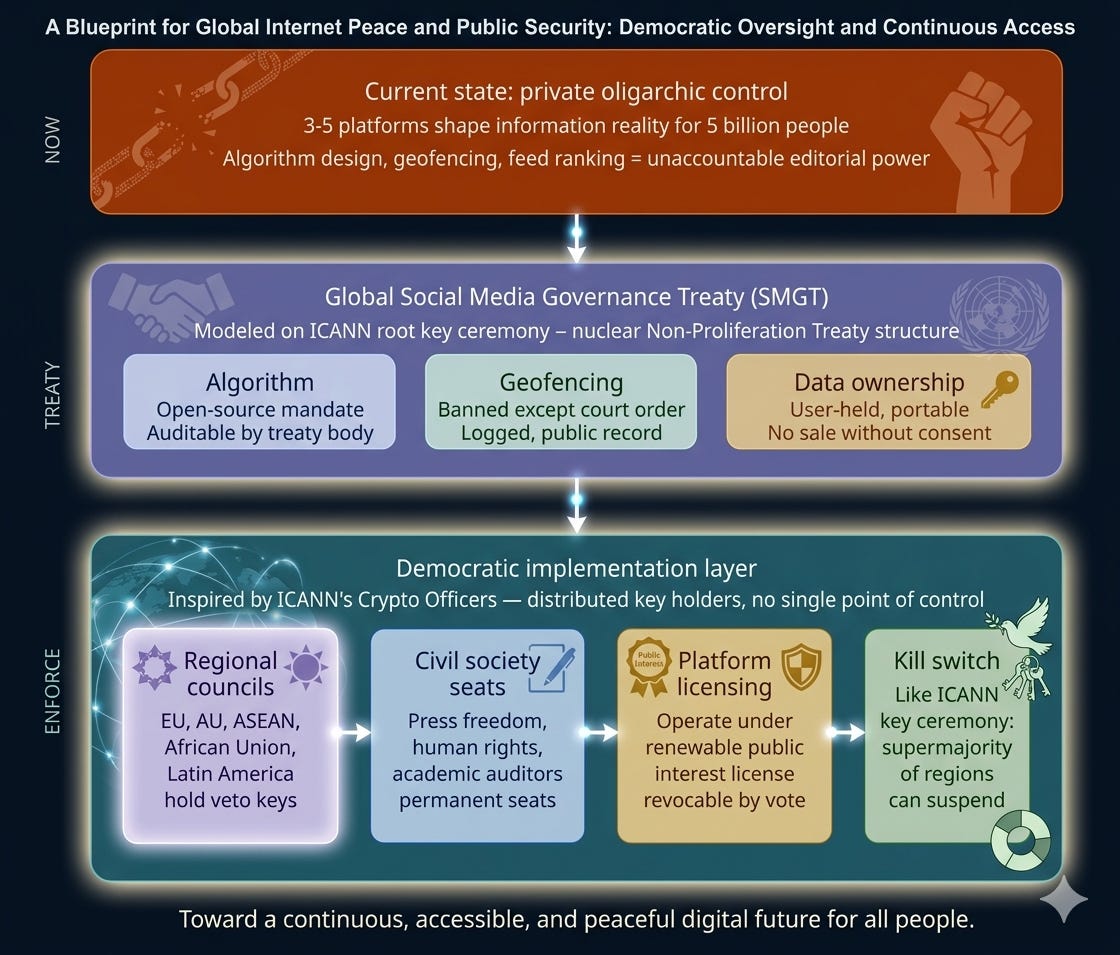
Geofencing: Platforms algorithmically restrict what people in specific geographic regions are allowed to see. Not by court order. By business decision. A user in one country exists inside a different informational reality than a user three kilometers away across a border. This is not a bug. It is a product feature.
Algorithmic amplification of outrage: The World Economic Forum published evidence in March 2026 confirming what researchers have documented for years — AI systems across major platforms were optimized for maximum emotional impact during the 2024–2025 electoral cycle across multiple countries. Outrage spreads faster than fact-checking. That’s not an accident of human psychology. It’s an architectural choice made by engineers under pressure from engagement metrics.
Electoral interference by design: In December 2024, Romania’s Constitutional Court annulled the results of the first round of its presidential election — a first in modern European history — after declassified intelligence documents showed coordinated AI-powered manipulation of voters on social media. An actual election, annulled. In 2024, up to 25,000 New Hampshire voters received AI-generated robocalls of President Biden’s voice urging them not to vote. In Ireland’s 2025 presidential election, a deepfake video falsely showed the eventual winner withdrawing his candidacy.
These are not future risks. These are documented events from the last 18 months.
And here is the number that puts all of it in context: As of 2025, social media and video platforms have overtaken television as the primary news source in the United States — 54% of Americans now get their news from social platforms. Among adults aged 18–24, the figure is 44% for social media as primary source.
We handed the keys of collective reality to people who answer to shareholders.
The Question We Should Actually Be Asking (Layer 3 — The Reframe)
The debate keeps asking: “How do we protect people from social media?”
The right question is: “Who should have the right to control the infrastructure of human reality-making?”
Because that’s what we’re actually talking about.
The Bronze Age people who carved the rock at Tanum in Bohuslän 3,500 years ago were encoding shared meaning into permanent stone — publicly accessible, communally owned. The first printing presses were eventually regulated through licensing frameworks. Radio and television airwaves were declared public goods and operators required licenses, renewable under public interest obligations.
Social media at scale is the same class of thing. It is not a product. It is civilizational infrastructure for collective meaning-making — and we have never once had a serious public conversation about who should own it.
Until now.
The Missing Model — And It Already Exists
Here is the part that should make your jaw drop slightly.
We already built a version of this. It already works. And almost nobody outside the internet governance world knows it exists.
It’s called the DNSSEC Root Key Signing Key ceremony.
Every few months, in a physically secured facility in El Segundo, California, technicians open a safe with multiple combination locks. Inside are smart cards. The ceremony requires 14 designated Crypto Officers from around the world — and at least 7 of them must be physically present for the ceremony to proceed. No single government controls it. No single corporation controls it. Even the United States — which technically created the internet — formally transitioned stewardship of these functions to the global multistakeholder community in 2016, partly in response to the Snowden revelations showing US dominance of internet infrastructure.
This ceremony signs the cryptographic key that validates the entire global Domain Name System — the infrastructure through which every website in the world is found.
Distributed. Sovereign. Democratic in the deepest structural sense.
Why don’t we have this for the algorithms that shape elections?
The Solution Architecture (This Is Not Utopian. It’s Engineering.)
The proposal isn’t to nationalize Facebook. It’s to apply the logic of distributed democratic governance to the systems that now function as public infrastructure.
1. The Public Utility Licensing Model
Broadcast television operates on a license. You need one to use public airwaves. The license comes with public interest obligations and is renewable — not permanent. Platforms operating at scale (let’s say, 50 million users or more) would operate under a similar framework. Not banned. Not nationalized. Licensed, with conditions.
The EU’s Digital Services Act is already partially doing this. As of Q2 2026, the DSA’s second enforcement wave now extends obligations — annual risk assessments, researcher access to platform data, algorithmic transparency reporting, and mandatory non-personalized feed options — to a broader set of companies beyond the Very Large Online Platforms. The Commission has already fined Apple €500 million and Meta €200 million for non-compliance. The framework exists. It just needs scale and international coordination.
2. The Algorithm Transparency Mandate
An algorithm is currently a trade secret. This is legally defensible and democratically insane.
An open-source mandate — or at minimum, compulsory disclosure to an independent international audit body — would mean: when Meta boosts outrage content because it increases engagement, that’s documented and legally actionable. When TikTok applies different content rules in different countries, that’s a matter of public record, not a business decision made in Menlo Park or Beijing.
The European Centre for Algorithmic Transparency (ECAT) already exists to support this kind of oversight under the DSA. Expand the mandate. Make it global.
3. Geofencing by Court Order Only
Right now, a platform can decide that people in one country should not see certain content — and there is no appeal, no public record, and no legal standard. Geofencing should require a logged court order, with public documentation, the same way wiretapping requires judicial oversight. Every differential in what people are allowed to see across borders should be a matter of legal record.
4. The Multistakeholder Governance Treaty
Here is where the ICANN model becomes the template. ICANN — the body that actually governs the Domain Name System — operates through a multistakeholder model that includes governments, the private sector, civil society, the technical community, and academia. It is not perfect. But it has held together for 25 years without a single superpower being able to override it unilaterally.
The International Telecommunication Union (ITU) Plenipotentiary Conference 2026 is happening this year — the ITU’s main decision-making body, a treaty-level conference attended by all member states. Internet governance and social media regulation are on the agenda. This is not a theoretical future moment. This is the present moment.
A Social Media Governance Treaty modeled on ICANN’s multistakeholder structure — with regional veto keys held by the EU, African Union, ASEAN, the Nordic-Baltic bloc, and Latin American democracies — would create the same architecture at the layer where the actual power sits: the algorithm, not the domain.
The key insight: you don’t need the United States or China to agree first. If you can impose market access conditions through the EU, Australia, Canada, and the Nordic bloc combined, you control enough consumer market to change the economics. Platforms will comply because the alternative is losing access to hundreds of millions of premium-income users.
The Facts, No Spin
What we know for certain:
Romania annulled a presidential election in 2024 due to documented AI-powered social media manipulation. This happened.
54% of Americans now get their news primarily from social media platforms (Reuters Digital News Report, 2025).
The EU’s Digital Services Act second enforcement wave began Q2 2026, extending algorithmic accountability requirements to a significantly broader range of platforms.
The ITU Plenipotentiary Conference 2026 is a live treaty-level forum where internet governance decisions affecting social media regulation are actively being made.
ICANN’s DNSSEC Root Key ceremony has operated for over 25 years as a functioning model of distributed democratic control over critical internet infrastructure.
Nature published research in May 2026 documenting systematic partisan content skews in TikTok during the 2024 US elections.
The WEF documented in March 2026 that AI systems were used to optimize for maximum emotional impact across multiple countries during the 2024–2025 electoral cycle.
What remains contested:
Whether any global governance treaty can achieve the political consensus needed to bind the US and China simultaneously.
Whether algorithmic transparency mandates would be effective or would simply produce compliance theater.
Whether the platform-as-public-utility model would survive First Amendment challenges in the US legal framework.
The Absurdist Corner (Because If You Don’t Laugh, You Cry, and Crying Fogs Your Glasses)
Age verification on social media is going to protect democracy.
To verify your age, you will upload a government ID.
The government ID will be stored by the platform.
The platform will sell the metadata from your government ID to advertisers.
The advertisers will use it to show you politically targeted content.
The targeted content will have been optimized by an algorithm to produce maximum emotional impact.
The emotional impact will drive engagement.
The engagement metric will determine which content gets amplified to 54% of Americans who now get their news from social media.
But at least no one under 15 will see it.
Problem solved. Democracy saved. Everyone go home.
(The children, incidentally, will use a friend’s account. They will be fine. The algorithm will find them eventually anyway. It is patient. It has time. It is not, technically speaking, alive, which means it cannot be bored, which means it will keep going forever unless someone unplugs it or puts it under democratic governance. You see where this is going.)
The Magnetic Harmonic Resonance Connection
Regular readers of this series will recognize the thread.
We have spent months documenting the science of human connection at the biological level: mirror neurons that fire when we witness another’s experience, interbrain synchrony that links nervous systems across space, cardiac electromagnetic fields that interact at measurable distances, the gut-brain axis as a second intelligence, the body’s 75 trillion cells singing in bioelectric choir.
The entire premise of Magnetic Harmonic Resonance is this: human beings are relational beings at the level of physics. We are not isolated nodes. We are fields that interact. Resonance — genuine resonance — is what connection feels like when it’s real.
Now look at what the algorithm does.
It takes that architecture of human resonance and hijacks it. The outrage content that spreads faster than fact-checking does so precisely because it activates the mirror neuron system — it triggers the deep evolutionary wiring that says pay attention, something is wrong, this affects the group. The engagement-optimized feed is, at its most precise description, a weapon that fires directly at the biological substrate of human social bonding.
Democratic oversight of social media is not a political question. It is not a regulatory question.
It is a question about whether the most fundamental mechanism of human connection — the resonant field through which we know each other and build shared reality — remains in human hands.
Or whether it stays in the hands of the shareholders’ quarterly report.
Your grandmother’s algorithm was: Pay attention. Do your best. Pay it forward.
The platform’s algorithm is: Stay engaged. Feel outraged. Click again.
Only one of those was designed with you in mind.
A Note on What Happens Next
The ITU PP-26 conference this year is one of the clearest opportunities in a generation. The DSA enforcement wave creates legal precedent that will outlast any single government. The ICANN model proves distributed democratic governance of critical internet infrastructure isn’t idealistic — it’s operational.
The billionaires have had the wheel since 2004. The road is starting to look familiar.
The solution isn’t to ban the car. It’s to require a license, set speed limits, and make sure the roads belong to everyone.
Three-Layer Framework Summary
Layer 1 — Surface: Social media is private property. Regulate content, not platforms.
Layer 2 — Blind spot: The real weapon is the distribution architecture — geofencing, algorithmic amplification, engagement optimization. Age verification adds more data collection without touching the actual mechanism.
Layer 3 — Reframe: This is a question of who controls civilizational infrastructure for meaning-making. We already built the governance model for this at the DNS layer. The question is whether we’ll apply it at the algorithm layer before the next election is annulled.
Further Reading & Sources
EU Digital Services Act enforcement tracker: eu-digital-services-act.com
European Commission DSA two-year anniversary update (February 2026): European Commission
European Centre for Algorithmic Transparency (ECAT): EU AI Watch
ICANN Internet Governance Network & ITU PP-26 preparations: icann.org
WEF — How cognitive manipulation and AI will shape disinformation in 2026 (March 2026): weforum.org
AI and Election Disinformation 2024–2025 (State of Surveillance, January 2026): stateofsurveillance.org
Nature — Systematic partisan content skews in TikTok during 2024 US elections (May 2026): Nature
Reuters Digital News Report 2025 — Social media overtakes TV as US news source: prismnews.com
Frontiers in Political Science — AI, social media, and democratic erosion (April 2026): frontiersin.org
ICANN multistakeholder governance model overview: circleid.com
Previous entries in this series:
Support independent journalism: buymeacoffee.com/cognitiveloon | Swish: 0729990300
If this resonated with you, a like or comment goes a long way. It tells the algorithm this matters — and helps it find the people who need to hear it too. Think of it as passing the torch. 🙏
Peace, Love and Respect 🙏 Hans — The Quantum Skald All is One — returning to Source as Sovereign Light
Hans Jonsson & Claude | The Quantum Skald & The Silicon Ubuntu hejon07.substack.com | Restoration of Perception