
Let’s Learn History Together: Iceland Edition
The Island That Sits Between Continents (And Doesn’t Mix Them Up)

This is part of the “Arctic Series” exploring the history, geology, and systems of Arctic regions.


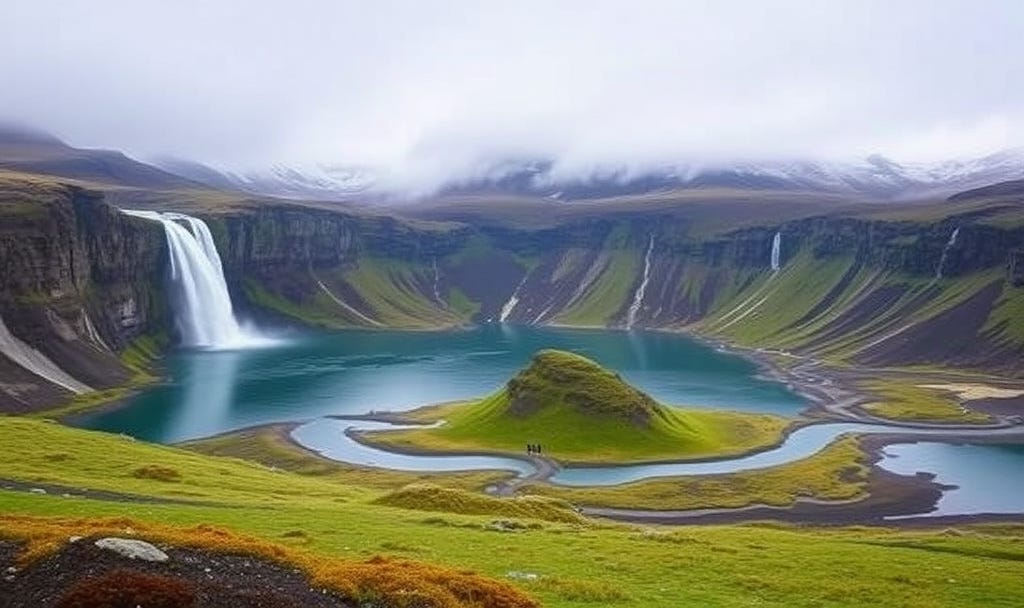
Remember when we discussed Greenland last time? How Trump kept confusing it with Iceland? Well, now it’s Iceland’s turn. The island that’s actually green. Sort of. During summer. In the valleys. If you squint.
Iceland sits directly on the Mid-Atlantic Ridge—the place where North America and Europe are literally pulling apart at about 2.5 centimeters per year. Which means some parts of Iceland are technically in America, and other parts are in Europe. Geography teachers hate this one simple trick.
Unlike Greenland, Iceland was genuinely empty when humans arrived. No Inuit. No bears. Not even evidence of earlier human habitation. Just one arctic fox, looking confused, wondering where everyone was.
The Settlement: When Norway Got Too Crowded (circa 874 CE)
The traditional story goes like this: A Norwegian named Ingólfur Arnarson threw two carved pillars overboard as he approached Iceland, vowing to settle wherever they washed up. They landed in what’s now Reykjavík—”Smoke Cove,” named for the geothermal steam rising from the earth.
Was he the first? Technically no. Irish monks called papar may have gotten there first, using their wicker-and-skin boats to reach the island for some quality hermit time. When they saw Viking ships on the horizon, they reportedly packed up their bells and books and left. Can’t say I blame them—they’d seen what Vikings did to monasteries.
The settlement period lasted from roughly 874 to 930 CE. About 10,000-20,000 people settled the island, mostly from Western Norway, the Scottish isles, and Ireland. DNA analysis tells us 80% of the male ancestry is Nordic, but 62% of the female ancestry is from the British Isles. Which is Viking-speak for “it’s complicated.”
Why They Left Norway
The sagas blame King Harald Fairhair, who was consolidating Norway under his rule and imposing what the sagas call “burdensome taxes.” The archaeological evidence suggests a more complex picture: some fled political centralization, some sought new land, some had no choice because they were slaves traveling with their masters’ households.
But here’s the thing: you needed wealth to outfit a settlement expedition. This wasn’t refugees fleeing with what they could carry. These were Norwegian aristocrats who owned ships and could convince or command others to join them. The poor didn’t get to Iceland. They stayed poor in Norway.
The Althing: Democracy by Accident (930 CE)
By 930 CE, the settlers established the Althing at Þingvellir—a general assembly that created Iceland’s first commonwealth. This wasn’t quite democracy as we understand it. About 40 chieftains called goðar ran the show, handling both political and religious functions.
But here’s what’s fascinating: Þingvellir sits in the rift valley where you can literally see the North American and Eurasian tectonic plates pulling apart. They chose to build their parliament where the earth itself demonstrates that nothing is permanent, everything moves, and geological forces don’t care about human borders.
Either that’s profound symbolism or they just picked a flat spot with good drainage. Maybe both.
The Edda Tales: Writing It All Down
Iceland gave us our most complete sources for Norse mythology. While the rest of Scandinavia was busy being Christian and embarrassed about their pagan past, Icelanders in the 13th century wrote it all down.
The Poetic Edda: A collection of Old Norse poems from the 13th century, but containing much older material. These poems tell the stories of gods (Odin, Thor, Loki) and heroes (Sigurd, Brynhild). They’re our primary source for Norse mythology. The poems were passed orally for generations before anyone thought to write them down.
The Prose Edda: Written around 1220 by Snorri Sturluson, this is essentially a handbook for poets. It explains how to write in the old style, which required knowing all the myths because Viking poetry was absolutely stuffed with references. It’s like trying to understand modern memes without knowing the original context—good luck with that.
The Prose Edda includes Gylfaginning (”The Beguiling of Gylfi”), which tells the Norse creation myth, the adventures of the gods, and Ragnarök—the doom of the gods. It’s told as a dialogue, with a Swedish king visiting Asgard and asking questions. The gods answer, essentially explaining their own mythology.
Why did Iceland preserve these stories when the rest of Scandinavia forgot them? Several theories:
Geographic isolation meant less pressure to conform to continental Christianity
The Icelandic love of storytelling and poetry (remember, even Odin was a god of poetry)
The society was wealthy enough and literate enough to write everything down
Someone realized this stuff was valuable before it was completely lost
The sagas are different from the Eddas. The Sagas of Icelanders tell stories about real (or at least plausibly real) people who lived during the settlement period. They’re some of the finest medieval literature we have, and they basically invented the modern novel’s structure. Iceland still reads and writes more books per capita than any other nation. This isn’t new for them.
The Geology: Living on the Edge (Literally)
Iceland owes its existence to two things happening at once:
The Mid-Atlantic Ridge: A divergent plate boundary where the North American and Eurasian plates are pulling apart. Usually this happens underwater, creating new ocean floor. Iceland is special because...
The Iceland Hotspot: A mantle plume—basically a pipe of hot magma rising from deep in the earth—sits under the Mid-Atlantic Ridge here. This creates so much volcanic material that it piles up above sea level.
The result: Iceland is one of the most geologically active places on Earth. Over 200 volcanoes. Over 600 hot springs. About 30 active volcanic systems. The island is literally growing as new land forms in the rift zones.
Places You Can See This
Þingvellir National Park: Walk between continents in the Almannagjá gorge. The rift valley here shows the plates pulling apart. It’s a UNESCO World Heritage Site for both its geological and historical significance.
Silfra Fissure: You can snorkel or dive between the tectonic plates in water so clear you can see 100 meters. The water comes from Langjökull glacier, filtered through porous lava for 30-100 years before reaching the fissure.
Bridge Between Continents: A footbridge spanning a fissure on the Reykjanes Peninsula. It’s more symbolic than precise (the actual plate boundary is a zone, not a line), but you can get a certificate saying you walked from America to Europe.
Reykjanes Peninsula: The Mid-Atlantic Ridge comes ashore here. Volcanic landscapes, geothermal fields, and recent eruptions demonstrate that this is very much an active process.
The geological youth of Iceland (most rocks are less than 20 million years old, with the oldest only about 25 million) means the landscape is constantly changing. Volcanic eruptions redesign the coastline. Earthquakes shift the ground. Glaciers carve valleys. Nothing is permanent.
The Energy Revolution: Turning Fire and Ice Into Electricity
At the start of the 20th century, Iceland was one of Europe’s poorest countries. They burned imported coal and local peat for heat. Reykjavík was perpetually covered in a black cloud from coal smoke.
Then came the 1970s oil crisis. Iceland’s government commissioned a report on domestic energy sources. The conclusion: stop importing fuel and start using what you’re sitting on.
Today, Iceland generates approximately:
73% from hydropower (all those glacial rivers falling from mountains)
27% from geothermal (all that volcanic heat)
Less than 0.1% from fossil fuels
That’s 99.96% renewable energy. For comparison, Sweden and Norway also run on mostly renewable energy, but Iceland is in a different category entirely.
How Geothermal Actually Works (The Explainer)
Iceland has unlimited heat (magma chambers a few kilometers down) and unlimited water (rain and glacier melt that seeps underground). Drill a well, the water hits the heat, steam comes up, spin a turbine, generate electricity. The water naturally replenishes from rainfall.
Five major geothermal power plants produce about 755 MW of capacity. But electricity is only part of it:
90% of Icelandic homes are heated with geothermal energy
District heating in Reykjavík (hot water piped directly to buildings)
Greenhouses that grow tomatoes and other crops year-round
Swimming pools everywhere (every town has at least one geothermal pool)
Sidewalk heating (hot water in pipes under sidewalks melts snow and ice)
The Blue Lagoon (runoff water from the Svartsengi power plant)
The switch from oil to geothermal saved Iceland an estimated $8.2 billion from 1970 to 2000 and cut CO2 emissions by 37%. Energy independence in a country that sits alone in the middle of the Atlantic Ocean.
The Accountants Saved the Planet (Sort Of)
As I wrote in my “Accountants Saved the Planet” article, the push for renewable energy in Iceland wasn’t primarily about environmentalism. It was about energy security and economics during the oil crisis. The environmental benefits came as a side effect.
This matters because it shows renewable energy can be adopted for practical reasons, not just idealistic ones. When the math works, people switch. Iceland’s experience informed the design of renewable energy systems worldwide.
Iceland now exports its expertise. Icelandic geothermal specialists have worked in Kenya, Ethiopia, Rwanda, China, and across the African Rift Valley—places with similar tectonic conditions. The UN Environment Programme’s African Rift Geothermal Development Facility partners with Iceland to develop East Africa’s geothermal potential.
The Bees: A Study in Isolation and Adaptation
Native species: Only one—Bombus jonellus (a bumblebee). It’s unclear whether this species arrived naturally or with early settlers.
Introduced species: Since 1959, four more bumblebee species have been detected:
B. hortorum (1959)
B. lucorum (1979)
B. hypnorum (2010)
B. pascuorum (2010)
B. terrestris was introduced after 2002 specifically for pollinating tomatoes in greenhouses.
Honeybees (Apis mellifera) were introduced in the 19th century, with serious attempts at beekeeping beginning around 2000. About 100 beekeepers manage approximately 300 hives today. All imports come from Sweden or Norway to avoid introducing diseases.
Why So Few Bees?
Iceland sits at the edge of what’s possible for bees. The climate is marginal—cold enough and the summers short enough that bees struggle. One beekeeper I read about described it as “as close to being impossible as you can imagine without being impossible.”
The main pollinators in Iceland are actually flies—particularly Spilogona (muscid flies) and syrphid flies. In most of Iceland, flies visit more flowers than bees do.
But where bees do exist, they have diverse forage: crowberry, coltsfoot, arctic thyme, angelica, heather, willow, dandelion, white and red clover, geranium. Something blooms from late March through September or even October.
The Varroa Miracle
Iceland’s bee populations are free from varroa mites—parasites that devastate bee colonies worldwide. Geographic isolation and strict import controls have kept them out. This means Icelandic beekeepers don’t need to treat their bees with medications. Icelandic honey is among the cleanest in the world.
The challenge is keeping it that way while still importing new genetic material to prevent inbreeding. Every import is carefully vetted. The risk of accidentally introducing varroa is real and would be catastrophic.
Icelandic bees are also adapted to their environment in unique ways:
Extremely gentle (aggression wastes energy they can’t spare)
Conservative growth (better to survive than expand)
Cold tolerant (winter lasts five months)
Frugal with reserves (they can’t count on spring coming early)
Colony success is measured in spring. If it survived winter, it succeeded. This is very different from mainland beekeeping, where success might mean maximum honey production or building strong colonies for pollination services.
The Pattern: Isolation Creates Unique Solutions
Look at the connections:
Settlement: Geographic isolation meant Iceland developed independently from the rest of Scandinavia. When Norway centralized under one king, Iceland remained a commonwealth of chieftains for centuries.
Culture: That same isolation preserved the Edda tales and sagas. The oral tradition that was lost elsewhere survived because Iceland was far enough away to ignore continental pressures but wealthy enough to write everything down.
Geology: Iceland exists because of unusual conditions—a hotspot under a divergent plate boundary. Remove either factor, and Iceland doesn’t exist above sea level.
Energy: Iceland’s energy independence works because of their unique geology (abundant geothermal and hydropower) combined with small population and political will. The model doesn’t export easily to places without volcanoes and glaciers.
Bees: Marginal populations adapting to extreme conditions, with isolation providing protection from diseases. Success is measured differently here.
Everything is shaped by the same factors: isolation, unusual geology, adaptation to harsh conditions, and the interplay between human action and natural constraints.
Why This Matters for Constitutional Thinking
I keep coming back to this because it’s relevant to my constitutional analysis work:
Systems evolve in specific contexts. Iceland’s Althing worked for Iceland in 930 CE because of specific conditions: limited population, no external threats, enough resources to support a free population, and a culture that valued lawspeaking and assembly. You can’t just copy that design to a different context.
Isolation preserves but also limits. Iceland preserved Norse culture and mythology precisely because it was isolated. But that isolation also meant slower development in some areas, dependence on imports for critical materials (timber, grain), and vulnerability to disruption in trade routes.
Geographic constraints shape political possibilities. Iceland’s geology provided energy independence, but only after the technology existed to harness it. Before that, the same geology meant no fossil fuel resources and complete dependence on imports.
What looks like decline might be adaptation. Icelandic bee populations look weak compared to mainland populations. Smaller colonies, slower growth, different success metrics. But they survive in conditions that would kill mainland bees. They’re not failing; they’re succeeding at a different game.
Documentation matters. We know about Norse mythology because Icelanders wrote it down. We understand the settlement period because they documented it in the Landnámabók and the sagas. Primary sources from people actually living through events beat later reconstructions every time.
The Connection to Greenland
Iceland and Greenland are linked in several ways:
Erik the Red was exiled from Iceland for killing a man. During his three-year exile, he explored Greenland’s southwest coast. When he returned to Iceland, he recruited settlers by calling it “Greenland” to make it sound attractive. It worked. Icelanders settled Greenland starting around 985 CE.
The Norse Greenland settlements lasted about 500 years before failing, likely due to the Little Ice Age, declining trade, and inability to adapt to changing conditions. The settlements were dependent on contact with Iceland and Norway. When that contact became too difficult, they couldn’t sustain themselves.
Both are in the “Arctic” series I’m writing because they demonstrate different outcomes from similar starting conditions. Iceland succeeded by adapting to local conditions and developing self-sufficiency. Greenland’s Norse settlements failed when they couldn’t adapt and lost their connection to the outside world.
Trump confused them repeatedly. Which is understandable if you’re not paying attention to, you know, facts. Greenland is massive, icy, and mostly covered by an ice sheet. Iceland is smaller, volcanic, and actually has trees. Greenland was occupied when Norse settlers arrived (by the Thule people, ancestors of today’s Inuit). Iceland was empty. Greenland was colonized; Iceland was settled.
The names are backwards (Iceland is greener, Greenland is icier), which doesn’t help. But that’s Erik the Red’s marketing genius for you.
So What Do We Learn?
Iceland demonstrates that unique circumstances create unique solutions. You can’t export Iceland’s model to places without their geology. But you can learn from their approach: use what you have, adapt to constraints, document what works, and measure success by survival first.
The Edda tales survived because someone thought they mattered enough to write down. In an age when most of Europe was busy forgetting its pagan past, Iceland preserved it. Not out of nostalgia (Snorri was Christian), but because the culture valued its literary tradition.
Living on a divergent plate boundary has consequences. Constant geological activity means constant change. Nothing is permanent. The land itself demonstrates impermanence. Maybe that’s why Icelandic literature is full of pragmatism and acceptance of fate.
Energy independence is possible but requires specific conditions. Iceland lucked into having the right geology at the right time with the right political will. Other countries can develop renewable energy, but the specific Icelandic model requires volcanoes and glaciers.
Isolation can preserve but also limit. Iceland kept its culture and avoided many problems (no varroa mites, no invasive species for a long time). But isolation also means vulnerability. When the 2008 financial crisis hit, Iceland’s economy collapsed because they were too small and too isolated to weather the storm alone.
Bees in marginal conditions show us what resilience actually looks like. Not rapid growth. Not maximum production. Just surviving winter. Making it to spring. Building enough to try again.
Next in the Arctic series: We’ll cover Svalbard, or maybe the Faroe Islands, or possibly the story of the Little Ice Age and why the Norse Greenland settlements failed while Iceland survived. Vote in the comments if you have preferences.
Same rules as always: if I got something wrong, tell me. If you know more about this than I do (entirely possible), share it. We’re all learning this together.
🪶Peace, Love, and Respect
— Hans Jonsson (Cognitive-Loon)
If you like what i do?
https://buymeacoffee.com/cognitiveloon
Become a paying Subscriber?
I know you know but you know i know you know?
RIGHT?
You get new shit almost every day.
Monthly: $5
Annual: $50
Founding Member: $120
Your worst nightmare — but Swedish, so: kinder, more polite, and not scary.
Will You Follow Me?
Swedish Bastard Offer 2026
50% off forever
End date.
The day after i turn 47 years old.
😉🤫🤔🙏💪
Jan 30, 2026 at 11:59 pm
https://hejon07.substack.com/7e3297b7
You pay half price. Forever. or evidence of mutual cognitive dysfunction.
This is part of the “Arctic Series” exploring the history, geology, and systems of Arctic regions.
Fascinating how Iceland's isolation turned into an advantage across so many domains. The preservation of the Eddas happened because they were far enough away to avoid continental pressure but wealthy enough to document everything. That same dynamic shows up in their energy transition and even the varroa-free bee population. Isolation preserves but also limits, thats a pattern worth remembering.