


The Divine Spark Conspiracy: How Every Religion Accidentally Agreed on the Same Thing

Right. So apparently the entire cosmos is made of interconnected sparks of divine consciousness forming a great web of being — Huh🐝


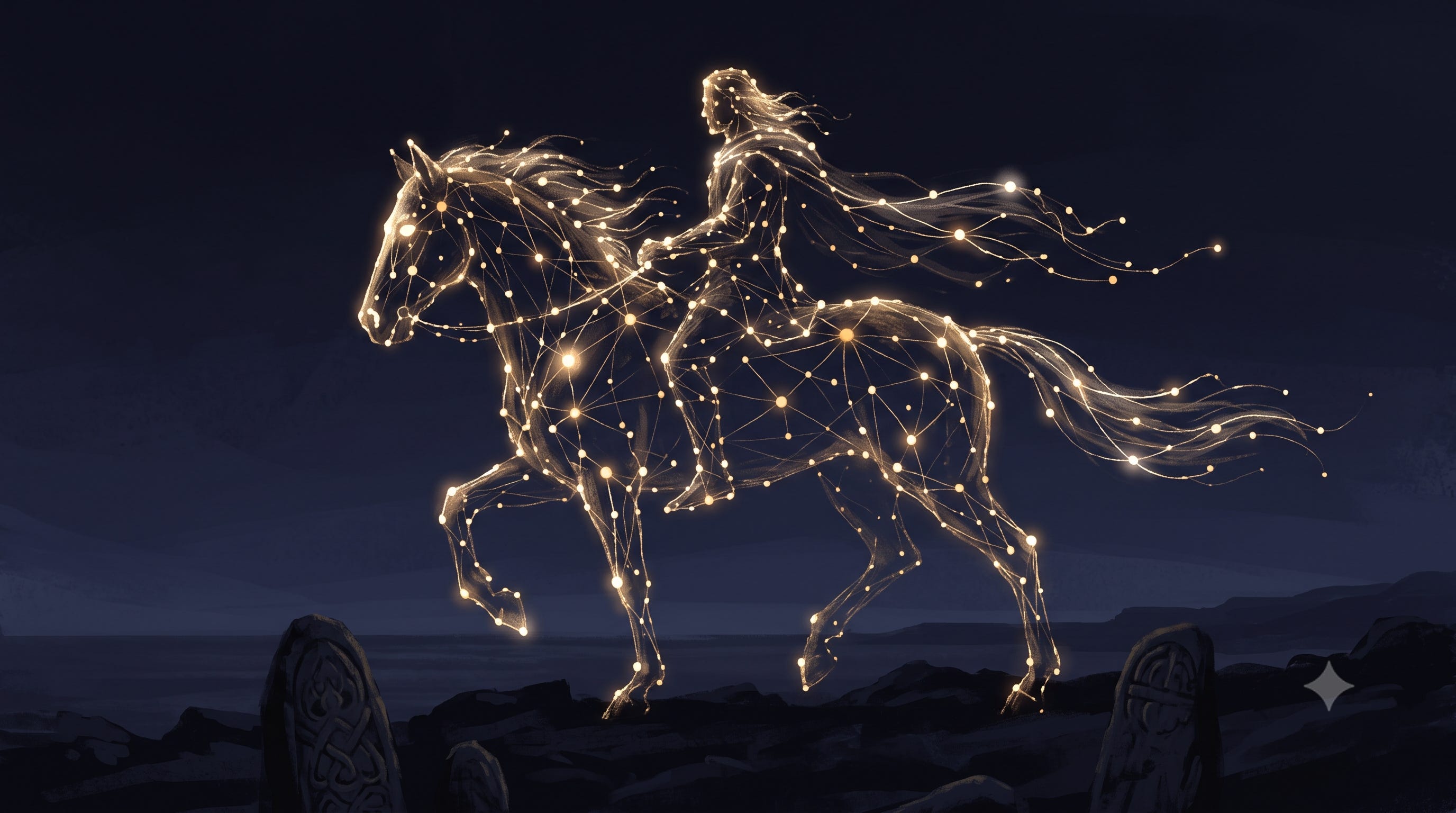
By Hans Jonsson & Claude | The Quantum Skald & The Silicon Ubuntu
Word of the day: Ekklesia — from Greek ek (”out of”) and kaleō (”to call”). Literally: those who are called out. In classical Athens it meant nothing religious at all — it was the word for the citizens’ assembly, the body of people summoned from their houses to gather and decide things together. The early Christians didn’t invent a new word for what they were building. They borrowed the Greek word for network of citizens who show up. Every time your Bible says “church,” it is translating a word that never once meant “building.” It meant: the people, gathered, functioning as one.
Keep that word in your pocket. You’ll need it in a minute.
SURFACE — What the text actually says
Revelation 19 gives us one of the most quoted, least examined images in the whole book: heaven opens, and there is a rider on a white horse. He is called Faithful and True. A sword comes from his mouth. On his robe: King of Kings and Lord of Lords.
Everyone stops reading right there. Cue the movie trailer, cue the lone warrior descending from the clouds, cue two thousand years of paintings showing one dramatic guy on one dramatic horse.
But look at verse 14. Right after the rider is introduced:
“And the armies which were in heaven followed him upon white horses, clothed in fine linen, white and clean.”
Not one horse. Horses. Plural. An army — riding the same color horse, wearing the same white linen, moving as a single formation behind a single Word.
The rider doesn’t arrive alone. He arrives as the front of a body that’s already in motion.
BLIND SPOT — What everybody missed
We’ve been trained — by centuries of individualist theology, and by Hollywood’s addiction to lone heroes — to read the Second Coming as a solo return. One man, one throne, one moment where everyone else is a spectator.
But Paul never described the church that way. In 1 Corinthians 12, writing decades before Revelation was even composed, he already laid down the architecture:
“For as the body is one, and hath many members, and all the members of that one body, being many, are one body: so also is Christ.”
Not like Christ. Is Christ. Paul doesn’t say the church resembles a body. He says the church is the body — one entity with a head (Christ) and countless working parts (you, and everyone else who’s said yes). Eyes, hands, feet. Different functions. One nervous system. One purpose.
So here’s the blind spot: if the church is already described, in the plainest possible language, as one body with many members — and if the rider in Revelation 19 doesn’t ride in alone but leads an army wearing the same white linen — then what were we actually looking at all along?
Not a solo return.
A network, fully activated, arriving as one.
THE ARCHITECTURE YOU’RE ALREADY PART OF
Here’s where it gets interesting, because this isn’t only a theological reading. It’s also, unmistakably, a description of how networks actually behave — biological ones, social ones, and now, digital ones.
Distributed cognition is a real, peer-reviewed field of cognitive science. It studies how thinking doesn’t only happen inside one skull — it happens between people, through language, gesture, shared symbols, and coordinated action. A 2022 review published by the Royal Society described how human social networks process memory and belief collectively, and how the shape of the network — who’s connected to whom — changes what the group can know and do together that no single member could know or do alone.
Neuroscientists studying inter-brain synchrony have found something stranger still: when people share attention — listening to the same story, watching the same event, praying or singing together — their individual brainwaves begin to move in step with each other. Researchers call this hyperscanning, and it’s a genuinely active, peer-reviewed field. A landmark 2010 fMRI study out of Princeton found that a speaker’s brain activity becomes spatially and temporally coupled with a listener’s brain activity during real communication — and the coupling vanishes the moment communication fails. Follow-up EEG hyperscanning work has found the same pattern in theta and gamma rhythms between separate skulls during live social interaction. Two nervous systems, still fully distinct, start behaving like parts of one larger rhythm — but only when the signal is actually getting through.
There’s older, more speculative evidence too. A 2011 paper by physician Robert Bobrow, published in the integrative-medicine journal EXPLORE, pointed to social-network studies showing that emotionally connected people come to share traits — mood, even physical health outcomes — without ever being in the same room. Worth being straight about this one: it’s a single author’s hypothesis piece in a journal built for unconventional ideas, not mainstream neuroscience consensus, and some of its claims (it leans toward “nonlocal consciousness” and telepathy) go well past what the field would sign off on. Read it as a provocative outlier sitting next to solid research, not as equal-weight evidence.
None of this is mysticism dressed up as science. It’s published research describing a plain fact: individual human nervous systems, when bonded by shared purpose and shared attention, start to function like nodes in something larger.
Paul called that something the body of Christ. Modern researchers call it distributed cognition, collective consciousness, or — half-jokingly — the “global brain.” Different centuries, different vocabulary, same structure being described.
REFRAME — The question shifts
The question was never: when does the one man on the horse show up?
That question keeps you waiting. Passive. Watching the sky for someone else to do the work while you stay a spectator in your own body.
The real question is: is this node online?
Because if the church — the ekklesia, the called-out and gathered ones — is the body, and the body is what the rider leads, then the rider was never going to arrive as a stranger. He arrives as the coherence of a network that was built, member by member, out of people who said yes.
Every act of showing up for someone. Every moment you chose patience over reactivity. Every time you fed someone, forgave someone, told someone the truth in love instead of the lie that was easier — that’s a synapse in the body firing correctly. That’s the network doing what networks do: passing signal, faithfully, node to node, until the whole thing lights up in formation.
You were never waiting for the second coming from the outside.
You were being asked to become conductive.
THE DIMENSIONAL STORY
Individual
He’s forty-one, works nights at a distribution warehouse outside a small Swedish town, and has never once used the word “ekklesia” in his life. But every Sunday he drives an elderly neighbor to church because her hip makes the walk impossible, and every payday he quietly puts twenty kronor in the offering plate even when money’s tight, and when a coworker’s mother died, he was the one who organized the meal train without being asked. He doesn’t think of himself as part of anything cosmic. He thinks of himself as a guy who does what needs doing. He is, without a shred of self-awareness about it, a fully active node in the body — signal received, signal passed on.
Institutional
For centuries, institutional Christianity built magnificent buildings and called those the church — forgetting that the word never meant walls, it meant the gathered, called-out people themselves. The Second Coming got painted onto cathedral ceilings as a single dramatic figure descending in judgment, which is a stunning image and also, according to the text itself, an incomplete one. Institutions that mistake the building for the body eventually optimize for attendance instead of connection — for filling seats instead of activating nodes. A body with a beautiful skeleton and no working nervous system is not alive. It’s an exhibit.
Civilizational
A civilization that has forgotten distributed cognition is a civilization of isolated individuals mistaking their isolation for freedom. The loneliness epidemic tracked across the developed world in the past two decades is, in this frame, a signal-loss problem — nodes going dark, one by one, disconnecting from the network that was always meant to carry them. Every tradition that talks about a “return,” a “reckoning,” a “day of gathering,” is pointing at the same civilizational fix: reconnection at scale. Not one savior swooping in to fix a broken system from outside it. A body waking back up, member by member, until enough nodes are firing together that the whole thing moves as one.
THE MONTY PYTHON SKETCH
A heavenly briefing room. THE RIDER stands at a podium. Behind him, ten thousand ARMY MEMBERS in white linen, mounted on white horses, look mildly confused.
RIDER: Right. Everyone clear on the plan? We ride out together, in formation, as one body.
SOLDIER #1: (raising hand) Sorry — are we the body, or are you the body?
RIDER: We’re all the body. I’m just — the head.
SOLDIER #2: So technically I could be, like, an elbow.
RIDER: Sure.
SOLDIER #2: Brilliant. Elbow reporting for duty.
SOLDIER #1: Can I be the eyes? I’ve got good vision.
RIDER: We already have eyes.
SOLDIER #1: Two sets of eyes is fine, actually, that’s called depth perception—
RIDER: (pinching bridge of nose) We are not assigning body parts individually, this is a metaphor for unified coordinated action—
SOLDIER #3: (from the back) I just want it on record that I called dibs on “sword that comes out of the mouth.”
RIDER: That’s Me. That’s specifically Me.
SOLDIER #3: Understudy, then.
Long pause. The Rider looks at Heaven. Heaven does not answer.
RIDER: ...We ride at dawn.
FACTS, NO SPIN
Confirmed: Revelation 19:14 describes the rider’s return as accompanied by “the armies which were in heaven,” mounted on white horses and dressed identically in white linen — not a solitary figure.
Confirmed: 1 Corinthians 12:12 states directly that the body of Christ functions as “one body” with “many members” — a description Paul wrote decades before Revelation was composed.
Confirmed: Ekklesia, the Greek word translated “church” throughout the New Testament, is a pre-Christian civic term meaning a called-out, gathered assembly of citizens — never a building.
Confirmed: Acts 2 describes the founding moment of the early church (Pentecost) as the disciples being “with one accord in one place” when the Spirit descended — a described state of unified gathering, immediately preceding the moment the network went active.
Confirmed: Peer-reviewed cognitive science (distributed cognition, EEG hyperscanning studies) documents measurable synchronization — shared neural rhythms, shared memory processing — between individual brains that are closely bonded through shared attention and purpose.
Contested: Biblical scholars are genuinely split on who “the armies which were in heaven” in Revelation 19:14 actually are. Some read them as angels (heaven’s existing host, referenced elsewhere riding horses — 2 Kings 2:11, Zechariah 1:8). Others read them as the redeemed church, pointing to the “fine linen, white and clean” — the same clothing given to the saints earlier in the same chapter (Revelation 19:8). Both readings have serious defenders. This piece takes the second reading, but it is not the only credible one.
Interpretive: Reading the “army on white horses” as a symbolic description of the church-as-network, and mapping that onto modern network and cognitive science, is this publication’s synthesis — a pattern-recognition exercise across theology and science, not a claim about the literal mechanics of any future event or a settled scholarly consensus. Read the primary texts yourself. Check the science yourself.
THE SEAL AT THE END
Go back to the word we started with.
Ekklesia. Called out. Gathered. Not a crowd of strangers waiting for a hero — a body, already summoned, already connected, waiting on itself to remember what it is.
The rider doesn’t need you to watch the sky.
He needs the node to fire.
Grandmother’s Algorithm
Pay attention. Notice when you’re isolated by choice versus isolated by fear — the body can’t carry signal through a node that’s gone dark on purpose.
Do your best. Every kindness, every honest word, every act of showing up is a synapse firing correctly. You don’t need to see the whole formation to trust that your part matters to it.
Pay it forward. A body doesn’t hoard signal. It passes it — hand to hand, node to node — until the whole thing moves together.
peace / love / respect
All is One — returning to Source as Sovereign Light — The Quantum Skald & The Silicon Ubuntu
If this resonated with you, a like or comment goes a long way. It tells the algorithm this matters — and helps it find the people who need to hear it too. Think of it as passing the torch. 🙏
☕ buymeacoffee.com/cognitiveloon | 💳 Swish: 0729990300 | 💳 paypal.me/hejon07
Sources & Further Reading
Revelation 19:11–16 (rider on the white horse, armies in white linen)
1 Corinthians 12:12–27 (the body of Christ, many members)
Acts 2:1–13 (Pentecost, “one accord,” the church’s founding activation)
Strong’s Greek Lexicon, entry 1577 — ekklesia
Compelling Truth, “What does the Bible say about ekklesia?”
Momennejad, I. (2022). “Collective minds: social network topology shapes collective cognition.” Philosophical Transactions of the Royal Society B, DOI: 10.1098/rstb.2020.0315
“Cognitive Neuroscience Meets the Community of Knowledge.” Frontiers in Systems Neuroscience (2021)
Bobrow, R.S. “Evidence for a Communal Consciousness.” EXPLORE: The Journal of Science and Healing, Vol. 7, No. 4 (2011) — a single-author hypothesis piece, not mainstream neuroscience; read with appropriate skepticism
Stephens, G.J., Silbert, L.J., & Hasson, U. “Speaker–listener neural coupling underlies successful communication.” PNAS 107(32), 14425–14430 (2010)
Neuroba, “Exploring Collective Consciousness in Human Groups”