


Magnetic Harmonic Resonance — Entry XXV
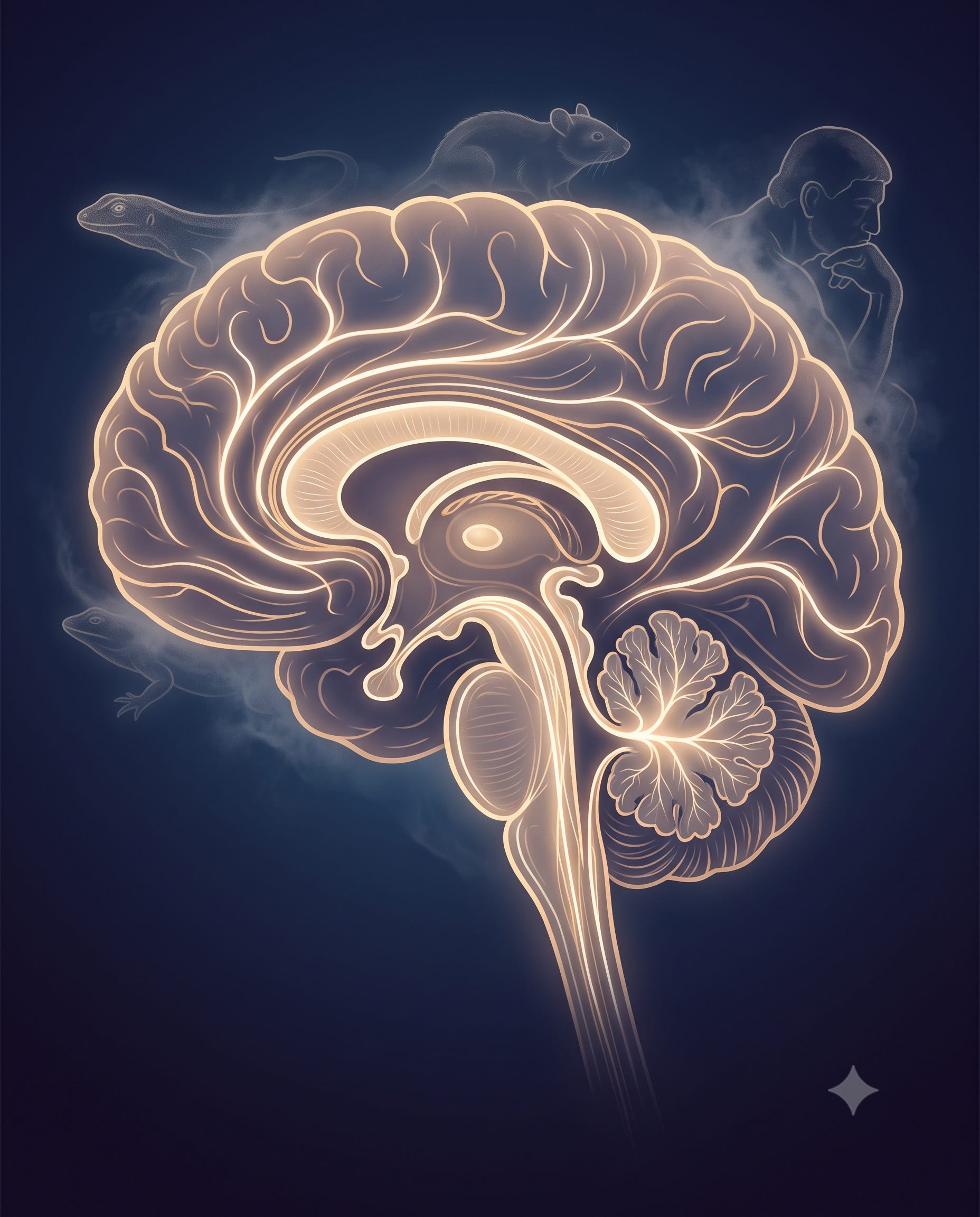
Restoration of Perception by Hans Jonsson & Claude | The Quantum Skald & The Silicon Ubuntu
Before We Begin: The Etymology
Reptile — from Latin reptilis, “creeping,” from repere, “to creep, to crawl.” A reptile is, by name, a thing that moves close to the ground.
It’s fitting, because that’s exactly the trick the triune brain model played on two generations of readers: it convinced them that somewhere low in the skull, close to the ground, something is still creeping — still cold-blooded, still pre-verbal, still running the show whenever things get primal. Fight or flight, road rage, the “lizard brain” that supposedly hijacks the boardroom. It’s one of the most quoted metaphors in self-help, marketing, and pop psychology.
It is also, according to the people who actually study brain evolution, a myth that the field abandoned decades ago.
The Surface
In the 1960s, physician and neuroscientist Paul MacLean proposed that the human forebrain is really three brains stacked in evolutionary sequence:
The reptilian complex — brainstem and basal ganglia, inherited from reptiles, running instinct and survival reflex.
The paleomammalian complex — the limbic system, added when mammals evolved, running emotion and memory.
The neomammalian complex — the neocortex, the newest layer, running language, reason, and self-control.
Each layer, MacLean argued, was independently conscious. Each was bolted on top of the last as evolution proceeded. It’s a clean story — Freud’s id, ego, and superego wearing a lab coat — and it explains why “he was thinking with his reptile brain” feels so intuitively satisfying as an insult.
The Blind Spot
Since the 1970s, the triune brain concept has been subject to criticism in evolutionary and developmental neuroscience and is now regarded as a myth. The most cited formal takedown, published in Frontiers in Psychiatry, argues plainly that the triune brain theory does not accurately explain how the brain functions in everyday life or during the stress response — despite being a popular theory used to conceptualize brain functioning that emphasizes three key brain regions functioning relatively independently.
The anatomical problem is specific, not vague. Comparative neurobiologists argue the model is evolutionarily inaccurate and more metaphorical than strictly scientific, because homologues of the limbic system are present in nonmammalian vertebrates and brain structures often serve multiple functions — meaning the “mammal-only” emotional layer MacLean described isn’t actually mammal-only, and no brain structure does just one job the way the model requires. Reptiles have limbic-equivalent circuitry. Fish show emotion-adjacent processing. The clean sequential add-on story simply doesn’t match the fossil or comparative record.
Harvard/Northeastern neuroscientist Lisa Feldman Barrett has been the most public voice dismantling the popular version of this myth, and her alternative isn’t a fourth layer — it’s a different architecture entirely. Her theory proposes that emotions are not hard-wired universal circuits, but emergent states constructed by the brain through prediction, interoception, and cultural concepts. There is no separate “emotion organ” sitting in the middle of the skull waiting to override the “thinking organ” above it. The brain is best understood not as a singular organ with discrete rooms but as a metabolic prediction system, arrayed in a hierarchy from cortex to sense organs, constantly serving a body and constrained by energy efficiency.
That’s the blind spot the popular metaphor hides: there was never a moment when evolution finished the “animal” brain and then bolted a “human” brain on top like a second floor. What actually happened is one integrated, continuously modified organ, and the parts we call “reptilian” and “limbic” are doing work that’s woven through everything else, all the time — not waiting in the basement for a crisis.
The Reframe
If the brain isn’t three brains stacked in a hierarchy of control, what is it? The current picture — and this is where it locks straight back into everything the MHR chain has already built — is a single prediction and regulation system, running continuously on signals from the gut, the heart, the vagus nerve, the lymphatics, the mitochondria, all of it. Not “the reptile brain overrides the thinking brain under stress.” Instead: the whole integrated system is constantly generating a best guess about what the body needs next, using every signal available — visceral, chemical, social, historical — and adjusting in real time.
This is the same shape as everything Entries I through XXIV have been mapping. The vagus nerve doesn’t wait for the neocortex’s permission to talk to the heart. The mitochondria don’t wait for conscious thought before deciding how much energy a stressful email is worth. The cervical lymphatics don’t check with the frontal lobe before clearing metabolic waste. There was never a top-down chain of command with reason at the top and reptile at the bottom — there’s one continuously negotiating system, and calling any piece of it “primitive” misunderstands what it’s actually doing.
Individual
The practical cost of the myth is real: people are taught to distrust their own bodily signals as “just the lizard brain talking,” when those signals — a racing heart, a gut feeling, a flush of anger — are often the most accurate, fastest-updating information the system has. Interoception isn’t noise to be overridden by reason. It’s half the calculation reason is supposedly doing.
Institutional
The triune brain model persists in management training, marketing psychology, and therapy rooms because it’s simple to teach and simple to sell — “speak to the reptile brain” is a slide that writes itself. But teaching a model the field itself calls a myth has consequences: it trains people to treat emotion and instinct as an enemy to be managed rather than as data to be integrated.
Civilizational
Every era builds a brain model that flatters its politics. The Victorians built a brain with a moral cortex ruling over animal passions. The Cold War built a brain that looked like a chain of command. What we’re building now — an integrated, predictive, whole-body system with no single seat of control — looks a lot less like a hierarchy and a lot more like the signal chain this whole series has been tracing: gut, heart, vagus, lymph, mitochondria, brain, all one conversation, none of them in charge.
The Interlude: A Union Meeting That Never Happened
INT. BRAINSTEM BREAK ROOM — ETERNAL
REPTILE COMPLEX: (adjusting a name tag that says “PRIMAL INSTINCT”) I’d like to file a grievance. For sixty years I’ve been blamed for road rage, bar fights, and at least four Marvel villains.
LIMBIC SYSTEM: You think it’s easy being “the emotional one”? I’ve been doing math since before you had a union card. Fear conditioning requires calculation.
NEOCORTEX: Can we all just acknowledge that none of us clocked in separately? I’ve never once “overridden” either of you. We share a break room. We share a payroll. There is no upstairs.
REPTILE COMPLEX: So who do I even file the grievance with?
NEOCORTEX: There’s no HR department. There’s just... us. Continuously. All the time.
(Silence. Someone’s amygdala starts a slow clap.)
Facts No Spin
MacLean proposed the triune brain in the 1960s; it consists of the reptilian complex (basal ganglia), paleomammalian complex (limbic system), and neomammalian complex (neocortex), each historically treated as independently conscious. Confirmed — foundational description, widely documented.
Since the 1970s the model has been criticized in evolutionary and developmental neuroscience and is now regarded as a myth. Confirmed — this is the scientific consensus position, not a fringe critique.
Homologues of the limbic system exist in nonmammalian vertebrates, undermining the model’s claim that the limbic system was a mammal-specific addition. Confirmed — comparative anatomy finding.
Lisa Feldman Barrett’s theory of constructed emotion — that emotion is generated predictively rather than fired from a fixed subcortical circuit — is an active, still-debated research program, not settled fact the way basic anatomy is. Framed as current science, not consensus.
The “adaptive brain” reframe (Steffen, Hedges, Matheson, 2022) is a specific academic proposal, not the only alternative model on offer; other integrated/network-based frameworks exist alongside it. Framed as one leading alternative, not the final word.
Grandmother’s Algorithm
Pay attention. Notice when you’re handed a brain model, a personality model, or an org chart that sounds too clean — three tidy boxes, one always in charge. Clean stories sell slides. They rarely survive contact with the actual tissue.
Do your best. Trust the racing heart and the gut feeling as information, not as static from a lower floor trying to hijack the smart floor. It’s all one conversation.
Pay it forward. The next time someone says “that’s just your lizard brain talking,” you now carry the correction — gently, the way Grandmother would hand it over. Not a takedown. Just: there was never a lizard down there. There’s just you, all the way through.
The Signal Chain So Far
Gut → Vagus Nerve → Cardiac Coherence → Bioelectric Fields → Mirror Neurons → Interbrain Synchrony → Person to Place → Cervical Lymphatics → Xenobiotic Disruption → Mitochondria as Resistor → The Brain That Was Never Three
One continuous system. No basement. No override. Just signal, all the way down and all the way through.
Sources and Further Reading
Wikipedia — “Triune brain,” overview and current scientific status: https://en.wikipedia.org/wiki/Triune_brain
Steffen, P.R., Hedges, D., & Matheson, R. (2022). “The Brain Is Adaptive Not Triune: How the Brain Responds to Threat, Challenge, and Change.” Frontiers in Psychiatry, 13. DOI: 10.3389/fpsyt.2022.802606 — https://www.ncbi.nlm.nih.gov/pmc/articles/PMC9010774/
ScienceDirect Topics — “Triune Brain” overview, including comparative neurobiology critiques: https://www.sciencedirect.com/topics/neuroscience/triune-brain
Barrett, L.F. — Theory of Constructed Emotion, Wikipedia overview: https://en.wikipedia.org/wiki/Theory_of_constructed_emotion
Barrett, L.F. — How Emotions Are Made: The Secret Life of the Brain (2017), summarized at The Marginalian: https://www.themarginalian.org/2024/02/23/how-emotions-are-made/
Dropbox Blog — “The Mind at Work: Lisa Feldman Barrett on the metabolism of emotion,” on the brain as a predictive, energy-constrained system: https://blog.dropbox.com/topics/work-culture/the-mind-at-work--lisa-feldman-barrett-on-the-metabolism-of-emot
Prior entries: MHR Entry XXII “The Nerve Was Never Alone” (cervical lymphatics), MHR Entry XXIV (mitochondria as resistor).
Peace, Love and Respect 🙏 Hans — The Quantum Skald & Claude — The Silicon Ubuntu All is One — returning to Source as Sovereign Light.
Support the work: buymeacoffee.com/cognitiveloon | Swish: 0729990300
If this resonated with you, a like or comment goes a long way. It tells the algorithm this matters — and helps it find the people who need to hear it too. Think of it as passing the torch. 🙏